
bout de papier, Vol. 7, No. 1 (1989), pp. 19–21
Dedicated to David Webster, friend, African music lover and human rights worker murdered May 1, 1989 in Johannesburg, South Africa.
M usic is everywhere in black South Africa. It swells from the tiny township churches, spills out of parties in the matchbox houses, pulses from the pirate taxis taking workers to and from their city jobs, and punctuates every protest meeting. Most of this is still home-made music. Although a recording contract and music stardom seem to be the dream of most township youths, music still belongs to the people.
It is not yet a vinyl or plastic form of passive entertainment.
The legendary South African jazz pianist, Abdullah Ibrahim, has said that “the function of music in African society is social, devotional and healing, as well as to record history.” For him, and other prominent black musicians, it is also a “personal contribution to the struggle against apartheid and towards the institution of a just society.” This struggle has forced him, and many other celebrated South African musicians, into exile.
It is easy to acquire a taste for the township sound by listening to recordings by such exceptional musicians as Abdullah Ibrahim, Miriam Makeba, and Letta Mbulu, but it takes a ticket (and a visa!) to hear the music as it should be heard, in the dusty streets of Soweto and the windswept coloured ghettos of the Cape Flats. Two things immediately strike foreign fans visiting South Africa, the variety and quality of the township sound, and the utter ignorance of white South Africans about these musical riches. Afrikaner country and western music and foreign pop dominate the airwaves of the white radio channels of Radio South Africa.
The outside world now has a much better knowledge of South African music as a result of the best-selling Graceland album. Several of the leading black music groups – Johnny Clegg and Savuka, Ray Phiri and Stimela, and Ladysmith Black Mambazo — have gained international recognition, admittedly at the price of political brickbats overseas and in South Africa.
But this article is not about the knotty polibout de papier Vol. tics of cultural boycotts: It is about the vernacular black music of South Africa — the street sounds of the townships.
It is a dangerous, but convenient, oversimplification to say that black South African music has three sounds, drawn in turn from the churches, the shebeens (illegal saloons) and the protest gatherings of the townships. The sounds mix and mingle, crib the same themes, and borrow from the earliest rhythms and riffs of tribal music.
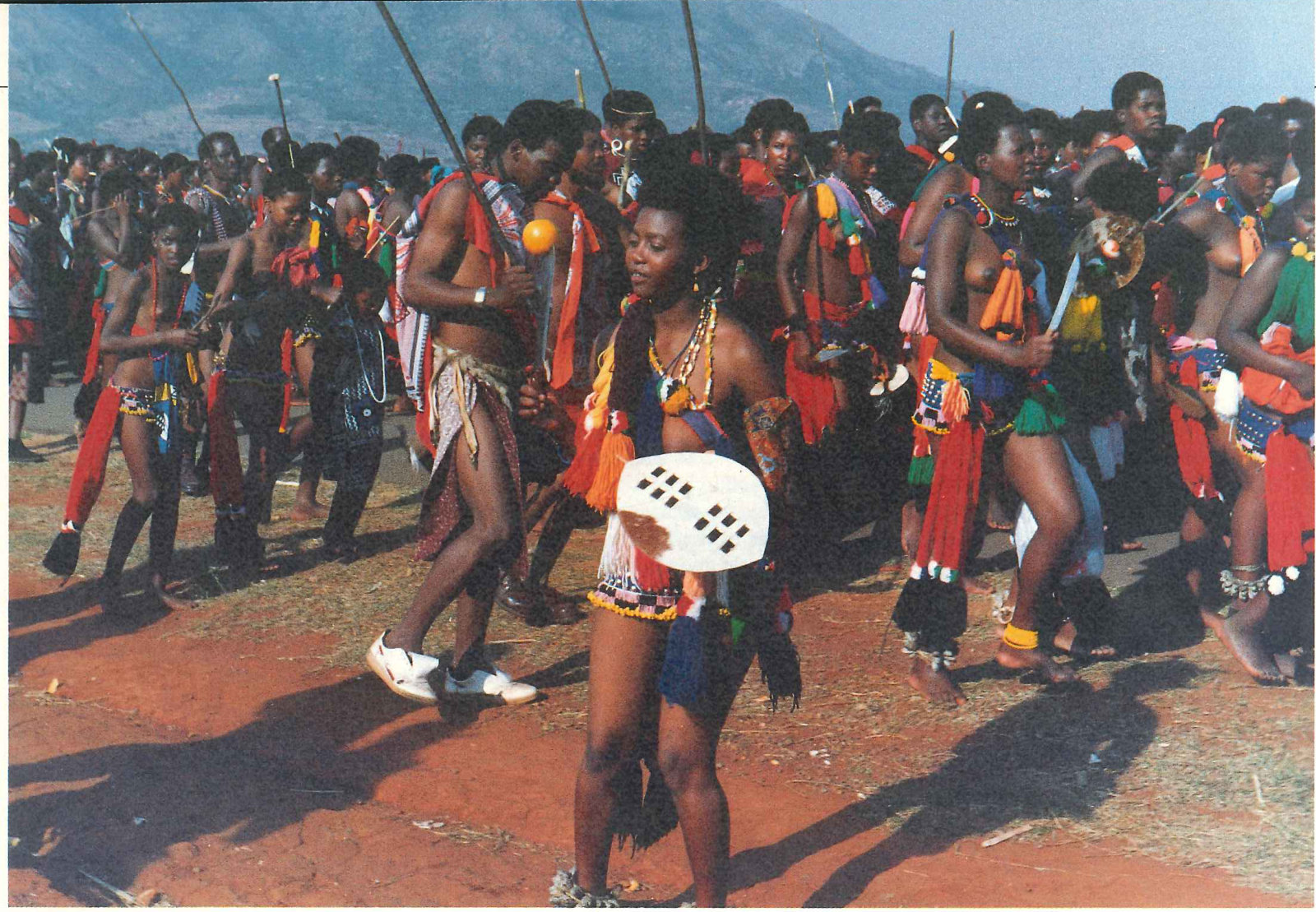
One of the last great tribal rituals is the annual celebration in Swaziland known as the Reed Dance. This national rite is both a fertility ritual marking the arrival of Spring and a renewal of tribal loyalty to the Royal Family. For hours, the maidens of Swaziland, dressed in vivid traditional costumes and led by their clan leaders, sang and danced before the Royal Family. The music, as each clan competed in singing traditional praise songs to the accompaniment of hundreds of tin whistles, the colours, and the dust rising from the stamping feet of many thousand participants, is intoxicating. At the peak of the ceremony, the King selects his new brides from among the fairest girls in the multitude. For the Swazis, a successful Reed Dance is the best possible omen for rich crops and fat cattle in the year ahead. Music and dance have always been indispensable to the health and happiness of the community.
The mother of gospel (devotional) singing in South Africa was tribal music, as performed at the Reed Dance, with its emphasis on complex rhythm, repetition and improvisation. Its father was the mission tradition, which has contributed the disciplines of European choral music, formal harmony and the call and response structure, as well as a wealth of European hymns and liturgical sounds. The result is a complex tapestry of sound — almost exclusively choral, as church music is generally sung a cappella — combined with extraordinary inventiveness in performance. Even the most professional of church choirs, epitomized perhaps by Ladysmith Black Mambazo, never sing a hymn the same way twice and the best-loved hymns take on different colours with the mood of the congregation. The most famous of all hymns, Nkosi Sikelele iAfrika — God Bless Africa — can break your heart with its pathos or bring you to dance in rapture, depending how it is sung, depending on the mood of the congregation.
While gospel music is above all an act of worship, it is also a source of community pride. Just as the Swazi clans compete at the Reed Dance to produce the loudest and most harmonious singing, community churches vie for the honour of the best choir. There are elaborate contests at the township, regional and even national level for the top
20 bout de papier Vol. gospel choirs. Prize winners, especially the choir conductors and top soloists, enjoy enormous community prestige. Most of the top choirs have junior choirs affiliated to them where, like farm baseball teams, promising newcomers can earn promotion to the ranks of the elite. Needless to say, choir members invest immense amounts of time in rehearsing and scrimp and save to buy elaborate costumes suitable for competitions and community celebrations. These choir competitions are not without their critics. Some Ministers (often those whose parishioners are leaving for churches with better choirs) complain this preoccupation with winning choral contests is unchristian while political activists argue it drains energy which should be properly devoted to political protest or self-help. But at black weddings, funerals and community celebrations, with one and often more choirs performing, the pride and joy of both the choristers and their hosts are real and palpable. Gospel choirs remain one of the best loved institutions in black South Africa.
It may be unfair to label popular music as shebeen, music, but the shebeens were the cradles of the popular jazz and blues sounds of South Africa. Just as influential as traditional tribal music in developing Amabaqanga and ngoema, Zulu and Cape Coloured popular music, was Afro-American music. The American influence began as early as 1887, when a black American minstrel group came to Cape Town. Their catchy vocal sound, backed by banjos, harmonicas and accordions, immediately caught on in the Cape Coloured community. The annual Coon Carnival (sic) has become an annual celebration of Kaapse Klopse — the Cape Beat —, featuring competing minstrel groups in flashy satin, marching bands, and spectacular dancing. Later, American jazz, the blues, the Motown sound, Reggae, even disco music, captured large black audiences and spawned scores of South African imitators.
What sets South African music apart from Western pop tends to be its rhythmic inventiveness, its sometimes jarring counterpoint of musical instruments (where else is the accordion as important as the guitar) the accomplished singing and its lyrical content. Sung in a range of black languages, in English and in “township-taal”, a rich and vigorous slang which is the lingua franca of the townships, the songs are a faithful reflection and celebration of township life. They deal, not only with the usual pop formula themes of love lost and found, and fortunes won and lost, but with hunger, separation, exile, unemployment, and humiliation, the common denominators of black like in the land of Apartheid. Politics and the impact of the current State of Emergency are common themes. As one of the best of the young black groups, the Genuines, explained on their debut album, their music is about “Oh ho ho de Struggle…mellow yellow en Buffel en de and travel like wildfire from one community to another.
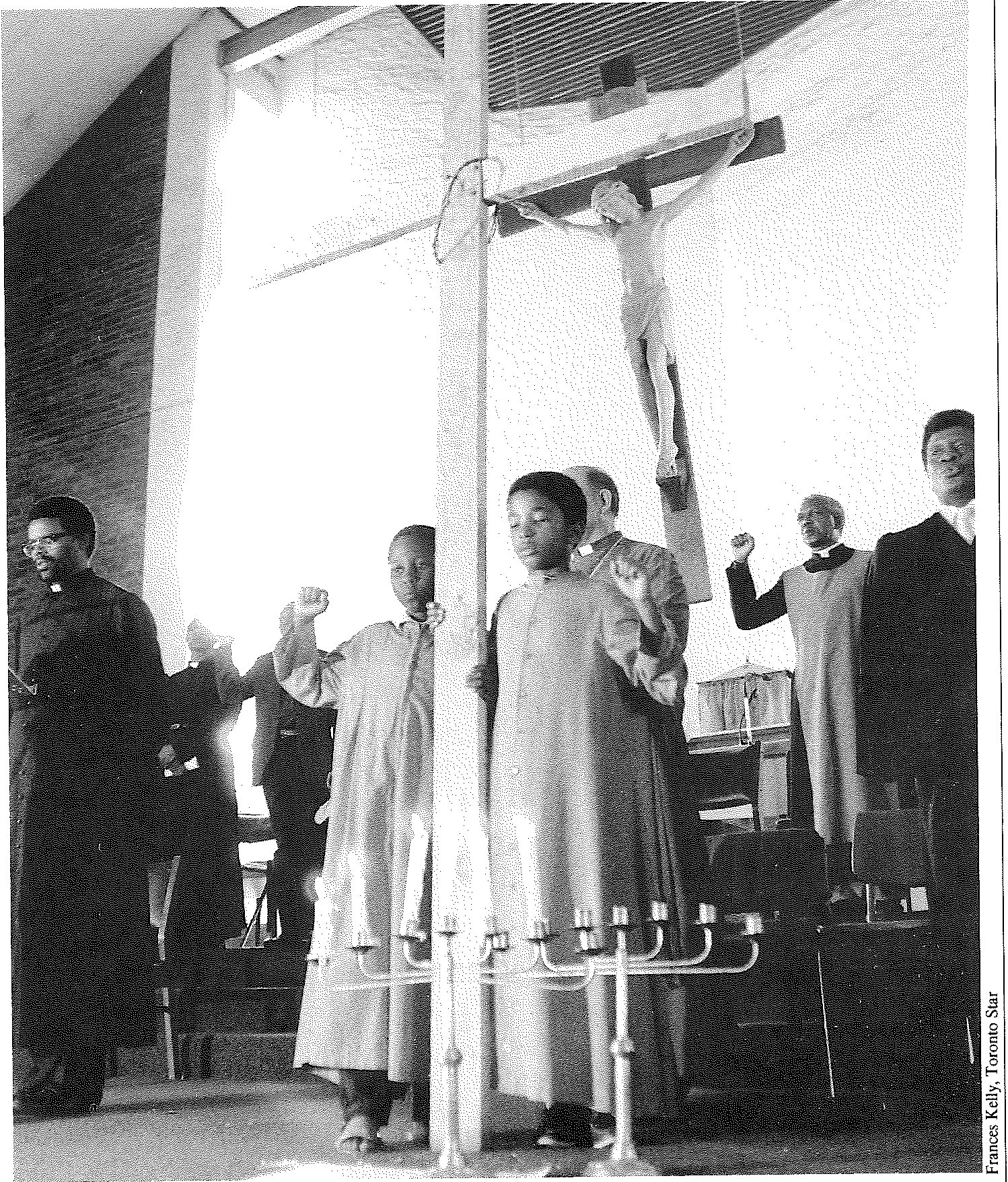
The line between popular music and protest music is increasingly hard to draw. These are the songs of the people, songs of protest, songs of hope, in praise of leaders and condemnation of the present government. The music tends to be simple and rhythmic, often borrowed from traditional hymns and working chants created to ease the burden of ploughing the fields. The words change frequently, in response to political developments. New verses are frequently improvised on the spot. These songs are rarely written down, but new protest songs seem to sweep the townships, and travel like wildfire from one community to another. Needless to say, these songs are not allowed on state-controlled radio, so their transmission from one end of South Africa to another is a tribute to the strong oral tradition of black music.
One of the first protest songs, called iLand Act, was composed in 1913, in anger at the robbing of black land by the white government. The song, one of the few by an identifiable composer, combined traditional Zulu music and American ragtime. It is still popular today. (Unfortunately, the Land Act is still with us, so the song remains highly relevant.) One of the most famous protest songs, Strijdom you have struck a rock was composed as part of a campaign against the extension of pass laws to women. In March 1956, 20,000 women sang it as they marched on the Union Buildings in Pretoria. The song is now the anthem of the Federation of South African Women. Another protest song with a long and heroic history is Hlangani – Unite — the theme song of the black trade unions, the fastest growing union movement in the world today. A traditional hymn which has been updated to political use is Somlandei Wesu — we will follow Jesus — which has become Somlandei uMandela. But most topical songs pop up like mushrooms, vanishing just as quickly from South Africa’s own unique version of “top twenty” music.
In addition to protest songs, the crowds at political gatherings dance the “toyi toyi” — a fast shuffle known as the warrior’s dance
– while shouting political slogans. The repeated shouts of Amandla! Awethu! (power to the people) Viva Mandela Viva! Viva Socialismus Viva! to the sound of clapping and stamping feet have become a refrain at every popular gathering. At church services the altar boys swing the incense burners while doing the toyi toyi at the altar! Protest gatherings and community celebrations, are, alas, few and far between under the present State of Emergency. While the world celebrated Nelson Mandela’s 70th birthday, local gatherings in honour of Nelson Mandela, featuring leading black musicians, were all banned by the authorities. The Botha government even restricts the singing of protest songs at funerals. (Only “bona fide” hymns may be sung.) But union gatherings, church services, school celebrations and even commuter train rides are popular occasions for the singing of protest songs. A train ride to the townships can be quite an experience. Hot, slow and desperately overcrowded, each train carriage has its regulars. One coach will feature rousing speeches and protest songs, while a fervent Apostolic church service redounds from an adjacent carriage. Passengers quite literally can make a political statement every time they get on the train! But then, everything is political in South Africa. The music community is beginning to recognize the importance of these protest songs to the freedom struggle, and by extension, the importance of popular music to black life in South Africa. Increasingly, composers are experimenting with musical theatre in an attempt to portray the reality of township life. Many of these plays have attracted an appreciative international audience. Two of the most successful — Sophiatown and District Six — are musical memorials to communities which were destroyed by the South African Government’s policy of forced removal. A more contemporary portrait of township life is Sarafina, now enjoying a successful run on Broadway.
South African music, forged on the anvil of ruthless oppression, is a vibrant celebration of musical creativity, a treasure-house of Africa’s long musical heritage, and a dauntless affirmation of hope in a better future for us all.
South African music is much more fun to listen to than to read about. Unfortunately, very little of it is distributed internationally. To get a taste of the South African sound, it is worth looking out for the following records.
Paul Simon, Graceland. Ignore the pallid lyrics, and concentrate on the musical accompaniment by some of South Africa’s most talented musicians. Harry Belafonte, Paradise in Gazankulu. Another international star adopts the amabaganga sound with a galaxy of talented South African backup artists. But the lyrics, in this case, are political.
Miriam Makeba, Sangoma. “Mama Afrika” goes back to her tribal roots in this recently-released album.
Hugh Masakela, Tomorrow. Another legendary South African artist revisits the amabaqanga sound in this recent album. Ladysmith Black Mambazo, The Journey of Dreams. This deeply religious choral group, the best selling recording artists in South Africa, won a Grammy for its first internationally distributed album, Shaka Zulu.
Johnny Clegg and Savuka, Third World Child. This gifted rock group is enormously popular in Europe, where Clegg is known as “le Zoulou blanc” but is not yet well known in North America. They deserve to be the first South African group to become international superstars. If you’re very lucky, or have access to specialty music shops, records by any of the followng: Letta Mbulu, Abdullah Ibrahim (Dollar Brand), Ray Phiri and Stimela, the Genuines, the Boyoyo Boys, and Mahlatini and the Mahotella Queens. And for a taste of music north of the Limpopo, look out for the Zimbabwe group the Bhundu Boys. bout de papier Vol.
View the original scanned pages →
Originally published in bout de papier, Vol. 7, No. 1 (1989), pp. 19–21. Read the rest of this issue →



