
bout de papier, Vol. 7, No. 1 (1989), pp. 26–29
Lt. Col. David Leslie was the senior Canadian officer with the United Nations Good Offices Mission in Afghanistan and Pakistan (UNGOMAP). The following article is based on his impressions and observations after six months in Afghanistan and before the last of the Soviet troops left the country.
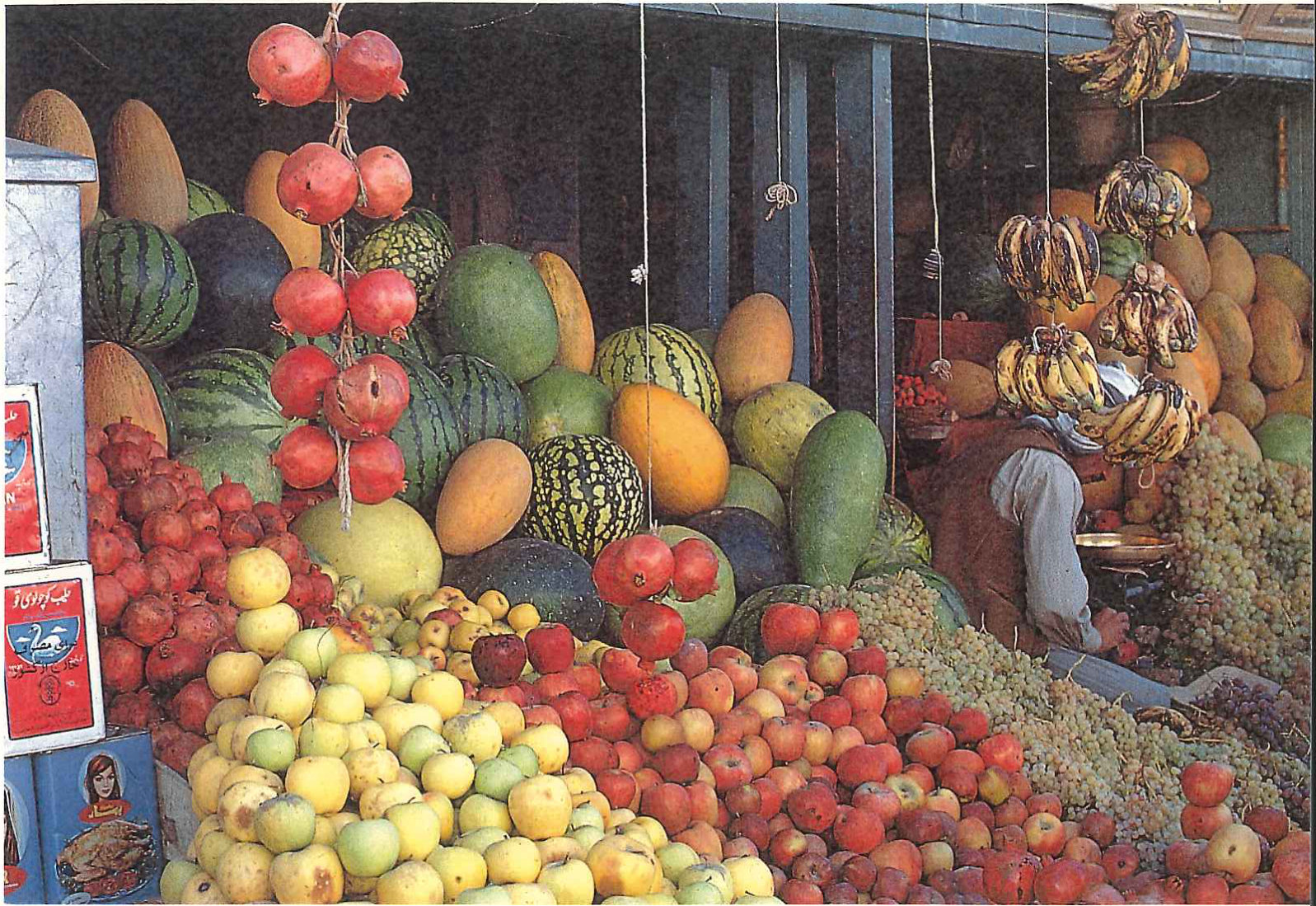
Kabul can best be described as a tried city — tired of war, tired of commodity shortages, tired of family tragedy, tired of rocketting Tired of living? No, quite the contrary. Through the strength and courage of its people, the city continues to get on with the business of commerce, education, shopping and working. By dawn, the night-time drone of Afghan and Soviet military transport aircraft has been replaced by the rumble of military convoys and civilian transport vehicles racing (often four abreast on three-lane streets) towards the Salang Road, the major North-South artery which links Kabul with the outside world. By sunrise, the vegetable bazaars are stocked with produce and filled with customers. Interruptions to the flow of goods from the North and East (the Jalalabad Road) have, however, created food shortages resulting in sharp price increases, long lineups, poorly stocked shops in the bazaars and citizens resigned to hardship and deprivation. By mid-morning most shelves are bare of produce other than sweet melon.
As the day progresses, city streets become more and more congested with cars, trucks, donkey carts and hand-pushed conveyances. The sound of horns drown out most other noises, except the call to prayer. Traffic in Kabul is relatively manageable, without the anarchy seen in Beirut and Damascus. Streets do not become massive parking lots like they do in Bangkok and motorists are more predictable than those in Ottawa. One distinctive characteristic of local traffic is that drivers, wishing to turn off main streets, proceed to the furthest lane from the direction in which the turn is to be made, then, with a burst of speed, loud horns and vigorous hand actions, make a sharp turn across three lanes of moving traffic. The origin of this high adventure may have something to do with the fact that drivers spend so much time looking backward that they become disoriented. Having said that, given the choice of driving in India, Pakistan, Afghanistan or Ottawa, I would choose Afghanistan. Motorists display far less “derring-do” and fatalism than in India and Pakistan, and unlike their Ottawa counterparts, do use hand and light signals.
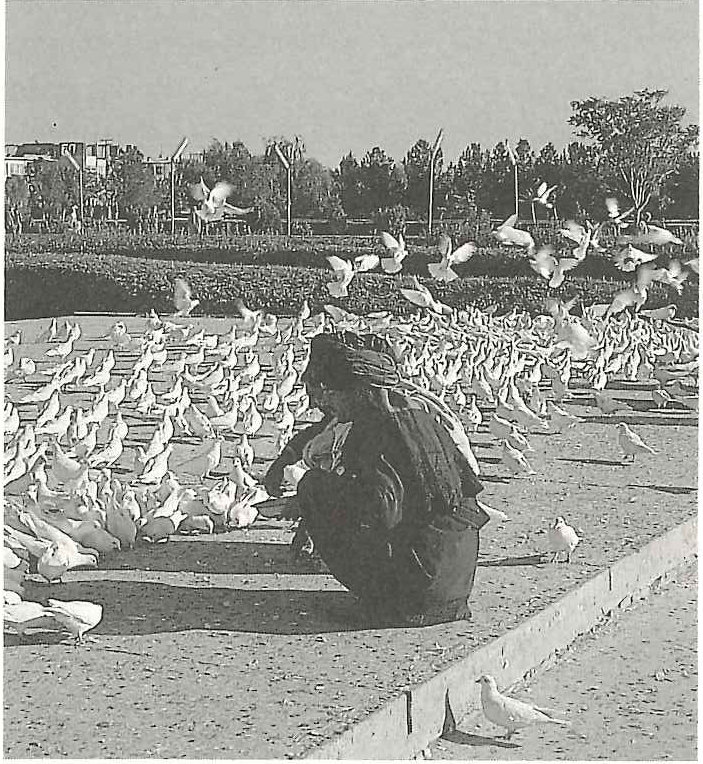
Old men feed birds outside mosque, Kabul.
On the streets, a UN officer is required to wear a uniform (on and off duty) walking and must always be accompanied by at least one other officer. This measure has been adopted to minimize the possibility of being mistakenly identified as Soviet troops, who are not always received with open arms in Kabul. In addition most of us wear the UN-issue “baseball cap” in lieu of the traditional blue beret for the simple reason that many Soviet troops wear blue berets.
Walking in Kabul is not unlike walking in other cities in the region – sidewalks are broken and uneven and, more often than not, end in a pile of rubble strategically placed to force the pedestrian into the traffic. There is, however, one important difference. Between many street surfaces and the sidewalk there is a concrete ditch approximately 75 cm in width and of indeterminate depth. The ditches are usually filled with water and have been constructed to cope with melting snow and heavy rainfalls during the winter months. A car catching its right front wheel in the ditch creates a spectacular result. Ottawa drivers trained in splashing passersby would be in for a rude shock in Kabul! There is no easy or graceful way to cross the ditch. Only a long jump will do the trick. The alternatives are an undignified sprawl into the less-than-pure water or a headlong plunge into the side of a passing car.
On the streets, I was struck by the marked and sobering absence of young men of military age, as well as the number of young men carrying the scars of war – amputations, crippling injuries and disfigurement. These sights are grim reminders of the realities of life in Afghanistan.
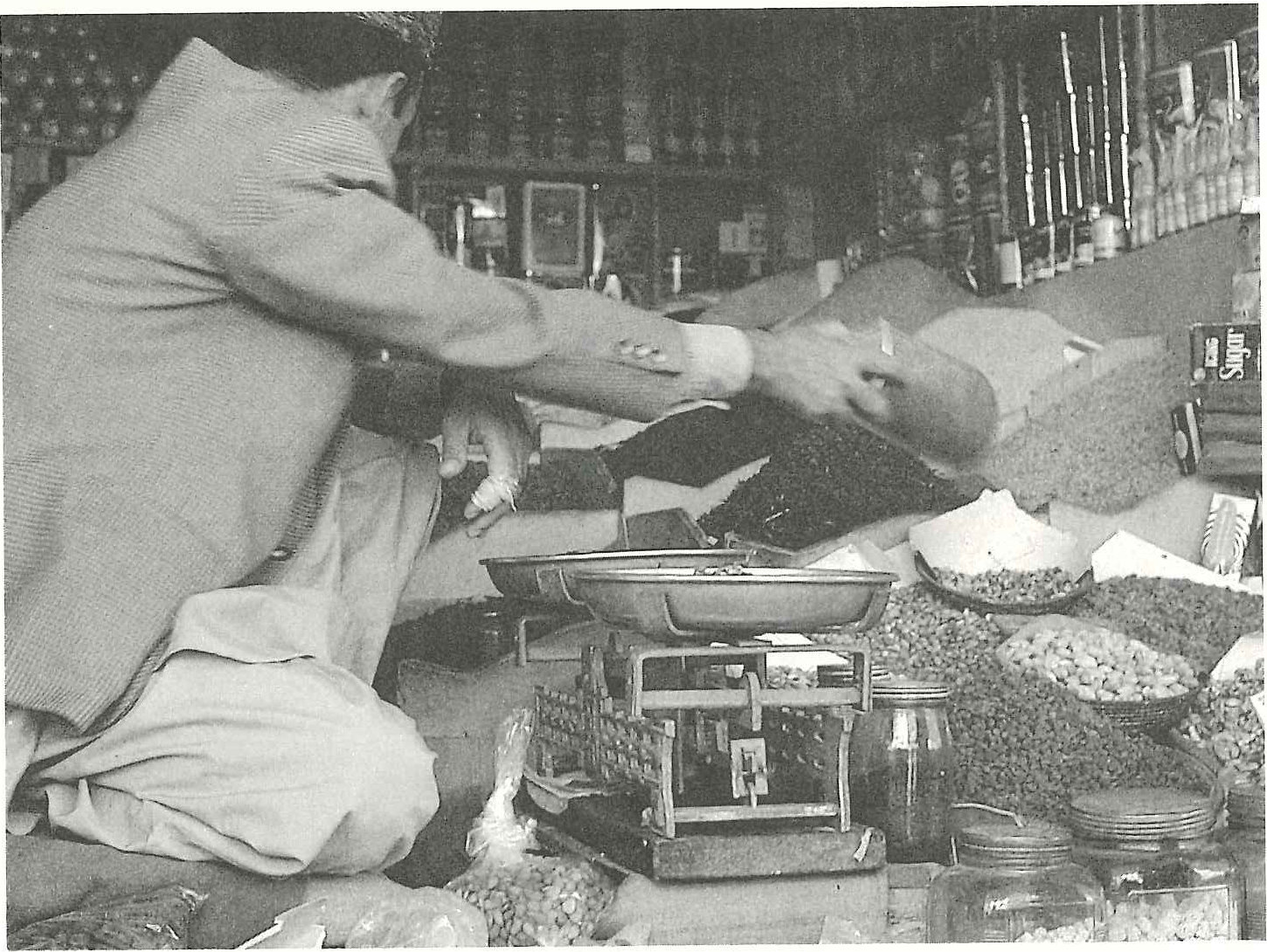
Dedicated shoppers direct themselves to the bazaars of the Old City where Afghan carpets are the most popular item and carpet factories and shops abound. A visit to a carpet factory is a “must” for every visitor. Cost adjustments are directly proportional to the bargaining skill of the shopper. Old carpets are the thing to buy, but one has to be careful. Carpets are frequently aged artificially by either frequent washings or spreading them on the street to allow passing vehicles to hasten the process. Most carpets are manufactured by teams of young children working in threes and fours. Quick, strong, and supple fingers and infinite patience are essential. It takes months to produce a carpet and as long as one year for a single artisan to finish a large carpet. bout de papier Vol.
There are two forms of cycling in Kabul: bicycling and recyling. There is nothing distinctive about bicycling — it is as disruptive to traffic flow as in any other city — but recycling is a different matter. Recycling of steel shipping containers has become a major industry. Many goods arrive in containers and the cost of the container is included in the total cost of the shipment. When the goods are removed, the importer is left with an empty container. Hundreds can be found in various parts of the city awaiting a buyer. Enterprising Afghans have found uses for them: Row upon row of containers transformed into workshops, stores, shelters, and storage facilities. An acetylene torch skillfully used may produce a steel panel for a truck body, a storm door, a car door, a security gate, a bedstead or a roof.
The skies over Kabul resound to the roar of Ilyushin 76 (“Candid”) and Antonov 12 (“Cub”) transport aircraft and the scream of low-flying MIG fighters. During daylight hours, every military aircraft discharges a trail of flares designed to confuse heatseeking surface-to-air missiles. Kabul is ringed by hills which call for aircraft to execute tight turns over the city and the burning flares and contrails against the deep blue sky create a spectacular visual effect. A “Candid” discharges clusters of five to six flares every two or three seconds. In the three circuits taken to reach cruising altitude, the aircraft discharges hundreds of flares. Unfortunately, burning flares reaching ground level often cause fires.
The unnatural calm which falls over Kabul at night is broken only by the roar of increased military aircraft activity flying in total blackout conditions and “things that go bump in the night”. One learns quickly to distinguish between “outgoing” and “incoming”. ’. Outgoing is usually Soviet artillery or heavy mortar fire. A SCUD-B surface-to-surface missile passing overhead is unforgettable – flaming motor, thick contrail and a clearly-visible missile body gaining speed in a sweeping trajectory. The SCUD-B with its illuminating flares, is like a fireworks display on July Ist, but without the joy and excitement.
“Incoming” is a different matter. The sight and sound of a 122 mm “Katyusha” rocket is not pleasant, and the results can be deva-
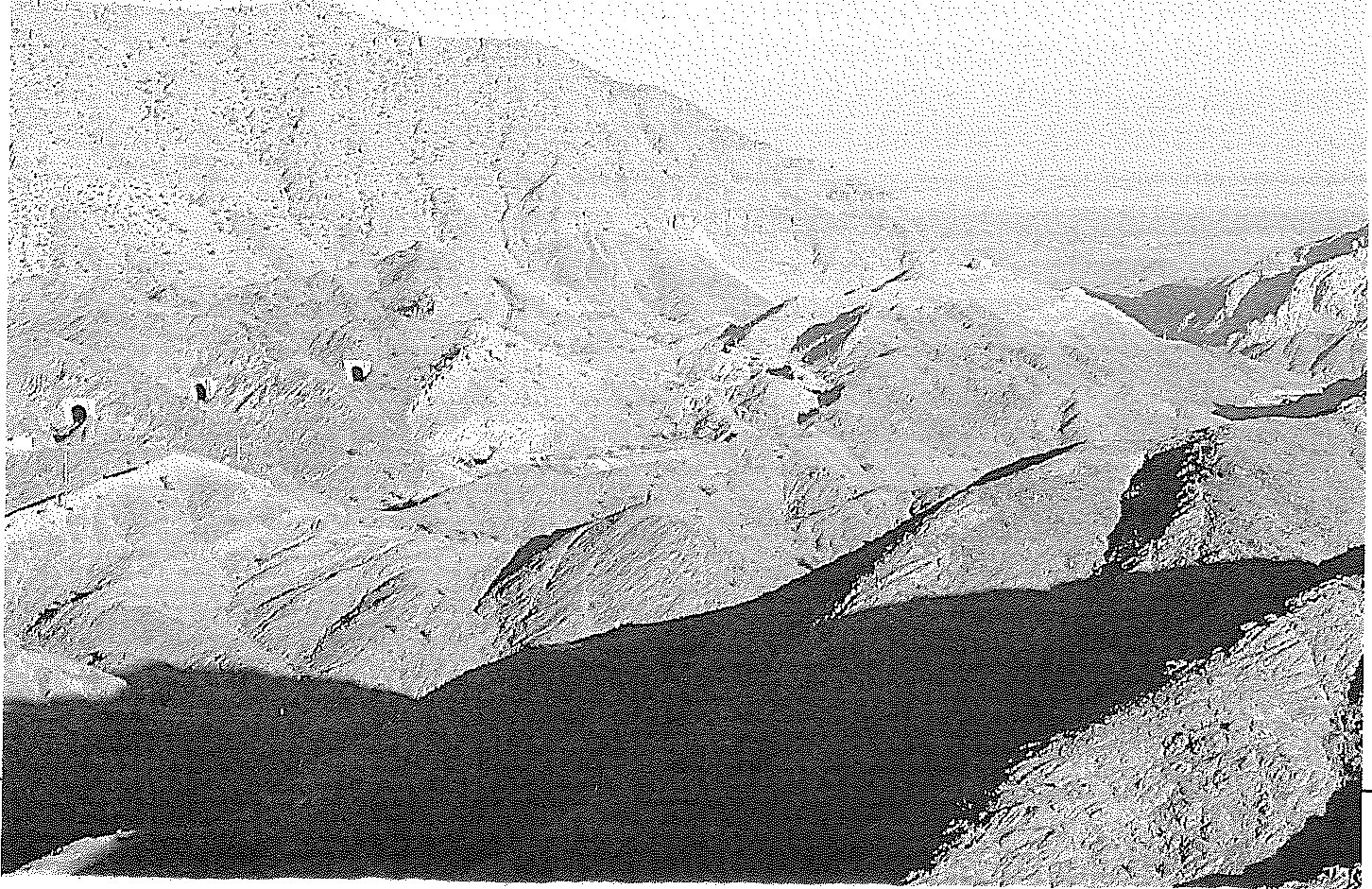
Ali Masjid Fort. From this spot one can view both e. stating. Concentrations of 50 and 60 rockets in the space of one hour are not frequent, but have occurred several times during our stay. Most attacks consist of between six and twenty rockets aimed indiscriminately. It’s difficult to keep track of the numbers, but a “normal” week’s rocketting activity amounts to roughly 70 or 80 impacts. In spite of it all, life goes on. Only in those districts where rockets have hit is the pattern of life disrupted. Elsewhere in the city, traffic moves normally and it is “business as usual”
*Vhile most visitors (excluding Soviet ips, of course) are restricted to Kabul, officers have unique opportunities to el to various parts of Afghanistan in the ormance of duties associated with the firmation of the withdrawal of Soviet torces from the Country. There is no opportunity for in-country off duty or leave travel. Permanent Observation Posts (OPs) have been established in Hairatan and Torghundi on the Afghan-Soviet frontier. OPs are manned by between two and four officers and rotations occur every two or three weeks. Additional teams have deployed to other regions (Kunduz, Bagram, Jalalabad, Gardez, and Kandahar) for shorter periods at irregular intervals. Various “carriers” are used but most often it is Afghan Ariana Airlines, whose motto is “Be a Second Marco Polo — Travel Ariana”.. Having travelled by Ariana, I would add “Where Every Flight is an Adventure”. Alternatively, we are transported to OPS by night in Soviet military aircraft where each passenger is issued a freefall parachute (no experience necessary. There is nothing blacker than the interior of an unlit aircraft. Passengers have been known to ask where the doors are in the event exit by parachute is required. Travel by Afghan and Soviet helicopter can best be described as “very fast, very low” and the two differ in only one respect: the Soviets fly by night, the Afghans fly by day. The “official” reason given for the difference is that Afghan pilots are not issued maps and navigation aids are limited. Now that is a confidence builder!
Night life is virtually non-existant — no theatres, restaurants, or cinemas. As embassies reduce staff, members of the diplomatic rendez-vous are a handful of embassy-sponsored clubs. A self-imposed curfew between 22:00 hrs and 04:00 hrs has a dampening effect on social pursuits, but frequent small arms fire tends to discourage after-dark walks in the streets anyway. There are no social contacts with Afghan officials. A Middle Eastern diplomat stated that his contacts were his cook, his sweeper, and the melon seller. In the words of one Western diplomat Kabul “feels like the most isolated, cut off part in the world. It’s like living in a monastery without the spiritual benefits.”
The stresses brought about by living in such an environment make temporary relief a necessity. This usually means a short trip to islamabad on board the UN courier flight. : Islamabad is our haven. The bright lights, restaurants, greenery, wide boulevards, freedom of movement by day and night and, above all else, HAMBURGERS, SALAD and ICE CREAM at the American Embassy Club are a welcome change to life in Kabul. In addition, the assistance and generosity extended to our small contingent by every member of the Canadian Embassy in Islamabad has been excellent from the moment we arrived and has exceeded, by a wide margin, Embassy support to the nine other national contingents represented in UNGOMAP. We have known that our interests are being served and that there is a caring Canadian presence nearby.
For this Canadian peacekeeper, Kabul has been an unforgetable experience. I have developed strong feelings towards the people and the country and will leave very much aware of the tragedy endured by Afghanistan and the extremely limited future it faces. I have also experienced an emotion that I could not have imagined prior to coming here, that of being swept up in the fever of witnessing Soviet troops crossing the Oxus River and rejoicing in the fact that they were going home unscathed bout de papier Vol.
View the original scanned pages →
Originally published in bout de papier, Vol. 7, No. 1 (1989), pp. 26–29. Read the rest of this issue →



