
bout de papier, Vol. 6, No. 4 (1989), pp. 47–48
“It was awful, Liebnitz!!” said the Privy Clerk. “There I was. It was about fifty years from now, and seven parties had won seats in the federal elections. After repeated failures by the party leaders to cobble together a majority, the Governor General had called them all together in a big dark room. I was seated away from the table on a high stool. I had no real idea what was going on. The GG tried to explain the situation to me, but all the leaders were shouting their demands and conditions at the same time, and I was getting horribly confused. Then suddenly all fell quiet, and they just looked at me. I didn’t know what to do. Then the GG coughed and said, “Well, perhaps we’d better give you some time to solve our little problem. What say we get in touch with you again tomorrow night and you tell us how to assemble our majority?” Then they all vanished, leaving me staring at the table in a cold sweat until I woke up. I haven’t slept a wink in three nights, Liebnitz. I know it was just a dream, but I’m terrified to doze off in case I wind up back in that room — because I haven’t the faintest idea how to set up the coalition. You’re my last hope.
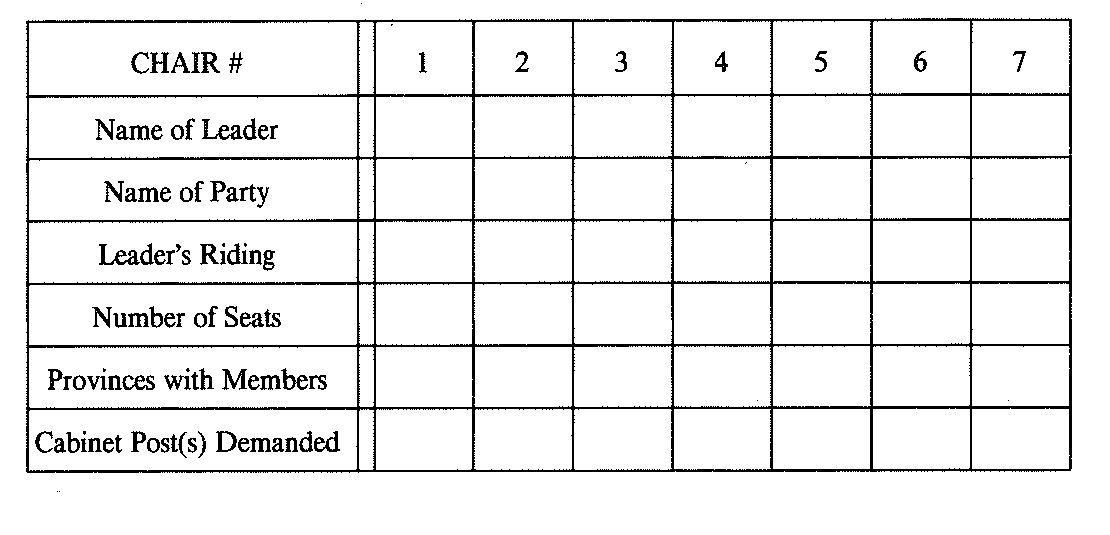
Replied the ace logician, “Well, let’s see. What’s exactly do you remember?” The Clerk handed Liebnitz a memo, saying “I’ve noted down all I can recall of what I saw and heard. The table was round. The GG and the seven party leaders sat evenly-spaced about it. The chair numbers go clockwise from the GG’s left, with him in #8. Each of the leaders had a different riding and party. Each demanded one out of a different list of cabinet posts as a precondition for joining the coalition. Each party had won a different total number of seats in a different combination of provinces. “ The Clerk’s memo added the following:
(1) The leader directly opposite the GG is Jeanne la Tournante from Muskoka-Mariposa riding; her party’s seats (an even number) are all in the North and Ontario. She will enter a coalition only as PM or Deputy PM.
(2) Beside her is a man named Growlton Gnash, head of the Committee for Bemused Canadians, which had won 40 seats, all in Nova Scotia, New Brunswick and Newfoundland.
(3) The two largest parties are the Radical Conservative Centrists (“We Serve You Right”) and the Moderate Conservative Libertarians (“A National Governing Party”). They won 83 and 78 seats respectively. Their leaders hate each other and will under no circumstances serve together.
(4) The member for Autremont leads a party with exactly 5 times the number of seats as the Sons of the Soil, whose leader sits just to his right.
(5) Billy van Tulip, head of the Ralliement des Arrivistes, sits for Goatsnest. He will enter a coalition only as PM or Minister of Finance.
(6) Louis Réalité will take his party into a coalition only as DPM or Minister of Finance; Mr. Edgeworthy Broadbeam, whose party carried 50 seats (all in Ontario and Quebec), Will not serve in any coalition that also includes Kealite.
(7) The member for Crepe Breton will bring his party into a coalition only as SSEA or Minister of Finance; the man directly across the table will come in only as PM or SSEA.
(8) The leader of the Rassemblement des Gaufres (“Free Love not Trade”) is in an odd-numbered chair; her party took 42 seats, all in Alberta and Manitoba.
(9) Myron Balogna, the ineffable MP from Charlottetown-Green Gables, will serve in a coalition only as PM; his party’s seats are all in PEI and Quebec.
(10) Carmella (Mel) Lustig, MP for Drumheller-Tarpits, will enter a coalition only as DPM or SSEA; she will not serve if the party leader two seats to her right is Minister of Finance or if the leader two seats to her left is SSEA.
(11) The party led by the member from Medicine Jaw is the smallest at 10 seats, i.e. every riding in Saskatchewan.
(12) The leader of the OHSO Responsible Socialists (“Neither Gauche nor Sinister”) sits beside the GG on one side; the leader of the party that took 45 seats (all in BC) sits beside the GG on the other Side.
“One more thing you’ll need to know,” said the Privy Clark when Liebnitz looked up. Their House is made up of 348 Members, so the minimum for a majority is 175. And it is a rule that any coalition must include representation from each of five regions: BC and the North; the Prairies; Ontario; Quebec; and Maritimes.”
“Lots of information there,” said the logician. “Let’s do a chart to get it organized.” Pause. “Yes, that comes out quite well. Now let’s look at the rules and personal pre-conditions for building the coalition.” Silence. “Hrumph! Well, I can certainly see why they were having problems. There’s only one combination that works at all. Here you are — sweet dreams.”
Can you duplicate Liebnitz’ feat by (a) filling in the chart and (b) indicating the parties in the coalition, the total number of seats held by the new government and the names of the PM, DPM, SSEA and Minister of Finance? Send in your answer to bout de papier and win a book prize!! If you only get the chart, send it in anyway — if no-one else gets part (b) either, you could still win. (To say nothing of getting the Privy Clerk to sleep.)
Letters to A Aalto
Dear A Aalto, I like the mixture of word and logic puzzles, but would prefer more and harder word puzzles. Rogues was too easy. But I always enjoy and work on your puzzle.
Robert Logie, Canadian Embassy, New Delhi Dear A Aalto, Word puzzles, such as The Name of the Rogues and Cities of the Silver Screen, can be done on a “pick it up and put it down”, basis, making them much easier to deal with purely from the standpoint of logistics.
I await the next A Aalto puzzle with breathless anticipation. Alan Bones, Canadian Embassy, Kuala Lumpur Dear A Aalto, Just a short note to say how much we enjoy the last page in “bout”. Keep those brain cells spinning.
T. Tenor, Ottawa
View the original scanned pages →
Originally published in bout de papier, Vol. 6, No. 4 (1989), pp. 47–48. Read the rest of this issue →



