
bout de papier, Vol. 6, No. 4 (1989), pp. 27–30
The following was originally a speech given to a meeting of the Professional Association of Foreign Service Officers which was subsequently revised for publication in bout de papier.
In considering the challenges and changes that confront Canada’s foreign policy and Foreign Service over the next decade, it is important to begin with a recognition of the fundamental forces that are transforming the post World War II international system and order as we approach its half century anniversary. There are basic changes in the relative capability among the major powers in the system that are generating a new internationalism in the world. This new internationalism means a different price tag and a different role for Canada. It is a larger role than we had in the past, but not necessarily a happier one. It means more burdens, more demands, more requirements for new investments, and maybe the possibility for exercising rather more influence in the world than Canadians have traditionally thought, or dared hope, they could.
The most striking trend in contemporary world politics is the systematic, sustained and probably irreversible decline of the United States as a system-dominant power. The American Empire was meteoric in its rise; it’s dominance at its height was historically unprecedented and, partly as a result, the speed and magnitude of its descent was unparalleled as well. It is clear that American’s have now recognized the trend and have begun to debate its implications for their role in the world. Students of Canadian foreign policy largely have not. In this, they have perhaps just followed the lead of their government, whose green paper on foreign policy, Competetiveness and Security, was premised on an America exercising perpetual primacy in the world.
Does the U.S. domestic political system have the carrying capacity to cope with the unfortunate historical fact of a reduced place for America, in what is now a much more integrated world? There is nothing in America’s historical experience to prepare them for this condition. When they were weak, they were insulated by an isolationist foreign policy and British hegemony from outside predators. For most of their life as a country, they have been on an upward swing in relative power, which has reinforced the extraordinary sense of self confidence and exceptionalism which has characterized the American republic since its inception. But, if one looks closely at its critical capabilities for the future, at the foundation for big-project science, national security science or the dynamic technologies of the future, the situation is quite clear. Not only American corporations, but America itself is hollow at the core.
What is the solution for the United States? One hope for them is to adopt the Canadian model, which has stood their fellow North American country in such good stead during the century which, in a quiet way, has indeed belonged to it. Here the prescriptions are clear — demilitarize, accept massive amounts of direct foreign investment from the technological, managerial and financial powers of the world, and because this is a Canadian rather than Japanese model, accept as a basic national value effective multiculturalism, and the openess to the outside world which genuine multiculturalism brings.
The second country experiencing a difficult time on the curve of relative capability is the Soviet Union. They too have recognized their decline and this recognition has brought Gorbachev to the fore. Will Gorbachev endure? Yes, if only because the maternalistic, middle aged baby boomer in the Soviet Union – Communist yuppies — yearn for the rewards that only he and his approach can bring. Will Gorbachevism turn the Soviet Union around? Probably not. The flight path of the Soviet Union through history in terms of relative capability is basically a straight line. It’s not going up nor is it going down. In a sense, it has recognized its historical fate, and begun to withdraw from some of its imperial pretentions, Afghanistan being the latest.
In this age of the two declining dinasours, where even an outburst of institutionalized superpower summitry seems insufficient to engender a condominium of the duopolist, to whom will power pass? Across the Pacific, will it be China or Japan? Canadians informed by historical baggage, tend to answer China. They are wrong, at least for the next quarter century or so. Clearly, Japan, in terms of relative national capability, is going up – straight up. It is not just a post-war phenomenon. It came not just after Honda managed to export its products into the United States. It is a longer 20th century trend. Japan was rising rapidly until 1941. It flattened out while they fought and lost the war. But their ascent was frozen for only ten years. Then, they took off exactly where they left off and kept going. The problem for Canada is that, relative to our competitors, we are lagging very badly. This is nowhere more true than in our broadcast media, whose images of Japan are still locked in traditional stereotypes and the worldview of World War Il. As to the newly industrializing countrie ho are most visible across the Paciic, the are not generating a new strata of middle powers of the kind that we historically would love to form a partnership with. Most of the NICs are basically the Guadeloupes of the dominant Anglo-American imperial systems of the past rather than the most historically resilient “likeminded” middle powers in Europe and India. Once one gets beyond Taiwan, South Korea, Hong Kong, and Singapore, to look at more longstanding middle powers such as Mexico, there are few who are willing or able to take the leap into being major middle powers, able to practise the diplomacy of constraint and eventually graduate into the major power rank. The debate really comes down to India or Brazil, and whether their second level space and nuclear programs can withstand the competing claims of their international indebtedness and the demands of their populations.
And, what about Europe? Despite the emergence of real European cooperation on the road to 1922, Europe is ultimately too multipolar to be a single entity or even a very stable bloc. And, even if it appears to the outside world as a single thing, there remains the questions of whose Europe is it to be? The historic fear in Canadian foreign policy — the distrust of a regional Europe or a fortress Europa — what was offered in the late 1960’s and the 1970’s — a French-centred Europe, just when Gaullism was imposing itself on Canadian foreign policy and Canada with such destructive consequences. But now that Gaullism has gone, or shifted its target 10 Europeand d prol scheme place in has become more apparent. This more modest France highlights Germany as the dominant power in the European region. This is overwhelmingly evident in the economic sphere. But Germany is also moving — slowly and cautiously but relentlessly and cumulatively — beyond that.
The world of the year 2000 will not be one of isolated and competitive regional blocs, for neither the configuration of emerging powers and the cascading, multifunctional interdependencies among them will allow for that. In the year 2000, the dominant powers are going to be an aging United States and Soviet Union, and fast-fading Britain and France and an ascending Japan and Germany. Torontonians can be forgiven for adding Italy, partly because things Italian matter so much in Toronto, but also because Italy was at the seven power Summit that Toronto hosted last year. (Those outside Toronto will have to settle for the fact that Italy now has a greater GNP than the United Kingdom as evidence for Italy’s inclusion.) Japan, Germany and Italy are, of course, the great powers who lost the Second World War. That may be why they have grown so relatively rapidly in the postwar period. It is certainly why they were excluded so systematically from the institutionalized arrangements for managing international order in the postwar world. The challenge for Canadian foreign policy, because we too were often excluded, is to recognize our natural affinity with this trilogy of non-mother countries and to think up a new modern generation of international institutions in which Germany, Japan, Italy and Canada have their rightful place.
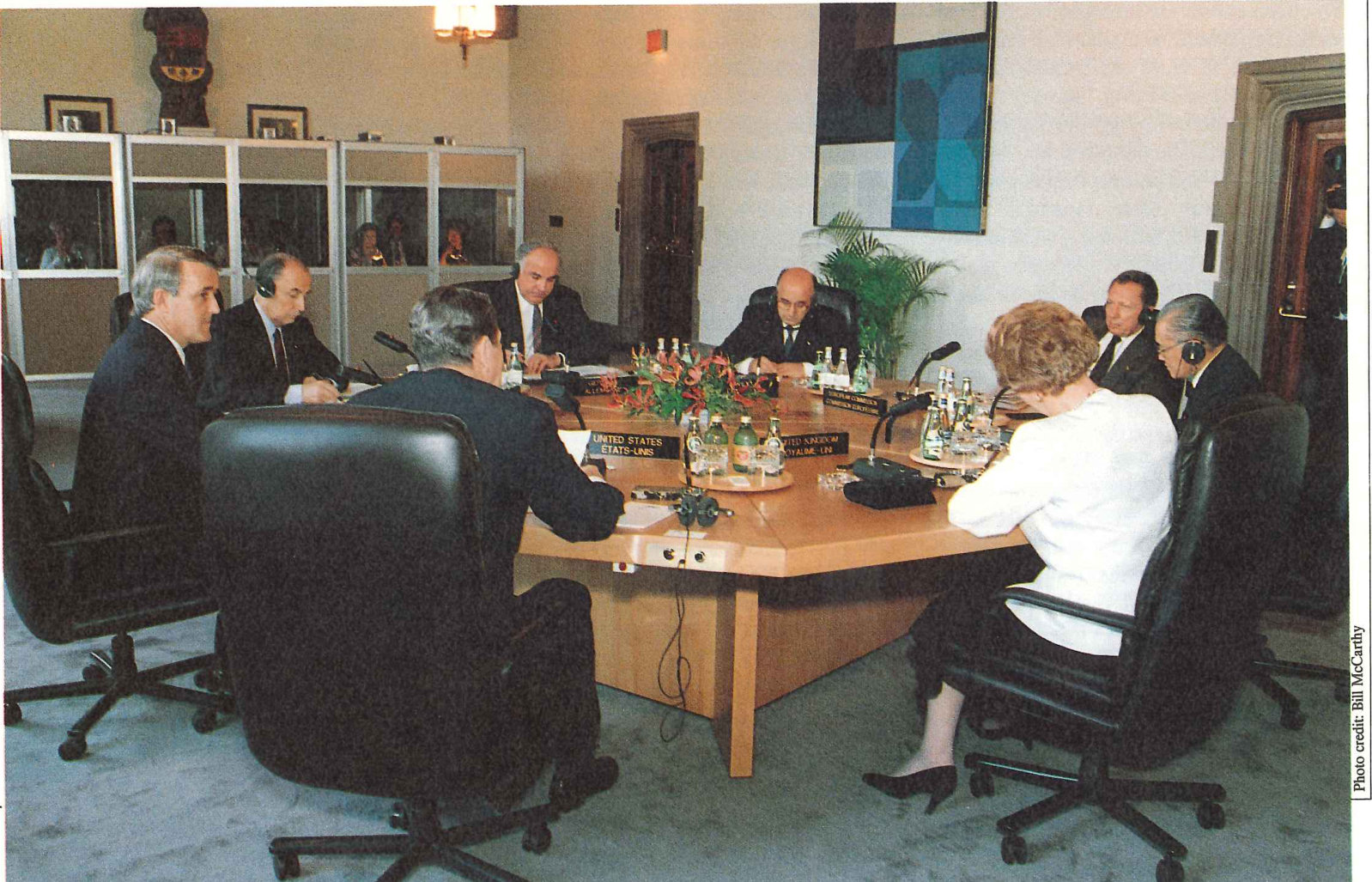
A few years ago some thinkers in External Affairs invented the term “plurilateralism” to begin this Canadian exercise in new thinking. To add to this, one might usefully resurrect an old and forgotten term in the lexicon of international relations — that of a great power concert. In world politics today, one exists and operates with remarkable effectiveness. Its centre is not the Security Council of the United Nations, where Canadians have been conditioned to fix their vision. It is the Summit of the seven major industrial democracies of the Western World.
Throughout the western world, people are very skeptical about the value of the Summit. The leading doubters have been the forums founders — the Presidents of France.
But no one who has ever gotten an invitation to the Summit has ever exercised their option not to show up. And, there is an impressive list of countries that want to get in but can’t. One of the challenges for Canadian foreign policy is to go beyond the Summit connection with Japan, Germany and Italy to develop a serious bilateral relationship with them, so that Canada can activate a new set of associated powers for ventures in a number of fields from debt, aid, and arms control to security policy, environmental protection and space operations as well.
But, it would be wrong to confine the Canadian foreign policy of the future to the cosy clique of the Summit club. For beyond the plutocracy of the North, lie Canada’s rich networks of association with the South. The famous futurologist Herman Kahn once said that, “Canada was a regional power without a region.” He was profoundly wrong. His characterization is not only wrong as a judgment about Canada, it is wrong as a way of thinking about the world. Herman Kahn, not surprisingly, was from that old German school of geopolitics in which land mattered and water didn’t. (They didn’t even think about the quintessential Canadian concern — ice). The basic fact of Canadian historical experience has been that oceans, and the British navy and British empire on top of them, connected rather than divided. Canada thus began life several centuries ago as an inherently global power, as a full participant in a global community. And over the years, we acquired a distinctive place on the periphery of the international system, a place to which we are uniquely sensitive and where we can make a difference. Canada, in fact, has lots of regions in the world.
To identify them, in the first instance, it is useful to recall an important historical fact. With the sole exception of the Duchy of Mascovy, since the treaty of Westphalia, Canada has been the most successful territorially-expansionist state in the modern interstate system. Some say we simply got the stuff that nobody wanted, but Newfoundland was a hard-fight: We wanted it and we won. Canada’s full sovereignty over the Canadian Arctic, even without the capabilities to adequately survey it, let alone control it, is something about which virtually all Canadians agree. One might suspect we won because the Americans allowed us to, but bitter memories of the Alaskan panhandle and Greenland in World War II, as well as the fact that the Americans have been our antagonists over most of the pieces of land, water and ice we did win, refute the point. As the late John Holmes was fond of suggesting, Canada’s vast territorial domain was not really acquired in a fit of absentmindedness. Rather, the very name and motto of the country suggest it was secured as a matter of divine right.
Beyond our empire of ice lies Africa. Canada has, with only intermittent effort, acquired an important role in sub-Saharan Africa, francophone and anglophone alike. One can argue about whether or not our aid program is creating more of a population problem than it is helping and other difficult tradeoffs, but that sense of deep historical commitment is there. The problems of South Africa have resonance with some of our deepest values and interests which we affirm in the international system as well. There are also those areas of the world where retreating British, and more recently French, imperial power have opened up a need for modern countries, with major resources and an international orientation to play a large role. The list is long enough to confirm our global relevance, if not our great power role.
But, even this raises a basic question — how much longer can Canada go on running a foreign policy on the cheap? How much longer can we go on lacking the physical assets to back our diplomacy and still expect our values to prevail. One can quibble about the priorities, and many will with a vengeance in this age of Prime Ministerially directed expenditure. But some fundamentals endure.
Even in an age when Canada was merely a modest middle power, it depended critically for its success on Hans Morgenthau’s ultimate factor of national power – that great force multiplier of material assets — the “quality of diplomacy.” Canada’s compares rather well by international standards. But, the time has surely come to transform the Canadian Foreign Service from an upscale boutique in a niche market (peacekeeping, hosting summits, preserving prosperity in North America) into a major player around the world. Canada might get by through bringing home another major multilateral triumph in the 1990’s — to go with the United Nations Law of the Sea Treaty of decades past. But even with a Canadian sponsored or brokered international law of the environment, it is important to get back to basics, fast.
To do their jobs properly, diplomats need posts abroad and a capacity for political reporting. Given that Japan ranked third when Canada started to build its network of posts, and given that it is now the second or third most powerful country in the world, Canada would be well advised to invest in more than just two posts in that country. If Canada’s political leaders are looking for a role in Central America, or how to avoid one, then resident representation in Managua would surely provide some prudent insurance. Similarly, if Canada is to sustain its leadership in the campaign against apartheid in South Africa, or extend it to embrace military assistance or peacekeeping roles, then it would be appropriate to have embassies in Botswana and Namibia.
The recollection of Canada’s peacekeeping legend points to a broader problem — the decline in the status of Canada’s professional diplomatic corps. However intellectually confining the peacekeeping mediation mystique and its larger ideology of middle power liberal-internationalism may have been, it did honour public service and diplomacy as a high calling for the best and brightest young Canadians of the day. That status and sense of specialness is now evaporating. The primary cause is not the Trudeauian belief that diplomats should spend more time running other departments in Ottawa, nor the change which came from co-habitation with Trade Commissioners in the Pearson building itself. It is the sense of secondary status that comes from the clear message that native foreign service officers need not apply for the top jobs in the system because these have been reserved for a better breed
Professors across Canada have difficulty in countering with evidence the theory of their most intellectually promising and politically sensitive students that the surest way to become an ambassador and exert influence on Canadian foreign policy is to turn down External’s job offer, go into law or business, make a fortune in the private sector first, and then get a classmate-turned-politician to provide a fast track to the top. It may well be that on the really tough assignments in difficult places — say London, Lisbon, Dublin and Boston – that political appointees can provide better value for dollar than the coddled careerists of the foreign service corps. But then, let the Senate of Canada create its own set of posts abroad to provide a fair test of whether political appointees, without the hidden help of loyal, long suffering professionals supporting them on station, can out perform a post peopled entirely with professionals from bottom to top.
Beyond an expanded and strengthened diplomatic corps, lie further requirements. Although Oliver North and the French in New Zealand have recently given overseas intelligence agencies a bad name, a suitably adapted Canadian version that protected our benign international image could reduce our dependence on whatever American and British friends chose to provide at any moment. Given our skill in communications and public broadcasting, one could expect a CBC International with global coverage, with, for example Japanese-language programming beamed to Japan, and with a capability to transmit the Canadian message, to the world, not just on radio but on television as well. And most importantly, there is simply no excuse for the world’s third space power not to have the capability to survey from space its own territory – and that of its adversaries and allies as well.
Can we afford the relatively modest sums required for these capabilities in the new dark age of expenditure restraint? Can the materialistic, middle-aged baby boomer taxpayers in Canada be made to realize that their old age security, properly conceived, depends less on the size of their future inflation adjusted cheque from Ottawa, than on how well our diplomats can construct a new international order to prevent the invasion of ultraviolet rays through an ozone-depleted atmosphere, radioactivity from decaying Soviet reactors in space or on the ground, refugees hitting Canada’s eastern shores in lifeboats, or the many other real physical penetrations of Canada in the modern age? Certainly the challenge is more complicated than in the good old golden days, when Lester Pearson merely called in Blair Fraser for a drink, and External’s domestic communications strategy unfolded on a sea of charming irreverence and baseball anecdotes. In part, this is because today’s politicians communicate with their publics not through the written word of elite newspapers and newsmagazines (which foreign service officers such as Pearson trusted and, if necessary, could produce) but through the vastly more powerful medium of television news (which few modern foreign service officers understand). In part, this is because those publics now talk to their representatives directly, comprehensively and often instantly through public opinion polls (another new communications technology which too few foreign service officers, and the political science professors which taught them, adequately appreciate and comprehend.)
A more important cause of the challenge, however, is the underlying message that public opinion polls reveal. The old, virtually unanimous national consensus on the reigning ideology of Pearsonianism, externally legitimated by our Nobel Peace Prize of 1957 and confirmed (through the UN) in 1988, has broken down. As suggested in the work of Professor Don Munton, this old foreign policy consensus in Canada is being replaced by a more variegated and volatile mix. Pearsonian internationalism endures, but it now has some formidable competition from economic and cultural nationalists, still preoccupied with the threat to a fragile Canada from the late, great United States.
There is emerging, however, a new internationalism focused not on the old idols of the United Nations, peacekeeping, and international institutions and law, but instead preoccupied directly with the plight of dispossessed and deprived human beings around the world. The spotlight on the aid program, human rights, Ethiopia, South Africa, those who flee from political oppression and on our obligations to help rebuild a nature-ravaged Jamaica and Bangladesh. It is easy to overstate, or declare as irrelevant to foreign policy narrowly conceived, this growing public sense of the essential illegitimacy of individuals dying in great volume at the hands of natural or political disasters on the planet. But the public’s assumption of an obligation to help compensate for, if not yet prevent, such disasters, is likely to be durable and deep. It is, in part, a product of modern television, whose unique ability to instantly transmit human suffering from distant lands in ways that evoke an instant political response at home has been combined with the high, and ever increasing, attention to international affairs which North American television network news provides. And in Canada, the television fuelled image of the new internationalism is a fully bilingual and bicultural experience. After the difficult period of the 1960’s and 1970’s, the creation of such a consensus among anglophones and francophones about the way the world works and how Canada should work in it is an historical accomplishment of some importance. And far more than Canadians in blue berets or on the United Nations Security Council, this image of a global caring and sharing Canada is the foundation upon which a new foreign policy consensus in Canada can be built.
Widely differentiated interest groups will pose a challenge to formulating a new consensus. So too will the demographic composition of Canada change as a consequence of Canada’s immigration and refugee policy. Canada is developing a world view that is very differently focused, and much more genuinely global, than that of the United States. It is one that will increasingly be defined by particular ethnic groups which mobilize, as ethnic groups, to place demands on Canadian foreign policy. The recent challenges the government has faced in dealing with Canadians in the Jewish community, in the Ukrainian community, and in the Sikh and Indian communities, are just the start. That is going to require a range of linguistic and cultural skills and a kind of free-floating pluralism that will challenge the middle-aged managers in the academic and foreign service professions alike. It will certainly compound the difficulties of developing a new consensus on Canadian foreign policy.
Finally, it is worth reconsidering how, in this new world abroad and at home, the Government of Canada has organized itself for deliberation and decision-making in international affairs. Despite much institutional growth and reorganization, Ottawa’s foreign policymaking machinery is still largely focused on coping with the world of the Gouzenko affair and ensuing Cold War. One can be grateful that international summitry forces the Prime Minister to encounter the real world periodically, for back in Ottawa, in his own cabinet, he personally deals, on a routine basis, only with the grim world of security and intelligence, the immediate political crises that hit Priorities and Planning, and now the “do less on everything else” mentality of Expenditure Management Review. At lower levels of the cabinet system, his colleagues and their servants in the PCO still operate in a system which fuses foreign policy with defence of the basic vintage military sort. In the 1980’s, External Affairs and the House of Commons, have made international trade their preferred conceptual partner. This may have been a wise choice for a materialistic decade, but could well be inappropriate for the 1990’s, when environment has replaced trade as the reigning priority in even our bilateral relations with the US (and perhaps beyond), and when movements of civilian populations rather than troops abroad give the Canadian government most cause for concern. Short of the comprehensive efforts at institutional architecture and construction that tend to come only with war, one is left to look, more modestly, to the days when executive interchange will send External’s officers to Inuit communities in the Arctic to learn about sustainable development, when the foreign service visitor program despatches its sovietologists to the Bedford Institute of Oceanography to explore ways to free ice-trapped whales, when social affairs becomes the most prestigious — as well as the most beleagured – stream in the whole corps, and when, to politically protect this new institutionalism of the new internationalism, the Secretary of State for External Affairs becomes a Deputy Prime Minister as well.
View the original scanned pages →
Originally published in bout de papier, Vol. 6, No. 4 (1989), pp. 27–30. Read the rest of this issue →



