
bout de papier, Vol. 6, No. 4 (1989), pp. 22–23
One of the most colourful appointees as a Canadian Head of Post was General Victor Odlum. He was originally appointed in 1940 as our first High Commissioner to Australia (in order to relieve the Prime Minister of the political embarrassment of having him command the Second Canadian Division). When his efforts to have Canadian Forces engaged in Pacific defence caused problems with the Australian Government, Odium was moved to China when that post was opened in 1943. Once a general, always a general. The post was run with his accustomed military flare, much to the consternation of his diplomatic colleagues who resented being ordered around and inspected as if on parade, for no other reason than to satisfy the General’s wishes to be a commanding officer. When he was posted as Ambassador to Ankara in 1948, he very quickly found another avenue in which he could exercise his military flare. In the spring of 1948, there was some fear that the Soviet Union might invade Greece and Turkey. Assuming that their likely route of evacuation from Ankara would be cut off by the prior invasion of Greece, and in the absence of any directions from Ottawa, Odlum informed External Affairs that he had devised his own plan of escape.
“As I have not heard from you, I must assume that you have not been able to picture a probable situation and, as a consequence, have neither directions nor advice to give at the present moment. I am not at all surprised at this, for it must be more difficult for you than it is for me to envisage what is likely to happen.
“I have, naturally, because it is my custom to do so, made plans of my own. To these I will adhere unless, before it is necessary to put them into effect, I receive other instructions from you. They are based upon the prime consideration that the only transport facilities we will have under our own control will be our motorcars. At the present moment, we have three of these. I am informed that Colonel Bingham’s car has already left New York. I would make immediate use of at least three of these cars and with them send (possibly) Colonel Bingham and (certainly) Mr. Cox with the majority of the members of the staff. They would travel by overland route heading for Beirut, in Syria. I would remain behind myself and might keep Colonel Bingham with me. I would not feel like leaving Ankara until it had been agreed by the Turkish Government, as well as by my senior colleagues in the Diplomatic Corps, that a move was necessary.
“It is true that here in Ankara, we have not as many administrative problems requiring last minute attention as rest on the shoulders of the Canadian Ambassador in Athens. There are a good many Canadians in Greece; but there are few, if any, Canadians in Turkey for whom we would have to assume responsibility. The number is certainly negligible. In any event, we could not do much for them because those who are here in Turkey are out of our reach. We have no facilities which we could place at their disposal in any event. My major task would be to look after the Embassy staff and records, and to keep you advised up to the last moment.
“In order to be able to carry out the programme I have in mind, it would be necessary to secure, at some early stage, a number of drums of petrol and with them a supply of oil. We would keep these stored and ready for emergency. We ought to have one vehicle which could play the part of a truck to carry our heavier material as well as the supply of petrol. It is true that there are petrol stations between here and Beirut; but, under the circumstances which would certainly prevail, we could not be sure that their supplies of petrol would be available for us. The petrol in the tanks would probably be requisitioned by military authorities.
“If you concur in my major suggestion, I think it would be wise to have a sturdy truck shipped to Ankara. This truck would be most valuable in any event. It would be invaluable in case of evacuation.
’There are financial aspects to the situation concerning which I have already written you. I have asked that an emergency fund be placed at my disposal in the form of physical currency, to be held as a reserve until the worst comes or, in the alternative, until the whole situation clears up.
“As long as signal communications continue, I would be able to keep in touch with you and to get last minute instructions. At the same time I know that, as General LaFlèche [Canadian Ambassador in Athens] has suggested, communication systems may become badly disorganized. Even if not disorganized, they will certainly be so congested that I could not be sure that messages would get through…
“I am sure that, through my Arab friends, I would be given all necessary protection and assistance in travelling through Syria, Lebanon, Iraq, Arabia and parts of Palestine. Moreover, through them and in Egypt, I would be able to secure local funds in any grave emergency.
“At an early date a substantial shipment of canned goods and supplies, ordered last fall, will arrive from Eaton’s, in Toronto. An ample reserve will be set aside for use only if and when it may be necessary to move out of Turkey under pressure.
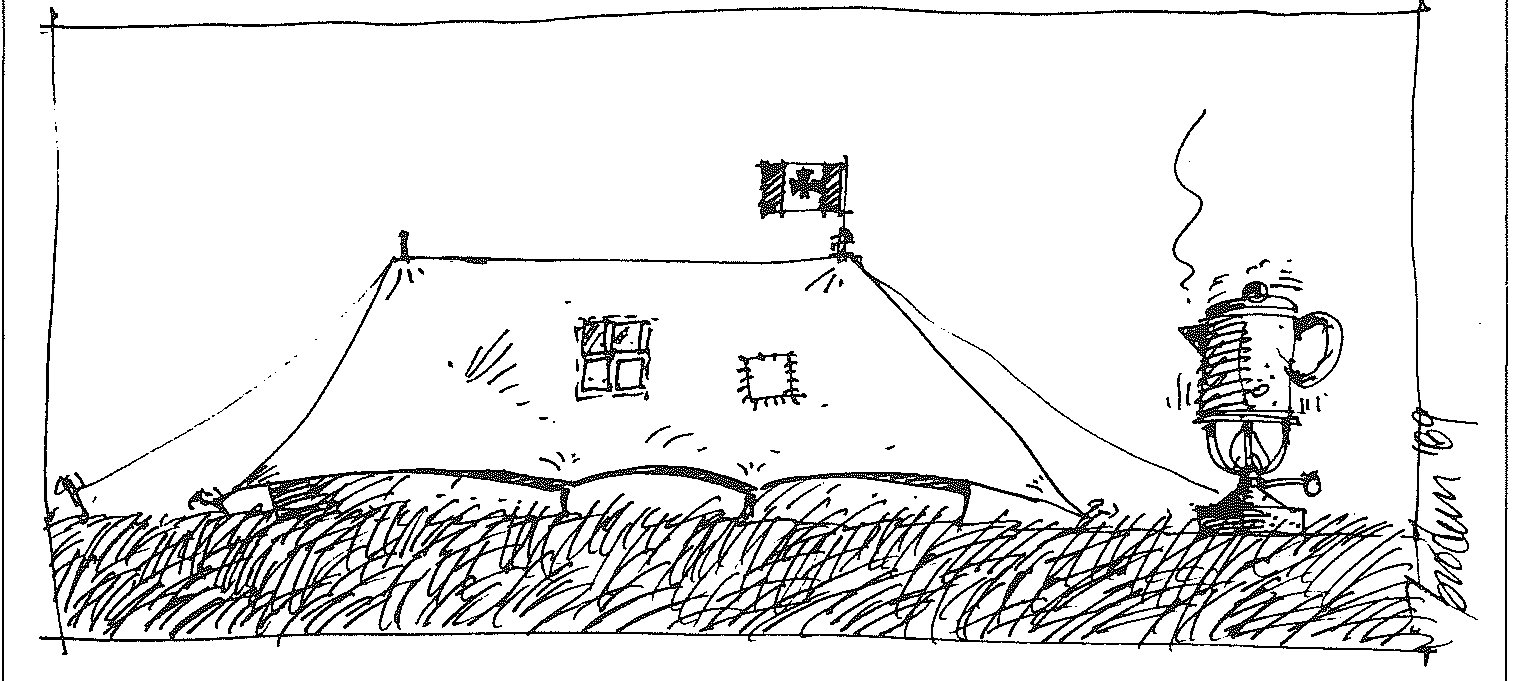
Fortunately, and perhaps with some foresight, I brought with me camping equipment, including knives, forks, plates, cups and cooking utensils. Moreover, there are two camp beds and with them, a “roll” table and folding canvas chairs. These would provide comfortable travelling accommodation for my wife and Mrs. Cox. The rest would have to adjust themselves to “service” conditions and customs. As a matter of fact, even without any help from you, I am reasonably prepared to face any emergency; but a truck, primarily to carry a supply of petrol, would certainly be of great assistance. It is true that my camping kit was not designed for so many people; but by second and even third “sittings” “, it could be made to do. I even have a South African canvas water bag, and a small Australian silk tent!”
Ottawa gave him neither additional funds with which to purchase petrol nor a truck, and a year later he was once again writing to the Under-Secretary to update his evacuation plans in case, this time, of an attack from the air. Not to be defeated by Ottawa’s reluctance, he had devised his own means of acquiring a truck in the event of an emergency.
“Assuming that from the first hour communication would be gone and that all traffic, including air, would be in confusion, I turned my thoughts to transport by motor car and truck. These could be under our own control. Reference to previous despatches on this subject will show that I have not changed my mind. In fact, my opinions are held more firmly than ever.
“I admit that there is a school of thought which believes that Turkey, being tough, will not be attacked, but will instead, be sidetracked. The many who think this way are taking the situation very light heartedly and are making no preparations.
“For my own part, I cannot adhere to this school. It would be very wrong for me to do so, unless I had sound grounds for my convictions. Instead of having such grounds, my mind turns in an entirely different direction, as will be disclosed in the despatch referred to above; and so I feel it my duty to provide for the worst eventuality, not for the best.
“To evacuate the last Embassy group (after all records have been destroyed) by motor car would mean:
(a) Sufficient cars and a truck, the latter to carry gasoline and supplies;
(b) Reserve gasoline (since the purchase of gasoline at that time would almost certainly be impossible);
(c) Reserve food supplies (for the same reason);
(d) Usable currency — Turkish lira, U.S. dollars or gold. “I have consistently assumed that a route to the north would be an impossible one; that the coastal harbours of Turkey would be in confusion (under bombs, as was Boulogne when I tried to get out of France in 1940); and that the only feasible route would be the south, through the Arab countries. “Believing those things, I set out to make concrete plans. We have three passenger cars; and we could use the station wagon as a truck, if necessary, but it would hardly be strong enough to carry a substantial load over the bad Turkish roads. A six-wheel truck would be much more reliable – and for one of these I have made arrangements. But I will only buy it in emergency. I have Turkish lira and U.S. dollars in the bank — although I have not yet succeeded in changing the latter into physical currency. (This I expect to do before the summer is over.) I have put aside a reserve of gasoline — as the Embassy accounts will show. I have adequate reserve food in storage and so I am nearly ready… “You will ask why I show so much concern at a time when “peace” propaganda is the major feature of the moment and while everywhere — except in China, Burma, Malaya, Indonesia and Greece — the air is so quiet that it is almost somnolent. Hitler’s attack on Russia was a “noisy” one and its preparations were obvious to all observers. But the Russians do not think or act as Hitler did. With them everything is screened behind veils of distance and silence. If and when they strike, it will probably be just as silently and with great speed.. “In a letter I received a few days ago from General Pope [Head of the Canadian Military Mission in Berlin], he made reference to the fact that from every quarter come reports that there is neither tension nor apparent preparation for aggressive movement. General Pope very shrewdly added that when all men talk that way it is time for some men to be on their guard!”
The saga does not end here as Odlum kept firing off further despatches on other evacuation procedures that he was planning, such as how he had used petty cash to purchase small quantities of sodium nitrate and sodium chlorate which he had used to conduct experiments in the chemical destruction of documents before demanding that Ottawa ship him, by separate sea bags in order to avoid an explosion, sufficient quantities for the anticipated emergency. Given how ill-prepared the Department had been to assist those who found themselves under German invasion in Western Europe in 1940, Odlum’s anxieties were not entirely without foundation, but, as usual, overdrawn.
Fortunately for both Odlum and the Department, his evacuation plans never had to be activated. The lengthy telegraphic battle between a Department which sought to moderate or, more often, ignore his plans and pleas for help in implementing them, and an Ambassador determined above all else to carry them through was happily avoided by a more peaceful turn in world events.
View the original scanned pages →
Originally published in bout de papier, Vol. 6, No. 4 (1989), pp. 22–23. Read the rest of this issue →



