
bout de papier, Vol. 6, No. 3 (1988), pp. 32–33
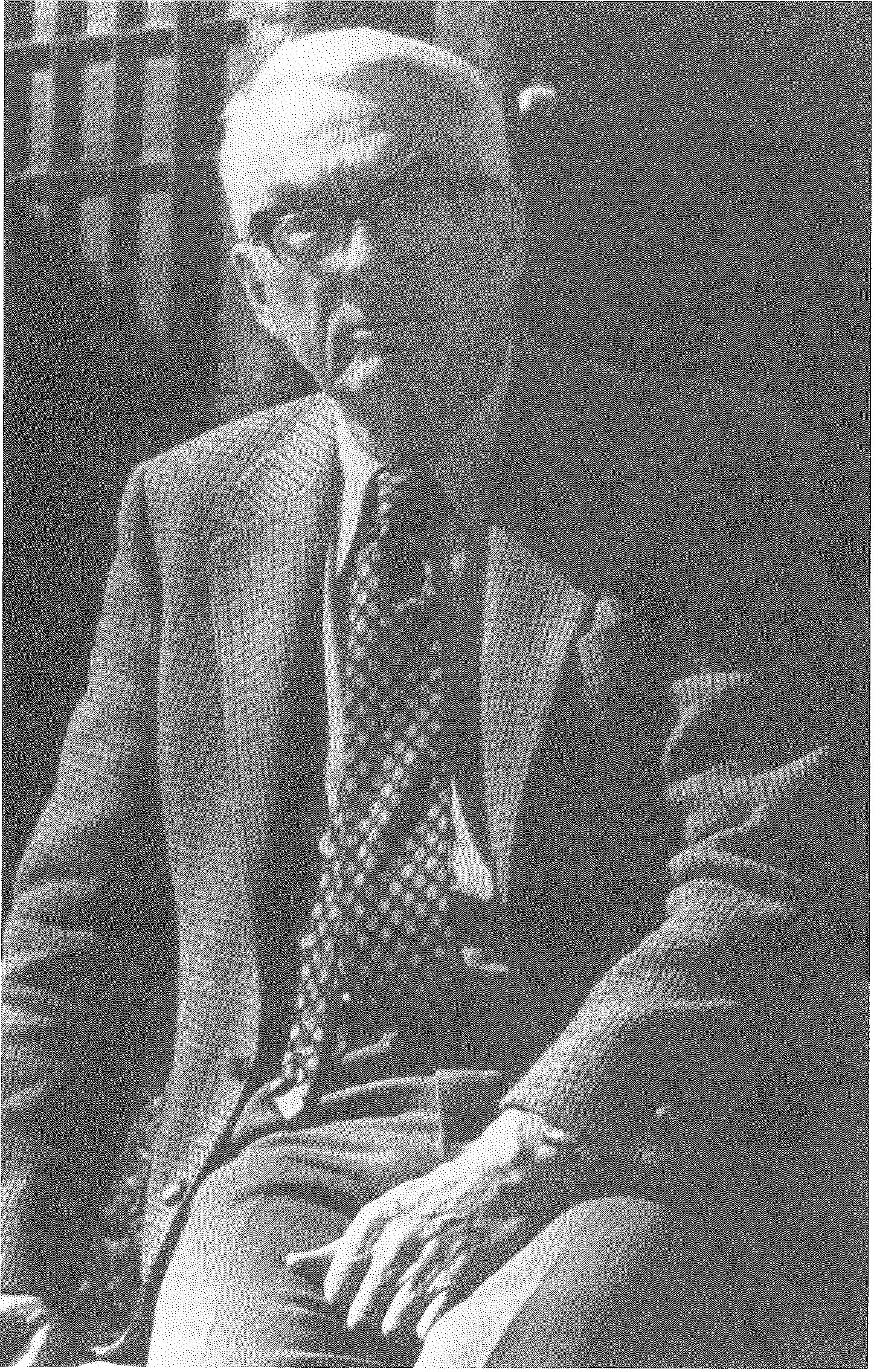
John Wendell Holmes died August 13 in London, Ontario after a full and rewarding life devoted to international understanding. He never aspired to high office and was embarrassed by compliments. Yet during his 78 years he managed to combine three brilliant careers as diplomat, teacher and moving force in the Canadian Institute of International Affairs. He was awarded many honours, including the Order of Canada and ten honourary doctorates. He was elected a fellow of the Royal Society of Canada and received the Society’s Tyrrell Medal in 1986. The library of the Canadain Institute for International Affairs was named in his honour and a volume of essays on Canadian diplomacy, An Acceptance of Paradox, was published as a tribute to him in his lifetime.
In all three careers, spanning almost 50 years, he practiced the art of the diplomatist, helping to shape the formulation and implementation of foreign policy in the Department of External Affairs, promoting through the CIlA a better public understanding of foreign affairs, and nurturing in his students a • deeper appreciation of Canada’s international role.
After getting his BA at the University of Western Ontario and his MA at the University of Toronto, he did graduate studies in history at the University of London but these were interrupted by the outbreak of the war. Debarred by poor eyesight from military service, he joined the CIA in 1940, where he was first Information Secretary and then National Secretary. In 1943, he joined the Department of External Affairs, working in Ottawa for a year on Commonwealth affairs and the question of post-war international institutions. He then spent three years as First Secretary at Canada House in London and a year as Chargé d’Affaires in Moscow. When the Korean War broke out he joined the Canadian Delegation to the United Nations in New York and a year later returned to Ottawa to become Head of the UN Division. From 1951 to 53, he was seconded to the Directing Staff of the National Defence College. He was then appointed Assistant Under-Secretary of State for External Affairs responsible for the UN, the Far East and Commonwealth affairs, and in that capacity worked closely with Lester Pearson during the Suez crisis.
In 1960, he resigned from the foreign service to rejoin the CIA, first as President and then as Director General. He was instrumental in revitalizing that organization by obtaining major grants and organizing numerous conferences and publications. He also wrote and spoke extensively Canadian foreign policy, and this led him eventually to a new teaching career. Though he relinquished his position of Director General in 1973, he remained associated with the Institute as Counsellor, and provided insight and support for its activities to the end.
In 1967 he became a visiting professor of international relations at the University of Toronto and began a graduate seminar on Canadian foreign policy. In 1971, he started undergraduate courses in Canadian foreign policy and international institutions at Glendon College of York University. During the 70’s he supervised doctoral students at Toronto and was Claude T. Bissell Visiting Professor of Canadian-American Relations there in 1980-81. He also spent two terms as visiting professor of history at Leeds University in England in 1979 and 85.
He was the author of many books and articles on Canadian foreign policy which became widely known and used as reference works. Particularly notable were The Better Part of Valour: Essays on Canadian Diplomacy, Canada: a Middle Aged Power, Life with Uncle: the Canadian-American Relationship and his two-volume work The Shaping of Peace: Canada and the Search for World Order. He was also a frequent commentator in the press, on radio and television, and was much sought after as a keynote speaker and a participant in academic conferences.
John Holmes had the knack of shedding new light on old truths, of going to the heart of the matter and of winning understanding for unpleasant facts with wit and elegance. His simplicity was never oversimplified and his objectivity was never offensive. I remember one occasion when he gave a brilliantly illuminating and disarmingly frank exposition of Canada-U.S. relations to a conference of the American Assembly, which at one and the same time charmed his largely American audience but left them in no doubt about Canadian concerns.
He saw his academic role, in his own words, as a “facilitator,” encouraging the creative work of others, but his input and his went far beyond that. He thoroughly enjoyed teaching and his students thoroughly enjoyed learning from him. For they found in him a practitioner who eschewed all dogma and jargon, who explained foreign policy in the down-to-earth terms of case studies and who could tell them how it was really done. He did not neglect theory but he preferred to derive it pragmatically from empirical evidence.
The kernel of his political theory was the reality of conflict and the necessity of promoting its peaceful accommodation. Hence the emphasis he gave to compromise. The real world he saw was devoid of absolutes and perfect solutions; he insisted on seeing all sides of every issue, without passion or prejudice. Reason was his sheet anchor and conciliation, his leit-motiv. He constantly drew attention to the conflicting pressures under which foreign policy makers have to operate, the pros and cons they have to weigh and the fact that in practice they have to choose, not between good and bad policies, but between bad and less bad policies.
Two themes ran like a thread throughout his career: Canada’s international vocation as a middle power; and the role of the UN as an imperfect but essential experiment in international conciliation and cooperation. With respect to the first, he became increasingly concerned with the need for Canada to reconcile its internationalist role with the conflicting pressures generated by its ever closer and more complex relationship with the United States. In Canada: a Middle Aged Power he criticized the distortions introduced by both the “bigotted defenders of sovereignty” and the “liberal internationalists who denounce sovereignty and nationalism in the abstract as evil.” He was fully conscious of the fundamental problem which the disparity of power between Canada and the United States introduced into the relationship, but he argued for a rational approach to it management rather than indulging in either “anti-Americanism” or “anti-anti-Americanism.”
With respect to the UN, he remained to the end a believer in a realistic and evolutionary approach. He was opposed to those who expect too much of the UN system as well as to those who dismiss it as useless. And he was profoundly disturbed in recent years by a tendency he saw on the part of the United States and some other governments to emphasize the system’s shortcomings and to downgrade its role in the patient construction of a more orderly and cooperative world. He saw better public education as an antidote for that. One of the last projects in which he was involved was a plan for an Academic Council on the UN System which a group of American, Canadian and Mexican scholars were putting together to promote research and teaching on international institutions.
Beyond his professional competence as a diplomat, his persuasiveness as a publicist and his effectiveness as an educator, John Holmes’ most endearing trait was his ability to inspire confidence and friendship in those, of all age groups and in many walks of life, with whom he came in contact. His circle of friends and colleagues was enormous and his circle of influence extended far and wide in Canada and abroad. I myself owe him a tremendous debt of gratitude as a mentor and friend, not least because he was partly responsible for putting the idea of a diplomatic career into my head when I first met him in Ottawa in 1943.
Humility was his hallmark, tolerance was his touchstone and moderation was his motto. All who knew him, either personally or by reputation, will continue to be nurtured by his spirit for long years to come.
View the original scanned pages →
Originally published in bout de papier, Vol. 6, No. 3 (1988), pp. 32–33. Read the rest of this issue →



