
bout de papier, Vol. 6, No. 2 (1988) — Summer 1988 // Été 1988, pp. 6–7
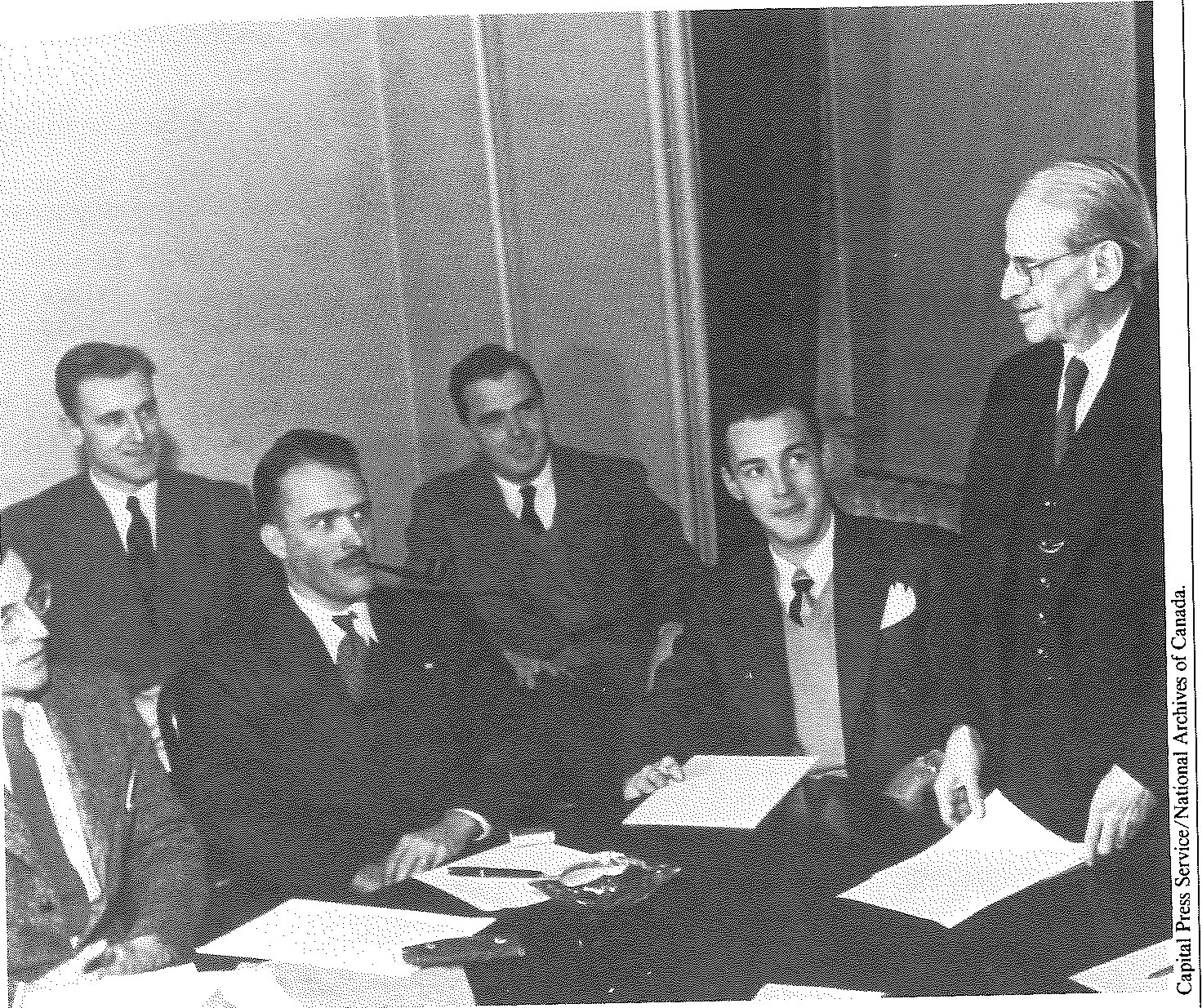
Canada, like the U.K., recruits university graduates for its diplomatic service and trains them on the job. In contrast, a number of European, Asian, African and Latin American countries have specialized institutes or programs for training diplomats both on entry into the service and during their careers. A recent meeting in Vienna of Deans and Directors of Diplomatic Academies and Institutes of International Relations, attended by representatives from over twenty countries, provided an opportunity to compare the different national approaches and to address a series of questions. Who engages in international diplomacy? What skills are required? How are these skills acquired, and does the process of acquisition affect the way in which diplomacy is conducted. and the outcome of international negotiations in various areas?
My thesis is that diplomatic training should be regarded as a foreign policy tool. By training not only its diplomats but also those from other countries, a state can condition the way in which international relations are conducted and possibly the outcome of negotiations. Diplomatic training can thus become an instrument of foreign policy in a broader sense than is implied by the expenditure on training itself.
The characteristics of the various academies and institutions gathered in Vienna were somewhat different. Some, such as South Korea and Saudi Arabia, trained only their own nationals, while the Oxford University Foreign Service Programme in the U.K. admitted only foreign students, primarily from developing countries. Others, such as the Austrian Diplomatic Academy, enrolled students from both Austria and abroad. In the Cameroun and in Trinidad, institutes provided facilities for a regional grouping of countries, while in North America, university undergraduate and postgraduate programs were directed towards nationals and foreigners with interests in pursuing a career in international affairs in both the public and private sectors.
It is known that Japanese firms finance students to attend the Massachusetts Institute of Technology and other leading U.S. universities in order to learn about the latest technological developments which can then be transferred through human capital investment when the student returns home. Some diplomatic academies perform in a related way. By inviting or enrolling foreign diplomats in, for example, a U.K. or U.S. institution, attitudes and thinking about international relations can be exported by the institution’s host country when the foreigner returns home and is employed by his or her government. A country can, in the long run, enhance its influence in international relations by offering to train foreign diplomats. The U.K., through the Oxford University Foreign Service Programme, and the U.S., through various university programs, provide such conditioning as a matter of policy choice. The U.S. probably exercises a wider influence, not only because of the larger number involved but also because their university graduates enter careers in both the public and private sectors. It is increasingly recognized that diplomatic skills are relevant not only to traditional diplomats but also to other government officials, as well as to executives in the private sector and in nonprofit organizations.
The subject matter of courses taught in these academies and institutes range from diplomatic history, geography, international law, politics and economics through business and management studies. Language training is also stressed, while some institutions are requiring a knowledge of computer applications. In diplomatic academies, as opposed to universities, more applied topics are emphasized, such as negotiating skills.
The emphasis of course content differs between Western institutions and those in some of the developing countries, and thus may influence the manner in which some negotiations are carried out. European academies and institutes stress the importance of a knowledge of international law and diplomatic history from the Congress of Vienna of 1814-15, with emphasis on the way diplomacy has been conducted in the past.
Teaching in institutions in developing countries is less concerned about diplomatic history (and an international system that is s viewed as being biased against their interests) and more concerned that their diplomats understand the political and economic circumstances that have led to their actual or perceived state of international dependency. These institutes teach about the New International Economic Order (NIEO), and the divisions between North and South, and they are more likely to use the writings of those in Latin America and the Caribbean, who have adopted the “dependencia” model to explain under-development.
In North America greater emphasis is placed on international business and management. Georgetown University in Washington, D.C., has a program in business, diplomacy. The Fletcher School of Law and Diplomacy has a joint program with the Massachusetts Institute of Technology, allowing the student to obtain a masters degree in management as well as in law and diplomacy. The Norman Paterson School of International Affairs at Carleton University allows students to concentrate their studies on international management. A different perspective is evident in the South. In Yaounde, the Institut des Relations Internationales du Cameroun describes a course on international economics as dealing with “the impact of the ’New Beast’ (the multinational corporations or MNCs) on the global economy”.
More generally, exposure in the South to the Congress of Vienna will likely be as limited as exposure in the North to documents from the Economic Commission For Latin America. The consequence may be misunderstanding and an adversarial situation when those trained in differing settings meet in actual international negotiations.
A narrowing of these differences may be reached by an international exchange of students and by the development of teaching materials, such as case studies and simulation exercises, which aim to force students to take positions opposed to their natural biases. Such materials exist and more are being developed. Their authorship requires recognition of the different backgrounds and biases of the students using the materials. However, it is possible that careful selection of teaching materials and teaching methods will help in the long run to reduce the adversarial nature of international negotiations.
In answer, therefore, to the questions outlined at the start, growing international economic, political and military interdependence means that diplomacy is conducted by a wide range of government officials, by the military, as well as by those in the private sector and non-government organizations.
A broad range of skills is required by those engaged in diplomacy, including languages, computer literacy as well as the more traditional disciplines of history, geography, law, politics, sociology and economics. Business and management studies are now recognized as important, and a strong case can be made for the study of comparative religions given the background of many international conflict situations.
Outside of on-the-job training, skills can be acquired through a combination of lectures, seminars, personal research and internships, as well as the use of case studies and simulations. A mixture of students from different countries, with different ethnic and religious backgrounds is conducive to learning through listening to the points of view of others. Unlike a carpenter or welder, it is difficult for a student of diplomacy to obtain hands-on experience in the workshop. Simulation studies, along with lectures and seminars, can however, be a way to gain some exposure to the future diplomatic work environment.
Finally, although it would be difficult to test the proposition, a case can be made that the process of diplomatic training in terms of the interaction of students, subjects taught and methods of teaching, will affect the way in which diplomacy is conducted and the outcome of international negotiations.
Canadian governments, federal and provincial, should consider not only the way in which their own diplomats are trained, but whether they should be offering training to those from developing countries. Canadian business should also re-examine the type of skills and training required by their executives as growing international trade and investment give rise to more issues for diplomatic-type international negotiations. At present, Canadian foreign service officers are recruited subsequent to graduation from various university programs. One proposal to consider would be for mid-career training at Canadian universities either in individual disciplines, or in a specialized course similar to executive management programs run by business schools for corporate executives. In addition, a Canadian university might offer a program for diplomats from developing countries. Both actions would serve Canada’s national interests well.
View the original scanned pages →
Originally published in bout de papier, Vol. 6, No. 2 (1988) — Summer 1988 // Été 1988, pp. 6–7. Read the rest of this issue →



