
bout de papier, Vol. 6, No. 1 (1988) — Spring 1988 // Printemps 1988, p. 42
LDC Liebnitz was reminiscing with his old friend Chief Inspector de Toombs about the ace logician’s school days. “You wouldn’t have believed the final exam,” Liebnitz exclaimed.
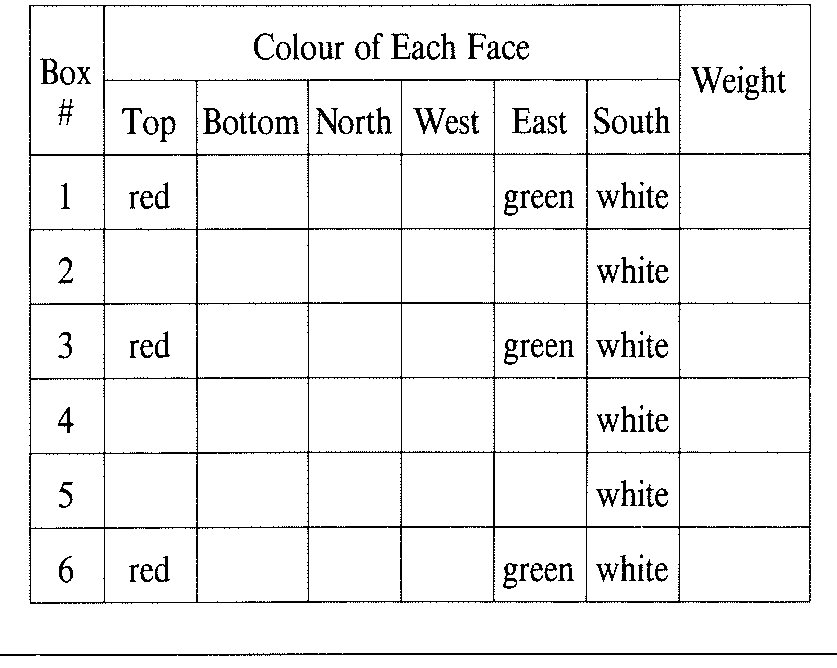
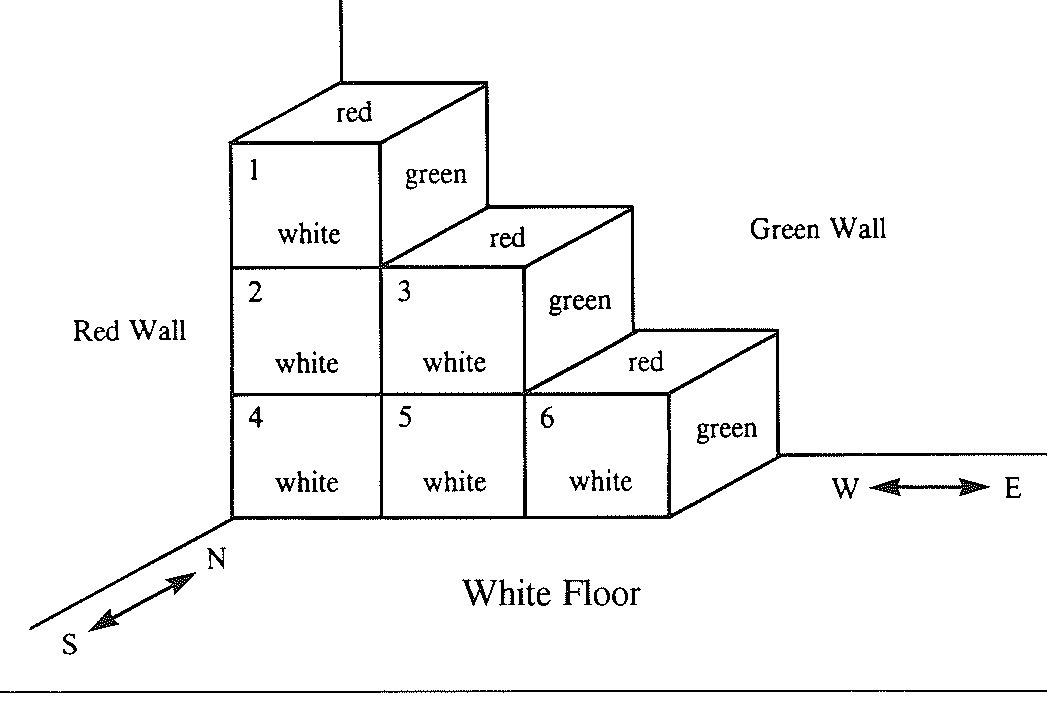
“Our instructors’ motto was ’Puzzle or Die’ — and they meant it! Imagine yourself locked in a room completely bare except for six boxes piled in the northwest corner. The walls run exactly north-south and east-west; the north wall is green, the west wall red and the floor white. Each box is made of rigid steel and they are all exactly the same size, about 50 cm by 60 cm by 70 cm. (Let me draw you a picture of how they were stacked — three in the corner, then two to the east, then one to the east of that.) The boxes fit flat on the floor, flush with both walls and flush with each other — not so much as a hair’s-width crack or overlapping edge anywhere. There’s one small keyhole on the front (south) face of each box. From past experience, you know that turning the right key in a keyhole will cause the top face of that box to hinge open on a spring (unless there is another box on top — the springs aren’t strong enough for that). Each face of each box is painted uniformly red, green or white. Of the faces you can see, all the south faces are white, all the top faces red and all the east faces green. Let me make you a little chart with that information filled in.”
“Now comes the interesting part. Printed on another wall of the room is the following information:
1. The box that weighs the same as the three lightest boxes put together contains a time bomb that will go off in half an hour. To the east of the box with the red north face is a box containing a bomb that will go off if its box is moved more than 3 cm or so in any direction from its present position. Over the box with the white top face is a box containing a bomb that will go off if the box is opened.
2. Each of the six boxes has exactly two red faces, two green faces and two white faces. Five of the six (including #1, #3 and #6) are “regular” boxes, on which no two touching faces of the same box have the same colour; one box does not follow this rule. At the start, no face of a given colour is placed against a face, wall or floor of the same colour (e.g., no red face on one box is placed against a red face on another box, or against the red wall), and this rule must continue to be observed if you move the boxes around (or you will be shot).
3. Each box weighs an exact number of kilos (no fractions). In the order #1 to 6, each box except #1 weighs exactly two kilos more than the previous one. And the total weight of all six boxes is in the exact square of their average weight.
4. There are three kinds of locks and three kinds of keys. The locks you can see on the south face of the boxes are Type A locks, and can be opened by any Type A key. The time bomb is defused by using a Type B key on a Type B lock inside the box — no amount of fiddling by hand will help you with this bomb, and there is no way at all for you to defuse the other two. Finally, some of the boxes are joined rigidly together or fixed to the walls with a Type C lock, which can be opened with any Type C key; once this has been unlocked, the box will move freely.
5. Be careful — any key will fit into any lock, but no key can be pulled out again. The right kind of key can be used to lock and unlock a given lock as often as you want, while if you put the wrong kind of key in a lock (e.g., a Type A key in a Type Block) it won’t turn the lock at all, but in neither case will the key come out of the keyhole once it is inserted.
6. The boxes are so slippery on all faces that it is almost impossible to get a grip on them. As they are at the start, in order to lift a box, you must get your hands under it, and in order to slide it sideways, you must get your hand directly behind it — that is, if you want to shift a box to the east, your hand must be on the west face of the box, not merely trying to push eastward along the south face or the top.
7. To the east of the box with a red west face is a box containing one Type A and two Type C keys. The box that is exactly 7 times the weight of the lightest box is already unlocked and contains a Type B key. The “irregular” box contains a Type A key and is locked to the box to its east (the “C” keyhole is inside the irregular box). The box to the west of the box with the green top face is locked to the north wall. “Well, there I was, de Toombs. I had absolutely nothing to work with but my bare hands and a single Type A key they had given me at the door — a heavy steel thing far too thick for the cracks between and around the boxes. I was wearing a rip-proof Teflon jumpsuit with no loose threads, and my hair had been cut short. They thought of everything. But I knew there had to be a way to find and defuse that time bomb without setting the other two off. And there was — although I had only seven seconds to spare when I defused it!!” Can you repeat Liebnitz’s graduation achievement, by completing the chart and listing the step-by-step process needed to get at and safely defuse the time bomb? Inspector de Toombs is still trying to get up the courage to ask how many failed the exam. Please send your answers to bout de papier. The first correctly drawn answer wins a book prize!
View the original scanned pages →
Originally published in bout de papier, Vol. 6, No. 1 (1988) — Spring 1988 // Printemps 1988, p. 42. Read the rest of this issue →



