
bout de papier, Vol. 6, No. 1 (1988) — Spring 1988 // Printemps 1988, pp. 26–29
What I have to say about the review of Canada’s participation in NATO, following the election of the first Trudeau government in 1968, will be my personal recollections. They will be of a general character as befits a Minister. In the nature of things, these recollections may be less objective than the analyses of outside observers like historians or even of inside observers like bureaucrats. What I can contribute to understanding of what happened during that momentous period in the history of Canadian foreign policy is a description of the motivation and reflections of one of the principal players, the Secretary of State for External Affairs.
In the election campaign of 1968, the Liberal Partv under its new leader had promised a review of foreign policy, particularly in relation to membership in NATO. As newly appointed Secretary of State for External Affairs and at the request of Prime Minister Trudeau, I helped to draft the planks in the platform. I am frank to admit that I would have preferred not to include special mention of Canada’s membership in NATO in the 1968 election platform, since I did not have doubts about that aspect of our foreign policy. I did not raise objections because I was confident of the outcome and thought that a thorough review would help to clear the air.
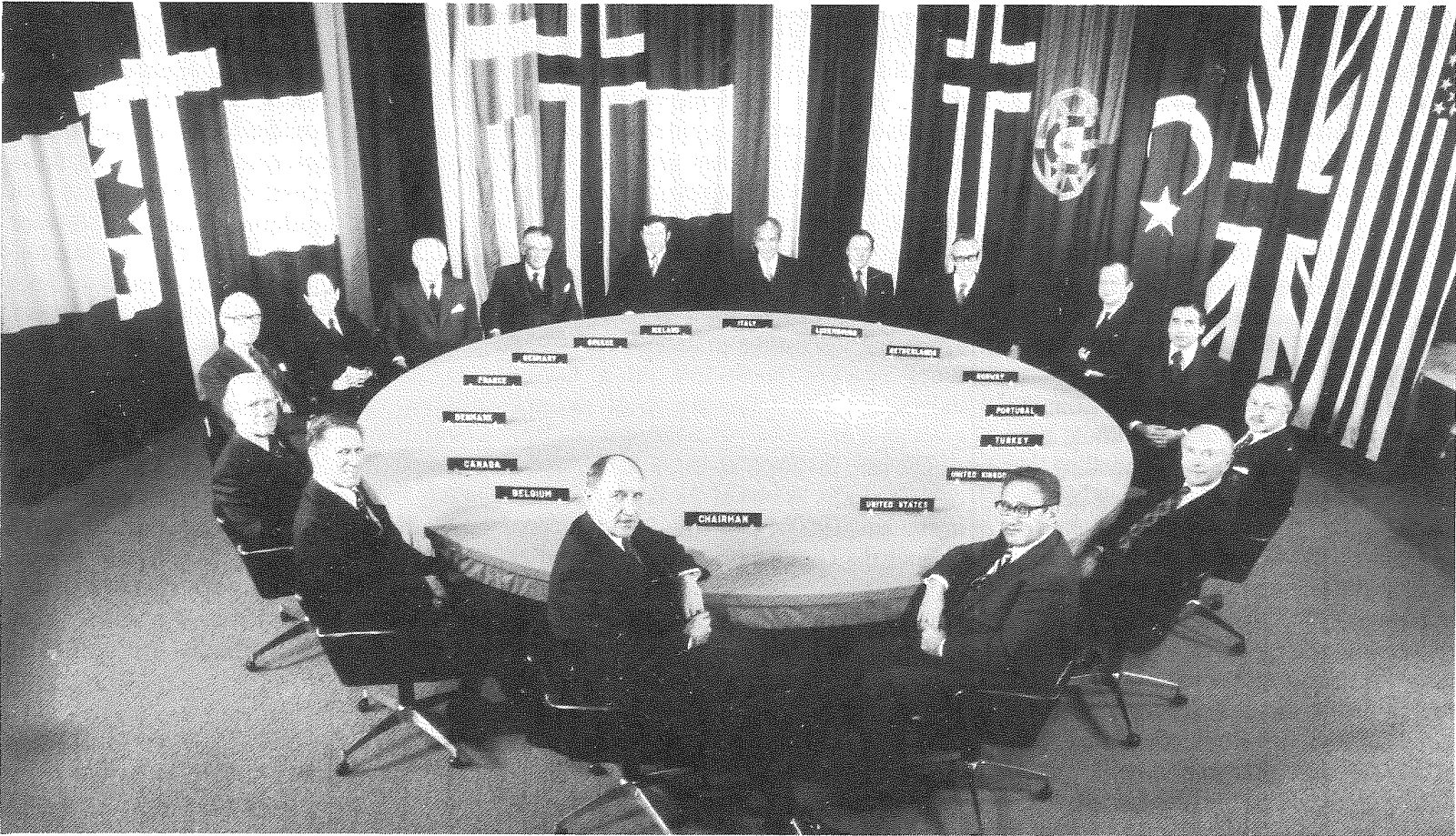
During the Pearson regime, some ministers may have raised the subject in the Cabinet Committee on External Affairs and Defence of which I was not a member; there was no serious debate in Cabinet itself or among ministers. As a matter of fact, foreign policy was seldom discussed in Cabinet. Mr. Pearson and Mr. Martin settled those professional matters between themselves. It was only when the amateurs succeeded them, namely Mr. Trudeau and myself, that foreign policy emerged from time to time on the Cabinet agenda. I can recall only one discussion in the Pearson Cabinet, a discussion that followed a public speech by Walter Gordon in May, 1967, in which he advocated Canada’s withdrawal from NATO, foreshadowing the position to be taken by several ministers of the Trudeau cabinet. As a member of Cabinet, I can say with some confidence that Mr. Gordon’s speech did not reflect cabinet thinking at that time. At policy conferences of the Liberal Party there was very little debate of any kind about NATO and what debate there was reflected the great esteem accorded to Mr. Pearson as one of the architects of the Atlantic Alliance.
In the minority Parliaments that followed the 1963 and 1965 elections, the Liberals and Progressive Conservatives in the Commons supported Canada’s membership in NATO. The NDP members, with occasional exceptions, were opposed. In those years, the House of Commons seldom held formal debates on foreign policy and when it did there was no indication of serious doubts by Liberal speakers on the backbenches about our continued membership in NATO or about the extent of our participation.
When Canadian political parties elect leaders they are more concerned about the personalities than about the policies of the contenders for office. Nevertheless, I mention in passing that in his campaign for the leadership of the Liberal Party and in his speeches to the delegates in 1968, Mr. Trudeau made only passing references to foreign policy and did not anticipate the comprehensive foreign policy review he would advocate after he became Prime Minister. Views on foreign policy by the candidates were not issues in the contest, even though Paul Martin, also a candidate, was then Secretary of State for External Affairs and Mr. Trudeau, just six years before, had condemned Prime Minister Pearson for having withdrawn his objections to the presence of nuclear weapons on Canadian soil. Mr. Kierans was the only candidate who took a hard position against Canadian participation in NATO.
Certainly, there was no public clamour, in the press or elsewhere, to review our NATO commitments. A public opinion poll, taken when the review was underway and published on December 11, 1968, gave the following results.
NATIONAL Quebec Ontario West
Continue there 64% 55% 66% 71%
Called back 23 32 22 20
Qualified 3 1 5
Don’t know 10 13 11
100% 100% 100% 100%
The Question:
“As you may know, Canadian troops are stationed in Europe as part of NATO. Do you think they should continue there, or should the Canadian Government bring them back?”
In the academic community there were, (as there always are) professors who criticized various aspects of Canadian foreign policy but although there were critics of our NATO policy, there was no consensus that the time had come to leave NATO or to move our troops out of Europe. At an early stage of the foreign policy review, I asked a group of academics to meet with me and invited them to let me have their suggestions about the future of Canadian foreign policy. Characteristically, they said they preferred to criticize what the government proposed to do.
One is bound to reach the conclusion that Mr. Trudeau wanted a review, not because of pressure from the Party or from public opinion, informal or otherwise, but because he was not ready to accept without question the structure of Canadian foreign policy as developed under his predecessor, Mr. Pearson. Some go further and hold the view, which I do not share, that Mr. Trudeau wanted to make a clean break with Mr. Pearson’s foreign policies, which they said he did not admire. As later events were to show, Mr. Trudeau’s support for a review came in the main from close associates and relative newcomers to the cabinet — especially Gérard Pelletier, Jean Marchand, Eric Kierans and Donald Macdonald — who, at the time, favoured either withdrawal from NATO or withdrawal of our troops from Europe.
The official review was carried on in the government and in Parliament. On one occasion, Mr. Kierans went public with his views on NATO in the belief that ministers could differ publicly on matters that had not yet been decided in cabinet. As Minister of External Affairs, I felt myself bound to reply and so did the Minister of National Defence. The result was public confusion and acute embarrassment to the government.
The House of Commons was the first to report on the question of Canada’s participation in NATO. On my initiative as Secretary of State for External Affairs, the House on January 16, 1969, approved an Order of Reference to the Standing Committee on External Affairs and National Defence authorizing a thorough review of Canada’s policy with respect to defence and external affairs. On March 26, three months later, the Committee, after 24 meetings in Canada, travels to Cyprus, the Federal Republic of Germany, Great Britain, Switzerland, Sweden, France and Belgium, hearing witnesses in Canada and meeting and discussing with many prominent persons at home and abroad, issued a preliminary report and included the following as its first two recommendations:
- Canada should continue to play an effective role in the preservation of peace through membership in NATO.
- Canada should continue to maintain forces in Europe as a contribution to the collective defence arrangements of NATO.
The Report also included recommendations which assumed the continuation of then existing numbers of our NATO contingent in Europe and of the roles to which they had been assigned. The Chairman of the Committee, Ian Wahn, did not agree with these recommendations, favouring instead, I am informed, what can only be described as an extreme isolationist policy for Canada. Nevertheless, his name appeared as Chairman on the interim report when it was submitted to the House of Commons.
Just how much influence the Standing Committee’s Report had on the government’s decision is one of those unanswerable questions. The fact that it did favour more or less the status quo was evidence to the members of the cabinet — useful to me, as the Cabinet Committee’s meetings were drawing to a close, for example — that Liberal M.P.s with a special interest in external affairs and defence, who formed the majority of the Committee, as well as Progressive Conservative M.P.s, supported NATO.
Anticipating events, the Department of External Affairs, before the election, had prepared a foreign policy review. At the time, I was not aware of this paper. Only later did I learn of its contents. It was shown to the Prime Minister and considered by him as not fully serving his purpose. What Mr. Trudeau had in mind, it became clear from the outset, was a thorough, fundamental, no-holds-barred review of all the options for Canada, extending from neutrality and non-alignment at one end to a continuation of the existing level of participation in NATO at the other.
On April 8, 1969, the Alliance was 20 years old and it was intended to mark the occasion at a meeting in Washington. For obvious reasons, it was desirable that the Canadian Government make its decision about NATO before that date, which helped to concentrate the debate.
The question was referred to the Cabinet Committee on Priorities and Planning, presided over by the Prime Minister. Senior military advisers a well as senior public servants from External Affairs and National Defence were in attendance. The debate was orderly and thorough as the Prime Minister had promised. He, himself, probed and questioned, without revealing his personal preference, as was characteristic of his behaviour as Chairman of Cabinet. Every assumption upon which policy had been based was brought forward and questioned. Neutrality and non-alignment – unthinkable alternatives in the minds of some, particularly the military – were rejected only after serious examination. Careful consideration was given to the alternative of a defence arrangement only with the United States.
In the end, after weeks of debate, it became clear that there was no consensus in favour of any of the alternatives to membership in NATO. It also became clear that several ministers had strong objections to our existing policy with respect to NATO. They took the view, as I understood them, that we had little influence in NATO, were not essential to the survival of the Alliance and our participation diverted personnel and resources away from what should be our primary purpose, namely safeguarding and strengthening Canadian sovereignty on the North American Continent. Some of the ministers favoured withdrawal from NATO. Others could accept membership but wanted Canadian troops brought back to Canada to serve in North America. The great majority of the ministers were not convinced by these arguments to change direction. They favoured membership in NATO and the presence of Canadian troops in Europe as continuing to be in the best interests of Canada in terms of security as well as external political relationships.
So it came down to a question of the number of troops in Europe. As Secretary of State for External Affairs, I was reconciled to some reduction for financial reasons. It would have been quite unreasonable, at a time of financial stringency, to expect the government to ask Parliament to approve increases in defence expenditures of hundreds of millions of dollars to equip our 10,000 troops in Europe to fulfil the tasks to which they had been assigned. In addition, I felt, as did many of my colleagues, that a reduction could also help to support the argument that European members of NATO which had experienced a “magnificent recovery” should be making a relatively larger contribution to their own defence.
The selection of a 50% reduction was in the nature of things somewhat arbitrary. What was important to me was that the Canadian presence in Europe should continue to be substantial and not merely token.
Having made the decsiion, when was it to be announced? The Minister of National Defence and I favoured an immediate announcement, coinciding more or less with the 20th anniversary of NATO, that Canada had decided, after mature and careful consideration, to stay in the Alliance with troops in Europe. The public announcement of the reduction, we suggested, should be made some months later after our Allies had been warned of our intentions and had an opportunity of discussing with us how the reduction could be announced with least damage to the Alliance.
Our advice was not accepted. On April 3, 1969, Mr. Trudeau made an announcement which included these words: “The Canadian Government intends, in consultation with Canada’s allies, to take early steps to bring about a planned and phased reduction in the size of the Canadian forces in Europe.” The size of the cut was to be made known to our Allies a month or so later at a meeting of the Defence Planning Committee of NATO. In other words, we consulted our Allies about the implementation of the cut, not about when the cut should be announced, the size of which came as a shock to them.
The result was what Mr. Cadieux, the Minister of National Defence, and I had feared — strong criticism from our Allies in both the United States and Europe about the lack of consultation and a widespread impression that notwithstanding the continuing support for NATO expressed by the Prime Minister in his April 3, 1969, announcement, Canada had lost interest in NATO and that this was the first step in a policy of withdrawal, similar to the policy then being advocated by Senator Mike Mansfield for the United States. I did not enjoy the 20th anniversary meeting in Washington on April 10, or the periodical meetings of NATO Foreign Ministers that followed in the year or two after our blunt announcement.
In due course, it came to be realized, of course, that it did not make much difference to the military posture of the Alliance whether Canada had 10,000 or 5,000 military personnel in Europe. What mattered was the strength of our commitment to joint defence in the event of conflict. In other words, was our 1969 reduction what we said it was, namely an adjustment justified by financial stringencies supported by the changing pattern of relationships within the Alliance, or did it reflect declining support for NATO in Canada and foreshadow further withdrawals?
The White Paper on Defence, released in August, 1971, and signed by the Honourable Donald Macdonald, who had been one of the leading doubters about NATO, was reassuring. As had already been indicated by the prime Minister, NATO was assigned priority below protection of Canadian sovereignty and defence of North America in the deployment of our defence forces, but support for the principle of collective defence was reaffirmed without qualification. There was a flat assertion that “the government has no plans for further reductions” in the strength of Canadian Forces assigned to Allied Command Europe.
Although it took time to implement the 1969 decision and this caused some confusion about the direction of Canadian policy, the statements of positive support by the Prime Minister and by Donald Macdonald as Minister of National Defence for Canada’s continued participation in NATO were on the whole reassuring. For the P.M., the question was over. A decision had been made. It was no longer a major issue in Parliament or in the press and, according to Gallup, in a poll taken in August, 1969, a majority of the public — 51% — supported what the government had done. Many years later, Mr. Trudeau remarked to me that it was truly remarkable that after we had reached our decision on NATO, the issue disappeared.
When the foreign policy review was underway, those of us who had been in government for some years realized that our membership in NATO and the presence of our troops in Europe was more than a statement of military solidarity with our European and American allies. It was a statement of our political relationship in the most general sense. This realization became widespread throughout the government, when in the middle 1970s, an attempt was made to improve economic relations with the European Communities. Although European spokesmen had been too diplomatic to say so, they obviously made a link between trade and Canada’s support for NATO. Hence the appearance in “Defence in the 1970s” signed, as I have said, by Donald Macdonald, of these words of justification for Canadian membership in NATO:
“Canadian membership in NATO can thus be justified solely on security and political grounds. Canada has in addition a direct interest in the economic well-being of Western Europe and in the preservation of trading relations with this second ranking Canadian market. In connection with the further development and probable enlargelent oi the european Economı ommunitv (HEC) Canada is engagin in important negotiations with certain of our allies who are current and prospective members of the EEC. The community of interest we share with these countries through common NATO membership should be a positive factor in these negotiations.”
In 1976, a “Framework Agreement” on economic relations between Canada and the European Communities was finally negotiated. To quote from the first preamble, it was “inspired by the common heritage, special affinity and shared aspirations which united Canada and the countries of the European Communities.” Membership in NATO represented part of that affinity and those shared aspirations.
Canada’s membership in NATO not only survived the review; after the decision was made to stay, support for the Alliance and our participation in it was expressed more frequently and in stronger terms by the Trudeau government than had been heard for many years. This verbal support was not, however, matched by similar material support for our Armed Forces, who found it increasingly difficult from year to year to discharge their responsibilities either at home or abroad. Our reputation in NATO was therefore never fully restored.
The whole foreign policy review that followed the 1968 election was an extraordinary event that took place because an extraordinary Canadian had become Prime Minister. Never before or since has anything comparable in comprehensiveness been attempted. When it was completed, there was no radical change in the shape or direction of Canadian foreign policy; there were, however, some important innovations and developments in external relations during the Trudeau years that followed the review and arose out of it, such as the establishment of diplomatic relations with the People’s Republic of China and with the Vatican, the creation of the International Development Research Centre, extension of authority over the coastal waters during the course of negotiations on the Law of the Sea, the inclusion of Canada at the Summit, to name a few.
Ironically, although one of the principal objectives of the review, in the minds of its advocates, was to give a more nationalistic flavour to our foreign policy — and it did have that result – Canada’s involvement internationally was extended, not curtailed during the Trudeau years and no Canadian Prime Minister, not even Mr. Pearson himself, was as much involved in international affairs as Mr. Trudeau.
One final point: one of the principal results of the review was, as I have described, to confirm membership in NATO but to reduce the number of Canadian troops stationed in Europe. Without the stimulus of the review, the decision to reduce the numbers would probably not have been made and the size of the reduction might have been different. My personal opinion is that even if Mr. Pearson had continued as Prime Minister he would have found it necessary and expedient to cut back, as did the Trudeau administration.
View the original scanned pages →
Originally published in bout de papier, Vol. 6, No. 1 (1988) — Spring 1988 // Printemps 1988, pp. 26–29. Read the rest of this issue →



