
bout de papier, Vol. 6, No. 1 (1988) — Spring 1988 // Printemps 1988, pp. 6–8
Ethnics and Foreign Policy
Editor,
In his reply (Fall 87) to my letter (Spring 87), Alan Bowker took issue with my treatment of “security” and “human rights” as objectives of foreign policy and, more particularly, as means to cater to “ethnic” voters. I wish he had not begged the central question by contending that “human rights” are an “aspect” of “security”
The two values are as distinct as they are precious. They may be consistent with one another. One may even be a precondition of the other. To suggest, however, that one is a part of the other is better rhetoric than logic, and the confusion could lead to bad policy. We cannot escape, simply by stretching the usual meaning of words, the unpleasant possibility that by pressing another country for internal change we could be reducing the prospects for peaceful relations.
Pressing the Soviet Union to improve its respect for rights, for example, could be at the cost of reducing its disposition to negotiate arms control. This is not so now, but the current situation appears to have more to do with domestic economic pressures within the USSR than Western demands.
My uneasiness about Canada’s present position, most notably in the CSCE, can best be explained by a dip into autobiography. I joined External in 1953, and had one posting – Bonn under Charles Ritchie and then Escott Reid. My one remaining year was on the “German” desk in Ottawa. It was a year when the Berlin Crisis was a frightening preoccupation, and I had frequent access to the Under-Secretary, that “brooding genius,” Norman Robertson.
While most of us were concerned about surviving the coming months, Robertson focussed on the coming decades, and how to defuse the “German Problem” at the core of East-West tension. The stakes were for him too high to permit a serious concern about personal or national recognition, and domestic politics appeared to be of little matter. Of one of my rare ideas for easing the crisis, he said “A good idea. Too good to be advanced as one of our own until we have taken a week or two to persuade the Americans that it is their idea”.
On Robertson’s instruction, and under his close guidance, I drafted a study of the probable consequences of the recognition of the Oder-Neisse frontier and the East German regime. At the time such thinking was considered subversive in NATO circles, and the resultant memorandum upset some senior officials in External, especially George Drew in London. I left DEA about then, and a recent skim of the files does not suggest that the “Robertson Plan” was pushed hard. Given his passion for anonymity, however, it is hard to be sure.
I published his ideas as my own (International Journal 1960) and was later told by a leading German historian that it was the first blueprint he had seen of what became, a decade later, the Brandt Ostpolitik, and changed history.
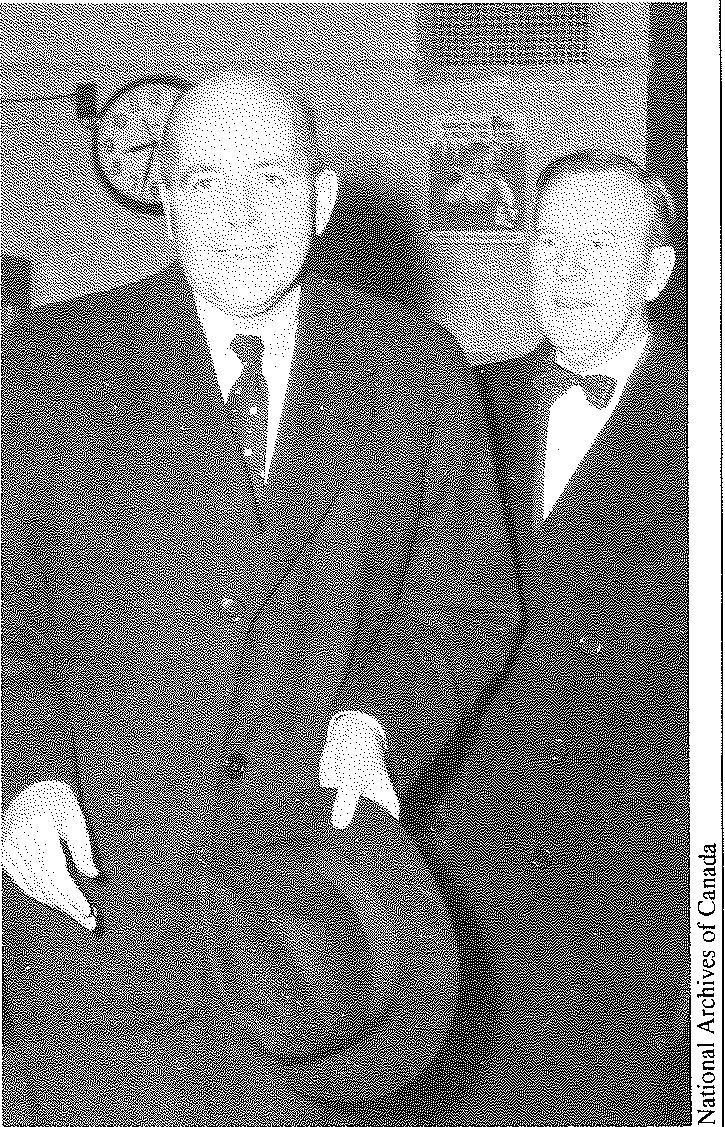
Such experience made me proud of Canadian diplomacy and the Department. Generations of students heard that Canada must remain a serious member of NATO, not for defence in any obvious sense, but to augment our quiet influence for diplomatic imagination and military restraint. I was dismayed by the Cold War rhetoric of Diefenbaker and Macdonald, and also by Trudeau’s failure to recognize the importance to peace of Canada’s reputation as a good Alliance member. More upsetting still was his suggestion that Canada was just une nation comme toutes les autres, and like them should adopt a narrow view of its national interest. He learned differently, and ultimately did more for peace than most recipients of the Nobel award. But much harm however, had already been done to the idealism, morale and efficiency of our foreign service.
I knew, of course, that the world moves on. The Cold War had moderated. New international actors had come to the fore.
New issues, including human rights, were rising on the global agenda. Within Canada, domestic politics intruded into what had once been a largely elite preserve.
Nothing, however, had prepared me for the shock of the CSCE files I was permitted to read when writing a chapter on Canada’s part in drafting the Helsinki Final Act, (in Canada and the Conference on Security and Cooperation in Europe, ed. Robert Spencer). The impact was enhanced by interviews with almost all members of our delegation, relevant politicians, and foreign observers. Our delegation, everyone agreed, superb. Cohesive, inventive and energetic, it was almost certainly the delegation that made the most of its modest diplomatic assets and opportunities. None of that surprised me.
But what had become of the constructive Doves who had once prevailed in External? Our CSCE delegation took pride in being the toughest in the NATO camp, and they probably were, apart from the ineffectual Dutch. We insisted on squeezing every conceivable concession out of the Soviet side, and often berated our allies for being hasty or soft. Concerning the Eastern borders, we were more German than the Germans.
Why the shift in Canada’s role from Moderator to Cold Warrior? One memorandum to Cabinet explained our CSCE participation in terms of Trudeau’s celebrated six themes. Far more credible, however, were the numerous references to regaining the respect of the European allies, respect that had been dissipated by the early Trudeau’s denigration of NATO and the sharp cutback in our forces. The support of the Europeans was especially desirable because of our quest for the elusive “Contractual Link”
Also found in the files, but much more prominent in the interviews, were enthusiastic references to the domestic political gains from taking a tough line on humanitarian questions such as family reunification. One former Trudeau minister stressed the utility of our CSCE diplomacy in appeasing the Canadians of East European background who had been offended by the Prime Minister’s Dovish utterances on relations with the Soviet Bloc.
Several items on file argue that progress on humanitarian issues is a precondition of detente. I saw only one acknowledgement that pressing for domestic change could well be at the expense of detente. I wish I had seen in the files, or heard, more evidence of serious thought on the relationship between human rights and security as ably competing objectives of foreign policy.
I have never said, as Mr. Bowker implies, that the primary aim of Canada’s CSCE policy has been “solely” to cater to the ethnic minorities, but that aim does seem to have loomed large, too large in my judgement.
The present could be a time when we can afford safely to give first priority in our foreign policy to human rights, and I recognize that the CSCE has always had more to do with rights than with security. As a steady diet, however, international peace must be our first objective. Furthermore, while harsh rhetoric in international fora can occasionally serve a useful purpose, apart from pleasing domestic groups, our best approach is almost always the brand of quiet persuasion practiced by diplomats such as Pearson, Robertson, Leger, MacKay, Reid and Holmes.
Peyton V. Lyon Appleton
Patronage and the Foreign Service
Editor,
This is not an original thought just a possibly timely re-discovery. The other day while seeking to confirm the dates of Arnold Heeney’s two terms as Canadian ambassador to Washington (1953-57, 1959-62). I sat leafing through his book, The things that are Caesar’s. The final paragraphs of his conclusion struck me as worth rebroadcasting, as the fervor waxes (and wanes) over patronage appointments in the public service and more particularly, within the foreign service, over non-career appointments as Canadian heads of posts abroad.
Arnold Heeney was one of the quintessential public servants of a Canadian public service which, certainly in his day in it, had a high reputation at home and abroad. Thus: “In recent years there has been a tendency to substitute temporary for permanent advisers to government: to institute in Ottawa, as elsewhere, a cadre of experts and confidantes devoted to particular policies and politicians rather than to the permanent service of the state. In a rapidly changing society this is probably inevitable. It is no longer likely that a professional Civil Service, however competent, can remain wholly in tune with the political and social situation of contemporary Canada. The prime minister must be free to accept advice and appoint advisers from outside the ranks of the regular public service.
“Yet there are dangers in this trend. There is the danger of a return to patronage, a bypassing of the carefully developed nonpolitical service recruited on merit alone. Will able men and women be content to join a service for life knowing that they may have no chance of rising to its most sensitive and demanding posts? There is also the danger that the importance of administration and expertise continuing through changes in political power, the traditional role of the civil service, may be underrated.
“The Public Service is not autonomous. It exists only to serve the government and the people. Nevertheless, in itself, it embodies the principle of national unity which remains the greatest political aim of government in this land. In the Civil Service men and women from all parts of Canada work together and share a common direct responsibility and direct loyalty to the federal government. The federal Civil Service is a professional microcosm of Canada itself. Obviously this expression of national unity is of particular importance as Canada seeks to become a genuinely bilingual community. The implementation of the recommendations of the B and B Commission with respect to the Civil Service will be a long and difficult process. But it has begun; and the measure of its success is of great significance to the future of Canada.
“In a complex society which makes ever-increasing demands on government, a large and complicated public service is inevitable. Great size and complexity carry with them terrible dangers, chiefly, of course, the dangers commonly associated with the word bureaucracy.’ Individual civil servants may well lose — or may never acquire — the sense of vocation which is so important to the quality of human achievement. They may well feel themselves to be without purpose in a massive government machine.
Should this happen, able men and women will not be persuaded to enter the Public Service. To prevent this happening should be the continual care, not only of government, but of all Canadians.” In any event Order in Council appointments (the most senior ones) to the public service are among The Things That Are Caesar’s. Nevertheless!
Jim Nutt
Editor,
I have read with much interest your Winter issue and congratulate you on an excellent publication. I was particularily delighted to note the prominence you gave to your fight against the unconscionable patronage appointments to heads of post. In particular your cartoon on Page 39 was “bang on”.
Recently when a newspaper columnist wrote that the Paris post was one of the plums at the disposal of the PM, as if such appointments were now accepted as “plums”. I wrote to the SSEA complaining about the plethora of such patronage appointments in a Service that had an enviable world-wide reputation. I pointed out that such actions would inevitably damage that Service and certainly lower its morale….
Perhaps we are waging a war that is already lost. Perhaps “Ambassadors” are not any more really important. George Ignatieff touches on the problem in his book “The Making of a Peacemonger” ’. In that (p. 253) George writes that under Trudeau ambassadors were reduced to carrying out administrative duties or to act as travel agents and greeters of the great ones from Ottawa. Apart from the disdain shown by politicans, there was also a similar tendency of the Head-office wallahs to consider that H.Q. knew best and that the officers on the sharp end of the operation, unless they happened to have come from the ranks of the Mandarins, were in fact only useful in carrying out instructions from what was known as “Killers Row”, their opinions being ignored, or not even being sought. If this seems bitter, I do not mean it so, but having served all of my career abroad (never in Ottawa) perhaps I am more sensitive to the age-old conflict between head office and people in the field…
R. Guy. C. Smith
Editor,
…I wish to comment on the article written by Colin Robertson “Dépêche d’Adieu” in the Fall issue of bout de papier.
It would seem quite naive, I believe, for anyone to accept the statistics on Patronage Appointments as shown in the insert on page 47. As shown, these statistics can be very misleading unless they were to provide information as to the number of Foreign Posts and Missions which were in place at the time each Prime Minister was in office. This is much more important than giving the number of years the nine P.M.s were in authority. Most of us know how to manipulate statistics and this example is no exception.
I, for one, favour the appointment of persons outside the Department of External Affairs who can make valuable contributions to the conduct of Canada’s diplomatic representation abroad. However, I have not hesitated to write to the Prime Minister’s Office when I felt that an appointee was unsuitable, as was the case for Jean Drapeau.
We must concede that not all Foreign Service Officers are luminaries albeit this sentiment seems to permeate all levels of the Service. It is questionable why one should continue to criticize appointments from outside the Service while we bury our heads in the the sand concerning the incompetence of some F.S. appointees.
It was refreshing to read Colin’s comments on page 48 “observations to guide our path”, particularly the para starting “It is ironic…etc”. Of course, this has always been true of Immigration officers before their integration with the Dept. of External Affairs, in the Social Affairs stream. We should not forget that some 20 Immigration Officers from Canada Immigration Centres are assisting and doing a very professional job albeit not F.S.O.s.
R. Saint-Vincent
View the original scanned pages →
Originally published in bout de papier, Vol. 6, No. 1 (1988) — Spring 1988 // Printemps 1988, pp. 6–8. Read the rest of this issue →



