
bout de papier, Vol. 5, No. 4 (1988) — Winter 1988 // Hiver 1988, pp. 18–20
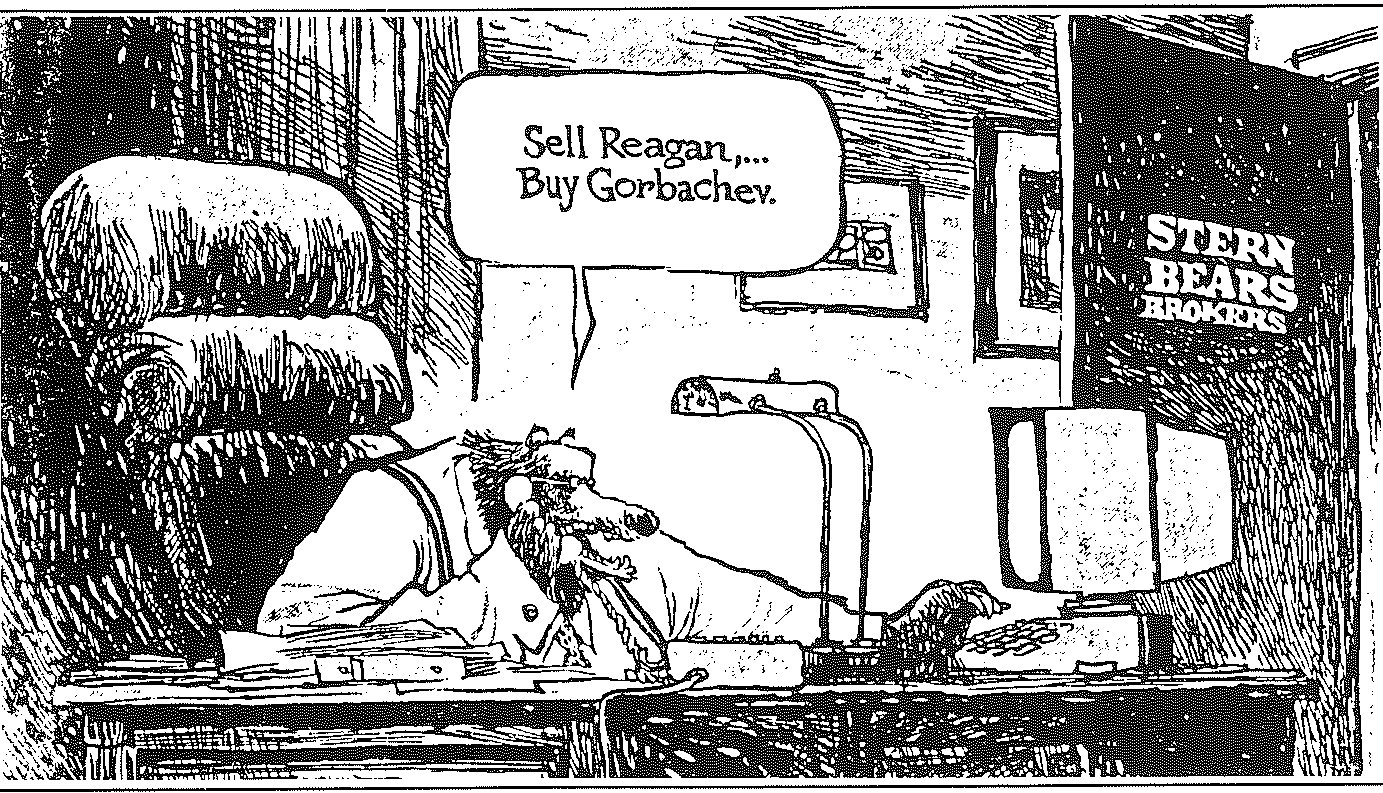
Shocking is not too strong a word to describe the fact that the Soviet Union has been in firm control of the international communications agenda for some time. Moscow is now associated in many people’s minds with the Peace Conference, several offers to negotiate arms control, Reykjavik, a new openness, and a host of disarmament proposals. They are in the driver’s seat and the West appears to be reduced to ad hoc reactions and wobbly-footed counter-proposals that don’t seem to possess the same drive, freshness, and initiative.
To someone who values the communication process, this news is as distressing as the invasion and occupation of Afghanistan. There’s no loss of life, but at stake may be a way of life. While many Western democracies are paralysed by apparent or real scandals (Iran arms, tuna, strikes, credibility issues) the Soviet Union has few such constraints and is free to concentrate on its communications strategy.
Also, while we in the West appear to have lingering doubts about the arts, science and practitioners of communications, the Soviet Union has done its homework and is mounting a superb campaign aimed at getting a very few, clear messages across. Doubts in the West stem from such diverse sources as Goebbels, McLuhan, Key and others. Only Goebbels displayed any evil in his use of communications techniques; McLuhan was intellectually playful, while Key (Subliminal Seduction – a sort of “Son of Vance Packard”) may have been more erotically playful. But taken together, they all add up to one of two messages, if you advocate a communications strategy to attain your goals, you’re either manipulative or esoteric bordering on incoherent. This gives senior administrators an unfortunate reticence in using valuable communications techniques to achieve corporate goals.
It’s no coincidence that the Soviet Union’s successful communications campaign has occurred during the tenure of the country’s most media-genic leader. Mikhail Gorbachev and his wife Raisa are the latter-day Kennedys or Trudeaus of the Soviet Union. The Gorbachev’s messages will continue to be virtually uninterrupted by real or imagined scandals; communication advisors will probably not have to be pulled away from their tasks to put out short-term fires.
So, being a successful media performer now appears to be an integral part of a successful communications strategy — even in the Soviet Union, or, especially in the Soviet Union. But for the professional communicator there are unfortunately very few places to turn for expert advice on being a good media performer. Most P.R. books deal with press releases and lists, and many companies specializing in training don’t possess the range of skills needed to “arm” a senior executive or administrator. Ex-journalists for example are often good at asking questions, but sometimes lack the skills to teach clients how to answer questions. Other trainers lack a policy or theoretical background
However, two recent publications will define the skills senior people need when dealing with the media, and help in choosing a consultant to hone media skills. These books may prove to be as valuable on your shelf as they might have to executives at Johnson & Johnson (makers of Tylenol) or Starkist Tuna.
A section of Business-Government Relations in Canada by Professor W.T. Stanbury (Methuen, Toronto 1986) offers advice for would-be media performers. The book is not so much written as compiled. There’s no real narrative, but dozens of lists and bullet points. The many summaries of social science data and studies make this book the last word on the topic, but at 678 pages and a dry style, you have to be really interested in the words.
Stanbury has listed the basic reasons why business people (or public administrators) don’t get along with the media:
• Business people are used to being the boss, but in public life, the media is the boss.
• Reporters may be personally but not professionally intimidated by “officials”
• Reporters are often not a high priority for administrators.
• Reporters need immediate high level access, which many senior people are not used to giving.
• The media does distort by its nature… albeit a benign distortion of simplification, amplification and the use of examples.
• Reporters judge a story on its interest, not on whether it is good for the administrator or organization being written about. He also offers a list of the 8 classic interview pitfalls, applying mainly to television, but useful for radio and print as well) or dirty questions often asked by interviewers, and the appropriate response:
1. The set up (a long preamble that’s a loaded question) RESPONSE: Challenge the premise, don’t nod your head during the question and state your positive version of the facts.
2. The “either… or” question where both alternatives are unacceptable. RESPONSE: Don’t attack the questioner, but say “neither” and state the true situation.
3. The irrelevancy… a question unrelated to your field or topic. RESPONSE: Acknowledge the question but quickly bridge to your communications objective.
4. The Empty Chair (a quote from someone not present) RESPONSE: Don’t argue with someone who isn’t there to defend his or her position. Say you haven’t seen or heard the remarks and bridge to your own message.
5. The Broadside (“You’re a polluter aren’t you?”) RESPONSE: Don’t get fazed. Say “No” in a nice but forceful way and bridge to your message.
6. The What If question… RESPONSE: Don’t speculate or try to predict the future but say “That raises the real issue of…” and state your case.
7. The Inconsistency. RESPONSE: If your company has been inconsistent admit it but show the consistency within that inconsistency.
8. No comment… don’t use it. This remark cuts off the conversation and is just plain rude. Stanbury’s advice is a good primer on media relations even if it’s buried in hundreds of pages of good, dry advice on government relations. You can’t go too far wrong by following his prescription for better relations with reporters. He advises readers to: get out in front of the issues and be leaders in their fields, to stop talking jargon, keep the lines of communication open to journalists and others (i.e. find out what people in other fields are thinking), educate journalists… slowly, make the reporter’s job as easy as possible (at AT&T they emphasize cooperativeness, quotability and confidence), don’t play favourites, never take advantage of or lie to the media and deal with bad news quickly. One of the only books completely dedicated to improving the reader’s chances of surviving ambush or hostile interviews is Talking Back to the Media. (It’s N.Y. publisher, Facts on File, has some other interesting titles dealing with the media, i.e. Would You Put That in Writing & Media Controversies.) Author Peter Hannaford takes a rather confrontational approach to media relations in Talking Back, but considering his background (former director of Public Affairs for Ronald Reagan) and some recent revelations about the techniques of journalists, his approach is worth knowing about.
The revelations cited are:
1. Former Ramparts editor, Warren Hinckle is quoted as saying “What journalism is all about is to attack everybody. First you decide what’s wrong, then you go out to find the facts to support that view, and then you generate enough controversy to attract attention”.
2. Journalist Janet Cooke published a story about an 8-year-old heroin addict in the Washington Post. The story was up for a Pulitzer prize when Ms. Cooke finally confessed to fabricating the story.
3. New York Daily News columnist Michael Daly admits to inventing a British soldier who shot a Northern Ireland teenager in cold blood. Daily admitted to altering facts in other columns as well.
4. A New York Times Sunday Magazine story by free-lance writer Christopher Jones, purporting to be an eyewitness account of conditions in Cambodia, had actually been concocted in the comfort of his home in Spain. Parts of the story had been lifted from a 1930 novel by André
Malraux.
5. “60 Minutes” accused Los Angeles physician Carl Galloway of involvement in a scheme to defraud health insurance companies. Galloway sued. On the witness stand CBS’ Dan Rather said he’d put in several calls to the doctor which were not returned. Rather stated that in his experience, failure to return calls tended to confirm his suspicions about the subject of his investigation.
6. New York writer Alastair Reid admitted to having used fiction in ostensibly factual articles on a number of occasions dating back to 1961. Meanwhile Fred Friendly, former president of CBS news and emeritus professor at Columbia’s Graduate School of Journalism, and Edward R. Murrow’s ex-producer, simply denounces any inaccuracies by saying: “A composite is a euphemism for a lie. It’s disorderly, it’s dishonest and it’s not journalism.” The book offers a more comprehensive approach than the analysis that journalists are people too and make mistakes. It offers a prescription for avoiding being a victim of those human mistakes. For example, Hannaford adds 4 new items to the list of what to do and remember when you’re being interviewed:
1. Don’t repeat the accuser’s allegations (i.e. say “I’m honest”, not “I am not a crook”).
2. Ask questions yourself.
3. Remember you’re not having a casual conversation with an old friend – be cautious and avoid flippancy.
4. Have a SOCO — that’s a single overriding communications objective that you return to regardless of the question asked (my company is doing a much better job and will be doing even more in the future to avoid pollution). An extremely useful lesson is to remember to offer your premise first and then answer the question. Barry Goldwater didn’t know this so his reflex “nuke ’em” answers were what got reported, not the milder discussion that followed. Ronald Reagan has learned the lesson though. Reagan used to say “no” to the question “Do you favour the Equal Rights Amendment?” This sounded antifeminist, abrupt and negative. Reagan then learned to set up the answer like this: “I support equal rights for women. The ERA is one approach. I think there is a better one. In recent years there have been some important changes in federal and state laws to ensure equal pay for equal work and other rights for women. We need to look at our statutes to find out where discrimination against women still exists and change those that do. The ERA, on the other hand, would result in years of tangled court cases. We can solve the remaining equal rights questions much more quickly by changing any laws that stand in the way of equality.” In part for the humour content, Hannaford offers the four defences to trick questions:
1. “I didn’t do it.”
2. “I did it, but there was a good reason.”
3. “I did it. I’m sorry. I was wrong and I’ve learned from my mistake.”
4. “Whoever says I did such a thing is a low-down, good-for-nothing bum” (or similar epithet). Follow this with a counter attack on your accuser – if you have the facts to back it up. Talking Back to the Media offers several excellent case studies as well. One is the Coors case. When the beer company with a bad reputation got a call from Mike Wallace, the V.P. for Corporate Public Affairs didn’t get sick or stonewall; he spent $60,000 preparing for the encounter. Media training was a big part of the strategy and the company scored a landmark P.R. triumph that helped turn Coors’ image around, lessen the effects of a growing boycott by union supporters and apparently increased sales. In fact, the Coors people lobbied “60 Minutes” to rerun the item on Coors the summer after it was first broadcast. The second deals with Richard V. Allen, President Reagan’s national security advisor who resigned after being cleared of charges that he had improperly accepted money and gifts from Japanese journalists and businessmen. His home was staked out by the media and news stories continued to make reference to his resignation and the allegations as if they were related. The stories usually didn’t mention the fact that Allen had been cleared Mr. Allen had his lawyers write to about 100 columnists, commentators and news organizations in the U.S. stating the facts of the case and enclosing several printed retractions or apologies from news organizations that had wrongly reported the events of Allen’s career in the White House and subsequent resignation. The lawyer’s letter stated that since Mr. Allen is an expert in a number of fields, he is often the subject of news reports or quotes. In these stories the media sometimes describe the events surrounding his resignation. Allen’s lawyer ends the letter by putting the media on notice that any misleading references to Mr. Allen or the failure to mention his exoneration will be actionable at law. The letter had the desired result, but naturally can only be used in water-tight and extreme cases.
The final case study worth a spot in Public Affairs professional’s files concerns crisis management. It involves a copycat scare following the Tylenol case. This one was in Detroit where several people put foreign objects including half a razor blade in sealed packages of hot dogs. The company reacted too quickly with partial information, but made a spectacular recovery by being honest and open with the media and its customers. Sales increased as a result whereas the company could have suffered huge losses or even bankruptcy.
The lists in both books are especially good They start the reader thinking about the communication process and what to watch out for. I’d just add a few other points:
1. Look at every contact with the media as an opportunity to get your message out.
2. Study media formats and reporters and read everything from light memoirs to heavy anthropological studies to find out more about the media.
3. Never forget you’re talking to a journalist.
4. Don’t be afraid of silence — don’t fill the gap with a gaff – just smile and wait for the next question.
5. Don’t argue ethics or efficacy with a journalist. Reform the media on your own time — you’re just doing your organization harm by attacking the media.
6. Remember the setting you’re in – the background may get on TV or be described on radio or in print.
7. Give reporters the best briefing materials your company can produce — it’ll show up in the story.
8. Take the bad press in stride — it’s sure to come eventually. Both these books underline the importance of television to companies, governments and lobby groups. It’s not too simplistic or even superficial to say it’s not what you say but how you say it and how you convey who you are that counts in the electronic age. There are a dozen or more sociological ways of saying it, and lots of die-hards who wish it weren’t so, but those are the facts.
Allan Bonner is a Toronto-based
View the original scanned pages →
Originally published in bout de papier, Vol. 5, No. 4 (1988) — Winter 1988 // Hiver 1988, pp. 18–20. Read the rest of this issue →



