
bout de papier, Vol. 5, No. 3 (1987) — Fall 1987 // Automne 1987, pp. 23–25
Willis Armstrong, a former American
foreign service officer who knew
Herbert Norman, reviews Barros’ No
Sense of Evil, Deneau, Toronto,
1986, 259 pp., and Roger Bowen’s
Innocence is not Enough, 1986,
Douglas & McIntyre, Vancouver/
Toronto, 409 pp.
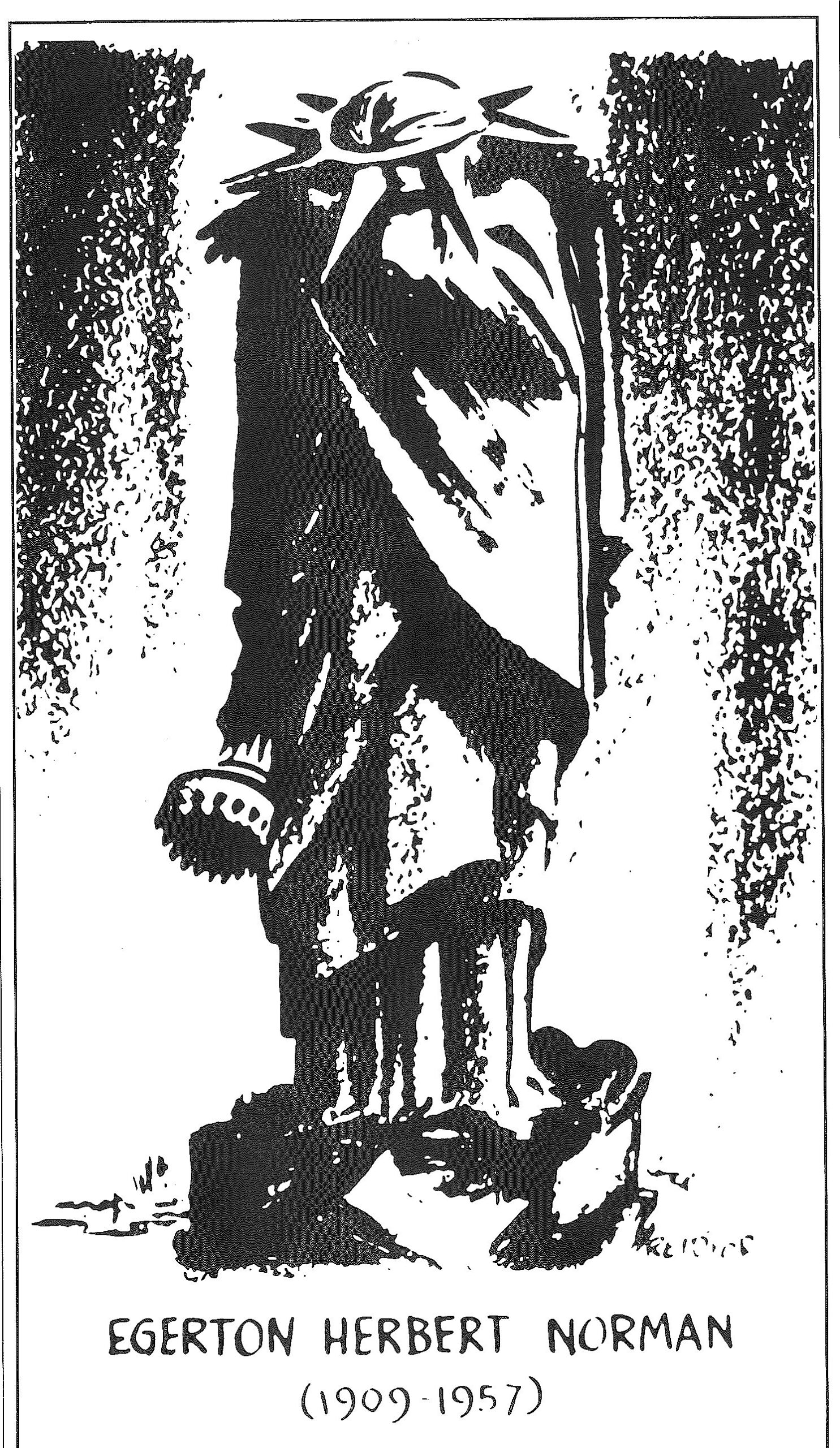
Herbert Norman, missionary son, one time Communist, distinguished foreign service officer, important advisor to SCAP on Japanese constitutional reconstruction, and protégé of Lester Pearson, has become an object of Canadian attention 30 years after his death by suicide. Two recent books, one a biography and the other a case study, are the centrepiece for academic and public attention. Both are written by Americans. (The reviewer is also a Yankee.) Both are possible as a result of recent opening of files and archives of the Canadian and US governments under legislation designed to encourage such disclosures. Thus the two authors draw on much of the same material. Both are advocates. Roger Bowen argues Norman’s innocence of being a Soviet agent. The other author, James Barros, is determined to prove the opposite. Neither succeeds in making his case, and both admit it. The weight of available data favours Bowen; knowledge of how the Soviet espionage system works favours Barros.
Bowen has written an outstanding book, notable for its meticulous scholarly research, its excellent organization, careful documentation, and care in drawing conclusions. While clearly in sympathy with his subject, he has not hesitated to look intensively at every aspect of the “case”, warts and all. In addition to the files of External Affairs, RCMP, State Department, FBI, and the US Senate Subcommittee on Internal Security, he has had access to the records, correspondence, and reminiscences of the Norman family, and he has interviewed survivors of the era with great diligence.
As revealed by Bowen, Norman was self-assured socially and in his professional career — an assurance justified by his demonstrated competence, well supported by quotations in the Bowen book from his despatches and cables. A former colleague of Norman’s told the reviewer “He was a damned good foreign service officer”. The issue of course was and is “Was he anything else at the same time? A Soviet agent?”
Bowen makes the point that Norman was above the nitty-gritty of life, a man who lived very well and who moved only in the most stimulating intellectual and social circles. Norman is quoted on his own security problems as saying “innocence is not enough” — convinced, as he said he was, of his loyalty in his diplomatic job. But if he was really not guilty of being a Soviet agent, he comes across in this book as much too innocent in a different sense of the term. Insufficiently aware of how one’s past tends to become an open book when one enters important government service, he clearly did not tell “the truth, the whole truth, and nothing but the truth” when he was under scrutiny by the RCMP and External Affairs — at least not in the beginning. Perhaps his allegedly clear conscience as to his loyalty and his foreign service performance seemed to him adequate refutation of what people might think or say about the significance of his Communist affiliations and views held in the past. If so, this seems to have been a fatal error in judgement, explicable only by an arrogance that failed to recognize the vital importance of dealing candidly with the real world. It is worth noting at this point that Barros’ book is entitled No Sense of Evil.
In Norman’s day, as now, the real world considered a person who had held Communist views and had such affiliations to be guilty of being a Soviet agent until he could demonstrate his innocence or convincingly recant. Granted, this attitude is contrary to the precepts of common law, but working for a government is not a citizen’s right. Rather it is a privilege which the government has the power to grant or withhold. Norman eventually began to tell more of the truth than he had at the beginning of the investigation, but no one knows whether he told the whole truth and nothing but the truth. As the author sagely remarks (p. 257) “truth told late is perceived as lies told earlier”. Norman’s performance must have aroused suspicions on the part of his investigators and accusers, despite his “clearance” by External. One does wonder about the wisdom of granting a security clearance to a man who has manifestly lied to his own government about his past. It is thus hard to avoid questioning External’s procedure in this case, in the face of considerable RCMP material of a quite derogatory nature, including reports from British services.
On the other hand, if one assumes that Norman was “hooked” as a Soviet agent since well before his entry into Canadian government service, his conduct in failing to tell the truth initially, and his reticence at all times, would be plausible. He is said to have manifested extreme apprehension in 1957 just before his suicide, being reluctant to “name names” if investigated again — as detailed in Bowen’s book. This sort of conduct could provide a basis for suspicion substantially greater than the circumstantial evidence cited by Barros and others. He was a very clever, cool, secretive, and competent person who could have maintained Soviet contacts over a long period of time, without getting caught.
No evidence is presented, by either Bowen or Barros, that Norman actually served as a Soviet agent while employed by the government of Canada. Perhaps, although he might have been a tempting target for Soviet recruiters, he didn’t pass their preliminary security screening because of his loquacity and apparent naiveté. On the other hand, he could have been a “sleeper”, consciously or otherwise. In any event, he was certainly in place.
A word is in order regarding government procedures for security clearance. Obviously they were in the process of development and had been since the Gouzenko revelations. The relationship between External and the RCMP seems muddy. The interrogation by colleagues (Heeney, Glazebrook) seems to have been too much “in the family”. The fact that in this instance the RCMP could give raw data to the FBI with impunity seems contrary to normal governmental prudence, especially since the RCMP seems not to have had the authority to grant or withhold security clearance.
The role of Lester Pearson is a fascinating aspect of the case. In his memoirs, written perhaps posthumously by others on the basis of his notes, Pearson recounts General MacArthur’s statement that Norman was the most valuable man in SCAP. He defends the thoroughness of the security scrutiny given to Norman and shows his full support of him. But in his public statements on the Norman case, Pearson was initially not forthcoming and later somewhat confusing. Pearson probably attracted unfavourable comment to himself without materially helping Norman. Clearly we do not have the full story of the Norman-Pearson relationship, and it is unlikely that we ever shall.
Bowen deals sensitively and comprehensively with the suicide, recounting all that is known of Norman’s movements and contacts, moods and attitudes, during the days before he jumped off the high building. He concludes that it was a carefully meditated decision, arrived at from a complex of motives: 1) a decision to make a Socratic statement of his own correctness; 2) a concern over the impact of renewed interest in his security status on his colleagues and friends, notably Pearson; 3) a sense of noblesse oblige, Japanese style (hara-kiri); 4) self-importance about his role in life; and, finally 5) a quailing at the thought of having to face investigators again. (A very private person, despite his outgoing and gregarious style, he had obviously found earlier interrogations painful.) In a sense, Norman was too precious (if innocent) for the profession in which he was engaged — a profession much rougher than a lot of North American idealists thought when they joined their respective foreign services. And of course if Norman were a Soviet agent his ego could not have borne the consequences of disclosure.
All of us deplore the chain of circumstances which led to the tragedy – the provision of unevaluated data by the RCMP to the FBI, the unobjective methods of Hoover’s FBI, the unwarranted provision of data to a Senate Subcommittee out for blood and headlines (with the avid cooperation of the fanatical General Willoughby), the inadequate handling of the matter by both governments, and the yellow journalism of the day. The continuing debate about the issue by publicists and writers of the present day reflects the fact that tales of espionage are a growth industry. As a CIA veteran remarked to Bowen, “a file has no age”
Bowen’s treatment of Norman’s wife leaves her a shadowy figure. Clearly Norman was the dominant marriage partner, but how important was family life to him? He did discuss suicide with his wife several times, but mostly in terms of method. She does not appear to have been privy to his thought process or to have known what he knew. Such remoteness from his career seems odd in a foreign service couple, where mutual dependence is often necessary for survival. We learn more about Norman from his letters to and from his brother, and from his brother’s testimony, than we do from his wife, as far as Bowen is concerned. While Bowen’s own motivation in his biographical effort doubtless arose from interest in a fellow Japanologist, he has obviously become personally concerned with the Norman family, and he writes with great sensitivity.
Innocence is Not Enough is a tragic story of a brilliant but flawed man caught up by the political forces of his time. He seemed unable to protect himself, either under the assumption he was innocent, or under the assumption that he was serving two masters. He was imbued with a desire to help his fellow man, at least in the generality, but he had trouble dealing with the world of practical men. The case against him is still mostly one of assertion and deduction (once a Communist, likely to continue). The case for him, although persuasive and fairly well documented, is not proven, despite the talent and sympathy Roger Bowen has dedicated to it. But his book makes fascinating reading.
The Norman story belongs to an earlier era when both the US and Canada were emerging from the age of innocence, and when they were amateurs in dealing with security questions. Sophisticated techniques have since been adopted for handling these matters in a discreet and professional way, without public scrutiny or hearings, and without either the complacency of the old boy network or the excessive zeal of the J. Edgar Hoovers.
View the original scanned pages →
Originally published in bout de papier, Vol. 5, No. 3 (1987) — Fall 1987 // Automne 1987, pp. 23–25. Read the rest of this issue →



