
bout de papier, Vol. 5, No. 1 (1987) — Spring 1987 // Printemps 1987, pp. 6–7
Canadians, who often boast that they comprise a cultural mosaic, can hardly complain when their ethnic diversity is reflected in their nation’s foreign policy. Indeed it is entirely appropriate that our minorities should lobby for their preferred policies and be accorded a serious hearing by the decision-makers. Very often, moreover, their priorities coincide with those of Canadians at large.
Whenever they do not, it is of course the obvious duty of the government, politely but firmly, to turn a deaf ear. Recent governments, however, have been reluctant to do so and have even encouraged ethnic group representatives to raise and press demands that are not necessarily in the national interest. Our electoral system fosters this practice by giving undue weight to small cohesive groups.
Only after many generations was Canada’s foreign policy liberated from its slavish attachment to “Mother England”, an attitude dictated by the predominant WASPs. A cause for even greater rejoicing is the post-World War Il convergence of the world views of our two largest ethnic groups, the two “founding nations”. Canada’s very survival had at times been threatened by differences over external policies between Anglo and Franco-Canadians. A major study of elite attitudes, however, confirmed in 1976 that there are now no significant differences, and even the Parti Québécois utlimately adopted a foreign policy virtually indistinguishable from that of Canada. Most of the other ethnic communities have also come to support the broad thrust of Canada’s foreign policy.
These great gains, unfortunately, are offset in part by concessions to several medium sized, or even small, minorities. Most Canadians whose heritage is East European, for example, quite understandably press for policies directed at the betterment of the rights of their kin living under Soviet subjection. And they generally prefer our diplomacy to be visible and loud. The politicians often oblige. According to Howard Green, the greatest foreign policy achievement of the Diefenbaker régime was the Prime Minister’s stirring denunciation of Soviet tyranny delivered from the UN pulpit. “The Speech” loomed large in subsequent party propaganda directed at the “ethnic” vote. It also inspired a major UN initiative that failed to enlist any support, not even from our NATO allies. Canada’s reputation for pragmatism and moderation suffered. Flora Macdonald, not exactly a Diefenbaker fan, nevertheless emulated “The Chief” by the Cold War stridency of her UN attacks on the Communist empire.
Trudeau declined to follow suit, but he tolerated the efforts of his Secretaries of State for External Affairs to bid for “ethnic” support by hardening the anti-Soviet tone of our our foreign policy. Mitchell Sharp, for example, was delighted when the Canadians negotiating the Helsinki Final Act emerged as the toughest of the NATO delegations in exerting pressure on the Soviet Union; we were even more German than the Germans concerning the Eastern borders and, in the follow-up conferences, Canada has continued to take a very severe line on Soviet adherence to the human rights
6 bout de papier Vol. provisions of the Act. This is a worthy cause in itself, but as Mr. Sharp has noted, stressing rights is also a splendid way to regain the “ethnic” votes that Diefenbaker had won, and Trudeau had shunned.
The Government continues to exploit the CSCE to cater to the East European and Jewish minorities. Last October, for example, DEA invited a number of experts and interested parties to a consultation on the current CSCE follow-up in Vienna. Spokesmen for East European and Jewish organizations predominated, and were strongly encouraged to raise complaints about Soviet transgressions to Ottawa, or directly to our delegation to the conference.
This is commendable — up to a point. Next to survival, human rights are the ultimate value. Apparently with strong public support, they are becoming a more central objective of our foreign policy. It is rarely clear, however, how the diplomacy of a modest power can alter the internal conditions of other states, especially proud super-powers. And the vigorous pursuit of human rights, presumably through loud diplomacy, may well reduce a nation’s capacity to promote other objectives, notably détente and control over the arms race. A mellowing of conditions within the Soviet Union, moreover, seems likelier to occur as the result of détente than of external pressure in a Cold War atmosphere.
Human rights violations are much worse in some areas than in others, and Canadian diplomacy can accomplish more in some than in others. If the government listens to the ethnic groups, however, its efforts are unlikely to be focused where the deprivations, or our opportunity to be constructive, are the greatest. Instead it will be where the domestic lobbying is most skillful. Even if we decide to give top priority to rights in our foreign policy, we should not permit ethnic minorities to determine Canada’s policies.
Canada enjoys an enviable reputation as a moderator and peace promoter. Would it endure if it becomes a front-line antagonist in the East-West slanging match? Let us, at very least, have a serious debate before Canada shifts from its traditional roles and style. Instead we are shifting with little thought, and largely to cater to the understandable demands of the East European and Jewish minorities.
In dealing with the Soviet Bloc, the dictates of our concern for human rights often conflicts with our concern for détente, perhaps even survival. Turning to the Middle East, the likeliest flashpoint if we ever stumble into World War Ill, the policy question should be easier. Self-determination for three million Palestinians will not guarantee peace in the area. There are too many rifts within the Arab Community. But enduring peace is inconceivable without an equitable settlement for the Palestinians. And this entails owning a good part of their former home land and, under a government of their own choosing.
Promoting peace in the Middle East does not, therefore, conflict with the promotion of human rights. Indeed one goal is a condition of the other. Canadians could work in the Middle East for both peace and rights. But do we? And if not, why not?
Canada was exceptionally influential in the creation of Israel; without the contributions of Justice Ivan Rand and Lester Pearson, the relevant UN resolution might never have passed. Canada’s role in containing the Suez Crisis is widely regarded as the high point in our diplomatic history. Canadian troops still soldier on in all the peace-keeping forces in the area, except the ill-fated UNIFIL.
But Canada is now a very marginal actor in the quest for Middle East peace. Among the reasons is the loss of our reputation for evenhandedness. Its voting pattern in the UN, for example, was till recently second only to the American in support of Israel. And it has been more reluctant than its European allies, or the Vatican, to develop meaningful contacts with the PLO, or to insist that this organization, which enjoys over 90% support of the Palestinian people, must be included in any peace talks. In many other ways, Ottawa is clearly partial to Israel
Why this tilt? One that diminishes our ability to promote specifically Canadian objectives, such as trade, or to contribute as in the past to the cause of peace?
The answer is not external pressure, whether from allies or the countries of the Middle East. Rather it is the political strength of the Jewish-Canadian Community and the resolve of the politicians of all parties to cater to it. Although only a modest 1.4% of the population, a commendably high proportion of Jewish Canadians vote, and they are concentrated in a handful of constituencies. They Ethnic groups should be heard, but not heeded. Not unless their demands are clearly consistent with Canada’s national interest. Are believed likely to swing their votes against any party that appears unsymphathetic to Israel. So our leaders are careful not to cause offence by talking to the Palestinian leadership, or by voting for UN resolutions to which Israel strongly objects.
The pro-Israel lobby, although by far the most professional in the foreign policy making process, does not always get its way, as in the struggle to obtain stiff anti-boycott legislation. In other cases, however, as in the promise to move the Canadian embassy to Jerusalem, it was the politicians who sought to purchase Jewish votes by offering even more than was demanded.
Although Israel lost considerable sympathy as a result of the brutal invasion of Lebanon, it cannot be said that the Canadian public is clamouring for a change in Middle East policy. Among scholars, however, and officials engaged in defending Canadian interests in the area, a consensus is growing that Canada’s pro-Israel tilt is contrary to the national interest, and the tilt is largely attributed to the lobbying of one of our smaller ethnic groups.
Ex-Ambassador William Barton told the Senate Foreign Affairs Committee of official misgivings in the UN setting:
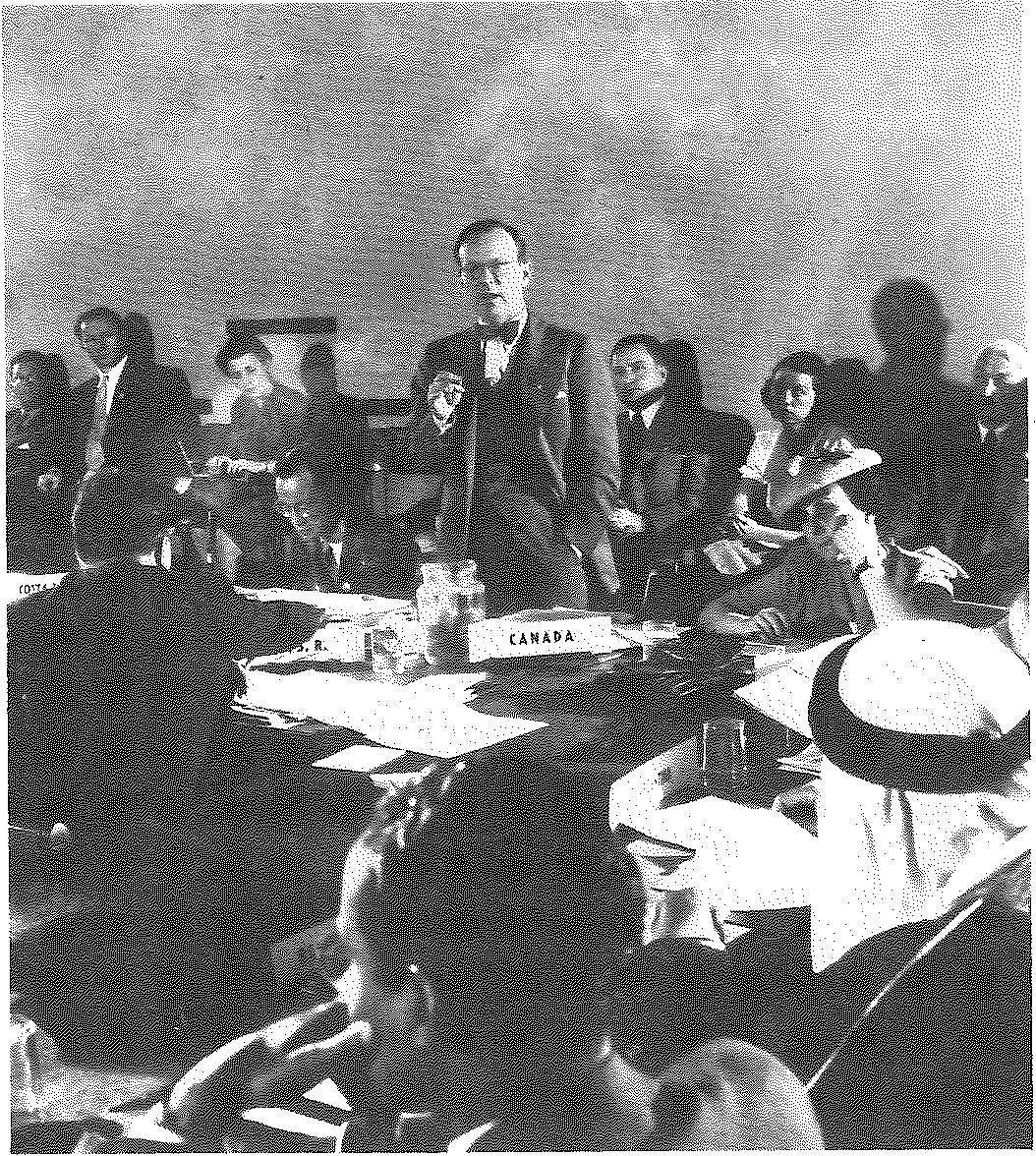
66 …over a considerable period, the Canadian government went to great lengths to find reasons for voting against or abstaining on resolutions critical of Israeli policies or supporting Arab rights which in all honesty were justified by the facts… Indeed we were generally identified along with Costa Rica and the USA as being the most pro-Israel delegation in the UN. As a worker in the UN for over 25 years, I can say that most of our delegates felt that this situation was not in the Canadian interest.”
Ethnic groups should be heard, but not heeded. Not unless their demands are clearly consistent with Canada’s national interest.
View the original scanned pages →
Originally published in bout de papier, Vol. 5, No. 1 (1987) — Spring 1987 // Printemps 1987, pp. 6–7. Read the rest of this issue →



