
bout de papier, Vol. 5, No. 1 (1987) — Spring 1987 // Printemps 1987, pp. 13–19
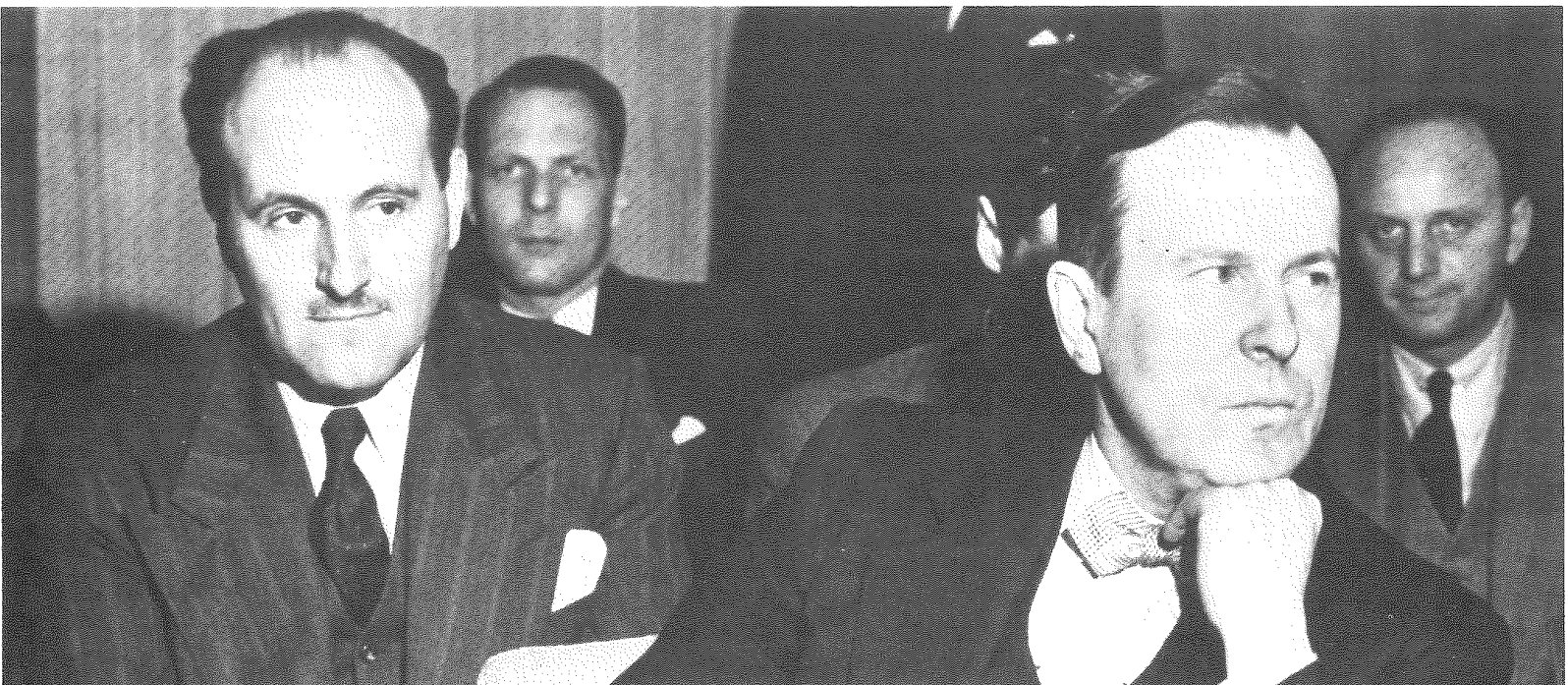
I was half an hour late. With reasonable instructions, but no map, I had decided I could find my way by foot to Palmerston Court. Toronto was not that big. Happily the pizza shop on Bathurst had a telephone and so I finally spoke to George Ignatieff. Within ten minutes I was at the door and bid welcome by Mrs. Ignatieff. She restored me with chocolate-covered digestives and a cup of tea.
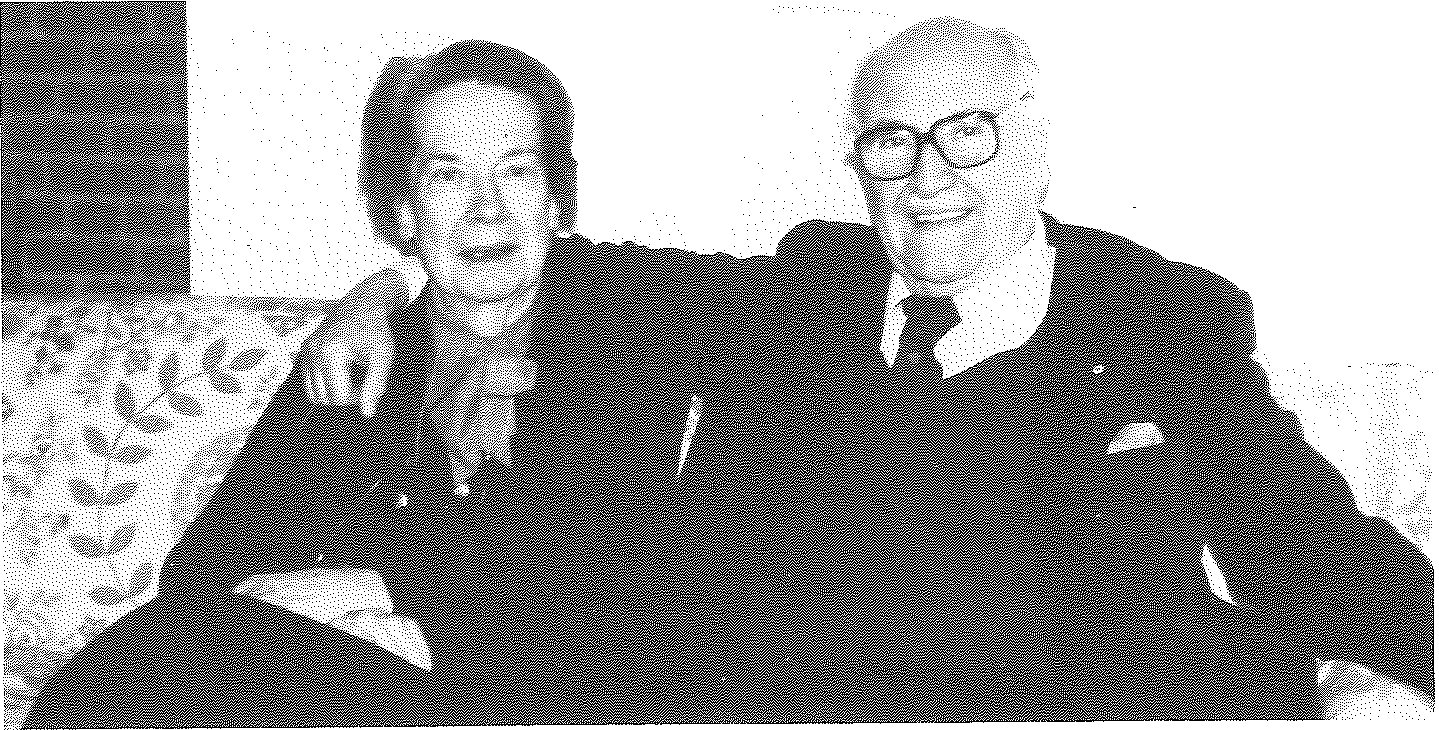
With her piercing eyes and appraising smile, I decided which one was the anchor in the family. Presented to Court, along with Maryon Pearson in 1937, she combines wit with charm and warmth. The sort of woman any man would want as a partner. The daughter of William Grant, principal of Upper Canada College, and the favourite niece of Vincent Massey, she fell in love with her future husband during his first posting in London, while she was staying with her relatives and working for MIS. They were married at year’s end in Montreal, both in the United Church — in deference to her family, and in the Russian Orthodox Cathedral for the sake of his.
George Ignatieff joined us shortly, looking delightfully rumpled in his velvet smoking jacket and old slippers. Born Count George Pavlovich in St. Petersburg on the eve of the Great War and the Russian Revolution, he fled with his family first to England and then to Canada. As he relates in his memoirs, The Making of a Peacemonger (reviewed in bout and recently reissued in paperback by Penguin), their reduced circumstances, like that of many other Russian emigrés, caused considerable disruption to the family. His mother put a premium on education and Ignatieff helped pay his way by working during the summer on a railroad crew out west. In 1935 he won the Rhodes Scholarship for Ontario and after graduation and brief service in the British army joined External Affairs in 1940 as Third Secretary in London. He resigned in 1972 to become Provost of Trinity College. He was appointed Chancellor of the University of Toronto in 1980.
Our former Ambassador to the United Nations in Yugoslavia, NATO (Paris), and the UN (both New York and Geneva) and for a brief few months Disarmament (during the Turner Ministry) is naturally gregarious and needed no prompting to get our discussion going (in fact, I had to ask him to stop so I could plug in my taperecorder). And then he was off and time flew as he took me back and forth through a long and interesting career. When the time came to go Toronto’s taxi service had taken temporary refuge from the stormy streets, so the recently retired Chancellor put on his parka and drove me to my next stop in his aging but still serviceable Volvo.
Meeting them, listening to a pair still very much in love, had been a delight. Both have given much of themselves to their country. Like their aging brick rowhouse, they are very much without pretension. But then the great have no need to flaunt it.
bout de papier: Why did you join External Affairs?
Mir. Ignatief: It certainly was not planned. I came to Canada as a refugee from Russia and was admitted under the category of a labourer. I started as an axeman on the survey party in Western Canada on joining the Crownest and Kettle Valley Railway and worked there two summers. I earned enough to go to college. This was, of course, the time of the Great Depression and I became interested in economics and what to do about the situation that our generation found ourselves in-looking for jobs and that sort of thing so I went into political economy and got terribly excited by the teaching of people like Harold lennis, Creighton and Glazebrook. When you get excited, interested, and stimulated intellectually, it has effect on your results. I did not seek to excel in scholarship. I just found that I was getting firsts and scholarships of one sort or another. Then I applied to the Rhodes Scholarship and to my great surprise, in 1936, was selected Rhodes Scholar for Ontario.
bout de papier: You beat out a couple of other notables.
Mr. Ignatieff: I beat out quite a few notables including Claude Bissell and Saul Rae. In those days the competition was very stiff-as it is now. There were few scholarships so the competition was very stiff. The Rhodes helped me get into External.
Dr. Skelton was then the Under-Secretary and he had been appointed by Mackenzie King, who was then Prime Minister and the Secretary of State for External Affairs. He was our boss. Dr. Skelton had been a notable professor at Queens. His whole background was academe and he would not accept anybody in those earliest days of External Affairs who had not excelled in scholarship. At one time I remember there was a question asked in the House just what proportion of the Department, in the days when there were only fifty or sixty officers, were Rhodes Scholars because some of the Quebec members felt that the Rhodes Scholarship implied a bias towards the British Empire. It did not but the fact was that in Skelton’s day you had to excel in academic performance. When I went to Oxford, I had two letters from professors who taught. One of them was to Mike Pearson. I did not know Pearson at all but as a student at Oxford and as a Rhodes Scholar I went to see Mike Pearson who was then the equivalent of Counsellor at Canada House under Vincent Massey. He became interested in my whole background. I could speak Russian and I had a European experience at school and college before I went to Canada. He was fascinated
14 bout de papier Vol. that I had worked on railroad construction and by my academic record. He raised the question first of all as to why I was interested in External and had I thought about it. I said that I had not and he said, “Think about it because you are the kind of person we need” I wrote the exam in the fall of 1939 just before the war, at Canada House. There were a whole lot of Canadian students competing. I forgot about it then and when the war broke out, like many other students, Ijoined up with the British Army because I was told by the advance guard of the military headquarters who had arrived in London that anybody wishing to join the Canadian Armed Forces had to pay their way back to Canada, if you please! There was no great rush for volunteers so I joined up with the British.
We were in danger, there was constant bombardment, the threat of invasion of Britain and there a tremendous overload of work.
I suddenly got a letter from Dr. Skelton that I had passed first among the candidates in the exam that had been set in London. Therefore, I was being offered the top appointment of that period which was to London. The letter from Skelton said I was to be an acting third secretary. In my reply I went to see Mike Pearson and said I was in an intelligence unit of the British Armed Forces and that if this was the way of getting into the Canadian service, where I felt I belonged, if he could get me transferred, I was willing to come. The Canadian government got me transferred and that is how I came into the service. I found myself in the company of Vincent Massey, Mike Pearson, Charles Ritchie and Hume Wrong. This was a star-studded cast. I describe it in my memoirs but Charles Ritchie has done a better job of it in The Siren Years. It is difficult to remember even in retrospect what this meant in terms of comradeship. We were in danger, there was constant bombardment, the threat of invasion of Britain and there was a tremendous overload of work.
bout de papier: Where did you live when vou were in London and what would ar average day have been like?
Mr. Ignatieff: I lived with my brother who was an engineer producing coal for the war effort. In those days you started with the princely salary of $2,200 a year.
Department, in its generosity — despite the letter that said that I was to be an acting third secretary — actually made me a senior clerk which excluded any allowance of any sort, so I had a net income of $2,100 a year to live on in wartime London. My brother lived in North Finchley and he helped me financially. I certainly made no money out of being a civilian. I was getting far less than I was in the army.
As a junior, you started in the morning helping code and decode the messages coming in and I alone was assigned the job of looking after the evacuation of Canadian women and children from the war zone, not just from England, but the refugees who had come over from the Continent and to try and organize them into parties that could be put on the troop ships which were going west to bring our first division and supplies over. I also dealt with the evacuation of children which British families wanted sent to Canada. I acted as sort of a nanny because there were an awful lot of families that felt that the invasion and the bombing threatened the lives of their children and they wanted them sent to Canada, some of them without any proper identification or any one looking after them. One had to organize all that and then I was also given the job of looking after internees and prisoners of war. Suddenly, under the threat of invasion, the British dumped all the aliens, whether they were refugees or not, onto Canada and Charles and I had to cope with thousands being sent over.
bout de papier: The question of Jewish refugees — was that an issue at the time?
Mr. Ignatieff: I did not have time to wrestle with any policies. I had to cope with being overwhelmed with all the things that you had to do. My impression is that it was true that Canada, as a government, had not been sufficiently anticipatory of the threat to the lives of Jewish refugees right through all the years leading up to the War. It is no use saying that Mr. Massey or so and so were not sufficiently responsive. From the time when these horrors were being committed in Germany, it should have been recognized. In retrospect, it is clear that the lives of these Jewish people were going to be at risk.
Where I came into it and found this very distasteful, in retrospect, was when there was a threat of invasion the War Office and the Home Office simply said we have got to clear all alien refugees and interned persons. Anybody holding a German, Italian or Austrian passport must go and Canada must take them. I had to explain to the War Office and Home Office that there was such a thing as the Statute of Westminster and that they had no right to send them through Canada without the permission of the Canada government and therefore they had to have more information — exactly what it was that we were being asked to do.
At that point, all I can say was that we were told untruths. We were assured that what we were being asked to do was to receive internees and prisoners of war who would be a threat to Britain in the event of invasion. What turned out was that they simply packed all people holding German, Austrian or Italian passports onto ships for Canada, Australia and New Zealand. Some of them were sunk on the way. We were given insufficient identification. My impression was that the majority who came to Canada were actually people of refugee status. We had to set up an enquiry under Dr. Paterson and go through these camps to identify who precisely these people were.
We were not helped in the least bit by the British government and indeed one of the things which I regard as being pretty disreputable was that at least one officer in the War Office was put on trial for having robbed these people. He took not only their papers of identification but whatever few valuables they had. He was no better than some of the Nazis. We only discovered that when we found that some of the bonafide prisoners, the Germans taken off submarines or sunk Germany ships, had not received the payments that their government gives when you are taken prisoner. The Swiss government complained that the Germans said that they did not receive their money and it turned out that this character had also pocketed that and was using a revolving fund to make money on the stock exchange.
Wars are cruel and the chief victims are the nomcombatants.
This is a sordid subject and it showed me how wars are cruel and the chief victims are the noncombatants. You have this combination of the injustice to refugees and the helplessness of women and children under threat of their very lives being chucked onto these cargo and other passenger ships also used for troop ships.
Having transferred from the comparative safety of the British Army where you had the means of defending yourself and were evacuated into fairly safe areas, I then lived in the middle of London under bombing like the rest of the innocent and unprotected victims of war whether they be refugees, women or children or what not. At work we would cope with the refugee problem all day and then at night we went back to what was called working for “air raid precautions”. You had to take your turn every night on the roof of Canada House to throw the fire bombs off.
bout de papier: It was very much a full day with very little room for social life? Mr. Ignatiell: Absolutely none. I did not go home very often and would, as often as not, sleep next door at the Canadian military headquarters bunker on hard boards.
bout de papier: Would you eat there as well? Mr. Ignatieff: That was one of the problems. You ate less and less because there was less and less to eat. There were some days when you found at lunch time there was nothing to eat but baked potatoes. We could slip into a pub.
Mrs. Ignatieff: The pubs always had something to eat but it was not great.
Mr. Ignatieff: There was no great luxury. Then the bombing extended into the West End. We had bombs that very narrowly missed Canada House but broke water mains and we were flooded out of our air raid shelter. We all had to get out or be drowned. Mrs. Ignatieff: There were a lot of roads in London made of wooden blocks. Because of the bombing whole roads broke up because of water mains being burst by bombs. Mr. Ignatieff: And the black out at night would have you stumbling about in the dark London during the war was a hard experience but the compensation was that we all became extremely close friends.
bout de papier: You both met there?
Mir. Ignatieff: Alison was Vincent Massey’s niece and we met during the war.
Mrs. Ignatieff: I had seen George around at Canada House early on.
bout de papier: Mrs. Ignatieff, you worked for MIS. What did you do for them? Mrs. Ignatieff: We had files and we would track people. Intelligence work that was very interesting.
bout de papier: How did you get into that? Mrs. Ignatieff: I got involved through a friend, Margot Archibald, whose uncle was a great man in the city. They were looking for people so I volunteered. I could not just do nothing and so I worked there all through the war – with some good guys and some bad guys. Anthony Blunt sat next door to me. At the time he was charming and delightful. He was surveyor of the Queen’s pictures and he used to bring in the most lovely pictures. After the war he was an advisor to Canada strangely enough on the purchase of pictures. He was really quite brilliant but obviously very unstable.
bout de papier: Did you run across some other members of that circle?
Mrs. Ignatieff: Yes. We often ran into Philby. I saw him quite a bit but he had a very good cover and then he appeared in Washington. Guy Burgess was a really dirty person, not only grubby but I can remember him telling me some really very unsavoury jokes. I was brought up in a boys’ school so it did not shock me but I thought how sleezy he was. Donald Maclean, on the other hand, was very elegant.
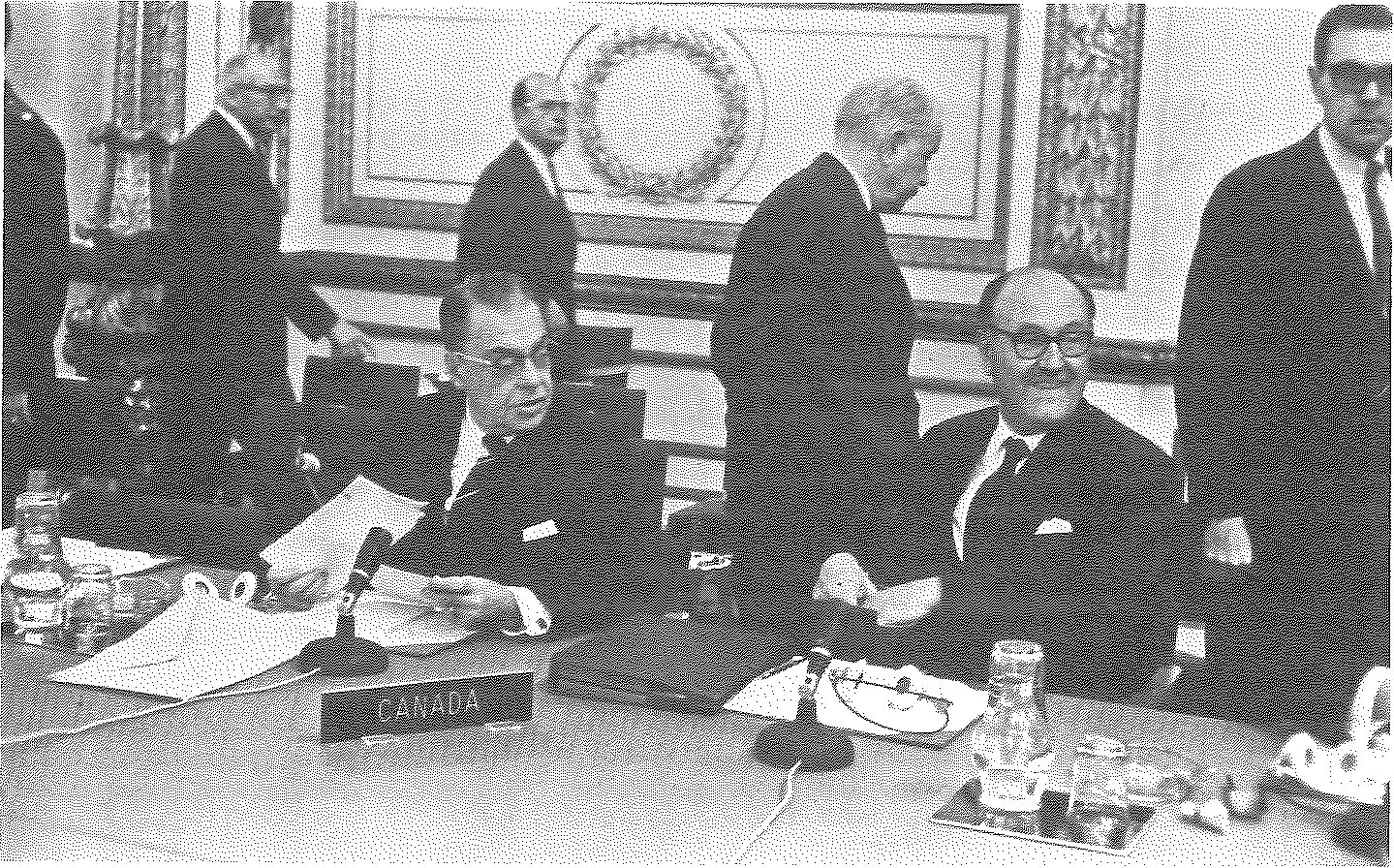
Mr. Ignatieff: He was my opposite number in the British Embassy in Washington.
One of the things I had to cope with in the middle of the war was with an eccentric relative of Mr. Massey’s. Mrs. Macdonald lived in Claridges. One day, she came into my office and said, “Who are you?” After I said my name was Ignatieff she said, “What! Canada has to employ foreigners?” I asked, “What was the problem” and she said, “They are electrocuting me in my bed in Claridges” I asked her what her symptoms were and she said, “I keep going up and down.” I said “Are you sure it’s electricity?” and she said, “Yes.” So I phoned Claridges and spoke to the assistant manager and said “I have Mrs. MacDonald with me and she says you are electrocuting her.” “Oh”, he said “She’s nuts. She came down into the air raid shelter with nothing on except a tin hat the other night”. I said to her “I have the assurances of Claridges that they will cease to electrocute you”. ’ She said “Well, that is very kind of you but I am going to complain to Mr. Massey that Canada should not be employing foreigners.” And so she did. A few days after she came back again and this time she said that Claridges was cheating her. I agreed that that was much more likely and asked what were the symptoms. She said they kept giving her these bills to pay, so I phoned the assistant manager again and told him I had Mrs. MacDonald with me and so on… I then told her that I had the assurance of Claridges that they would be very careful about the bills and she asked my name. I said “Smith” “Oh”, she said “I am so relieved. The last time I was here there was a foreigner at this desk. I am so glad to meet you Mr. Smith. Thank you so much.” And that was the other side of the war scene — a few crackpots as well.
“I have the assurances of cease to electrocute you.”
bout de papier: What makes a diplomat? Mr. Ignatieff: Infinite patience I discovered. Humour because there are all kinds of things to do and you must understand the other person’s point of view. That is one of the things which is not sufficiently understood. Why diplomats require the kind of training that they get is because they have to try and understand the background which makes the German or Hungarian or Russian make the kind of proposals that they make and try and find common ground between them. That does require a lot of training, not just in language, but in culture. Then, of course, the ability to render whatever it is in negotiations
16 bout de papier Vol. into precise language. Dr. Skelton was on the right track in demanding high academic qualifications. There was a great emphasis on precision in written and oral language. You were required to write written tests. Mr. Massey, who was my first sort of task master, would send letters I drafted back to me until I had, what in his view, was the most precise and well crafted piece of writing. And this was war time when we were terribly busy. He would not make any concessions. Likewise, people sometimes underestimate protocol. He was a stickler for protocol in the sense that a great deal of diplomacy is conducted, as you know, informally at social functions. From Mr. Massey, I learnt that if you are going to get anything out of a diplomatic social encounter you have to be very careful about how you select your guests, how you entertain them, and how you place them at a sit down occasion. Even in war time, there were more sit down functions than there are now. The planning of social encounters for diplomatic purposes was something that Mr. Massey did teach me about and also how to use your whole personality to try and get something out of the other side. If you go into a diplomatic encounter with the idea that you cannot trust the son of a bitch and you cannot get anything done, you are wasting your time and your government’s time. You have to see how much common ground you can find if you are really seeking an agreement, and that requires not only patience but sensitivity and knowledge of the personality you are dealing with – the cultural background, language and whole history of the problem in which you are involved
London was a wonderful training ground because you were not only dealing with the day-to-day problems of Canadians at war, but we were the centre of contact with all the allies. Very early in the war, after the invasion of Russia by the Nazis, we did our negotiating of agreements for supplies with the Soviet. Then came all the governments in exile and until General Vanier was appointed the representative of Canada to the allied governments, we handled these relations. My first meeting with de Gaulle was in Mr. Massey’s apartment in the Dorchester.
Our meeting was over St. Pierre and Miquelon. We are still squabbling with France over these islands. It is an important piece of Canadian history. The German U-boats used to penetrate right into the Gulf of St. Lawrence and I remember when they sank something like twenty ships in a week out of Montreal and Quebec. They were all being refuelled in St. Pierre and Miquelon. This was one occasion when Mr. King disagreed with Franklin Roosevelt and the American government. We were usually on their side on most things. But Cordell Hull, the U.S. Secretary of State and President Roosevelt were very much against any kind of recognition of the Free French and doing business with de Gaulle. They wanted to keep the door open and indeed favoured dealing with Vichy. This was my first encounter with de Gaulle. He was very short-tempered and a difficult person to deal with. I remember that when the lunch got rather tense, Mrs. Massey, who used to generally come to the rescue, saying “I hear that recently you were somewhere by the seaside”. That used to be one way of saying you had been in Casablanca or wherever it was. You never mentioned places. And he said, “Yes, but it was not pleasurable.”
What makes a diplomat? Infinite patience.
It was out of these experiences that friendships were formed. I recall how on a Sunday after a particular heavy bombing we went up on the roof of Canada House and looked at the scene of total devastation. The electricity and water supply had been cut and there was smoke and debris all around us. Mike Pearson asked just how much of this could civilization stand without breaking down. I remember it was at that point that I felt that we really had to take another look at the whole question of war in the era in which air warfare had become the dominant factor. This is when I began to think about peace-mongering and all the rest of it.
The funnier aspects, of course, are what Charles Ritchie relates in The Siren Years. Charles happened to be staying with a friend when there was a direct hit on where he usually lived. If he had been there he would have been killed. When he took me around to see this place the next day, all that was left was one of his suits waving in the wind. There was total debris where he would have been if he had been at home. One of the ways in which we coped with that was to change our sleeping places often. There was always night duty for air raid precautions anyway. In fact one of the trials of wartime London was that one really did not get very much sleep. Mrs. Ignatieff: You really did not. I was on a street far away from where George was, but when the sirens went I went up onto the roof of the house to throw off the fire bombs and to watch where the bombs were falling. After the bombs fell they used to ask “Where did the ’incident’ take place?”
Mr. Ignatieff: Out of that grew two things which were important in my life. One was the feeling that something had to be done to find better ways of resolving international disputes than bombing the hell out of cities. The other was the friendships that were formed. When I was sent back to Canada, in 1944, to work on the post-hostilities planning with John Holmes, I found myself working under Hume Wrong who had become a friend in Canada House under the wartime conditions. Mike Pearson was in Washington and he was very active in all the negotiations and consultations for the United Nations. International organizations were being set up such as the FAO. That is where I met people like Escott Reid, who was one of the big brains in this whole business of building up the brave new world of multilateral organizations. He was one of those behind planning for the U.N. and specialized organizations like the International Civil Aviation Organization in Montreal. Maurice Careless, the historian, Gerry Riddell, George Glazebrook, Robert McKay and a few other professors were all part of an incredibly small group. The whole company in External Affairs occupied only a very small portion of the East Block. The whole service, in 1944, when I came back was somewhere around 60 or 70 but there were not more than a couple of dozen of us in the East Block. We shared a portion of it with the Finance Department and the Prime Minister’s office. You knew everybody.
bout de papier: When did your day start? Mr. Ignatieff: The days were not quite as hard as they were in London but you had to appear by 8 or 8:30 because there was so much work to do and you stayed far into the night. I remember my first meeting with Mitchell Sharp. He was working for the Department of Finance at the time and he had an office next to mine. I suddenly heard someone singing something from Bach. I was intrigued that there was a finance official who had such good taste in music. I went in and found Mitchell and I realized then how keen he was on music. We made all kinds of friendships that way. Particularly, when I was chief secretary working on the preparations for San Francisco, I would work right through the day stopping for lunch usually at the cafeteria of the Chateau Laurier and then come back at night. I remember one night coming back and seeing bats flying about the East Block roof and rats scuttling about. It was a weird sort of feeling. I remember Norman Robertson sighing deeply as we worked. His office was in a corner down the hall from me and it included Sir John A. Macdonald’s couch, which enabled him as the Under-Secretary to at least lie down and think.
bout de papier: Was it really Macdonald’s couch?
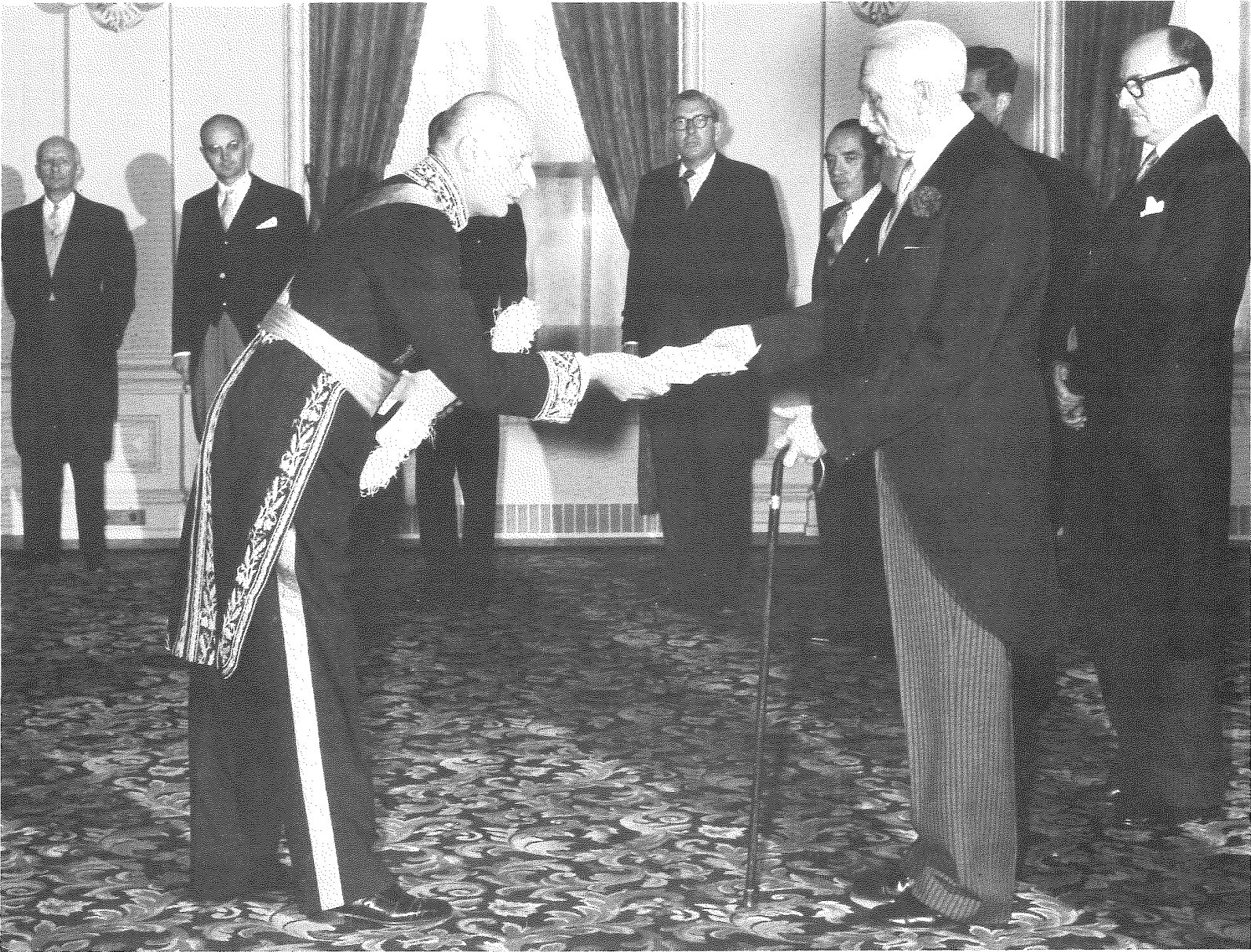
Mr. Ignatieff: Yes, it was. There was some wonderful old furniture in the East Block in those days and John A. Macdonald’s couch was in the Under-Secretary’s office in my day. It was a wonderful time because there were two rather different philosophies in the Department. There were three major figures in External Affairs at the time, Norman Robertson, Hume Wrong with Mike Pearson in Washington. Robertson and Wrong were Under-Secretary and Associate Under- Secretary respectively. Norman Robertson’s philosophy on the whole was: “Better get it right than get it written”. He preferred oral communication. Wrong was meticulous about the use of the written word — both as regards his own and that of his subordinates.
bout de papier: How did they get to work? Now we have Ministers and Deputy Ministers all driven by chauffeurs.
Mr. Ignatieff: It was not the numbers that counted in those days, it was the degree to which the then Prime Minister, Mr. King counted you as somebody who did or did not exist. Most of the bureaucracy did not exist as far as Mr. King was concerned. There were about a dozen people who he counted on for advice and Norman Robertson was at the top.
bout de papier: Was this within External Affairs or just generally?
Mr. Ignatieff: In those days he was Prime Minister and SSEA and he looked for advice from about a handful of officials. There was Norman Robertson, Clifford Clark, Mike Pearson, Graham Towers, Lou Rasminsky, Hume Wrong, Escott Reid from External Affairs, and Bill MacIntosh. The senior planners were these people that I mention and Pearson from Washington. Pearson was brought into all these discussions and consultations. Papers had to be prepared with very little guidance and access to the Prime Minister. Norman was not given to putting things in writing. I had to find out from Hume, who in turn had to find out from Norman, what we were supposed to do. To give you an example, we had just come through the war very closely tied to Britain. I had been in London and Lord Cranbourne, who was the Dominion Secretary in those days, sent us a series of questions that started — Would Canada consider itself at war if Britain was at war? We asked Mr. King for guidance and he said we would go back to 1939. Then we got into an argument with National Defence as to just what that meant. To them it meant that every sword was drawn the moment the crown was at war and every loyal Canadian soldier went to war. But to Mr. King it was not anything of the sort. He put it to Parliament to decide whether Canada should be at war and postponed the declaration of war for a week especially to establish that fact that it was no longer going to be an automatic commitment for Canadians to go to war. I had to explain this to National Defence, with little success I may say. We produced nothing in the reply to Lord Cranbourne’s inquiry as to what our defence relations would be. On the other hand, Mr. King felt a very deep commitment to Franklin Roosevelt. In the hour of greatest need, in 1940, when all Britain’s allies on Western Europe had been defeated by Hitler and Canadian forces were the only forces in 18 bout de papier Vol. the tamous meeting at Ugdensburg, Mir. Ning had been given the assurance by Roosevelt that the United States would not stand idly by if Canada was invaded. He felt that this was the guarantee he needed to enable Canada to throw its weight behind the war in Europe and make an impact, even before the entry of the United States into the war formally after the attack by Japan at Pearl Harbour. American assistance delivered at first through Canada was vital in 1940 and 1941. When we came to look at the post-hostilities, we concentrated on the United Nations following up the Atlantic charter and the tripartite meetings between the leaders of the U.S.A., Britain and the Soviet Union. We were also very clearly given the signal that Mr. King wanted to continue the bilateral relationship in continental defence through the Permanent Joint Board on Defence. That was one of the things we worked on and it was accepted in Cabinet.
bout de papier: You have a long history of experience in dealing with the Americans. Any advice or thoughts on how Canada should deal with the Americans? It is something of a continuing concern and interest. Mr. Ignatieff: It is a matter of concern and interest and I was very much impressed with the experience. After a period in New York with General McNaughton to open the mission to the U.N., I was sent to New York as the defence liaison counsellor with the Pentagon to discuss and negotiate on NATO and Korea. Unlike the British, Americans like to have our views absolutely straight. I am often told that we must not say ’such and such’ to the Americans because they will take it out on us this way or that way. That was not my experience. My experience was that you had to be clear in your own mind what you regarded on instructions from your government to be a vital national interest. If you said to them that this is absolutely something that we insist on, they listen. General McNaughton took that line in relation to the Columbia River diversion and in relation to the giving up of American bases in Canada. While we had a Permanent Joint Board of Defence for joint planning and consultation, we were not going to have American bases on Canadian territory. And was he ever farsighted.
bout de papier: Did the Americans want bases on Canadian territory?
Mr. Ignatieff: Yes. During the Korean War, when we were discussing the question of aircraft deployments and nuclear weapons — at that time the great enemy was supposed to be China because China had intervened in Korea — I said very definitely that we would insist on several things: One, the Canadian government reserves the right to give permission on every flight. There was to be no automatic permission to deploy or overtly Canada without the exercise of Canadian decision making. Moreover, since these were already equipped with nuclear weapons and we were conscious that this might give rise to an alert because of the Sino/Soviet Pact, there should be consultation between ministers and officials as to the conditions and circumstances that might give rise to implementation of an alert. These were written right into the Bilateral agreements in the early 1950’s. During 1948 to 1953, until the McCarthy period, our relations under the Truman régime and with Mr. St. Laurent and Mr. King were extremely close and marked by complete confidence. Our ambassador, Hume Wrong, was one of the few ambassadors who Dean Acheson, then Secretary of Staff, not only consulted about everything but was on very close terms of friendship. Throughout that period the rule was to be absolutely straight. If you had something that really was important you took this position because it was in our national interest and we would not compromise on it. During the Eisenhower régime, we got into a situation where President Eisenhower began this process of delegation of presidential authority. You were not quite sure exactly where you stood. You could no longer depend on the State Department to resolve your problems as we did during the days of Dean Acheson and Hume Wrong, because we were not quite sure exactly where John Foster Dulles stood on issues in relation to President Eisenhower or to his brother Allan who was also running his own show in the CIA. It was at that point that I remember saying to Arnold Heeney that I thought that we had to develop closer relations with Congress because there was no longer a clear line of responsibility with the Executive Branch of government. Particularly, when we were dealing with things such as the St. Lawrence Seaway, the power question and the boundary waters, there were so many lobbies all working at cross purposes within the United States system that affected us, that before I left in 1953 I put forward to Arnold Heeney that we had to develop relations with congressional committees and their chairmen.
bout de papier: What happened?
Mr. Ignatieff: He did not like that. He said that this was not consistent with the quiet diplomacy that he and Livingston Merchant had worked out and that this was contrary to the practices of Canadian diplomacy. Mr. Heeney always held to the view that politics and diplomacy should somehow be kept apart. It had become more and more difficult to maintain that especially in relation to trade matters. In the late 40’s and 50’s the Americans raised the question of a free trade agreement with Canada. They wanted access to our raw materials, particularly, strategic resources and access to water and power supplies. As we went into these discussions it seemed quite clear that there would be a loss of employment and the transfer of a good deal of investment southward as a result. The government said no and the contacts at the time were held very close to the chest. Mr. St. Laurent came down to close the discussion. It was basically to be a bilateral agreement initiated on the American side and not ours. I remember having to answer questions from Time magazine as to why we had not been more responsive to the idea. We were supposed to be the hewers of wood and drawers of water that supply you with raw materials, but we really could see very little benefit in terms of developing our own industry and providing employment. At that time the Canadian government, under a Liberal government, was committed to full employment. This does not seem to be the case now, but it was at that time. The answer to the U.S. therefore was absolutely no. But it was done quietly, and Mr. St. Laurent compensated by entering into cooperative arrangements about the development of joint agreements on the development of the St. Lawrence Seaway and certain arrangements about power sharing on the Niagara. We did make these limited agreements on that but we said ’no’ to a free trade deal. There were two things which made things difficult for Canada/US Relations as far as I was concerned. One was the McCarthy hearings and the other was the way in which the Unamerican Activities were applied to people like Herbert Norman and Mike Pearson.
bout de papier: What was Herbert Norman like?
Mr. Ignatieff: Herbert Norman was a quiet scholarly figure. He was regarded as the outstanding expert on Japanese literature, language and history. He had been borrowed by the Americans for his expertise and had served under General MacArthur. I find it difficult to place him in the same category as some of the spies that I ran across in Washington, people on the British side like Philby, McLean, and Burgess. I say in my book that he was not a spy. I was not aware until I got his dossier and had to reply to the Unamerican Activities that we would not have him investigated again about his communist connections before he entered the Foreign Service. I did not even know that he had been a partisan of the Communist cause before the war in 1938-1939 at a time when the Republican government in Spain was being supported by the Communist side and threatened by the Fascists and Nazis. I happened to be of quite a conservative mind myself and did not favour the position that some individuals like Norman apparently took, that you had somehow to become a Communist in order to support the loyalist cause in Spain. My sympathy was for the loyalıst cause rather than the fascist. No doubt, he was sympathetic to the lett but as I knew him he was a Japanese scholar and a very wise, well-informed, quiet, retiring, and unassertive character. By the kind of criteria that was applied in the days when I first went into the Department under Dr. Skelton, he passed muster as a scholar. That was what External looked for. They did not go in very deeply at to what their political opinions were in the forties. You had to pass the test oi scholarship which was thought to be the main requirement to be a diplomat. He certainly passed that test.
bout de papier: External has recently rewritten the foreign service exam and is examining the recruitment policy. Would you have any advice from your experience? Mr. Ignatieff: I would still say that scholarship should be a requirement, in the sense of a trained intellect capable of thinking and taking initiatives in new ideas and being able to express yourself clearly both orally and in writing. These are qualities which are cultivated in scholars and I still think should be given priority over some of the other considerations such as management abilities and how you fill in forms. By the time I was leaving the Department it seemed to me that the highest priority was given to management and diplomacy is not the same as business management. I quite agree that there is a place for management in running anything from a mission to a grocery store but that is sort of an interchangeable skill. If you want a professional diplomat capable of providing the kind of alternative to the resolution of conflicts of war by the use of diplomatic skills, you have to put a higher priority on intellect, training, honesty, and integrity. All these things seem to be taken for granted. On top of that you have to have the power of thinking and expressing yourself clearly. Therefore, I still think the old traditions of academic excellence have to be included.
Returning to Washington in the 1950s, there was this unfortunate experience towards the end of my posting, when the House Committee on Unamerican Activities not only went after Norman but after Pearson because of Hazen Sise, who had attended the Ambassador’s briefings in the Embassy and had joined some kind of left wing or maybe a Communist group.
bout de papier: Did you know Hazen Sise? Mr. Ignatieff: No. As I recollect, his father was a wealthy businessman in Montreal and the son came down as representative of the film board. Mike Pearson, as I knew him, was an extremely trustful person who was very frank with all his colleagues and people who worked for him. This guy took advantage of it I suppose. Elizabeth Bentley, who Sise turned this information over to, called it “unamerican activities”.. I was temporally in charge of the Mission between Hume Wrong’s departure and the arrival of Arnold Heeney and soon after his death — an event which was terribly uspetting for me. I was left in charge and had to cope with this unpleas ant atmosphere generated by the hunt for “unamerican activities” in Washington which seemed to do little in uncovering real espionage but was harmful by throwing the next wide “guilt by association”.
Mrs. Ignatieff: Elizabeth Bentley was a very unpleasant woman who did a lot of the damage.
View the original scanned pages →
Originally published in bout de papier, Vol. 5, No. 1 (1987) — Spring 1987 // Printemps 1987, pp. 13–19. Read the rest of this issue →



