
bout de papier, Vol. 4, No. 4 (1986) — Winter 1986 // Hiver 1986, pp. 6–24
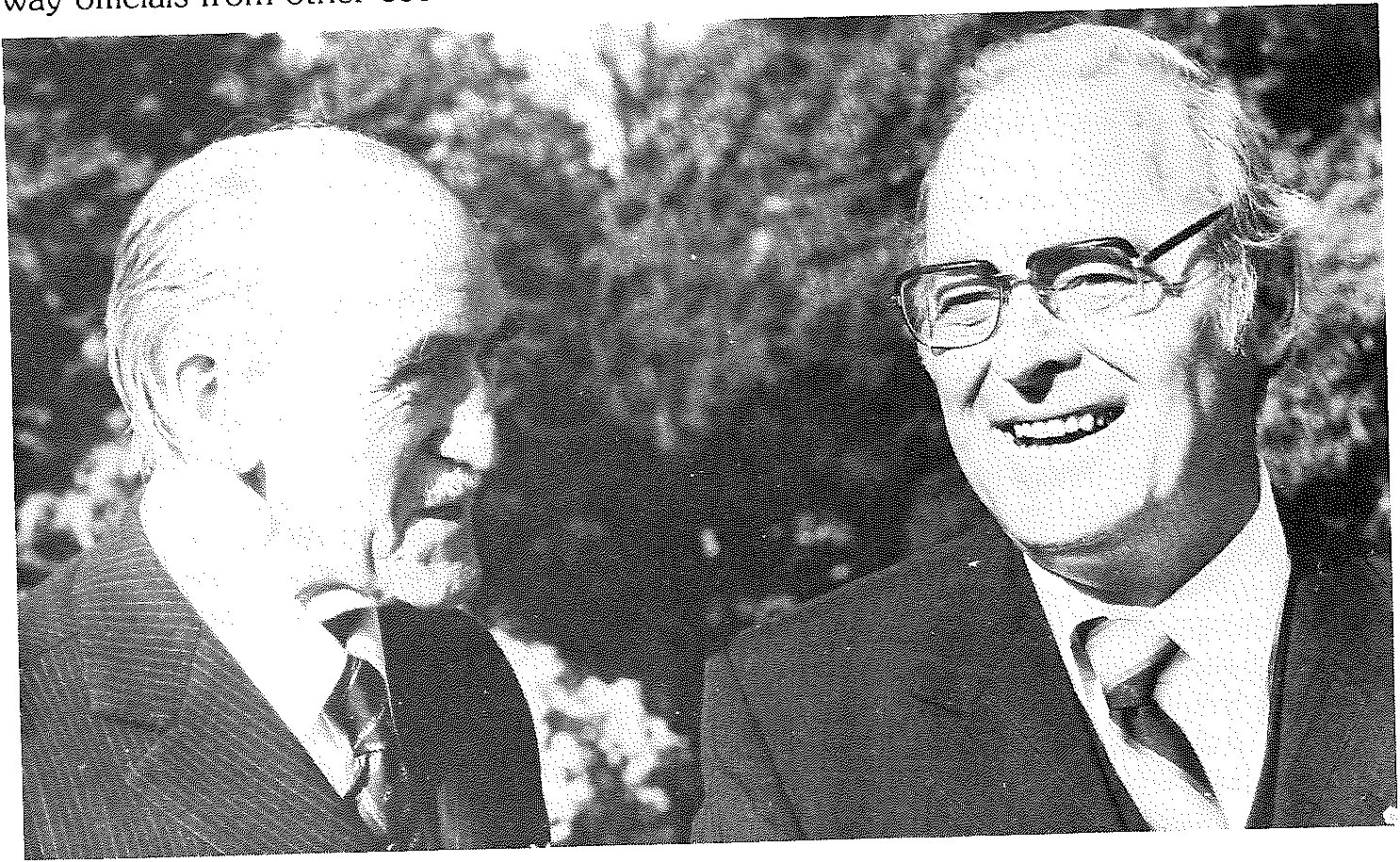
Born in Andover New Brunswick in 1916, Ed Ritchie received his B.A at Mount Allison University and then went to Oxford in 1940 as a Rhodes Scholar. He worked for the British Purchasing Commission and Ministry of Economic Warfare in the British Embassy in Washington before joining External Affairs in 1944. He left the Foreign Service briefly in 1946 to become special assistant to the Assistant Secretary General of the Economic Affairs Department at the UN in New York. After rejoining in 1948, he served in London and Washington He was Canadian Ambassador to Washington from 1966-70 when he returned as USSEA. His last posting before retirement was as Canadian Ambassador to Ireland. John McNab interviewed Mr. Ritchie at his home in Ottawa.
bout de papier: Mr. Ritchie, you had a very interesting career even before you became the Under-Secretary.
RITCHIE: Yes, I think I did. Starting off with Mike Pearson in Washington as, what he called, his temporary, probationary, third secretary, which was about as low as you could get. But it was one of the most interesting parts of my career. It was towards the end of the war when things were being created in Washington. It was a very exciting time and Pearson was a very interesting man to work for.
bout de papier: There has been a reference made to your being in the British Embassy in the early ’40’s. How did that happen?
RITCHIE: Yes, that is right — the Ministry of Economic Warfare. The Washington Mission was a collection of most interesting people from business, government and academic backgrounds. It was really very interesting working with the Americans at the time when they had their Board of Economic Warfare and when they created their Office of Strategic Services. I had to act with them on a liaison basis between the British and the Americans which is the usual Canadian role, I guess. I found it a very interesting time with the Brits. Then I joined the Canadian Embassy in Washington where Mike Pearson was Minister-Counsellor at that time.
bout de papier: Was that directly after the time with the Brits?
RITCHIE: Yes. The British were talking about various things I might do. I had just come back from Oxford before I went to join the Brits. Then I joined the Canadians. That must have been 1942, and I had been married in Washington shortly before. Mike Pearson had me working on various international economic questions at that stage. bout de papier: You were in Washington after the war concluded.
RITCHIE: Just at the end. I was in Washington before that with the British. But, with the Canadians, it was just a little before the end of the war.
bout de papier: Where did you go following that assignment in Washington? You ultimately went back to Washington, did you not?
RITCHIE: I went on loan to the United Nations. Mike Pearson suggested I go with the Economic Affairs Department at the United Nations in Hunter College, New York. I had just attended the Inaugural Meeting of the International Fund and Bank in Savanah in 1946, and went on shortly after that to join the United Nations Economic Affairs as Special Assistant to the Assistant Secretary General. I stayed there from 1946 to 1947. Then, in 1947, I went to Geneva for the GATT Conference where I was Special Assistant to the Executive Secretary who really ran the GATT Conference. I was there in 1947, then went to Havana in 1948. I should say that I first met Simon Reisman in Geneva in 1947. Some people regard the International Agencies as not a very interesting place to work, but I found it very interesting because it gave one a better understanding of the way officials from other countries worked.
There was quite a variety of them at the United Nations at that time, both in the Secretariat and in Delegations. It also gave you a good perspective on your own government and government service, how they looked to the rest of the world. I found that a fascinating background for my later work.
bout de papier: How did you think we fared in comparison?
RITCHIE: We looked very good. Dana Wilgress at the GATT Conference was a king-pin. He did a great job as the Chairman of the GATT Conference, that is, of the Tariff Negotiations working party which was the centre of the GATT Conference and then, of course, in Havana he was involved in a thing or two, and he was outstanding. There were a lot of outstanding people. Simon was just a young fellow then but doing an effective job of course. He was one of the principal finance department people working with John Deutsch. I would recommend working in an International Agency even though sometimes they seem to be ineffective — it is good experience. I was with one when things were being created and perhaps it was more exciting than it is now-a-days. That was 1947, then my wife and I and our son came back to North America from the Geneva Conference with a ditching in mid-ocean. We were home just long enough for me to be turned around and off to Havana for the Havana Conference which was supposed to create the International Trade Organization but never got ratified by the U.S. Congress. Still, it was a pretty good effort to construct a trade agency, but it never came into being so GATT had to make do as less than ideal as the international trade vehicle for the world at large, or for the Western world at least.
bout de papier: Is that how you think the GATT has performed between then and now, less than ideally?
RITCHIE: Yes, because it did not cover some aspects of economic relations that really needed to be covered, and I suspect that from the point of view of developing countries it would have been more satisfactory if there had been a stronger agency than the GATT now is. A lot depends on the capacity of the people who are staffing the GATT. I speak now as an old international civil servant. But Eric Windham White, as the head of the GATT, was tremendously effective in the formative years. I do not think all the heads of the GATT have been equally effective. He was a great international official in that period. He could talk to countries like a Dutch uncle about their economic behaviour and that sometimes was pretty damned important. And he would do it with great effect.
bout de papier: How long were you with the GATT?
RITCHIE: Until 1952. Again, at the government’s suggestion, I went on to London to work on the Canadian aspects of the Marshall Plan, which really meant helping to deal with questions arising out of our loan arrangements with the British and with some of the European countries, and with the Americans. I was there from 1948 until 1952. The most interesting thing I was involved in in the latter part of that was on economic aid. I should have said earlier on that when I was with Mike Pearson in Washington at the embassy, I had a lot to do with economic relief activities and in the military relief at the end of the war. Later, when economic aid for development became a possibility following the first Colombo Plan Conference in London, I was pretty closely associated with several aspects of that including the quite significant meeting in Delhi in 1953 when I was travelling in India and Pakistan and Ceylon with Jimmy Sinclair, who was the Minister who headed our delegation. Escott Reid was in Delhi, John Hadwen was in Pakistan, and Jim Hurley was in Ceylon and we visited all three of these countries. I was Chairman of the drafting committee of the Colombo Plan Conference in Delhi. I found it fascinating to work with the developing countries.
bout de papier: Did you stay focusing on the International Economic Affairs until you found yourself back in Washington?
RITCHIE: Yes, in all respects, including what are now called the third world problems, and the industrial countries, including the U.S. and Canada. Altogether I served in the U.S. 14 or 16 years, with the British and with the Canadians in various capacities. In the last phase, as ambassador following the other Ritchie.
bout de papier: Yes, many of us have noticed that there are two Ritchie’s successive on the wall in the library of the Embassy in Washington.
RITCHIE: That confused the Americans to no end
bout de papier: What were the major topics of interest between Canada and the United States when you were ambassador?
RITCHIE: The same as they always are. Later, when I came back to the Department as Under Secretary, we worked on the Autopact; that, of course, was a major development in our relations.
bout de papier: In the first year of your term as Under Secretary there was the Foreign Policy Review for Canadians headed by Mr. Sharp.
RITCHIE: Yes, that was unavoidable. The new government wanted to have a look at foreign policy, and obviously wanted to have a foreign policy that looked somewhat different from the foreign policy of its predecessor. Which was not something that greatly endeared the new government to some of the previous pillars of the earlier government. I think Mike Pearson was a little troubled with some aspects of that. review. Whether it had much effect and whether the effects were good or bad, it is hard for me to say objectively. A lot of good work was done on it. Mitchell Sharp put himself into it very whole-heartedly, as he did particularly on the Third Option which is an expression one does not use around these parts these days I gather. Although, you are hearing more about it from Punta del Este. That’s really the Third Option in operation. The GATT is Third Option. To contrast it with the free trade possibility between the U.S. and Canada is not very accurate. Obviously both things are important and not necessarily in conflict.
bout de papier: Can you give us your opinion on the free trade talks and how all that might come out?
RITCHIE: I do not find it easy to, and I do not think Mr. Mulroney finds it easy to either. I think this is a difficult one. I am glad to see there are some good people working on it in Simon’s shop and some of the others who are not necessarily in that actual organization. I do not know how you are set up at External on this at the moment. I have not really followed it too closely, but it will be clearer I think in a fairly short time as to whether or not something is going to wash or not here.
bout de papier: Mr. Mulroney seems to think it is the Americans now who are going to decide whether it is going to happen or not.
RITCHIE: It is a proper tactic for him to be adopting. I think we have looked for too long too eager. If you look too eager you are going to have to pay more than you probably should. I think it is well now to be looking a little less eager. Whether that is tactical or whether it is an actual appraisal
– I do not know. bout de papier: Could we come back for a moment to a couple of things that also happened when you were Undersecretary? It seemed that there was a lot of exciting things happening at the time, for example, the FLQ crisis in Quebec.
RITCHIE: Yes, I lost a good bit of sleep over that one. Who would have thought that this would have happened in any form, and particularly that it would happen with a diplomat involved. Diplomats were not in the habit of being picked up in those days. It has become more common now-a-days. Who would have thought External Affairs would have found itself in the centre of this thing.
bout de papier: External Affairs was in the centre?
RITCHIE: Yes – by accident, and by the fact that Cross was a diplomat, a foreign government representative. The accident I referred to was the fact that we happened to have had an operations centre which in those days nobody had. Now everybody has one. Mitchell Sharp was an active Minister whom the PM was prepared to let carry the ball, at least at the beginning of this thing. The PM was out of town at the very start and Sharp was central to it. We found ourselves deep into something that I would have not expected to have found myself into when I came back as the Under-Secretary mainly because of the economic issues. It is like Ken Taylor going to Tehran to convert a big export credit into sales. He did not get much chance to. I say that not too casually because it is one of the things that illustrates how impossible it is to apply some of the methods that auditors like to apply to foreign service operations. You cannot predict what is going to come up. PPBS (program planning and budgeting systems) is a great concept, but it does not apply to foreign relations and the Americans know that. My old tutor used to chair a committee in Washington, the Hitch Committee. Hitch because that was his name. He worked on the application of PPPS to their foreign affairs. They brought a great expert into Washington to apply it afterwards. Hitch was here one evening in Ottawa and we had dinner with him. At the end I said we would like to hear what he thought about the application of program planning and budgeting systems to foreign affairs and just how it would apply. His answer was “Not at all”. All those who are now undertaking great projects on a similar basis just have not been in the real world of the changing content of international relations. Country programs are probably a useful thing and something like the foreign policy reviews —inevitable. I do not go overboard for it or any of these devices. I guess I am still old fashioned, and I am probably old-fashioned because I am old!
bout de papier: One other development in those days was the establishment of relations with China. That happened shortly after your arrival?
RITCHIE: It happened in the midst of the October crisis. We were having the then Chinese Ambassador in to meet with the minister at lunchtime on a day when all the television cameras they could muster in this city were focused on the front of the East Block because that was where they were expecting some action relating to the FLQ. The. poor Chinese Ambassador came in quietly with Ralph Collins. He was told the Government’s decision and what he was to do. and he did it very nicely and appropriately. There are many symposia now on the recommendation and on how it came about — what we did right and what we did wrong. I must say that there were not very many of the things that were done that were all that wrong.
bout de papier: Was there general support for the decision of the Government?
RITCHIE: Without the Prime Minister’s strong interest, do not know whether it would have happened: Paul Martin was pretty keen on it too. would not try to line up the Cabinet as to who favoured it and who did not, but I think there was general support. The PM was strongly in favour. It was obviously something that could immediately distinguish his foreign policy from that of his predecessors. After the number of false starts that were made under other governments, for this government to be able to pull this off was obviously something that was going to be the hallmark of the period. It happened pretty successfully. I think that is the judgment people analysing what happened are now coming to.
bout de papier: One other event that happened at about the same time was the OPEC crisis. The first oil crisis. Did that upset things in the Department as much as one might expect?
RITCHIE: Just about as much. In other words, we did not notice it a great deal! It upset everything – the economy and that upsets the Department and the ability to do other things. It affected oil relations with the Americans quite substantially. It was quite a change from 1949 when we were so pleased with ourselves for getting an exemption from U.S. oil restrictions. There were the boycotts, and action taken to withhold oil or to keep out oil, both things and Canadian oil became very important there. Apart from Pierre Trudeau dancing the jig with Sheik Yamani on the desert sands, we did not get very close to it. The department was not terribly actively involved in anything directly related to the OPEC discussions.
bout de papier: One of the other things that has changed since you were the Under Secretary, Mr. Ritchie, is the organization of the Department. Did you not reorganize the Department fairly early on in your tenure by establishing four area bureaux?
RITCHIE: Yes, the creation of the Directors General. I still think it was a good organizational device. I had intended that the Directors General would be the key people in the Department, for various reasons that one can go into. It would be a planetary type of organization with the Directors General looking after all kinds of subjects. Assistant Under Secretaries would have more general responsibilities. The Directors General, with regard to each region or area of expertise, would be the key people. As far as I know, it has not worked that way. In fact, it got changed drastically.
I do not like to comment on the present organization. I have mixed feelings about the whole integration thing. I should not sound off about it because the Trade Commissioner Service was, as you know, of very high morale and was an effective organization. And, the External Affairs service was. Whether the blend of the two is equally effective all the time, I am not sure. I think there is a different function and it is not higher or lower. If you ask many who were brought up in the Trade Commissioners Service, they would not have put one service higher or lower than the other but would have seen fairly distinct functions for the two services. But there it is – they are now one.
bout de papier: The foreign policy review in 1970 said that “there should be maximum integration of the foreign service so that its operations will effectively contribute to the achievement of national objectives”. Ten years later the integration took place.
RITCHIE: There is a lot of argument for integration obviously. But, do they stand up?
bout de papier: As you mentioned, the majority of your time overseas was spent in the United States. Certain Canada/US issues are very much in the news again.
RITCHIE: I have always felt we should use the Columbia River Treaty to pressure the Americans and, in particular, our friend down there who is interested in shakes and shingles because, after all, he relies on Bonneville Power. Bonneville Power relies on the regulation we supply under the Columbia River Treaty for which we have been paid for only a period. It is hard to make out much of anything when negotiating with these tough characters.
bout de papier: You think they are as tough as their reputation?
RITCHIE: I think pretty much. Fortunately Simon was through all that with the Autopact and he knows how rough it was. I do not think he has any illusions.
The Autopact and the Columbia River Treaty were two very important and beneficial developments for Canada. Although the Columbia has been criticized at times. I think you can still make the argument that it was a good deal. It got twisted around a bit by the politics of the continent. I think the Autopact was quite an operation. It was not handled the way you handle the free trade issue now. It was much more departmental. By that I do not mean External Affairs, but individual departments. But it turned out well in the end despite all the misgivings. Paul Martin was working on that too. Even though Simon was the key official on the substance of the thing, Martin had the Department with the expertise in some of the key aspects of the whole thing. And, of course, he had the Windsor constituency with a heavy reliance on the auto industry. I am watching the present proceedings with great interest.
bout de papier: Mitchell Sharp was the SSEA during part of your tenure as Under Secretary. Can you describe the relationship between you and Mr. Sharp?
RITCHIE: I had known him as an official before I worked with him as a minister. He had been Deputy Minister of Trade and Commerce and a senior Finance Officer. He is an able man. Mitchell was head of the team on original trade negotiations with the Soviet Union.
bout de papier: While you were Under Secretary, Mr. Trudeau went to the RITCHIE: Yes, I was with him on that trip. That was a great expedition. I went back later under the Protocol of Consultation. My visit just happened to coincide with the 1972 hockey game, which we won. I have a photo of me with, what turned out to be, three presidents of the Soviet Union watching the game.
bout de papier: Was the USSR the country you thought it would be?
RITCHIE: I think very much so. I saw a good deal of it on the trip with Trudeau. We saw quite a bit of the variety of the country. I had just been in China before with Mitchell Sharp. China and Russia are quite different; they were then and are probably a little less conspicuously different now. There are changes occurring everywhere.
bout de papier: The photographs behind you are quite exceptional. Can you tell me about them?
RITCHIE: One is of L.B.J. (President Johnson) telling me what I should tell Mike Pearson about his speech in Temple University. I had just presented my credentials and he did not waste any time in getting down to business. The other was taken in Hyanisport, Mass. with Mike Pearson and Kennedy. The picture of the Pope was taken in Ireland. I was Ambassador there for three and a half years. It was idyllic. I liked it there very much. A fine country with an interesting history and people.
Before we part, I would like to offer a personal comment about Bruce Rankin whom we have lost.
I have had the privilege of working with Bruce Rankin over many years and in various capacities and have much respect and regard for him. Although he often told me that he preferred working in the field rather than at headquarters, I have no doubt that his honesty and directness and his ability to excite and inspire his colleagues at all levels would have been equally effective in Ottawa. He was a good colleague and friend and will be sorely missed
bout de papier: Thank you very much, Mr. Ritchie.
View the original scanned pages →
Originally published in bout de papier, Vol. 4, No. 4 (1986) — Winter 1986 // Hiver 1986, pp. 6–24. Read the rest of this issue →



