
bout de papier, Vol. 4, No. 3 (1986) — Fall 1986 // Automne 1986, pp. 33–34
It has frequently been observed that there exists a fundamental asymmetry within the department, in that the formal appraisal system, like many other aspects of bureaucratic process, works principally from the top down. Among other things, this situation has had a detrimental effect upon the department’s ability to effectively evaluate those occupying supervisory positions. Particularly noteworthy is the fact that the view from above is frequently at dramatic variance with the experience of those at the working level, whose perspectives, while of critical value, are not currently accorded any form of structured expression.
Regrettably, there are more than a few cases of managers who are regarded as successful on the basis of their ability to produce, but have achieved those results at the direct expense of the well-being of their subordinates. Moreover, any short-term gains are frequently dwarfed by longer term damage to private lives, and, in the end, to the fabric of the department itself. Conversely, many excellent managers, whose sensibility and compassion may result in steady, more consistent (if less dramatic) achieve. ments than those whose demands are extraordinary and uncompromising, do not always receive the credit which is their due. Accordingly, the time is ripe for the introduction of a countervailing the louvres and shine some clear, dry evaluation system which would pull open light upwards.
It will let FS Officers get data on managers’ abilities.
The objective of this proposal is the establishment of a system which will permit foreign service officers to obtain information, contributed by their col leagues, concerning the abilities and characteristics of the department’s managers. The present situation of reliance upon the vaguaries of corridor chatter, as verified (or disputed) by representatives of the Bureau of Personnel, is far too haphazard an approach in view of the considerable stakes involved. The purpose, therefore, of more productive and harmonious matching of professional personalities within the department. The result would be a more balanced and informed assignment process which would minimize the potential for career disasters. It would also provide a valuable new resource for senior managers in assessing the performance of the department’s middle managerial cadre.
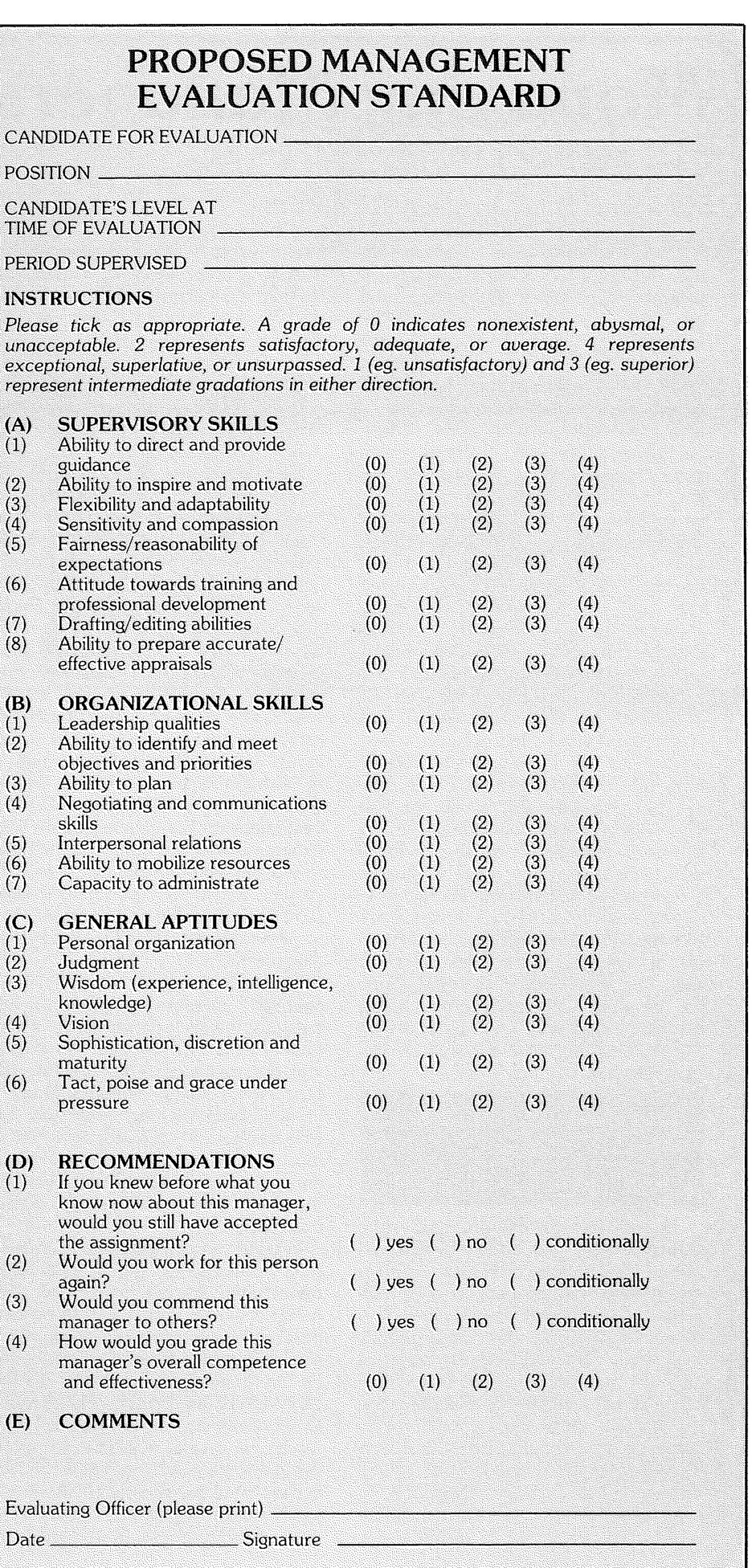
Participation, in terms of submitting evaluations, would be voluntary and open to officers at all levels. Rating forms, similar to the accompanying example, and including appropriate covering instructions, would be distributed to all interested parties. Participants would initially be invited to review the performance of each of the supervisors that they had worked under for at least six months over the previous five years. This, in turn, would permit the establishment of a reasonable data base in relatively short order. Both rating and reviewing officers (according to conventional appraisal jargon) would be candidates for annual evaluation, and a minimum of five evaluations per manager would be required for inclusion in the system. Individual contributions would remain confidential and accessible only to personnel authorized by the PASO executive.
These data would be collated and aggregate averages calculated for each category in which performance is being measured. Once the system is established and the results entered into the data base, the running averages could be easily updated each year as new evaluations are received. A variety of more advanced statistical techniques and indicators could also be explored in the search for more accurate or discreet information.
Prior to the publication of the results, those evaluated would be offered the opportunity to comment, and these remarks would, upon request, be incorporated into the finished product. The summary composites would be published, on an annual basis, as the PASO EVALUATION GUIDE (PEG), a catalogue of managerial “snapshots” which would be made available to foreign service personnel but would not be accessible to the general public.
The early adoption of the “PEG” system, more or less as outlined above, would represent a timely response to the stratified structure and cascade-like style which characterize the department. Similar types of evaluations are conducted variously in the universities and in the private sector; there is every reason to believe that the practice would bring similarly salutary results when instituted here. Moreover, the initiation of such a programme lies well within PAFSO’s mandate, and requires neither laborious consultations nor special permission to proceed
View from the trenches merits consideration.
The interests of PAFSO members would be well served by adopting this innovation. We owe it to ourselves to share our accumulated and collective experience on the issues of supervisory performance. Moreover, it is clear that the unique perspective offered by the view from the trenches merits closer consideration than has been the case to date. Indeed, the distinct nature of working-level insights has been deliberately reflected in the choice of evaluation criteria, some of which have entirely escaped measurement despite their crucial consequence in a balanced assessment of overall competence. Of equal importance is the observation that just as capable managers deserve credit for their good work, poor managers should be identified and, indeed, could benefit through exposure to an element of constructive criticism. In a larger sense, the proposal embodies a healthy and open approach to management-staff relations, and the ventilation of the department’s supervisory strata may help to introduce elements of dynamism and sensitivity which would not be unwel. come under prevailing circumstances.
The initiation of the “PEG” system represents a challenging and profoundly democratic opportunity to draw upon our own resources in the spirit of self. help. With support and encouragement of the membership, the quality of our working lives stands to benefit significantly.
If you agree, or disagree, or have suggestions as to how this proposal might be improved, please take a moment to inform PAFSO’s Executive Director of vour views.
View the original scanned pages →
Originally published in bout de papier, Vol. 4, No. 3 (1986) — Fall 1986 // Automne 1986, pp. 33–34. Read the rest of this issue →



