
bout de papier, Vol. 4, No. 3 (1986) — Fall 1986 // Automne 1986, pp. 9–13
He saw me drive up and came out to wait for me at the front door of the house he has lived in for nearly 60 years. The years have taken their natural toll and he apologized for being a bit tired – a couple of days before, he had gone for a cruise in Vancouver harbour with Lord Carrington. His snow white hair is thinning and the eyes are hooded with age. The walk is slow but steady. A tall man – he is a six-footer – his broad shoulders are slightly stooped but with the aid of his walking stick he still stands tall and erect and he struck an impressive figure standing there in his starched white shirt and three-piece suit. The handshake was firm. The voice, which echoed through the House of Commons for nearly three decades, is still strong; the mind is sharp. His sense of humour is wry, understated, and he expects, and deserves, a certain intelligence. At 90, one doesn’t have to suffer fools any more.
After our interview and before our tea, we toured his study with its memorabilia from bygone days — the signed photo of R.B. Bennett, cartoon caricatures of himself, group photos of Green the young officer on the eve of going across the sea to the Great War, Green the Minister with fellow diplomats and politicians. And, in the living room, scores of cards and pictures of his family; as he told me at the end of the chat, “the two things in life that matter the most are your family and your friends, and at my age most of your friends are dead, so the family is pretty important.”
Howard Green is a survivor from the last century. He was born on November
5, 1895, in the boomtown of Kaslo, on the shores of Lake Kootenay, inland British Columbia, where two years earlier a major silver strike had been made. In Canada, Sir John A. MacDonald had been dead only jour years, Mackenzie Bowell was Prime Minister and the Conservatives had been in power for all but five of the young Dominion’s 30 years. Victoria was Queen and Empress of India. There were troubles in the Transvaal, a British raiding party led by Starr Jameson had made a raid, Cuba was at war for its independence with Spain, Karl Marx had recently finished the third volume of Das Kapital. Tchaikovsky had just given the first performance of Swan Lake in St. Petersburg, Gillette had just invented the razor and Oscar Wilde was pursuing, unsuccessfully, his libel action against the Marquis of Queensbury. The young Green went to school in Kaslo and then went on to the University of Toronto where he took his BA and law degree at Osgoode Hall before enlisting with the 54th Kootenays in May, 1915. He went overseas with the Canadian Corps and, after duty in France, was demobilized in 1919. Called to the Bar of British Columbia in 1922, he took an active interest in Conservative politics and,, in 1935, resisting the tide that swept R.B. Bennett from office, won Vancouver South. He held the riding (the name was changed to Vancouver- Quadra in 1947) until the Diefenbaker defeat in 1963, ran again and lost in 1965 and then continued his law practise. He ran for the Conservative leadership in 1942, losing to John Bracken. He became Conservative House Leader in 1957 and, after the June election, was named Minister of Puolic Works and Minister of Defence Production. Following the death of Sidney Smith he was appointed SSEA on June 4, 1959.
The Department of 1959 was still housed in the East Block and Green’s office was beside that of Diefenbaker. Green would walk to work from his apartment at the corner of Metcalfe and Laurier. Norman Robertson was USSEA
– the Department consisted of 428 officers and a support staff of 1125. Canada had 61 posts abroad and Green introduced the practise of seeing every officer, however junior, before he was posted. Eschewing the role of honest broker, Howard Green summarized his approach to foreign policy in a speech to the House of Commons in February 1960 when he said that Canada “must decide instead that our role is to determine the right stand to take on problems, keeping in mind the Canadian background and, above all, using Canadian common sense. In effect, the time has come to take an independent approach.” This occasionally involved standing up to the United States and it was during his stewardship that the Government refused to stop trading with Communist China and Fidel Castro’s Cuba, despite American pressure. Green is perhaps best known for his interest in the United Nations and disarmament issues.
bout de papier: What made you get involved in politics?
GREEN: My family have been involved in politics in British Columbia for quite a long time. I had an uncle who was first mayor of my home town up in the Kootenays and then he was a provincial member and then provincial minister. In 1912, he was elected in a by election and soon after that he went to the Senate for 25 years. I went overseas with the Kootenay regiment in the first World War and we soldiers were very much interested in politics. We believed that when we got back to Canada we would run the country the way it should be run. After the war, I got involved in politics and eventually sat for this riding (Vancouver-Quadra) for 28 years.
bout de papier: In 1935, did you have to run against anyone to get the nomination?
GREEN: No, I got the unanimous nomination of the Conservative Association. I was President of the Association at that time. The downtown people wanted us to get a man who had money and let him pay his own way and let the election go. My people would not agree to that. They went ahead and nominated and I won by quite a small margin (279 votes). That was the election in which Mackenzie King came back to power.
bout de papier: Tell me more about your early life.
GREEN: I went to the University of Toronto for my law degree and graduated in 1920. I was called to the bar in 1922. I got the Silver Medal – after many years. They would not give us medals because we finished in the summer session. They felt that that did not constitute a good pass. It was not until some of our own fellows got to be benchers that we got our medals.
bout de papier: How long did you have to wait?
GREEN: Twenty years. I was a federal member before I got the medal.
bout de papier: You served in the first world war?
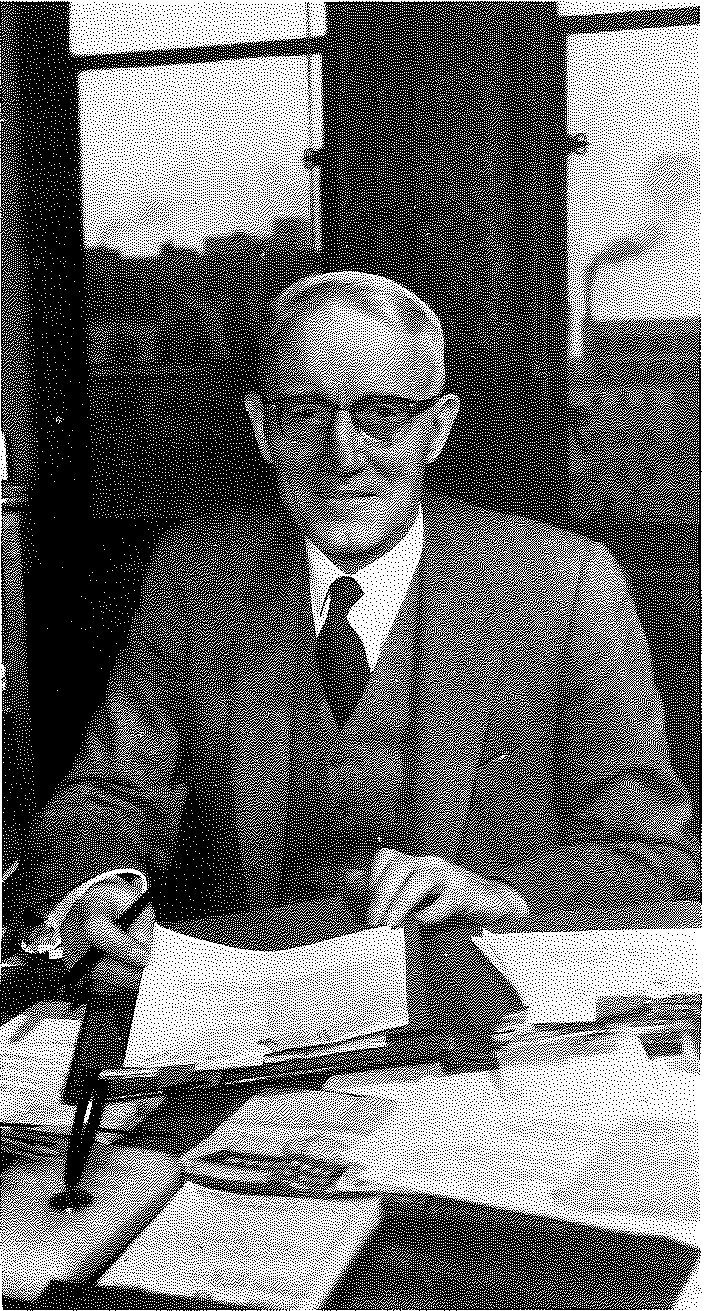
GREEN: Yes, I served with the Kootenay Batallion. (Kootenay is in the southeast part of the province.) I went to Europe with the 54th Batallion.
bout de papier: That was your first experience in international affairs?
GREEN: Well, it was an experience — I do not know about the international affairs part.
bout de papier: When you first went into the Diefenbaker Cabinet you were Minister of Public Works.
GREEN: Yes. That happened in a strange way too. We had organized the Caucus into committees to shadow certain ministers. I was chairman of the Transport Committee. After the 1957 elections, Diefenbaker had wired me to come east and while I was at the airport one of the newspaper men asked me what portfolio I was going to get. I said that I did not know but, very foolishly, I told him that I had been critic for the Transport Department. When I got to Toronto the next morning, the Globe and Mail front page said: Green says he is going to be Minister of Transport. When I got to Ottawa, Diefenbaker said I could be anything but the Minister of Transport. So that is how I got to be Minister of Public Works.
bout de papier: Did you ask for the Public Works portfolio?
GREEN: My committee had been checking Transport and Public Works. I asked for Public Works which also included housing, an area in which I was very interested. Public Works had had a very good minister, Bob Winters, and a very good deputy. I knew that they had that Department in good shape. So I got Public Works and had a very good time with it too. I had also been Chairman of the Caucus and House Leader while we were in opposition. After we formed the Government, I continued as House Leader. I was later given the Defence Production portfolio as well which was quite a handful because it included guns, arsenals, and foreign aid. It too was a very good Department and in good shape.
bout de papier: You then went to External Affairs. How did that come about?
GREEN: Sidney Smith, the former President of Toronto University, was the Secretary of State for External Affairs. Unfortunately, he died soon after getting the portfolio. Diefenbaker used to discuss with me quite often who should be appointed. This went on for quite a time. Then one morning he called me in to see him (our offices were adjacent) and he said that I was it — Iwas going to be the Secretary of State for External Affairs. I subsequently gave up the other portfolios.
Poor old External! Norman Robertson and Ross Campbell came to welcome me and I think they both thought they were about to lose their lives. I used to criticize External quite a lot in the House, you see. However, it all turned out very well. We all got along well and never had a cross word. Norman Robertson was from Vancouver and he was an excellent civil servant. I have known a lot of good ones but none of them better than Norman. He was the Under Secretary when I was appointed. Ross Campbell was the representative of the Department in the Minister’s office.
bout de papier: Was it tough adjusting to External Affairs?
GREEN: Well, I had to fit in as well as I could and it took some time. But the Department ran a good show, and liked the job very much.
bout de papier: Charles Ritchie told me that he thought a good foreign minister had to have two attributes: he has to have the ear of the Prime Minister and secondly, he has to have a vision of foreign policy.
GREEN: That I think is an accurate summing up of the situation.
bout de papier: What was your vision of foreign policy?
GREEN: I had quite a few of them so it is very hard to pin it down to one. One was to maintain and improve Canada’s position in the world, and another one was to strengthen the Commonwealth. We were also great believers in the United Nations.
bout de papier: What were some of the things you wanted to do to promote Canada’s position in the world?
GREEN: We wanted Canada to take as large a part as possible in the United Nations and in NATO. We wanted to be friendly with the United States, while at the same time being pretty careful that we were not too dominated by them. Eventually, we were greatly interested in disarmament. We thought that was the area where lay the possibility for a great world tragedy. We brought General Tommy Burns back from the Middle East (December 4, 1959: Burns had been Commander of the UN Peace Force), and made him our Disarmament Negotiator. Burns had a great deal of military experience, as well as United Nations experience. He had been in command of the first United Nations Peace force. We were heavily involved in the UN Disarmament Committee. We were able to accomplish quite a bit on that committee. The disarmament issue really blew up shortly after I was appointed Minister. There was a small Disarmament Committee, and one day (June 27, 1960) we had a Pole as chairman and he would not recognize any of the NATO people. He would only call on members of the communist group and then when he had finished with them he broke off the meeting. We, in the western delegations, were very annoyed about that and it really started things. The Warsaw Bloc action was a bad thing to do and they were being very difficult. We thought we could use Tommy Burns to deal with that kind of situation. I think Burns was the best man she con disarmament, probably the best man in the world. He did excellent work on that committee in the years that followed. Disarmament certainly was one of my main interests. We were also very interested in the Third Group countries and we were able to do quite a bit in the Commonwealth.
bout de papier: The Commonwealth was another area where Canada played a major role during the period you were in power. You were SSEA when South Africa left the Commonwealth?
GREEN: Yes, but I was not at the March 1961 Conference in London where the issue was decided. We did what we could to keep the Commonwealth together.
bout de papier: What would an average day at the office have been like?
GREEN: Our offices were in the East Block down the corridor from the Prime Minister’s office. Ross Campbell was my secretary. We had a good crew. An ordinary day would start at 9 o’clock and I would walk to work. We had dispatches in every day and quite often I had to finish them at night after I went home to my apartment. They would come in from all over the world. Then we would have various meetings. There was never any lack of work.
bout de papier: How were foreign policy decisions generally made?
GREEN: In some cases it would be in Cabinet. In other cases it might be Diefenbaker and myself or just one of us making the decision. It would depend primarily upon what he thought and how he wanted it discussed. We had good Cabinet meetings. We would receive papers ahead of time on the subject that was to be discussed. We had a very good man in the Prime Minister’s Office, Bob Bryce. He was the Clerk of the Privy Council.
When Diefenbaker was away, I chaired the Cabinet. I would be in touch with him every day by phone and we would discuss what had to be done. We got along very well We were both about the same age although I was in Parliament five years ahead of him. We saw pretty much alike on issues.
bout de papier: Did you back him in 1948?
GREEN: No, I never backed him, not in 1948 or 1956. He probably did not like that very much, but we were very good friends. In my judgement, John Diefenbaker has never had the credit he deserves as Prime Minister. The Conservative Party would never have had the support of the Prairies, as we have had since his time, if it had not been for Diefenbaker. When I was first elected we had one member in each of the Prairie provinces. John Diefenbaker really made the Prairies sympathetic to us. He was also a great humanitarian. He did not fool about in that area. The Bill of Rights was the accomplishment for which he would have liked most to be remembered. I remember going in one morning to the House and he had a newspaper man with him. As I went by I stopped and said: “Hello there John, I suppose you are talking about your ’goddamn’ Bill of Rights?” What is often forgotten is that he had a great sense of humour!
bout de papier: We have gone further now with the Charter than the Bill of Rights.
GREEN: Oh, a lot further. With this Charter, we are going to have law suits for the next hundred years!
bout de papier: Canada/US relations were rocky during this period and there has been much talk about the relationship between Mr. Diefenbaker and Mr. Kennedy. Mr. Diefenbaker, in his book, admitted it was not great.
GREEN: I went with Diefenbaker when he visited Kennedy on February 20, 1961. In the anteroom, where we waited to see him, there were pictures of naval battles. There was a whole series of American victories along the wall. Every one showed an American ship sinking a British ship. Just before you went in the door there was a painting of Kennedy’s torpedo boat going down. Diefenbaker said to Kennedy that it looked like the Americans had won all the naval battles. Diefenbaker said he would send him a picture of the Chesapeake and the Shannon.
Unfortunately, some things came up at our meeting – questions very similar to the free trade problems that seem to be developing in Ottawa now – which hurt Diefenbaker’s feelings. I was very sorry that they did. It may be that Mr. Kennedy was a little domineering with Mr. Diefenbaker, although I thought that our interview went off quite well. When we were in the office there was no trouble at all. Then we walked over to have lunch in another part of the building and when we were getting our hats, Kennedy suddenly appeared right over my shoulder and said: “Mr. Green, I want you to know that I am going to do everything I can for disarmament”. I have thought since then that probably his office was bugged. Anyway, he was very friendly with me. Then little things grew to be big things.
I was in Geneva at the time that Kennedy visited Canada in May 1961. I wish I had been home at that time. I might have helped. I could tell that there seemed to be some difficulty, but I was not made aware of it as we were busy in Geneva with the disarmament talks. Kennedy apparently dropped a note on Diefenbaker’s desk which Mr. Diefenbaker later put in the safety deposit box for safe keeping. I did not see the note but apparently it was very objectionable. Kennedy did not deserve very much sympathy on that score. Diefenbaker took it very seriously. I do not know – I might have done the same thing Kennedy was riding pretty high then and did not seem contrite. It was unfortunate. I hope this present trade problem does not blow up like that.
bout de papier: It reminds you of that period?
GREEN: Yes it does. People are getting pretty bitter around here about the timber issue.
bout de papier: What do you think of Mr. Mulroney’s effort with free trade?
GREEN: I think that increased trade would be very good. But is free trade the same thing or is that another matter? I think it is pretty difficult to work out and I am very worried about it. This province will be affected significantly.
IT’S A NUCLEAR VIREO… NO..IT’S A… CONVENTIONAL WARHEAD WARBLER ..ER.. NO.0.. ITSSA, ITTSA NON-COMMITTAL SHINY CRESTED
COURTESY OF PUBLIC ARCHIVES CANADA bout de papier: Did you meet President de Gaulle when you were Secretary of State?
GREEN: Yes, I had an audience with de Gaulle while in Paris. I admired President de Gaulle very much. Shortly before my audience, one of our university men out here — a lawyer – criticised de Gaulle over nuclear weapons. He called him all kinds of names. I expected to get the backlash but I do not think he knew about it. He was very friendly when he came to Canada when we were in office.
bout de papier: The Congo affair came to surface during your period as well.
GREEN: The Congo was a difficult problem.
bout de papier: Mr. Diefenbaker used to say that there were a lot of “Pearsonites” or “Pearsonalities” at External.
GREEN: Yes, he used to pull my leg and say: You and your Pearsonites! He could see the funny side of things but I got along very with the people in External. Charles Ritchie gives me great praise in his books. George Ignatieff as well. I got off pretty lightly, actually! Ritchie was at the United Nations for my first session. He was excellent and had a great sense of humour. Ignatieff is a great fellow too. He is Chancellor of Toronto University and he always comes to see me when he is in Vancouver. During my time he was an Ambassador and then Assistant Under Secretary. Ignatieff was a first class man. We had an awfully good crew!
bout de papier: When you went to Question Period in the House were you briefed ahead of time on subjects that might come up?
GREEN: Ordinarily, we would be told by the Opposition what they would raise. You could not expect a person to give a proper answer if they did not give you notice. They would give us notice in the morning and the Department would prepare an answer.
bout de papier: That is quite different from Question Period today where they try to catch the government off guard.
GREEN: Yes it is. I understand there is not a very good feeling in the House. We got along pretty well with the opposition members. Paul Martin and I were very good friends. He was the critic for External Affairs. When we were leaving, I told him he had better watch this disarmament business because the Defence people here and in Washington are working together. Pentagon and Defence Department officials would work on their respective governments to try and get their way, usually to get more weapons. He told me I did not need to warn him.
bout de papier: When major events came up, like the Congo or the Cuban Missile Crisis, would you bring the opposition in or speak to Paul Martin?
GREEN: Sometimes, but Paul Martin was not at the interview of October 22, 1962, when US Ambassador Merchant showed us the air pictures of the missiles in Cuba.
bout de papier: That was a very dramatic period.
GREEN: Oh, yes, and we were very worried. I remember that an electric transformer blew off in the middle of the night and I thought for sure it was a bomb.
bout de papier: There was a great deal of controversy about putting the Canadian troops on alert during the crisis (October 24, 1962). How did you find out about it?
GREEN: Douglas Harkness did it on his own. His action was quite controversial around the Cabinet. I did not know about it before he did it. It was funny about Harkness because he came to me a few days before taking the step. At the time, there were several cabinet ministers plotting to get rid of Diefenbaker if any trouble came up. Harkness came to me and said that we had to do something to protect Diefenbaker
– that these bastards were trying to get the P.M. That was the first inkling I had of future trouble. We had been working with the Americans trying to work out a scheme whereby we could leave part of the weapon in the States near the border and then get it on the actual weapon in the event of the blowup but we could not work out anything fast enough. That was a very difficult question. bout de papier: What do you think would have been the best solution? GREEN: Well, I was hopeful that they could make a quick transfer. But there was a difference of opinion between Defence and External Affairs. It was very clear that the Defence Department had different objectives and it was pretty hard to work things out together. bout de papier: The Prime Minister tended to agree more with the External position, did he not? GREEN: Yes. If he had not, I would have been in an impossible position. bout de papier: If he had gone the other way, what would you have done? GREEN: I do not know. It would have been very difficult. bout de papier: The Department backed you in the position you took? GREEN: Oh, I think so. I never heard of anyone that did not. bout de papier: In this kind of issue, the Department would brief you on the issue and then they would advise you. Who were some of the key people of the department? GREEN: Mr. Robertson was the key man in the whole Department and on the disarmament issue as well. I was defeated on the disarmament issue. At Defence Headauarters here in Vancouver this lady would parade up the street saying that Mr. Green was trying to prevent her husband from getting weapons. bout de papier: The April 1963 election was one of the few elections where the foreign policy question, was a major issue. Did you feel that the Americans had interfered more than they should have?
GREEN: I think so. I had an American come to my constituency meetings during the election. I think Diefenbaker was right about worrying about it.
bout de papier: Did you back Diefenbaker right to the end?
GREEN: Oh, yes. Gordon Churchill and I were two of his strongest backers.
bout de papier: During the transition back to the Liberals, did you meet with Paul Martin and brief him on some of the major issues?
GREEN: We did not have a full briefing but I did take up a lot with him.
bout de papier: Looking at the Commonwealth and the Third World — one of the issues was providing food and assistance to them.
GREEN: We had the External Aid office under Herb Moran. We extended aid to the French-speaking countries in Africa because of the French element in Canada. Mind you, we also wanted to get support from the Commonwealth and Francophonie on our various causes at the UN. I think it was a very good policy. We had pretty good relations with all these countries. We even sent French speaking troops to the Congo (July 1960) as part of the peacekeeping field.
bout de papier: What did you think of Dag Hammarskjold?
GREEN: He was a great world statesman and I have much admiration for him. There was a great tragedy in his loss. His plane was shot down or came down (September 1961). I do not think it was ever clearly established. Canada was one of the countries closest to COURTESY OF PUBLIC ARCHIVES CANADA
Hammarskjold. Ritchie was very close to him. I remember one day at the UN when I was presiding with Hammarskjold. I was scared to death for fear the Russians would raise hell about something. Fortunately, they did not.
bout de papier: It was a difficult period because the Cold War was really at its height. How were relations with Britain? At one point Mr. Diefenbaker had attempted to increase trade with Britain.
GREEN: That involved the preference tariff that R.B. Bennett had introduced following the Imperial Conference in 1932. It was very important. We were the people who were originally most in favour of the preference. We always liked to consider ourselves the Commonwealth Party, and support for the Commonwealth had always been one of our main beliefs.
bout de papier: Do you feel that sanctions are an effective tool?
GREEN: I doubt it. Look at South Africa today. I think that it is an extremely difficult problem.
bout de papier: Any thoughts about the current Government?
GREEN: I like what the Government is doing under Joe Clark in foreign policy. I think he is getting along fairly well. I know Joe Clark very well. In fact, I backed him at the Leadership in 1976. Pat Carney has done very well too. The Prime Minister is bright. He seems to put a lot of emphasis on public relations but then if you take a man with no experience in Parliament and put him in that job — it is expecting quite a lot.
bout de papier: John Turner is now the member for this riding.
GREEN: Yes, he now has my seat. He is a good friend of mine. His mother, Mrs. Ross, was a very capable person. I remember the day her husband told me that he could not get her to vote against me. We both come from the same home town but I only met her for the first time in Ottawa.
bout de papier: What were your relations with the press?
GREEN: I thought we got along fairly well with them. Diefenbaker was quite good at that. He kept friendly with the press. Charlie Lynch was a good friend of mine. At the first cabinet meeting after we were defeated in 1963, Charlie grabbed me going in the Privy Counsel Office and asked me to tell him what had happened in the election. So I told him that I had given a lot of thought to that, and I concluded that the reason I got licked was because I had not gotten enough votes! That was about the best thing you could say. If you tried to say much more than that, you were in trouble.
bout de papier: Did you run again after the election in 1963?
GREEN: I ran again in 1965 and got another licking. I did not know what was good for me you see! However, I have had no regrets. I was pretty lucky.
bout de papier: Was it possible to hold off-the-record chats with the press?
GREEN: It would vary depending on your relations with a particular individual. I do not know that the press is any different today. They have their own views as to what is right and what is wrong and they are pretty good at defending them. Parliamentarians can be pretty unreasonable sometimes, too.
bout de papier: Was Flora MacDonald in External Affairs when you were there?
GREEN: She was a secretary in the PC Headquarters and after that she got into politics. I remember her very well but we do not hear very much about her out here these days.
bout DEPAPIER: What about diplomatic appointments of people who are not Foreign Service Officers? Where did you stand on that issue?
GREEN: I was pretty tough about that. In External you had a group of men and women who had very high training, probably the best in the country, and they were doing a good job. I do not think you could expect to keep their loyalty if, when they get to a position when they could be made Ambassador, they are bypassed by a politician. It does not make any sense, in my view. I would very carefully avoid letting people like that get Ambassadorships in my time. Mind you, there are exceptions, like George Drew, who was excellent in London. You could not get anybody better.
Some of our fellows got pretty annoyed about my policy. Some members thought they should be appointed as Ambassadors, but we took a pretty firm stand on that. I think it was the best thing for the good of the Department.
bout de papier: Did the Prime Minister back you?
GREEN: Yes, he did. I never had any trouble with him. We had more disagreements when we were private members. I remember when Charlotte Whitton wanted to be Ambassador to Ireland. The Irish Ambassador in Ottawa was shaking in his shoes while the Canadian Ambassador in Dublin was shaking in his. One afternoon I got a phone call from Diefenbaker asking if we had a vacancy in Ireland. When I said yes, he mentioned Charlotte and I asked him to send her down to my office. She came down with fire in her eyes. She was a Catholic turned Protestant and a red hot Protestant she was, too. Fortunately, that night she got into a fight with a City Counsellor and that was the end of that.
bout de papier: Otherwise she might have gone off to Ireland?
GREEN: She quite possibly could have. She made trouble everywhere she went. She was very capable, mind you.
bout de papier: Are you working on your memoirs?
GREEN: No, I decided not to try to write a book. It may have been the wrong decision, but it would have meant being critical of some peple, making enemies of others and fighting battles all over again. The British are very good at writing books about public men. But I could not do it now. It may be that it is part of a person’s duty but I just did not have the stomach for it. And I had to make a living anyway. I could not fool around too much with a book. I am not sure very many people would have read it anyway. My two sons have written books and done very well.
bout de papier: I notice that you have a photo of yourself with Governor General Sauvé
GREEN: Yes, that was celebrating the 100th Anniversary of Vancouver. A hundred people over 60 years of age were given parchment certificates for good citizenship, and I received one. The other photos are of my family. I have I grandchildren and 10 great-grandchildren. There are two things in life that really matter you know: your friends and your family. Most of my friends have passed away but I have my family and they are all a great comfort to me.
bout de papier: Mr. Green, thank you very much for allowing me to come and speak with you. A bout de papier wants your
View the original scanned pages →
Originally published in bout de papier, Vol. 4, No. 3 (1986) — Fall 1986 // Automne 1986, pp. 9–13. Read the rest of this issue →



