
bout de papier, Vol. 4, No. 1 (1985) — Winter 1985 // Hiver 1985, pp. 14–17
Mitchell Sharp, Commissioner of the Northern Pipeline Agency. Miss Sabourin worked for every undersecretary from Norman Robertson to A.E. Gotlieb. She was made a member of the Order of Canada in 1974. bout de papier spoke with Miss Sabourin in December, 1985.
bout de papier: Let us start at the beginning.
SABOURIN: I joined the government July 4, 1949, and I was sworn in at the PCO at the same time as Klaus Goldschlag. In those days you went to one of the offices in the PCO and saw a man who had been doing it for years and there you swore allegiance and the oath of secrecy. Klaus Goldschlag and I were departmental twins and every year I would phone him and say ’Happy Anniversary’. When he went to Rome, it would have been our 25th anniversary, and I told him I would not be calling. He has an incredible memory and he sent me a telegram on the fourth.
bout de papier: How did you get in? What was the process?
SABOURIN: Originally I did not want to work in the government because I did not want to be a 9 to 5er, coming out with a herd of people. So my first job was at the French Embassy. I had earlier passed the Public Service exams, which were valid for a year. After ten months at the French Embassy when my friends at the Embassy were leaving, I thought I had better see if I could work some place else. I asked Gladys Arnold, who was head of the English section in the Information Service at the Embassy, if she knew anybody who wanted an excellent bilingual secretary; in 1949 there were not too many around! She phoned External because she knew an officer in personnel and I just walked over and that was it. I went. to the Information Division.
bout de papier: Who was working in the Information Division? The department was not very big then. Were they all still housed in the East Block?
SABOURIN: No, the Information Division and a few others (Legal Affairs) were in the Post Office Building. Paul Tremblay was Head of Division and most of the time in that division I worked for E.R. Bellemare, in the film, photo and radio section. One of the big projects we had was following up a survey in the United States with a view to a movie being made to correct all the misconceptions about Canada.
bout de papier: Was the movie made?
SABOURIN: Yes. There was a Canada- U.S. film agreement whereby some of the profits made with American films had to be spent on films developing Canadian themes. We had lots of consulates although not as many as we have now in the States. Numbered letters were sent out and they conducted their own little surveys dealing with popular misconceptions about Canada in the U.S.A. and sent all the results to Ottawa. The department had to co-ordinate them and pass the results onto whoever might in the future be using that part of the income from those films and their profits. In those days I was a Grade two stenographer.
bout de papier: What would an average day be like?
SABOURIN: Our hours were 8:30 to 5. In those days, of course, we worked Saturday morning.
bout de papier: When did working Saturdays end?
Pauline Sabourin was born in Sturgeon Falls, Ontario, and educated in Ottawa. She joined the Public Service in 1949 and is currently administrative assistant to the Hon.
SABOURIN: I cannot really remember because by then I was working in the undersecretary’s office and you worked Saturday whether it was a working day or not. They had different systems of having staff on duty with whoever the undersecretary was and/or of the four or five assistant undersecretaries.
bout de papier: Some of the simple things like communications with posts — you mentioned numbered letters – was that the principal method of communication?
SABOURIN: It was numbered letters and dispatches. Numbered letters could be signed by anybody in the department on behalf of the undersecretary or, of course, by the undersecretary himself; whereas dispatches, in principle, were from the Secretary of State and were signed mostly by more senior people or by the Minister himself, depending on the content of the dispatch.
We did not have photocopying in those days. Quite often you had to make six to 10 copies, which meant typing the document twice. The same applied when you got a dispatch or a numbered letter back from a post which was of interest to five or six divisions. You could copy it once with manual typewriters, and then you would do it again to make all your copies. That made you a fairly good typist. If you had to do a speech and required many copies then you did a stencil and you went down the hall and ran it off yourself. When the machine broke down you fixed it yourself – if you could They also had multi-lith mats where you could make better copies in larger numbers.
bout de papier: You did it all yourself?
SABOURIN: Oh yes. Those were the things that you did in the department. You would not do an Annual Report. That had to go to the Queen’s Printer which was in Hull. There was a lot of actual physical typing and dictation as well. I was two years in the Information Division.
bout de papier: Where would you have your lunch?
SABOURIN: In the East Block they had a very small, horrible cafeteria in the basement which was run by the Institute for the Blind. You could also go to Sparks Street and eat at the Connaught, or the Honeydew or different restaurants that are not there now.
bout de papier: Did the officers and the secretaries all eat in the same place?
SABOURIN: A lot of people went to the Chateau. I went the odd time but I think in those days I also brought along sandwiches partly because it was cheaper and also because it was faster.
bout de papier: Where did you move to after Information?
SABOURIN: I was two weeks in Protocol. In those days Georges Charpentier was there and Temp Fever was Chief of Protocol. Then I went to the undersecretary’s office to work for Mr. Léger who was assistant undersecretary at the time.
bout de papier: How was the undersecretary’s office?
SABOURIN: It was located in the front of the East Block. In those days I worked for people like John Holmes and Jean Chapdelaine. There were two other stenographers. They each worked for an assistant undersecretary. I worked for two assistants plus the executive assistant, who was then James Barker, I think. There was the undersecretary’s office and next door to him was his secretary plus another stenographer. Next door again there were two stenographers, and the registry, and the messenger. When I came, I sat in with those last four. Then there was one office for an assistant undersecretary and a small little room, which we always called the Chapel, for the executive assistant. It had the stained glass windows and was opposite the elevator. Then there were four more assistant undersecretaries. In those days there were people like George Glazebrook, R.M. McDonnell, R.A. Mackay, and Mr.. Cadieux as assistant undersecretary until he became legal advisor.
bout de papier: And would he stay as part of the undersecretarial pool?
SABOURIN? Yes. John Watkins was also there, after his return from Moscow.
bout de papier: He died in Montreal?
SABOURIN: Unfortunately yes. At that point he had retired. He was just visiting and was on his way back to where he lived in France. He was a highly cultured person. I always thought his greatest talent was his ability to speak to anyone whether an ambassador or me or the messenger, with the same degree of interest and appreciation. In those days we were a small family, but he would talk and chit chat about all kinds of things. He was a very interesting person and had an incredible background. He was a great expert on Scandanavian languages as well as Soviet affairs.
bout de papier: Was security a major concern? Was it something you were very conscious of every day?
SABOURIN: Extremely and I still am. We had briefings like everybody else. If you forgot a piece of carbon on your desk or whatever, you had to go and get it personally and you were given a little lecture on the importance of being careful.
I played tennis. An officer from the Russian Embassy came up to me and said “Ah, Miss Sabourin how are you today?” I had made a point of checking up on him and finding out what he did. But I was worried that he remembered my name. I did not like that. So I spoke to someone in the department about it and they were extremely grateful and said more people should be conscientious about things like that, because when you are a young girl playing at a tennis club and some Russian starts talking to you, you have to wonder why he even bothered remembering your name, and knew where you worked.
bout de papier: Tell me about John Holmes.
SABOURIN: He was a wonderful man. In those days everybody was extremely capable. I can always put up with anything from anybody as long as I know they are clever, intelligent, and doing something worthwhile. I got along with absolutely everybody.
bout de papier: They talk about those being the golden years.
SABOURIN: They certainly were as far as I am concerned.
bout de papier: You went through some interesting times. The Suez Canal Crisis for example. The undersecretary then would have been Mr. Léger. Do you remember much about the atmosphere during that time?
ABOURIN: I remember the numbe wn man at the British Hich Commissio came to the office when the whole thing blew up. I was not working for Mr. Léger, but I sat in the room with his secretary which was also the waiting room, and there was Mr. Pritchard, who was the British Deputy High Commissioner, and the UAR Ambassador who was waiting next in line. When Pritchard came out they met face to face. Mr. Pritchard said good morning very briskly. I do not think the UAR Ambassador said anything.
bout de papier: When a crisis like that hit, was there a discernable difference in the work of the office?
SABOURIN: Sure, and you could always tell by the number of hours you worked.
bout de papier: What would be the working day?
SABOURIN: When I think of one undersecretary, in particular, I would be gone from my front door 12 hours a day. I left a little before eight and got home around eight and the undersecretary would be there all that time. In those years you did not get paid for overtime, you got time off. There was so much overtime worked by so many people, in particular in the Communication Centre during a crisis in Lebanon, that they decided they would pay it off, otherwise, half the department could walk out for six months on leave. When they tallied all the hours and all monies they had to pay out, the most money was paid to individuals in the Communication Centre because they happened to make more money than I did. But I had worked more hours in overtime than anyone else in the department. However, because my rate was lower it cost them less.
bout de papier: You did not go out on a posting?
SABOURIN: I have never been out on a posting. Obviously, when you joined the department you supposedly had to serve somewhere. WhenI joined they were not as cut and dried in their rules and regulations and I was not as committed to foreign service. The longer I stayed the less I wanted to go. I went to the U.N. twice. I was at the General Assembly in New York in 1950 and in 1952. In 1952 the session was split up because that was the year of the American elections: Stevenson versus Eisenhower. It was a big year for Canada at the U.N. Korea was going full blast and you worked long hours. I had the chance to go to Paris for a couple of months in 1952. There was a big job relating to NATO that had to be done. At that time I was working for Mr. Léger, who was assistant undersecretary, and he was responsible for the U.N. among other things. I was torn between going to Paris without Mr. Léger or going to New York with him. So i went to New York. They sent about ten girls in those days and we stayed and worked at the Biltmore Hotel. The mission, or consulate, would set up the inner offices on one floor and the outer rooms were where you stayed for three months.
In 1950 the U.N. building was not completed, so we would drive for an hour either to Lake Success or Flushing Meadows and if you went to one place you usually stayed there all day.
bout de papier: How did you get there?
SABOURIN: They had cars with drivers. The whole delegation would load up a car and we would go. The secretary or stenographer would be the last one to leave with the last man on the last committee that finished its work around six o’clock. It was an hour’s drive to town. In 1950, Klaus Goldschlag was on the Canadian delegation and in the car he used to dictate all the way. He was an incredible person for work. We took turns working at the U.N.; loved it but a lot of girls did not so I usually replaced someone every day. We did the same in 1952, but it was a lot simpler because the U.N. building was available.
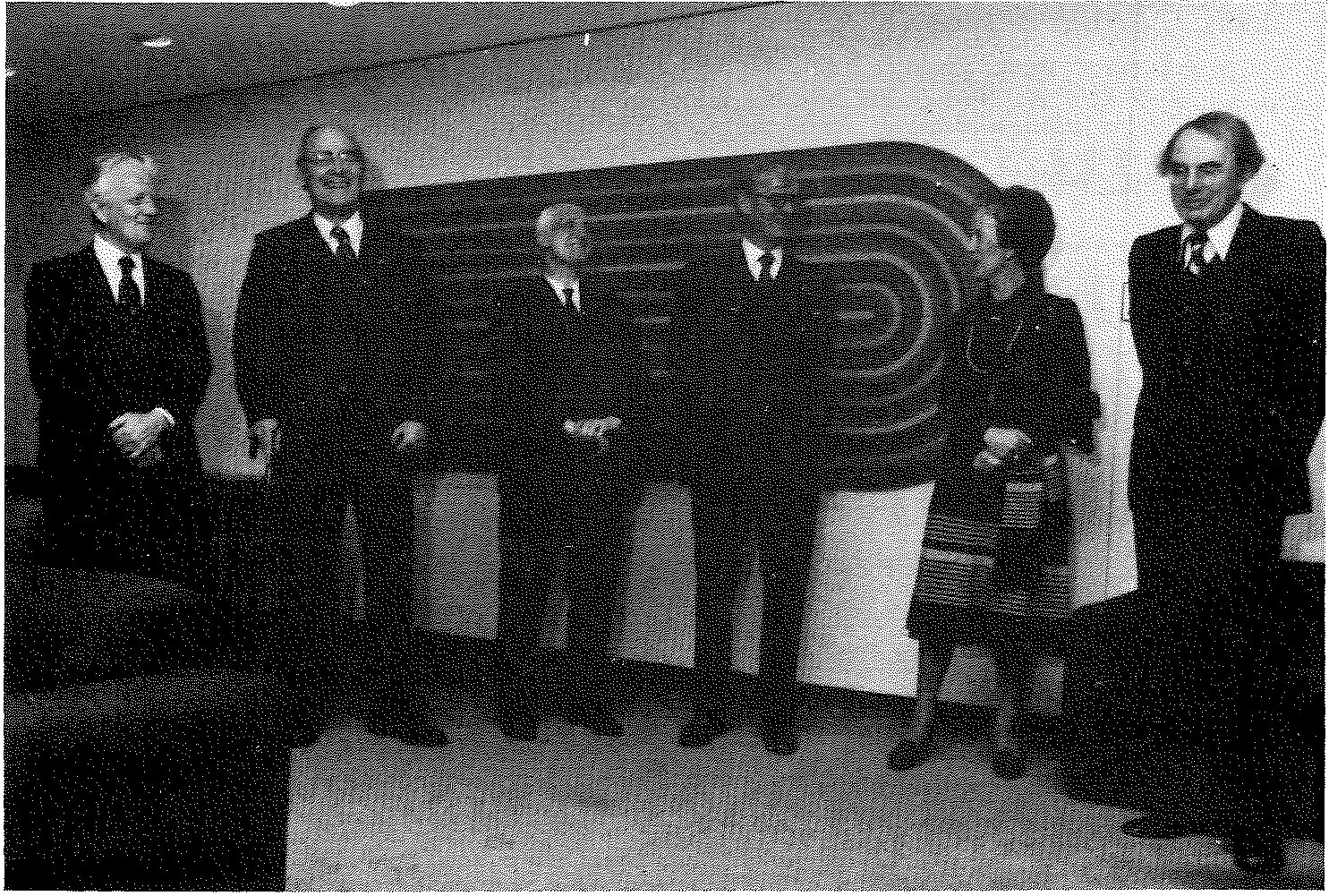
bout de papier: Did you still work out of the Biltmore?
SABOURIN: Oh yes. We had messengers who would run material back and forth to the Mission’s Comcentre.
bout de papier: Did you ever get a chance to go out to the theatre?
SABOURIN: The odd time. You got a day off about every ten days. We would stand in line all day to get tickets to see South Pacific that same night. We always ate at the same place. There are so many restaurants that are different now than in those days. Not long after the first time I went to the U.N. they wanted to post me to New York because the man I had been working for in the Information Division had been posted there, but there was no way I could go there as a Grade two secretary. I knew my income would not be enough to keep me going.
bout de papier: Were promotions slow then? How long did you have to wait to move from Grade two to Grade three?
SABOURIN: I joined as a two. So a couple of years after that I became a three.
Then, of course, they offered me New York which I refused. After that they wanted me to go to Turkey and then to Paris. In those days there was a shortage of bilinguals and I kept saying “no I did not want to go.” Personnel phoned me and I was told I would never be asked again to go on a posting and I would never be promoted. I was a rotational person who would not rotate. Then policies changed and they had some non-rotational staff, although very few in the stenographic field, which pleased me but might not have pleased other people. But I could never worry about what other people were thinking.
bout de papier: When I was speaking with Charles Ritchie, he said that when Jules Léger became undersecretary he thought that was the turning point as regards the use of French. Until then he said almost everything in the department was in English. There really was not much recognition of the French fact except on post and that was why a lot of Francophones liked to go on post. Did you do your work in English?
SABOURIN: When I first came to the Undersecretary’s office in 1952 there was no bilingual typewriter in that office. I was told to go to the stock room and find myself a typewriter. There was one with a bilingual keyboard and it would cost $285 to put it in shape because it was totally broken down. When Mr. Léger was undersecretary I did not work for him. I did some of his French work, but he did most of his work in English. He would write letters to his French colleagues at posts and to other government colleagues who might have written to him in French, or if he was initiating something. As I recall, there really was not very much of official anything in French. Part of the problem was that secretaries did not have bilingual keyboards. The department was way ahead of a lot of other government departments in promoting bilingualism but even so the typewriter situation was a big drawback.
Even in the days of Mr. Cadieux, if somebody drafted a letter in English to Mr. Léger for Mr. Cadieux’s signature, the accents would be put in by hand. To me that was unacceptable. To Mr. Cadieux it was unacceptable. So every time that happened, I was commissioned to phone the head of division where that letter came from to ask why. I remember telling Personnel that we were all supposed to become more bilingual, but how could we if we did not even have the machines? I can not tell you the many times I said that to people! Finally in the 60’s there was a rule made that all typewriters ordered in External Affairs were to be bilingual. I always say that when I die they can put on my tombstone “Got the accents on the keyboards in External Affairs”. To me there was nothing worse than putting accents in by hand, but some people thought it was quite acceptable.
bout de papier: When did the big change come? The impression given is that it was all English, even among some of the Francophones, as you pointed out.
SABOURIN: It really changed when Mr. Cadieux was undersecretary. There were more bilinguals. There was more interest in being bilingual and doing the right thing. I remember that at the beginning, people who knew something should be in French, would come to me and ask me if I would please do this letter because it was to so-and-so and would I type it for them. I ended up doing work for every Tom, Dick and Harry knowing it was for my boss’s signature. I finally had to speak up and Mr. Cadieux agreed that I really could not undertake to type all the French material that was going to be signed by him but drafted in other divisions because we had our own work. When I was doing the work, however, I thought “my goodness we are becoming bilingual so I had better help”. I was always anxious to help anybody at all times when it was possible.
bout de papier: Administration takes up a lot of time now. Did the undersecretary of the day spend a lot of time on personnel management?
SABOURIN: In earlier years the same problems did not exist because there were fewer people and fewer missions abroad. All the undersecretaries I knew were all very human people. When required, they would certainly deal with whatever had to be dealt with. They were not machines. Knowing that undersecretaries were busy, when they would come out and say “that was an incredible memorandum”, I would look up who drafted it and phone them. I have always believed that if you do something wrong you always hear about it, but how many times when you do good things you never hear, so I would phone the author and say the undersecretary thought his piece was very good. Of course, I had the undersecretary’s permission to do that.
bout de papier: That would have been a big boost.
SABOURIN: I appreciated it when people helped me. When you work for the undersecretary you cannot go in and moan and groan and complain bout all kinds of things, whereas in a division you can go to your boss. I could not, and I did not. But I always relied on a few people in the department at different levels and if I had personnel problems, not necessarily my own but different things, I would just go and speak to them. I always worked.
bout de papier: Talking about some of the undersecretaries. Obviously they were different men, all very capable. What were your impressions of some of them?
SABOURIN: Norman Robertson never asked for anything. He would just say something right out of the blue and I would go and sit at my desk and wonder what he meant. Then I would go in and volunteer something. He never asked, which meant you really had to pay attention and be interested in what you were doing. You had to want to be the best you could be and then it would fall into place. I am not talking about shorthand or typing, I am talking about other things which you have to do as a secretary. He was not a demanding person.
Quite often people wonder about wives and I guess it is more important when you go to a post abroad how people all get along. Mrs. Robertson is an extremely nice lady. She spoke to the Wives Association a couple of years ago and she was very good.
Mir. Léger, I knew him more when he was assistant undersecretary because I worked for him full time, had a terrific sense of humour. I remember when the World Health Organization had a big project on birth control in India and Mr. Léger was dictating a memo on the subject. He said to me: “What am I doing? Here I am the brother of a Cardinal.” Mrs. Léger was just the same way, thoughtful, kind, wonderful humour.
I used to go to all the meetinas in foreign lands attended by the undersecretary. That meant I went to all the NATO meetings, all the Canada-U.S., Canada-Japan, Canada- U.K. and Prime Minister’s meetings. I worked for everyone while there, and this continued throughout my career. In that respect, you got to know people in a different way. Mr. Robertson always worked very hard. He had been High Commissioner in London twice. The first time we went he asked if| had been to the office yet. I said no, and he said I had better go because they wanted to look me over. He was well loved in England.
bout de papier: What about the Ministers. Were they a bit more remote?
SABOURIN: In Ottawa certainly but not on delegations. I went to meetings with Prime Ministers Pearson, Diefenbaker, and Trudeau, and trips to Russia with the Prime Minister and the Minister. These gave me an idea of how things were abroad. You know you go to a country and some people come back and they are experts and they have been there for a week.
Mr. Robertson was followed by Mr. Cadieux, and he in turn by Mr. Ritchie. Mr. Ritchie had his stroke while he was undersecretary. He worked extremely hard and he had a very strong physique. He was the kind who would fly directly back from Tokyo, come to the office during the day, and then drive to New Brunswick the next day.
bout de papier: You have lived through a number of transitions obviously, both when the government changed and when the undersecretary changed. Yet you stayed on. Was there any question or was it understood that you would stay?
SABOURIN: I am sure there may have been questions sometime – “stuck with Pauline again” — you know. But I must say a lot of men in the undersecretary’s office for whom I did not work kept complaining that their secretaries kept changing every six months. In those days I used the American State Department as an example, because they had a non-rotational staff and a rotational staff. I kept saying that it the Americans do it it must make some sense. But rotationality was departmental policy. People all have different preferences so lam sure that some of the men might have wished so, but “Pauline is here so what do we do”.
After a while I was probably older than some of them. We had good people. We had Suzanne Filion, who was non-rotational, who did the registry work. She just retired from the department. We had Marcel Delisle, who was the messenger for years and years.
bout de papier: When the government changed in 1957 and later when Pearson came in 1963, did you notice a ditterence?
SABOURIN: No. It was not up to me to even pay attention. You read about things and you might not agree with them, but I was not supposed to comment and I did not. I was not interested in politics as a public servant. I did not want to change and go to work for a member of parliament. It did not appeal to me at all. The men obviously would not comment in front of me if they had any thoughts or opinions and they did their work extremely well for whomever was in power.
bout de papier: Regardless of who the Minister was?
SABOURIN: That is right. I liked all the Ministers. Mitchell Sharp, Paul Martin, Howard Green, Sidney Smith. He died not too long after he came to office. I think it was too much of a change from what he had been doing. We went to Latin America in 1958. We visited Brasilia, then to the inauguration of the President of Mexico. I went back in 1968 when they had a great ministerial mission, 10 countries in 30 days.
bout de papier: Looking back, any regrets?
SABOURIN: Oh my goodness no, right back to the beginning. Working hard never hurt anybody. I lived at home and had my mother, so I did not have to worry about anything. I could not have worked as hard as I did for so many years without her. People ask me why I never married and I tell them I have been working for close to 37 years, and I have always said, I only do one thing at a time. When I am married, I will not be answering this telephone!
bout de papier: You were made a member of the Order of Canada?
SABOURIN: Yes, in 1975. Mr. Ritchie was the undersecretary at the time. You know, my whole life is related. When I want to remember something, to whom I worked for and what meeting was going on in what country that I was going to.
bout de papier: You may not have been rotational but you must certainly have travelled a great deal?
SABOURIN: Yes. I have started to write a book and at the moment I am calling it “Forty-seven countries in Thirty Years” or “What Happened to my Life”. There is a club in Toronto that to belong you have to have visited 50 different countries. Now when I travel it is all on my own time and money which I really appreciate. I do not have to carry a typewriter any more.
bout de papier will, I hope, give me an opportunity to talk further about my work for A.E. Ritchie, H.B. Robinson and A.E. Gotlieb, former undersecretaries. If not, I know my former bosses know what I would have said without seeing it in writing. I continue to be happy, working, since May 1978, for the Commissioner of the Northern Pipeline Agency, the Honourable Mitchell Sharp.
bout de papier: Miss Sabourin, thank you very much. A
View the original scanned pages →
Originally published in bout de papier, Vol. 4, No. 1 (1985) — Winter 1985 // Hiver 1985, pp. 14–17. Read the rest of this issue →



