
bout de papier, Vol. 30, No. 4 (2019), pp. 22–25
In late July 2018, bout de papier had the chance to sit down with David Morrison to talk about The GAC Files, a podcast inspired by the people, events and ideas that shape Global Affairs Canada. The GAC Files is one of the first Government of Canada podcasts originating from the ranks of public servants, and sheds a unique and innovative light on the work our department does. This interview has been condensed and edited for clarity.
So why a podcast?
I came into my new job [as Associate Deputy Minister at Global Affairs] convinced that organizations don’t communicate well enough internally, which leads to people not knowing what the journey is, where we are in the journey and how their individual work fits in. l’ve seen it done well at UNICEF where everyone who works there seems to know the four elements of their strategic plan and how their own work contributes, and I think this makes an organization generally stronger.
I found a trust deficit at GAC. People were doing all sorts of great work on human resources, for example, but nobody believed in senior management. There’s a concept of “they” — as in “I was afraid they would take away my posting”, or “they never stick to their promises on HR”.
All of a sudden, I was the “they”.
I do know why some people feel cynical about some of the things that have gone on at GAC, and I understand it. I decided it was kind of on us, as senior management — we weren’t communicating out well enough that we were actually sweating the problems that everyone brings to our attention: the need for more promotion processes, the need for more transparency, where we are on the road to gender parity in the EX ranks, and so on. The frustrating thing, in my view, was that sometimes there was a good news story that we hadn’t told effectively enough.
Then along came “Me Too”. I worked in the department in the early stages of my career, and then left for 17 years. I joined right at the end of the 1980s, and if you believed even half of what you heard in those days about the shenanigans that were going on, we had a problem at Foreign Affairs. When I began to look into the variables that create situations in which bad behaviour occurs, I realized we had a perfect storm: small branch offices (Embassies and High Commissions) dominated by men, who controlled access to what everyone wanted (promotions and assignments) in the days when all of that traded upon reputation. There’s a real power asymmetry, and it probably, historically speaking, led to a whole bunch of bad behaviour.
Someone I respect put this to me as a real leadership moment, in that, before something forced us to react, senior management should get out front. From that point, it took about eight weeks to get out a broadcast message. I think the eventual message was actually quite good, but my frustration was that the time it took us to communicate was far too long. This is when I first hit upon the idea of a podcast as a new means of internal communications at GAC.
What were some of the challenges you faced starting an official podcast?
The first challenge was when I was told by colleagues: “This has to be on the intranet.” I was convinced that if it simply sat on the corporate intranet nobody would ever listen to it. You wouldn’t be able to download it onto your device. It would just be people listening at their desktops which kind of defeated the purpose I had in mind; you wouldn’t be able to listen in the car, at the gym, etc.
We never asked for permission, because it wasn’t clear who to ask! I had only recently become a deputy minister, so I kind of just asked myself. Certainly I told Ian Shugart.
The second speed bump was official languages. I kept being told that “you can’t do this because everything will have to be in both languages.” I really pushed back because I thought it would be sufficient to do what Canadian public servants always do: some French, some English and try to respond to questions in the language they were asked. I thought that would be sufficient. And as anyone who listens to The GAC Files knows, my French is not great, but I figured I could make a go of it. In the end, I opted for a bilingual format but also to have transcripts of all episodes in both languages. That was kind of like a belt-and-suspenders approach to ensure we were in compliance with official languages policy.
Tell me about the sausage-making of The GAC Files.
So, when I got excited about this, I googled “how to do a podcast.” It’s actually pretty easy: you need a couple microphones, a device to record into and then you sort of send it to iTunes and Stitcher or other hosting services. In terms of approach, I thought I would simply imitate the format of one of my favorite podcasts, which is called The Axe Files and features David Axelrod, former President Obama’s strategist. It was really about interviewing my colleagues and getting their stories. I think many colleagues at GAC have very interesting stories, so I didn’t worry about running out of topics. I eventually pitched the idea to the people in my office. Some of them raised their eyebrows, but they were supportive or came around. We brainstormed about how it could work, and how long each episode should be, who should be interviewed, and so on.
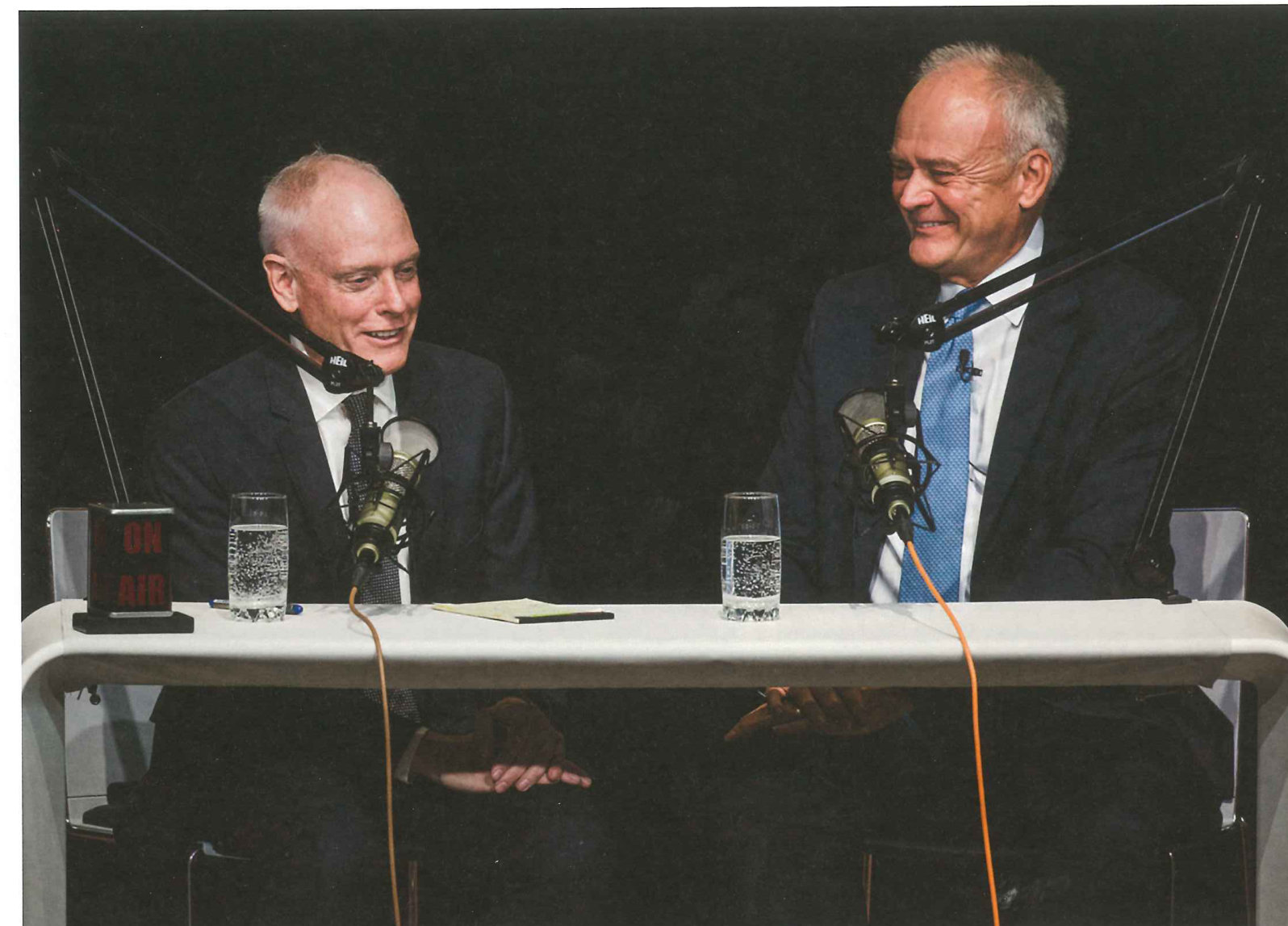
We then brought in internal communications — the L-branch — and went over some of the tech issues with the S-branch. At first the acting ADM of Communications, Charles Mojsej, sat in on each interview. Now it’s pretty routine. The team comes to my office and sets up the mics in about 15 minutes, before the interview. Andrea Martin takes pictures and there’s a sound person who works the levels during the recording session.
I get something about the person to be interviewed a couple of nights in advance if I don’t know him or her personally. We deliberately started with colleagues who are also friends of mine, like Stefanie Beck and Peter Boehm, because I knew I could talk to them and get things going in a way that would be accessible to a new audience. That’s why we didn’t start with the harassment episode, but only wove it in later. As I got into it I found I was keenest to focus on the individual and his or her journey. With Peter, I asked about his special-needs son, and what I wanted to get at was the support he had — or hadn’t — received from the department, because that can be an issue. Stefanie’s a single parent, I’m a single parent, so what’s that like when pursuing an international career?
I did one with David Da Silva, who in addition to being a very good and talented officer, is co-chair/ founder of the LGBTQ+ network. The department has always been able to tell employees that are going to be posted what the legal framework is for same-sex couples in Chile or Algeria, but we learned how the network he’s involved with has stepped up to tell colleagues what it’s actually like to live in country X or Y.
I recently interviewed Sacha Levasseur-Rivard. He was a pure development guy, then worked in a Geo, and now he’s doing Public Affairs. So that’s a story of a fairly young person navigating an amalgamated department. And that’s not just his story, that’s a story about the modern department.
I’m fascinated by people’s stories. I saw the podcast as a way of humanizing people, break down barriers, and try to catalyze a GAC-wide conversation on things that are important.
What would you say has been the most surprising thing about creating a podcast for the department?
Just how easy it was. From me saying “I have this idea,” to being on iTunes with three episodes, was about five weeks. Or perhaps the most surprising thing is a combination of how easy it was to start and what an appetite there is for learning more about what it’s like to work at GAC.
What are some of your favourite podcasts that you would recommend to bout de papier readers?
My favourite is The Axe Files, the one I’ve already mentioned. It’s long format, they last an hour and I listen to them when I’m running. I learn a lot about the people he interviews but also a lot about what’s going on in US politics or US public life.
My first podcast, like many people, was the Serial podcast on Adnan Syed, which was like a radio drama (an NPR investigative journalism podcast into the death of a high school student and subsequent trial and conviction of her boyfriend). I think I googled “Best podcasts of 2014/2015” and listened to that. I listened to S-town (another NPR investigative journalism podcast about an alleged murder that took place in Woodstock, Alabama).
I listen to Desert Island Discs (a BBC Radio 4 interview program about what people would bring to a deserted island) and you can go back 20 years and listen to some episodes.
I also listened to Presidential, which was done in 2016 by a young woman at The Washington Post, Lillian Cunningham. She figured out that Trump was going to be the 45th President of the US and that he would be elected roughly 45 weeks into the year, and so every Thursday for the whole year she had a podcast on one of the American presidents.
In January 2019, David Morrison left GAC to become Foreign and Defence Policy Advisor to the Prime Minister at the Privy Council Office.
Originally published in bout de papier, Vol. 30, No. 4 (2019), pp. 22–25. Read the rest of this issue →



