
bout de papier, Vol. 3, No. 3 (1985) — Fall 1985 // Automne 1985, pp. 13–16
Behind the ruddy-elfin features, owlish eyebrows and sliding glasses are a pair of penetrating eyes that give a measure of their owner. Gentleman, scholar and diplomat, John Holmes embodies the talents and traits of all three professions.
Mentor to several generations of students of international affairs, John Holmes was born in London, Ontario, in 1910. After working as National Secretary at the Canadian Institute of International Affairs, (CIA), he joined the Department of External Affairs in 1943 and was shortly thereafter posted to the Canadian High Commission in London as First Secretary. Later, after serving as chargé in Moscow, he headed the U.N. Division and he sat as Canada’s permanent representative to the fledgling United Nations. Prior to his retirement from the department in 1960 he was Assistant Undersecretary of State for External Affairs. He then rejoined the CIA as Director- General. He is currently Professor of International Relations at Glendon College, York University, and Research Director of the CIA. John Holmes is the author of two collections of essays on foreign policy: The Better Part of Valour (1970) and Canada: a middle aged power (1976) as well as the two volume set Canada and the Search for World Order (1979, 81).
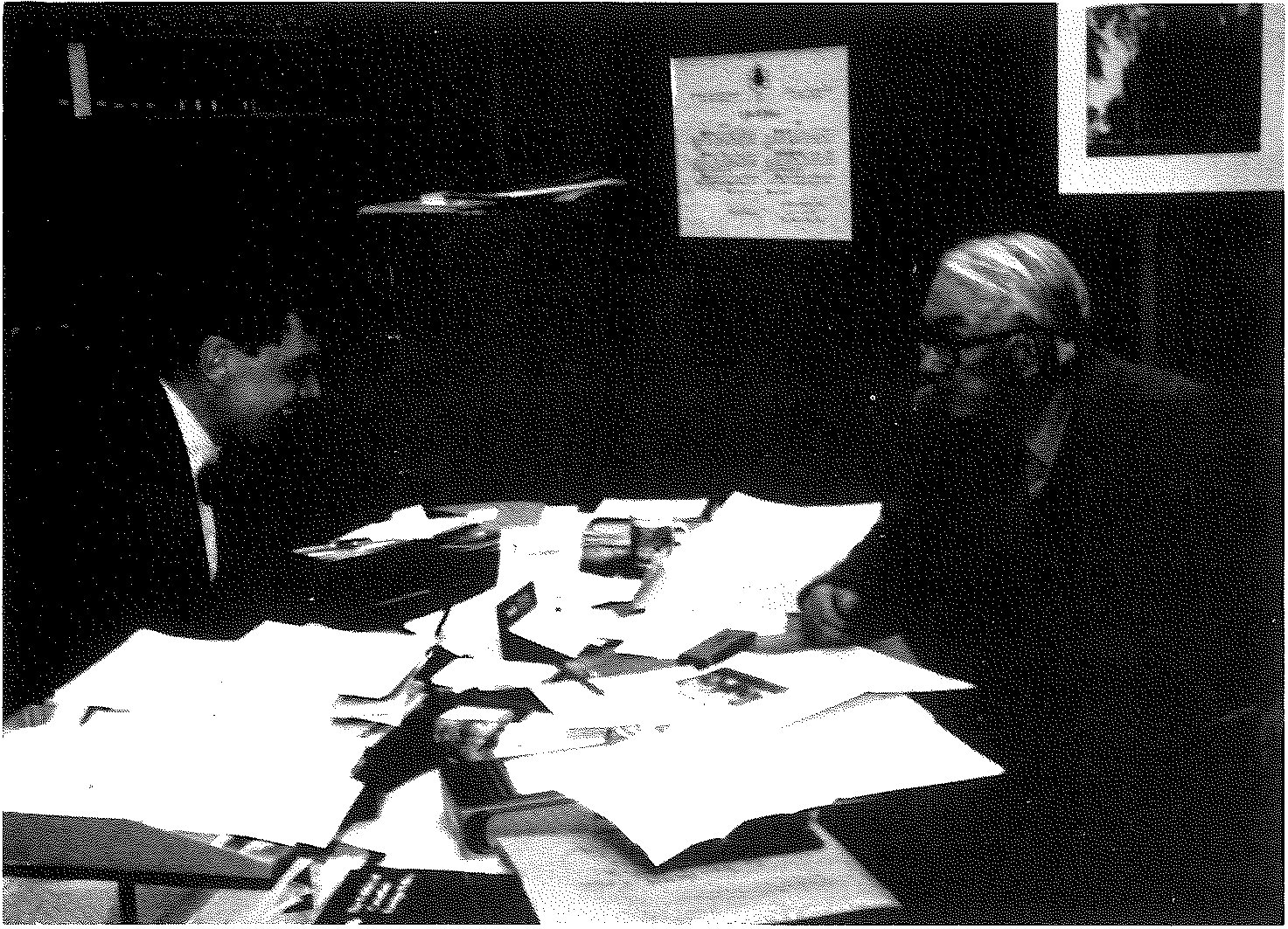
bout de papier interviewed John Holmes at his office in the CIIA headquarters in Toronto.
bout de papier: Why did you leave the foreign service in 1960?
J. HOLMES: To become president of the CIIA. I had been with the CIA before the war and I was taken on by External as a war-time temporary. They needed additional officers and anybody who had bad eyesight or was otherwise handicapped was eligible, so I joined intending to come back to the Institute at the end of the war. But by the end of the war with the expansion, I was in London and involved in the U.N. and they still needed bodies so I kept on for much longer than I had originally intended. The Institute subsequently asked me to come back in a new role in 1960.
bout de papier: Politics and the change of government played no role?
HOLMES: I had served the Diefenbaker government for two or three years. It wasn’t like working with Pearson but it was an interesting time and I found it quite a challenge. Mr. Diefenbaker and Howard Green were interesting people with whom to work.
bout de papier: Looking back on your career what were the achievements?
HOLMES: What I spent more time on than anything else were international institutions in general, two in particular — the U.N. and the Commonwealth. I was not involved in the establishment of NATO although I kept in touch and I was in favour of what was being done.
The first job I had during the war was secretary of the post war planning committee where I worked on peace treaties, arrangements for occupation in Europe and Japan and the creation of an international institution. Later I was posted to London where I worked very closely with the British on the peace treaty and things of that sort. I was involved to some extent in the preliminaries with the whole summer of 1945 devoted to a discussion of the U.N. and then I was assigned to the Canadian delegation of the first General Assembly.
I later went off to Moscow for a while, then I went to Paris in 1948 when the General Assembly met there. We were on the Security Council then and I worked with General McNaughton. From then on I was involved in U.N. affairs practically all the time. I spent a lot of time in New York and for a couple of long stretches I was called acting permanent representative which is kind of a contradiction.
I was sitting on that hot seat when the Korean war started in 1950. That was quite a time. And I was there for the Suez crisis in 1956. The development of international institutions is very close to my heart.
bout de papier: You were there then when the compromise was made to admit the new members?
HOLMES: That’s right. That was a great moment! By 1955 Pearson and Martin together, and the team in general, had acquired quite a position in the U.N. by their skill, by their interest in compromise, by their trying to find ways and means to prevent confrontation, so that when the Suez crisis came along in 1956 we had some use. I remember very clearly going down to New York with Mr. Pearson. We arrived a little late. The Assembly was already meeting on the subject.
bout de papier: At this point had you been posted back to Ottawa?
HOLMES: Yes.
bout de papier: What were you doing in Ottawa at that time?
HOLMES: I had a brief interlude at the National Defence College from 1951 to 1952 and then from 1953 to 1960 I was an Assistant Undersecretary and I had responsibilities for the U.N., Commonwealth and the Far East. We had wide portfolios in those days because there were only four or five assistant undersecretaries. The U.N. kept me busy and I was back and forth to New York. The only time I ever sat on a Security Council seat was on the question of Lebanon in 1958. Charles Ritchie was our Ambassador but Charles was ill in Nova Scotia so I had to go down and sit in his seat
But most of the time I was where I liked toi be which was sitting behind, not having to make the speeches, but drafting little statements – making suggestions. I loved U.N. diplomacy. I hated New York but I liked U.N. diplomacy. We always talk about Canadian identity. I never quite understand it because you never had to worry about it there. Canada had a very distinct identity and nobody confused us with the British in the earlier days or the Americans later on, although we worked very happily with them. But there was something about that collaborative diplomacy. We knew we could be effective, we knew we could get things.
Paul Martin put together the majority on the new members in defiance of John Foster Dulles. All this talk about the way the Americans ran the U.N. is a gross overstatement. They certainly did not then. To do that you had to have lots of friends and you had to cultivate friends, you had to get contacts, not just among your own kind, and that was enormously interesting. suppose, also, you couldn’t help feeling that you were helping or trying to create a new world order.
bout de papier: What was in the back of your mind in terms of a vision of Canadian foreign policy? How would you define what you were trying to achieve?
HOLMES: There has been much talk lately about the suggestion that in the early days the Canadian national interest was sacrificed to internationalism and that somehow Mr. Pearson was running off trying to save the world when he should have been at home saving us from the Americans. I think that was utter dribble. The assumption for a long time after the war was that there was no Canadian national interest higher than that of a peaceful world in which we didn’t have to produce an army and which would then enable us to be a great trading nation.
I don’t think anybody thought of this as unselfish. That was a priority and there was strong feeling that before the war we’d been too passive. Now we really wanted to be constructive. Consequently you got this great Canadian interest in constructing a firm basis for the United Nations and the transformation of the Commonwealth from an old Empire, which might have become nothing but a kind of pleasant old boy’s association, into something that was of considerable relevance to the changing world, and finally NATO which to some extent seemed like a retreat from the ideals of the U.N. but which in fact was true to it.
We were not alone in insisting that NATO be made complimentary to the U.N., not a replacement as some people would have had. We think it strengthened the framework. After all, the concept of universal collective security was pretty well abandoned after the Korean War. Nobody said so publicly but it was abandoned because it was an unsound idea, so we passed to the concept of collective defence in NATO. NATO is not a collective security organization, although people say it is. I think this all fitted together and there was a feeling that you were present at the creation.
During the fifties I was also very much involved in the process of collective security. It became a major preoccupation at the time, because of the question of the commissions in IndoChina. For me, this reflected my Far East responsibilities and it was a constant headache.
bout de papier: It was more the French who were involved was it not? Were the Americans a significant influence?
HOLMES: Those people who say we joined the commission to be the tool of the Americans – that was nonsense. I was at the Geneva Conference in 1954. I was an observer at the IndoChina sessions. The Americans didn’t like the Geneva agreement. You may recall that they walked out of them. They gave them only token support. They did not like the agreement or anything to do with the commission. For our part, we accepted what seemed an inescapable responsibility. Better than that, we knew we would not get any support from the Americans. As you say it was a French interest at that time. Later on, I think the Americans began to think that the commission served a useful purpose in maintaining the peace, which is what we were always trying to do.
But that was a terribly difficult thing, certainly. We had previously sent people to the U.N. commission in Kashmir. But in that case it was pretty easy. All you did was to provide some bodies and send them to New York and say “over to you”. The U.N. then looked after them. With Indo China, without the U.N. to fall back on, there was nobody to fall back on.
bout de papier: Was the commission a Canadian idea? Was there any pressure put on Canada to participate?
HOLMES: That’s why we were chosen. The great irony was — MacKenzie King always used to say – you shouldn’t get involved in these things because we hadn’t any interest. Then we found that we were getting involved because we didn’t have any interest. It was because we were rather remote. The idea of the commission was that there would be a neutral chairman in India, a communist country — Poland, and a western country – Canada. We were not chosen at random. The peace commission was quite a strain and it took a lot of my time.
I also attended a fair number of Commonwealth Prime Ministers conferences. I always kept an eye on that, partly, I suppose, because I had been stationed in London at the end of the war. I was at the Commonwealth Prime Ministers’ meetings in 1944 and 1945-46 and then when India and Pakistan made their momentous decisions to stay in the commonwealth, there was a lot of excitement about the prospects. Again it seems I ve got this bias for institutions.
I was never directly involved in Canada/ U.S. relations, although the U.S. was always a major player in all those things. After Ileft the National Defence College I was supposed to go to Washington as minister counsellor with Hume Wrong who had been my boss in Ottawa when I first went there. I idolized him. And then it was decided that he would come back to Ottawa to be undersecretary, and so he switched things around and I went to Ottawa to be an assistant undersecretary. One of the great tragic disappointments of my life was that he held that job for about one week and then died. Fortunately he had already left many ideas. He had such an effect on my own ’formation’ as the French put it, and on so many people. Wrong wrote a wonderful mixture of idealism, and tough realism. Functionalism, of course, as distinct from utopism — I think it is still a part of External. I notice it in people. I’ve been running here for five years a continuing colloquium on International Institutions, the chief purpose of which is to bring some of the practionners from Ottawa to talk with the people trom various Ontario universities interested in institutions. So I see quite a few of them and the same kind of pragmatism is there. Fortunately I think with the idealism too.
bout de papier: You served abroad with a number of undersecretaries. Reflections on some of those you knew?
HOLMES: Norman Robertson was the first for whom I worked. I was very lucky because the shortage of bodies during, and just after the war, meant you did not have to be very bright to get interesting jobs or shoot up. I wasn’t there more than a month or so when Saul Rae, who had been Norman Robertson’s Executive Assistant, had to go off to Algeria, and I found myself picked for the Undersecretary’s outer office — barely knowing the names of the people. That was a tremendous experience.
bout de papier: Were you in the East Block or the Langevin Building?
HOLMES: The East Block. I was always there — I was never anywhere except the East Block. I still think of External Affairs as the East Block. But Norman Robertson was incredible, a towering intellect. A person of enormous human warmth, kindness, thoughtfulness and all sorts of things like that. Jack Grantstein put together a very good book on him, the only trouble was that Robertson hadn’t written very much. His wisdom was mostly conveyed in the spoken word. I can remember at that time my job was to pass stuff back and forth watching things and I was new to the game. I was a student of international affairs. I had worked with the Institute. I suddenly realized that I had no feelings for policy, about what to do and I watched with amazement how Robertson would sum up a situation and see what was possible. He always had to work within what he knew would be the limit prescribed by the Prime Minister. It was all very well to disagree with MacKenzie King, but what I began to realize with Robertson was that you went as far as you could in the direction you thought you should go, but still within the parameters of the possible.
Norman Robertson also instilled in me a very strong and rather orthodox view of the role of the civil servant. You very much were a civil servant and it was your job to certainly put forth ideas for suggestions. But nobody had elected you to decide the foreign policy of the country. Mr. King’s ideas were a little hard to swallow but he was the elected official. However, you didn’t have the feeling of constant frustration. Robertson could have influenced King a great deal. Hume Wrong, whom I also worked for had wonderfully fertile ideas. But he of course couldn’t get along with Mr. King. Mr. King didn’t like him. Partly, one suspected, because he was the grandson of Edward Blake.
Then I was fortunate because I went off to London where I worked for Vincent Massey which was a very interesting experience too. He is a much maligned man. He had his faults and his follies but also great qualities. He was very kind and thoughtful to his staff, he and Mrs. Massey. The London posting meant that I had a lot more responsibility than I might have had. To say that Massey only looked after the ceremonial part of the job would be unfair — he did it and superbly well. I’m not suggesting for a moment that that was a frivolous side, particularly when it was anything but frivolous. He kept a very careful interest in what was going on in policy in general but it meant that he left a lot more freedom to a very small statt
I was still pretty junior but I was the liaison with the Foreign Office and Commonwealth Relations Office. Doug Le Pan did the economic work – I had a wonderful time. I drafted all of Mr. Massey’s dispatches and letters on foreign policy. London was very important then because we had so few missions. We were very dependent on the British. A foreign office messenger would put on my desk a couple of times a day the boxes with the foreign office dispatches. That gave you an insight. I could read what the British Ambassador in Istanbul was writing. I don’t know if they shared everything but certainly a pretty large selection. We had to do a lot of reporting, not simply on the U.K. but on other broader general matters and particularly the relations among the big four. Issues like peace treaties, plans for the peace settlement. It was a fascinating place to be.
And then Mr. Massey retired and Norman Robertson turned up. I had a longer period with him in London which was wonderful because it was a more leisurely time for him. In Ottawa Robertson just worked all the time. Needless to say he worked hard in London but he also took a lot more time off. I lived with him for a while in his house and I could enjoy this extraordinary mind; wandering around in London and doing things like that.
Then I came back and I went to Moscow and I was in Paris for the Assembly.
bout de papier: Who was our Ambassador in Moscow?
HOLMES: Nobody. After the Gouzenko affair, and for some time afterwards, the Russians had kept their ambassador back in Moscow. But we never broke relations. I went there as a chargé d’affaires. I went in rather a hurry because Robert Ford, who had been holding the fort, was not very well and we had to get him out before the ice froze in the Baltic and so I was pitchforked in without even knowing the alphabet. I also had to get in there because the Russians were about to celebrate the 30th anniversary of the Revolution. Somebody had to be there. Later I came back to Ottawa. I missed the period when Mike Pearson was undersecretary. By the time I got back he was minister. Then Arnold Heeney became undersecretary and I worked with him.
bout de papier: He wasn’t from the foreign service was he?
HOLMES: He was from the Privy Council. He was moved over. I had an experience of very good undersecretaries. All of whom were quite different. Arnold Heeney was beautifully organized, wonderfully disciplined. I think people found him for that reason over-forbidding. To me he was a very close friend. I got much closer to him later on.
And then Gilles Léger. Gilles and I had been colleagues in London so he and Gaby were very dear friends. I was delighted when he became undersecretary. I think it’s a rather interesting point that Léger was, certainly in London, junior to me. He was junior to several of the other assistant undersecretaries. If you had had the kind of power struggle people talk of, we should have resented his appointment. But we were extremely enthusiastic about it. First of all I think we all agreed that it was high time that we had a francophone undersecretary. And he had such qualities – he was such a fine person to work with. One of his great achievements was moving into that difficult situation and getting such loyal support from everybody. Two or three of us had no desire to ever be undersecretaries. I never wanted to be an undersecretary. I enjoyed the job of sitting behind the delegates, passing the notes up – not making the speeches. Gilles was extremely sensitive and intelligent and knew how to work with people who were roughly on his level, although we all recognized his seniority.
It was a difficult time. We had a lot of problems like IndoChina. A constant headache; it was very difficult to know what to do, not unlike many other things in the mid 50s. Then came the change of government — that was a great challenge.
bout de papier: How did you prepare briefing documents for the new minister?
HOLMES: One of the problems was that we hadn’t had any experience. We had to assume that all previous instructions were cancelled. On the other hand, you know what the agenda in External Affairs is like. You couldn’t possibly get the new minister to give you his opinions on all these things and, of course, through the summer of 1957 Mr. Diefenbaker was our minister as well as being Prime Minister, so it was difficult to get his ear.
bout de papier: What did you do then? How were decisions made?
HOLMES: Unlike most people, I saw a lot of him in the summer partly because of the things I was doing and partly because Gilles was away. So quite a bit of the time I was acting undersecretary. I never had any complaint about the way I was treated by the Prime Minister. He really had a terrible
I can remember on one or two occasions when I was standing in a great queue outside his office. He would come out and say I’d better come in and I would try to explain the foreign policy issue. I remember that at that time we were the only small power on the five power U.N. committee on disarmament. This was a matter of much importance. We were in high company and they were meeting in London. The instructions had always gone to the minister and of course; the previous minister knew all the details. It was no fault of Mr. Diefenbaker — he didn’t know the details. I used to find that I would go in sometimes with things like We think you should abstain on the French amendment to the third paragraph of the Soviet resolution’. Well, it was hard enough for me to understand it. I found him very good about that and he’d be inclined to say ’well what’s your advice’. I don’t remember any unpleasantness. I remember one time I drafted a speech for him. I’d never done it before. I was used to drafting them for Mr. Pearson and he had a different style. I drafted something a little more florid than I would have for L.B.P. and I wasn’t quite sure about it. He telephoned me a few days later and said I understand you’ve spent the weekend drafting that speech and I just wanted to tell you it was one of the finest speeches I’ve had.’ I’m sure it wasn’t. If he had this deep suspicion of civil servants I never felt it. I got along with him quite well. Then of course Sidney Smith became minister in September and then we had our own minister and things were different. Then Howard Green came along. He was a great person to work for.
bout de papier: How do you see the role of the diplomat and journalist?
HOLMES: This is one of the things I learned from Mike Pearson. He liked the press and I don’t mean he liked it for purposes of publicity – he liked good journalists. You look at some of his closest friends, Scotty Reston of the New York Times, Grant Dexter of Winnipeg Free Press, Max Freeman of the Manchester Guardian, people like that. I used to go around with them a good deal to various places. I knew they liked him. I knew that even if he couldn’t tell them anything he would give them a good story. But it wasn’t only that. I think he liked them also because he was interested in their views, whereas a lot of diplomats tend to be suspicious of journalists. I got to know so many journalists working with him.
We were always quite close to them and it was an easy relationship. Pearson knew their position and he was sympathetic to it and would try to give them something. Occasionally, and I can think of one journalist, who said that one of the troubles with Mike was that he’d tell you something in confidence that you might the next day find out in some other way and now couldn’t use it.
This knowledge of journalists was particularly useful when I went to Moscow. It was terribly difficult to get any information. You were totally isolated — you had to get it where you could find it and I found that of the good journalists there, particularly the ones who had been there a long time, often would have contacts that went back to the war time when things were easier. People like the Guardian correspondent and a rather junior United Press reporter called Walter Cronkite, people like that.
I remember during the Diefenbaker period when one of the correspondents, a Globe correspondent I think, had a long story on defence policy. He had clearly talked to a lot of the people in National Defence. He didn’t quote them but he used the usual “informed source”. Diefenbaker was furious and clamped down and said we weren’t to talk to the press at all. None of us. That was very embarrassing because you couldn’t explain why to people like Blair Fraser and Norman Smith who were among my closest friends. This didn’t mean that I ever betrayed confidences, but they were responsible journalists and I had helped them to understand the issues which is what I think a foreign service officer can and should conscientiously do. It doesn’t mean you give away secrets; it doesn’t mean that you tell them what the government’s going to do; it doesn’t meant that you reveal secret information but a good journalist often called and said ’Look, how do I size this up’.
bout de papier: Of course, this was off the record
HOLMES: That’s right. You weren’t to be quoted. I think that’s kind of an easy relationship. Of course a journalist has to earn it. Once a journalist betrays your confidence then he gets no more briefing. I think recently in some of the discussion there has been too much of a tendency to describe the relationship in absolute terms. During my time in Ottawa and around the U.N. or even in Moscow it was a cosy kind of thing – there were a few journalists whom we knew. We knew the ones you could trust and the ones you could not. By that I mean the ones that get what you said straight and the ones who misunderstand. I don’t remember any great problems.
bout de papier: John Holmes, thank you very much.
View the original scanned pages →
Originally published in bout de papier, Vol. 3, No. 3 (1985) — Fall 1985 // Automne 1985, pp. 13–16. Read the rest of this issue →



