
bout de papier, Vol. 3, No. 2 (1985) — Summer 1985 // Été 1985, pp. 23–24
The first thing you notice about Roy McMurtry is his physical size. A big man, he still moves with the slow but sure step of the university footballer which he was at Trinity College. The eyes are hooded and the turmoil of a decade in politics is etched into the contours of his round but still boyish face. He makes no pretence at oratory; some of his convoluted phrases would leave a purist wincing but his easy smile and friendly manner make him eminently likeable.
Born in 1932 in Toronto, he lost his first try for a seat at Queen’s Park but triumphed in Eglinton in the 1975 general election. Appointed Attorney- General, he soon achieved a high public profile for his crusades against drunk driving and his successful efforts together with Roy Romanow of Saskatchewan and Jean Chrétien in the constitutional patriation. He sought the Conservative crown after the resignation of Bill Davis but was knocked out after the first ballot. Within the week he was lunching at 24 Sussex where he was asked by his fellow Irishman and friend Brian Mulroney to become Canadian High Commissioner in London. It was an offer he could not refuse.
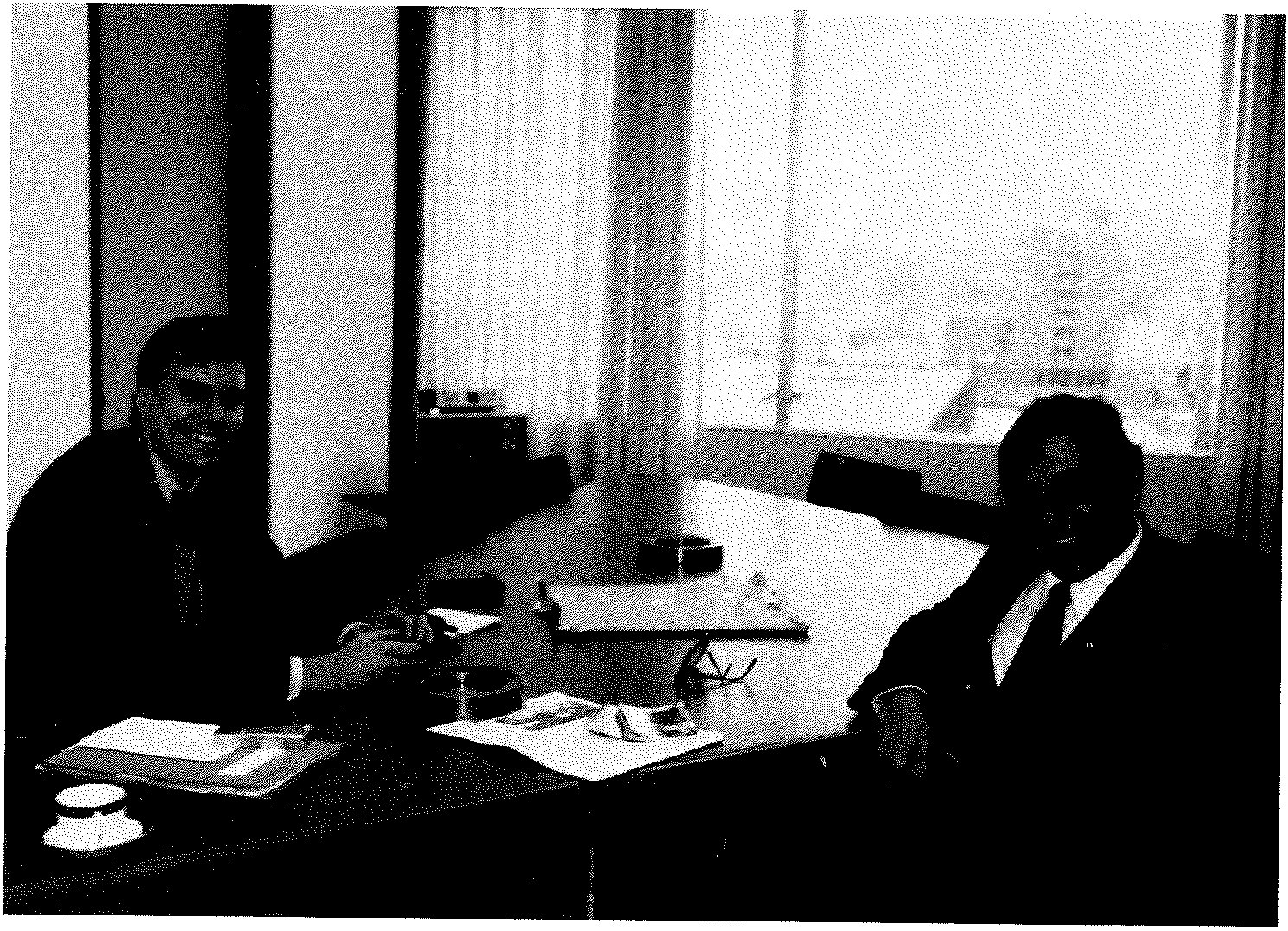
bout de papier interviewed Roy McMurtry at the Departmentof External Affairs shortly before he took up his posting.
bout de papier: Why do you want to be High Commissioner?
MCMURTRY: It’s obviously one of the most interesting jobs that one could ask for in the public service. I don’t think you have to be any sort of an expert, any kind of an expert on international affairs to know that the High Commissioner’s job in London is one of the most interesting jobs in the public service. Although my political background is of course provincial, I have always had a great interest in federal politics because of the international dimensions. As a provincial cabinet minister, I found opportunities to visit a number of nations representing the province and the country in my role as chairman of the Cabinet committee on race relations. While this doesn’t represent experience of any particular significance it does give me a number of glimpses as to how exciting it would be, how interesting it would be to represent Canada in one of the important capitals of the world.
bout de papier: Why Britain in particular?
MCMURTRY: Britain is of particular interest to me because the institutions that I’ve been most closely associated with in my adult life are of British origin, namely the justice system and the parliamentary system. I grew up in a legal family where the relationship with the British justice, judicial and legal institutions were an important part of my father’s life, and I was in practice as a trial lawyer for 17 years before entering politics. Even before entering politics, Great Britain always represented a very special part of the world in my life because of the legal association. And then when you add to that the parliamentary dimension and the other obvious areas of interest, a posting in London clearly is a very special opportunity.
bout de papier: How are you going about preparing for this new role?
MCMURTRY: I recognize the fact that the preparation for the new role, however careful it is, however comprehensive it is, will still be something less than adequate for the challenges, the opportunities to make a contribution. It is going to be a major learning experience on the job and while preparation, of course, is meeting as many people who have advice to offer, clearly there is a great deal to learn and most of the learning will take place in London.
bout de papier: Are you reading any books to make this transition?
MCMURTRY: I have been reading with great interest the London diaries of Charles Ritchie, re-reading the section of the Howard Ferguson biography – (Peter Oliver’s work on Howard Ferguson) dealing with his years as the High Commissioner and, of course, I have been given some very good briefing materials from the Ministry. Just reading through the briefing material that was given to Mr. Kelleher for his trip during the fall gives one a real flavour of what the job is all about and the multidimensional role that is played by the High Commission in London.
bout de papier: You talk about goals and roles, when you spoke with the Prime Minister did he say ’I would like you to do or emphasize any particular aspect’, or is there something in particular that you would like to emphasize over there, a particular goal that you may have set?
MCMURTRY: Well, I think it is a little premature to talk about goals other than to do the job as well as I can. Trade and investment obviously are a very high priority and will be for many years to come. I have a great deal to learn about international trade and investment coming from a provincial cabinet portfolio that was non economic and one of my goals is to see that we play as effective a role as possible in that area. It will probably be the number one priority. I am enormously interested in all of the other roles of the Commission, public affairs, representing Canada in the mother country as it were, is very special particularly as I think that there are many people in both countries, rightly or wrongly, who believe that many of us on both sides of the Atlantic tend to take our relationship a little bit for granted.
This particular relationship has been a very positive one over the years. I was very much a part of the events that created some modest strains on the relationship during the constitution activities. What was interesting to me, having spent quite a bit of time in Great Britain particularly in 1981, was the fact that notwithstanding the strains and the difficult position that I think that we Canadians put Great Britain in over the constitution, I was very impressed with the enormously strong, positive feeling that most people in Britain had towards Canada. At the same time I sort of sensed that, like any family, we have to guard against taking family relationships for granted. When it comes to the relationship between Great Britain and Canada there is always that danger. This will be a concern that will be given a priority. I don’t pretend to have any particular expertise to offer on cultural issues, except that I have always been very interested in issues related to the development of our cultural institutions. I’m rather intrigued by what I’ve heard of the efforts of the High Commission to interest the private sector, for example, to support Canadian culture internationally. That is an example of an initiative which I would like to pursue with a great deal of enthusiasm.
bout de papier: You are making the transition from politician to diplomat. What are the skills you think you bring, and that you can employ very usefully in the role of diplomat?
MCMURTRY: Well, diplomatic skills are essential political skills. I think the most common error that is made is assuming that there are different solitudes: the solitude of diplomacy, the solitude of the working politician, the solitude of the career public servant.
There is considerable overlapping and the personal skills that one may develop in one area will be equally useful in the other areas.
Someone who has been given a major post without any experience in the public service, particularly in External Affairs, may obviously in some people’s minds be a disadvantage because one hasn’t had the training. However, I think that somebody who has had a great deal of political experience and understanding of politics in the broader sense can be an effective advocate on behalf of the career public servants. I think the advantage of having somebody with a political background in some of these posts is that we can help bridge the traditional gaps, particularly at a time when the competition between the various ministries for funding is going to be enormous. This is going to be the reality of public life for some years to come. I wouldn’t have accepted this posting if I didn’t have a strong belief in the importance of the Ministry of External Affairs and I say this well aware of the fact that we’ve gone through a period of time during which there has been some political skepticism voiced about the role of ministries of External Affairs, particularly when communication and transportation is so advanced. I come to my job with a long standing bias that the Ministry of External Affairs must play the most major role and it has an enormously important mandate particularly in a world where the issues are becoming more complex every day. I would like to think that somebody with a political background, who understands the political process, can be a useful advocate for the service in that respect, coming as I do with the fundamental belief as to the crucial importance of the service.
bout de papier: How is your family reacting? Your wife is going to have a major role to play. Are your children going to go as MCMURTRY: It comes at a particularly interesting time because my wife, until this leadership campaign, had not been involved in my political life to a very large extent simply because of the six children, and had not spent a great deal of time with me out in the hustings. Of course the job of international diplomacy involves hustings of a different sort but the similarities are obvious. One of the reasons why this job appealed to me so much was because in watching her performance as we travelled about the province over a period of three months, meeting people at the different regions, I saw how much she enjoyed meeting people and this encouraged me to accept the job because I think she’ll be very effective. The children are all very excited of course. This was the concern because we are a very close knit family and I didn’t really know what their reaction would be. My children range from 17 to 27, so they’re not all at home but everybody was very enthusiastic. Even the youngest ones, who will be with us and will be leaving their friends, are very excited about living in another country — particularly in London.
bout de papier: Thank you Mr. McMurtry.
View the original scanned pages →
Originally published in bout de papier, Vol. 3, No. 2 (1985) — Summer 1985 // Été 1985, pp. 23–24. Read the rest of this issue →



