
bout de papier, Vol. 3, No. 2 (1985) — Summer 1985 // Été 1985, pp. 14–15
by Anne Trowell Hillmen
She was “a woman with a broad brow, wreathed in an aureole of white hair, and a face of aristocratic lineaments and spiritual refinement. … She was conversant with every small detail of political and economic life in Palestine. She had read all the literature in European languages which had been published on Palestine and the Middle East.”
This was a most unusual tribute for a Canadian diplomat in 1947 — a testimony to unique professional competence and personal gifts of an extraordinary order. But then Elizabeth Pauline MacCallum was a most unusual person.
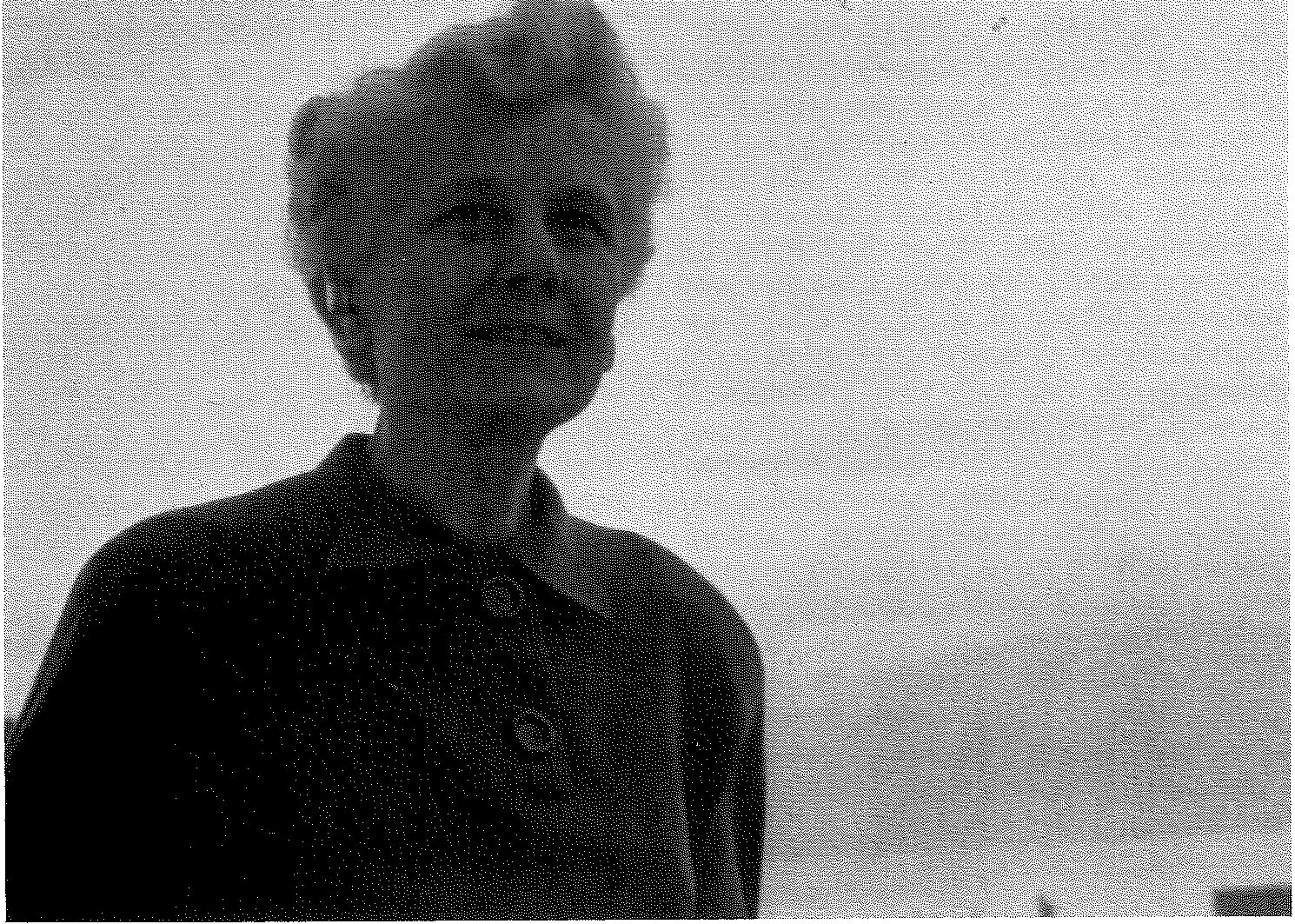
On June 12, 1985, just one week before she would have celebrated her 90th birthday, Elizabeth MacCallum died in Ottawa. Her career was varied and distinguished: a teacher, writer, scholar, and always a student; a pioneer in the Department of External Affairs, Middle East expert, a sensitive, perceptive colleague, and the first woman to serve as a Canadian head of post; a lively, active citizen of her community and of a world about which she cared deeply.
Elizabeth MacCallum, daughter of Canadian Presbyterian missionaries, was born in 1895 in a small town, Marash, in Turkey’s Taurus mountains. There she learned Turkish and Arabic and learned to love the Middle East with a passion that she never relinquished
The MacCallum family was transferred to Kingston, Ontario, in Elizabeth’s teens. She attended Kingston Collegiate and then Queen’s University where she studied under O.D. Skelton, a future Under Secretary of State for External Affairs. She received her masters degree in History and English in 1919.
Financial necessity, and an intense curiosity about her new country, had already propelled Elizabeth out of Kingston. She taught in Saskatchewan and Alberta from 1915 to 1917. There was a war on in Europe, and there was a national service aspect to these prairie teaching assignments. Elizabeth often remembered her part in local farming activities during that period of her life. After graduation from Queen’s she experienced what she later described as two “glorious” years teaching in Dawson City, Yukon from 1919-1921.
Elizabeth MacCallum, however, was not done with research and scholarship. The close of 1921 found her at Columbia University in New York. As post-graduate student in political science and history, she found tremendous intellectual satisfaction and stimulation in the give and take with her professors and with a surprising number of other women students. The quality of those women’s minds, she recalled, was “scintillating,” and the common room atmosphere challenging and rewarding. The contrast with Queen’s was striking; there “we just pushed ourselves through from day to day, doing the things we had to do.” She was at Columbia in 1921-1922 and 1924-1925, punctuating her studies with a stint as Assistant Secretary of the Social Service Council of Canada and Assistant Editor of the Journal, Social Welfare.
In 1925, on the recommendation of Elizabeth’s Columbia professors, she was appointed to the Foreign Policy Association, a prestigious New York-based organization which encouraged the study of diplomatic affairs and sponsored weekly nation-wide debates on current affairs by the policymakers of the day.
It was heady stuff: the electric atmosphere of the exchanges; the possibility, ever present, of violence; the excitement of rubbing elbows with the best minds of the era; the thought that, maybe, just maybe, some good could be done in an already very dangerous world. Dr. Skelton, by now head of External Affairs, participated in one of those debates, this time on Italian fascism.
From 1925 to 1931 MacCallum worked in the Foreign Policy Association’s Research Department. In this work, too, she was a pioneer: the department was then getting under way. She was one of six writer-researchers; they were given scope and intellectual freedom but expected to hold to the highest standards of objectivity and productivity. The more than twenty “monographs” she produced in these six years, mostly on Middle East affairs but ranging all the way to Australian politics, are masterpieces of thorough research, rigorous fair-mindedness, and clear, crisp writing. On Palestine, for example, she understood the complexity and divisions that centuries of history had wrought. The claims of the Jews were honourable and understandable. But weren’t the claims of the Arabs just as honourable and understandable?
During the FPA years she lived near Columbia, which in turn was near International House. She loved the Middle Eastern intellectual’s habit of combining coffee and discussion before embarking on evening study. Elizabeth was always, and preeminently, a scholar.
The “hard-plugging” at the FPA was, as she described it, highly stimulating. It was also wearing and exhausting, and in 1931 Elizabeth retired to a two acre market-garden in Uxbrige, Ontario. This endeavour reflected her long-held conviction that life must be balanced between the physical and the intellectual, and she kept the enterprise up until all of her money was gone.
Elizabeth now returned to New York to work for the World Peace Foundation, becoming an expert on Ethiopia at a time when Mussolini was about to bring that country to the centre of the international stage. She took on a travelling lectureship on the subject – earning more in a single night, $50, than she had in a year with her market garden — and published a book-length study, Rivalries in Ethiopia (1936).
In 1936 MacCallum returned to Canada, this time to Ottawa and the League of Nations Society, another of those post-1919 organizations determined to do everything possible to promote peace through an understanding of international issues. She worked there for four years, before moving on to the Canadian Legion’s Education Service, 1940-1942.
In 1942, at the age of 47, she was invited by the under-secretary’s secretary to share her talents with the Department of External Affairs. There was, she recalled, a “charged atmosphere” in the department during those years. Long hours and an unswerving dedication were the norm, and she gave unstintingly of her time and effort. Entering at the clerical level, for women were not allowed to be foreign service officers in those days, she was responsible for reading and marking up various newspapers.
Before long she was performing the duties of an officer: briefing colleagues, preparing policy papers, and almost naturally taking her place as the department’s resident expert on the Middle East. As part of the Canadian delegation to the San Francisco Conference in 1945 she was involved in negotiations for the peace settlements involving Libya and Ethiopia.
External Affairs seemed to Elizabeth the ideal job. She had bright, energetic colleagues, most with the same university background. There she could also specialize in the life and politics in the Middle East. Her work was both intellectual and all-absorbing, perfect counterpoise to her contemplative existence in Uxbridge.
Following the Second World War, in 1947, Elizabeth MacCallum was one of the first Canadian women to enter the foreign service. During the next ten years, a crucial decade in the history of Canadian foreign policy, she exercised an influence in the shaping and formulation of Canadian Middle Eastern policy out of all proportion to her departmental rank. All material with even a remote bearing on Middle Eastern questions passed through her hands. Whether in New York, as advisor to the Canadian UN delegation, or in Ottawa, she was respected for her expertise and for her strongminded determination to ensure a balanced and humane approach to the problems of the region. She was directly involved in the negotiations surrounding the partition of Palestine, the internationalization of Jerusalem, the setting up of Canada’s first mission in Beirut, and the Suez Crisis.
In 1954, when the mission was established in Beirut, MacCallum became Chargé d’Affaires, the first Canadian woman to carry an official letter of appointment in such a capacity to a foreign government. She took great pride in that distinction.
Beirut, however, exposed a flaw — and demonstrated Elizabeth’s courage. She had been deaf for many years. That had been one of her prime motives in retreating to rural Uxbridge after the constant strain of the FPA years. That had been the reason she had never married, because the “strain of conversation would have proved intolerable.” She described deaf conversation as nervous torture, the body “like a wired grand piano pulled to the utmost… each sound like a hammer hitting … everywhere.”
Her deafness made a diplomatic career with heavy social responsibilities, even in as congenial a spot as Beirut, very difficult. During the years from 1954 to 1956 in the Lebanese capital, her hearing declined to the point where two devices, one in each ear, were required. Her outlook, however, remained resolutely positive, «Outsiders», she said, «should adopt an attitude of compassion, understanding and quiet observation.»
Two difficult, trying years in Beirut thoroughly eroded her health, and in late 1957 she asked that she be allowed to take a leave of absence. The Department had wanted her back in Ottawa to direct the newly established Middle East Division but her request was respected. Only a year later, however, she returned to the department, retiring in 1960 at the age of 65. She spent the next four years in Turkey, working on village development and studying Turkish literature … again that combination of the physical and the intellectual. Her association with External Affairs continued on an intermittent basis until 1977; she worked for several years on contract in Historical Division, an appropriate home for someone so dedicated to the pursuit of the truth about the past.
In 1967, centennial year, she was honoured by being one of the first to be awarded the rank of Officer of the Order of Canada.
At the age of 82 Elizabeth decided, in a typically decisive manner, to turn her attention to community activities. She devoted much of her free time to working at Ottawa’s Civic Hospital with geriatric patients and people suffering hearing impairments, teaching herself the finger alphabet for communication with deaf mutes — a skill she had never acquired on her own behalf. Her aim, she said was to help people, even old people, to realize their full potential. She also polished up a long neglected skill at the piano to give weekly concerts to the patients. Gardening and – believe it or not — jogging provided other outlets for Elizabeth’s energy.
These last activities at the Civic Hospital fitted into a life-long pattern of teaching and giving. There was nothing so characteristic of Elizabeth MacCallum as her modesty and lack of pretentiousness, her open and generous approach to life. Her acute intelligence, gentle ways and unstinting patience made her a natural teacher; as so many of us came to know, no amount of time or effort was ever begrudged. My own interest in Middle East affairs and that of many others was tremendously enriched by her knowledge and expertise. As for herself, she was always courteous, always courageous, always resilient, no matter what the obstacle.
In the week that Elizabeth died in Ottawa’s Civic Hospital, her beloved Beirut was again in the headlines, this time as the scene of another hostage crisis. She felt such things deeply, always wondering what she could have done to make the situation turn out differently, always neglecting the personal cost. Were she alive, she would comment – not the first time – on the tragedy, destructiveness and utter futility of it all.
I am indebted to A.E. Blanchette, Paul Frankson, Don Page, Escott Reid, Louise Reynolds, H. Basil Robinson, and Michael Shenstone for their help with this brief account, and to Diane Gordon, who carried out a fascinating interview with Elizabeth MacCallum for the Queen’s University Oral History Project.
View the original scanned pages →
Originally published in bout de papier, Vol. 3, No. 2 (1985) — Summer 1985 // Été 1985, pp. 14–15. Read the rest of this issue →



