
bout de papier, Vol. 3, No. 2 (1985) — Summer 1985 // Été 1985, pp. 9–13
The eyes immediately appraise you upon entering the room. His manner is bluff but friendly and the still mellifluous deep voice readily vouches for his earlier and successful career as a broadcaster. His words flow smoothly and with a well-practised ease. The entry in the Canadian Parliamentary Guide describes him as a director of the Bavarian Brewing Company — his talent as trencherman is renowned. But if the manner is Falstaffian it is in the best sense for the English knight with a love for life possessed certain characteristics essential to politicians and diplomats: to charm and to con.
Born in St. John’s when Newfoundland was still a Crown colony of the British Empire, Don Jamieson was initially an opponent of the union with Canada in 1949. First elected to the House of Commons in a 1966 byelection, he served as the member for Burin-Burgeo (later Burin-St. George’s) until his resignation in May 1979 when he served briefly as Leader of the Newfoundland Liberal Party. During his parliamentary career he headed the ministries of Defence Production (1968), Transport (1969-72), Regional Economic Expansion (1972-75), Industry, Trade and Commerce (1975-76). He was Secretary of State for External Affairs from 1976-79. Named Canadian High Commissioner to Great Britain in 1982 he retired from that post in March.
bout de papier interviewed him at MacDonald House in London.
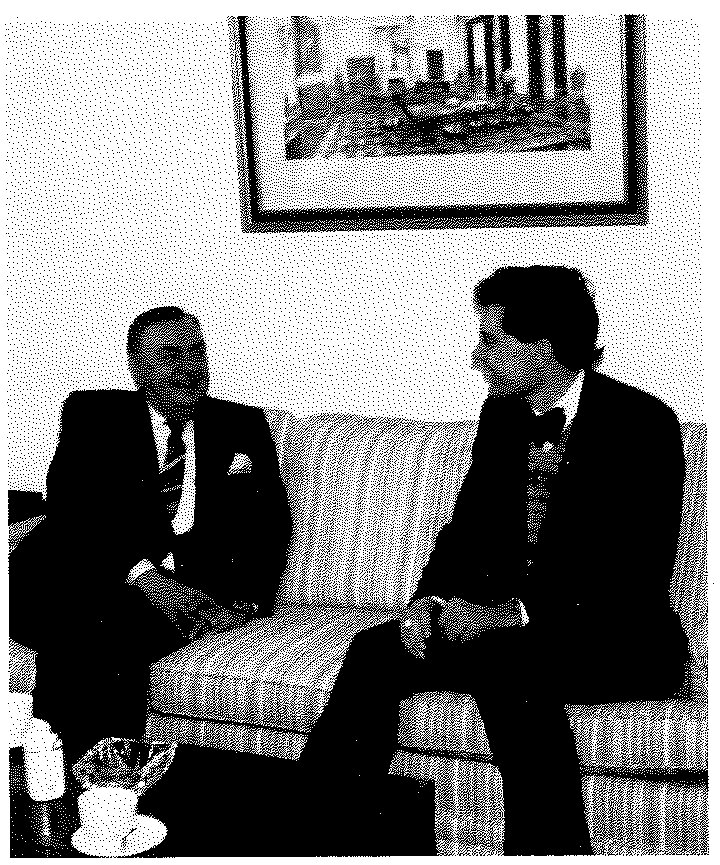
bout de papier: I think you and Paul Martin are unique in that you have both served as SSEA and then gone on to become High Commissioner to the Court of St. James. What is it like to move from commander in chief to general on the front line?
D. JAMIESON: The transition or transformation from the political/ministerial side to the administrative side is significantly greater and involves more change than most people realize. You may think that because you were the minister you’re going to know most of the things but you find that there are a lot of housekeeping issues, especially in a mission of this size, of which, as Minister, you were unaware. This mostly has to do with personnel. I find it also gets very confusing as to whom you speak to in Ottawa. The High Commission in London is unique because it is the only one that has its own Act of Parliament. Strictly speaking you are the representative not merely of the government, but of the Prime Minister. That’s an historical fact that you may wish to pursue. I gather it was done because of the strange relationship in the beginning between a Commonwealth country and what was, in those days, the British Empire. The first high commissioners, of course, had no diplomatic status. They simply represented their governments on an ad hoc basis and this led to a number of dicey situations between the Canadian government and the British government. The upshot of all of this was the creation (in fact Newfoundland is responsible or rather Canada is responsible although there is a Newfoundland element in there) of the use of the title High Commissioner. We started calling them high commissioners and then the whole Commonwealth followed our lead. Eventually they were given full diplomatic status as heads of post.
I am the first High Commissioner (although Mrs. Wadds may have had a short period) to have dealt with the new integrated External Affairs system which includes trade issues, economic issues, political issues, Commonwealth issues, immigration — in short, the whole bundle. That does cause some challenges for the High Commissioner in trying to figure out to whom does he make representations, with whom does he make contact. As Minister this sort of thing is handled by others. I don’t think it caused a serious problem but it can slow things up quite a bit.
As well, your relationship within the mission keeps being reassessed as the new scheme of things comes into place. You have one set of committees, or people, to whom you talk to on one issue and another set on other issues. There is a tendency in a large mission for watertight compartments to develop. The Canadian defence liaison staff, for example, goes about its own affairs in a natural sort of way. The political side follows suit as does the commercial and immigration sections. It is up to me to ensure that where there is spill-over (inevitable) between one and the other that there are proper lines of communications. These are things that would not occur to you as a minister. You would assume, properly, that they would have been done somewhere along the way, and as minister, you would ultimately get the end product of all that. In my role as head of post you deal with the bits and pieces, bring them together, and having brought them together you then have to find a means through which you can translate the result to headquarters in a fashion that ensures that they are seen by all the right people, who can take the appropriate action. That is the big difference between being minister and High Commissioner. A person who comes out of the political side is not usually aware of the comprehensive range of responsibilities that you have at this end.
bout de papier: What have been the issues on which you have had to spend most of your time? Mrs. Wadds appeared to be involved in the Constitution while Paul Martin was very much involved in the Heathrow/Air Canada controversy.
JAMIESON: Yes he was and I think that it’s fair to say that without Paul Martin we probably would have got turfed out of Heathrow. That’s a very good example of personal initiative which, in his case, was carried through very much by the High Commissioner. My own experience has been on two levels.
I suppose the most contentious continuing irritant has been the seal question, and all of the issues having to do with animals and the animal rights movement. One is constantly trying to make decisions as to what level you escalate, what do you respond to, when is it better to leave alone, that sort of thing. Last winter (1983-84) seemed like every day, in one way or another, we were involved with seals. It hasn’t been the same this year.
Then there is the Commonwealth. The Canadian position is fairly high profile and there is a tendency for quite a number of the high commissioners in London to rely on the Canadian High Commissioner and on this post to either create discussion groups on particular issues, or to join in representations to the Commonwealth Secretariat. In my own case, since I had felt while minister that we needed to do more on the trade and economic side, I have probably done more than my predecessors in starting and then maintaining contact with banks and investment houses, or what is roughly referred to over here as, The City.
These are the issues that shape your day although I should not omit mention of the hospitality role. Yesterday, for instance, I had lunch with the Massey Ferguson people. It was just a general review on how they were doing. Today, it’s Westminister Abbey at lunch for the unveiling of a statue of Lord and Lady Mountbatten. Tonight, it is Consolidated Bathhurst. You go from the sublime as it were in the West-minister Abbey to the hardnosed business kind of discussions and talk. Those are the things on which I spend a lot of time.
The center-piece of my own objectives while I’ve been here has been the creation of the Foundation for Canadian Studies. I’ve taken a personal interest in it and act as chairman of the Foundation through which we fund Canadian studies at various universities. This is a private fund largely contributed to by business as well as the provincial and federal governments. We have two or three quite good Canadian studies programs and this area is one of the items on which I met with the Agents General of the provinces this week. I meet with them fairly regularly on a whole range of subjects.
bout de papier: Once a month?
JAMIESON: It’s very difficult to say because you have to ask yourself, what’s a meeting? A heck of a lot of stuff is done in a quite informal way, either at receptions or dinners but certainly I would think that in any given month I will have seen all of them in one place or another and I might have seen them collectively. This particular one is a little project I have taken on to provide a Canadian room at Queen’s University in Belfast. We have never really done a lot of educational or university related activities with Northern Ireland. The meeting with the Agents General was to tell them what we, as a federal government, are prepared to do towards the creation of this Canadian room, such as providing books. It looks as though it’s going to come together very nicely.
One activity that needs to be mentioned, because I think it tends to be overlooked at home, is the enormous number of visitors. I don’t think we have another mission anywhere in the world, including Washington, where there are quite as many both official and unofficial visitors as we have in London. Canada House receives something like 80,000 Canadians a year. They feel it is their home away from home. I’ve had at least four premiers since the turn of the year, or roughly within the last two or three months. Mostly recently, Premiers Lougheed and Devine were here as the same time. You have to make sure that they get their appointments with various people. That takes a lot of time and the visitors tend to come in bunches. We do not set the itineraries. They usually say we think we’ll go to London and you might wind up with two or three of them at once.
Then there are the high-level public servants. I don’t deal with them personally but I usually talk to them. Later, either on your own initiative or at somebody’s request, you might do what I call a think piece. Somebody might say ’what is the future of trade with the U.K.?’ or you may decide on your own that you’ve learned certain things which you feel you ought to pass on to the people at home.
bout de papier: Looking back to the years when you were foreign minister, trade was a major issue. Canada/U.S relations were also a preoccupation. The media used to say if you were too good a friend of the U.S. to deal with Canada/U.S. relations in an even-handed matter.
JAMIESON: I had a very good run with the United States. I don’t think I sold the store. Ironically, the emphasis today seems to be to go even further in this direct ion with Mr. Mulroney saying we must give the Americans the benefit of the doubt and so forth. Compare that with what his party was saying – that I was too friendly with the United States or perhaps was too prone to be that way’ when I was minister. Actually I wasn’t but I had a good run with Cyrus Vance, who was the one I dealt with principally. I think we resolved a great many issues. They probably didn’t get as much high profile as they get now but then we both thought some things were best settled in a quiet, low key fashion. Protectionism, for example, was always there. In the great majority of cases we were able to resolve it without very much ’kafufful’. In some cases, I suppose, we resolved them too quietly because people weren’t even aware that there were problems.
Ifound the Americans tough to deal with but my biggest concern as minister had to be the North/South crisis because that was the period during which it began to take on a higher profile around the world. We had the special Paris Conference (Conference on Cooperation and Economic Development) and one or two others. It was not the dawning of awareness but there was certainly a big increase of interest in North/ South issues. It was a very frustrating problem because everybody paid lip service to it until you got down to looking for commitments.
The Pacific Rim also emerged as a new frontier of Canadian interest. Once the Common Market included Britain and expanded its membership, Canadians began to look for alternative trading partners. Summits were born during that period. I remember that the French had the first (Rambouillet 1975). It wasn’t called a summit in the strict sense of the word and we were not invited to it. Having been in Paris at that particular time, I recall making representations. The following year, when it was in Puerto Rico, we were included and we’ve been included ever since.
An Act respecting the High Commissioner for Canada in the United Kingdom
1. This Act may be cited as the High Commissioner in the United Kingdom Act. R.S., c. 142, s.
2. The Governor in Council may, under the Great Seal, from time to time, appoint an officer called the High Commissioner for Canada in the United Kingdom to hold office during pleasure. R.S., c. 142, s.
3. The High Commissioner for Canada in the United Kingdom shall (a) act as representative and resident agent of Canada in the United Kingdom, and in that capacity execute such powers and perform such duties as are, from time to time, conferred upon and assigned to him by the Governor in Council;
(b) carry out such instructions as he, from time to time, receives from the Secretary of State for External Affairs respecting the general interests of Canada in the United Kingdom; and (c) subject to paragraphs (a) and (b), supervise the official activities of the various agencies of the Canadian Government in the United Kingdom. R.S., c. 142, s.
4. There may be appointed in the manner authorized by law such officers and clerks in the office of the High Commissioner for Canada in the United Kingdom as may be necessary for the proper conduct of the business of the office. R.S., c. 142, s.
NOTE: This Act was repealed December 7, 1983. summitry came into its own during that time: Peacekeeping, the crisis in Middle East, Cyprus, and the like were also part and parcel of the issues with which I dealt.
bout de papier: Let’s look at foreign policy making. Take the North/South conference for example. It was one of the principal interests of the Prime Minister as well as that of Finance Minister MacEachen. How did you relate to them? Did you go to full Cabinet or was it the three of you who met, or just you and the PM?
JAMIESON: I think a variety of all three. In the case of Mr. MacEachen’s involvement, I took over from him just after he left External. One of the things that came out of the meeting I just mentioned in Paris was that the French were slightly embarrassed that we had not been asked and almost bent over backwards to ensure that Canada would co-chair that conference (OECD) and since Mr. MacEachen launched it, it was agreed that he would continue on as chairman. That meant a lot of talk between him and me in that period of about six months. They finally had a meeting in Paris. Nothing very much ever did come out of it.
As for policymaking, it was mostly between myself and the Prime Minister. If it involved expenditures or policy like CIDA, these things would obviously go to Cabinet or to a committee of Cabinet or something along that line. There was no one channel but rather a whole series of things and then, of course, there were some members of caucus who were tremendously interested in various foreign policy issues. I made it a point on every trip, and I don’t think there was an exception, to ensure that a cross-section of members of the Standing Committee on External Affairs and National Defence, from all parties, came along so that they had some awareness of what was happening
bout de papier: Paul Martin had said that while the relationship he had with Pearson was rather special, Pearson had told him that, having served as foreign minister, he knew that everyone in Cabinet was a potential foreign minister and liked to imagine themselves with some knowlege of foreign policy. Unless, however, the issue is really important, it is often better to have policy settled by the Prime Minister and the External Affairs minister.
JAMIESON: There is always a bit of a tension in Cabinet. I would use the same quote as Mr. Martin. Certainly every minister tends to think about himself in terms of foreign affairs while, at the same time, every Prime Minister tends to want to keep a reasonably tight leash on the whole question of foreign affairs. In the conventional days before air travel, before rapid communication, the foreign minister was the one who did most of the travel. The Prime Minister tended to get his information through the foreign minister. Similarly, if the heads of government around the world saw each other more than once a year it was very surprising. But now in Europe and between Canada and the U.S., ministers are coming back and forth all the time. Unquestionably that has complicated the role of foreign policy making. There is the OECD, the quadrilateral, the group of five, the list is endless and in most of these cases it is a minister other than the foreign minister who is involved. There is a real problem of maintaining an umbrella foreign policy when you have your Prime Minister saying one thing, your Foreign Minister saying another and your Trade Minister something different. Each of them has a legitimate concern but maybe, let’s say your Trade Minister or whoever, will come back and say to the Foreign Minister ’Look this national policy on foreign affairs, it is hurting over here’.. The whole question of protectionism is a classic case where you have, not only ministers, but trade groups and industries all saying that certain things have got to happen. Just like everything else, everybody seems to be against protectionism and yet everybody practices it in one form or another. So you have this difficulty in sustaining a comprehensive full foreign policy without a whole lot of other elements intruding into it which destroy its symmetry.
bout de papier: You have been a journalist, you’ve been foreign minister, you’ve been a diplomat. The relationship between the press and the foreign policy side of things has come under some scrutiny of late. How do you see the relationship between diplomat and journalist?
JAMIESON: Well, in the first place I am pleased to see that there is more interest in foreign affairs. It was always a frustration to me that not many informed people were writing about foreign policy and secondly, that even fewer Canadians were reading about it. I don’t know how many times I have talked to journalists who have put in a lot of work on a foreign affairs story only to find that it either didn’t get printed or it got hidden away somewhere and there just wasn’t that much interest in it. I think it is a good thing there are more journalists zeroing in on some of the key issues, if as a result there is more public awareness. If I have any fault to find with the press, it is that with a few exceptions they simply don’t dig deeply enough, and what they write tends to be, if not superficial, then it just takes a piece of some question, because you can’t write about North/South issues in a half column or a column or whatever the case might be.
There has always been this problem of looking for the bad things in CIDA and leaving everything that’s good to one side.
But it is miraculous to see what has happened on this Ethiopian situation. I think probably the media can take a fair bit of the credit for it — not just in Canada but world wide. It began here with some reports by a BBC chap and it has mushroomed. The only tragedy of it is that, God knows, Ethiopia is bad but it is not the only place in the world that is bad and so what you tend to have is perhaps a distortion or a feeling that your conscience is saved if you make a contribution to Ethiopian relief and you forget that South East Asia has got its problems, you forget that there are other parts of Africa that are just as bad. I think that Ethiopia is a water shed. I am not sure that we can ever go back to being sanguine about the situation of the third world after this because even if Ethiopia, as we all hope, gets itself out of this predicament, if it gets a decent food supply and so forth, I think that there’s a pattern that’s set in now that somebody will find some other place or will highlight some other problem and once again you will get the churches and the public and so on involved.
I think that one of the interesting things that barely had started when I was minister, was the involvement of outside groups, but most particularly the church. The church began to comment on killing in Central America and over here they have become very deeply involved in the cruise missile issue. What is really happening is that there is a new legitimacy being given to a lot of causes because it is respected church leaders, and not a bunch of crackpots, and the church leaders are not the kind of people you can dismiss out of hand. This is a new phenomena. I don’t think it is going to go away.
bout de papier: The press then picks it up?
JAMIESON: They pick it up and I hope they put somebody on it to do, perhaps, a more in depth story than has been the case in the past. Star Wars is a classic example of how the media has concentrated, probably more than the public at large, on this and made it a very big issue. It is fair to say that we’ve got a more educated population with each passing generation. If I have any strong view it is that with a few exceptions, and again they are limited – most of the press are highly cynical and dubious about Canada’s capacity to do anything very much. That is essentially what lies at the root of it all. So we’ve got to be in NATO – we’ve got to be in this and that but fundamentally we’re not going to make much of an impact.
It’s necessary to be there but they’re cynical about whether we can change the mind, say of the United States, or whatever. And of course nothing was more demonstrative of that than the initial reaction to the Trudeau peace initiative. By and large, the media just dismissed it. After a while, when they saw that the public thought there was something to it, they began to write about it more seriously and began to be a little bit more positive about what we could do.
I think that we need in our schools of journalism, and perhaps in the universities, a curriculum which would tend to produce more people who receive a knowledge of foreign affairs. I know from my own experience with schools of journalism that they deal with domestic issues. I’m not sure that they address how to write properly – that is another issue; but there is no really serious emphasis on foreign affairs and on Canada’s role in the world.
bout de papier: You said earlier that politicians can play a role in the foreign service. You have, as have some of your predecessors. You’re soon to be replaced by Mr. McMurtry – how do you feel about all that? Do you feel you could only have served a Liberal government? You have been serving a Conservative government for the past six months. Does it work?
JAMIESON: Let me go back to the basis of the question — namely the political appointees. I learned as Minister and it has been reconfirmed, that by and large we have a first class group of people in the foreign service. We have some bad ones — but by and large give a foreign service officer a job to do and they’ll do it. I don’t think you can develop a foreign service • if somebody entering it knows that every attractive job that is going to come along, whether it is Ambassador — whatever the hell it is, is going to go to somebody else. Therefore, I would be very much against the idea of politicising the foreign service in the sense of having — I guess the American system is an example — a general turnover. On the second point, however, I think there are jobs, and I think London happens to be one of them, for former politicians. London is unique in this respect. London combines, unlike Washington for instance, the cultural centre of the country. It provides the economic centre, not only of the country but of a big slice of the world, and it’s the political heart of the country. Now that puts together something very strange and quite unusual — maybe Paris comes close — but certainly London is unique. In those circumstances, while a career foreign service officer could do a good job, I don’t doubt that there is some merit in having someone of experience with political judgement. If it becomes purely and simply a matter of picking somebody of the same political party that would be a mistake. I felt no qualms after having been in seven or eight portfolios, and having been foreign minister that I could do the job and that I could do it professionally. I think I have done it professionally.
You ask whether one could serve another government? I think you can. I think the problem is not with the High Commissioner, it’s not with the Ambassador. I think he can serve alright and that there is no real conflict of interest. I should add, by the way, that there is a big difference too, when you’ve been absent for a period of four or five years, and you’re older — I’m retiring, and I was going to be gone anyway within a few months – but I think that if you have had a separation from the House of Commons for a period, then the same sort of antagonisms perhaps are not there. They certainly weren’t in my own case. But, I can see how a government, or a minister from Ottawa, would probably feel more comfortable with someone with whom he had worked, or someone whom he knew, someone who was a known supporter. I think in those cases that I can completely understand it. My view is that it’s interesting that a Liberal government had a High Commissioner here through that crucial period of the constitution and it didn’t seem to create any serious problems. So I think that it can be done and I would hate to see a revolving door kind of public service, such that every time a party moved everybody and his uncle had to go also.
From my own part, I think it is a nice end of a public career. I am perfectly pleased to be going back. I have no grounds for complaint with Mr. Clark at all or with any of the ministers with whom I have come in contact. They have all been extremely generous to me so that I think that if anything, that proves the point that you can in fact be of a different political stripe.
Let me look at a more serious question
– that is the whole question of what goes on within the career civil service — the career foreign service officer and the kind of decisions, which by the way are not always made by politicans but rather bureaucrats, on who goes where and who does what and the manipulations and monoeuverings and what have you that go on. If you find that things get out of whack because, in some cases, you put somebody in and the next thing you know he is out after seven or eight months or a year because you want him to do something else, or find in other cases that people get extended beyond the normal term, that is bound to disappoint somebody else who’s worked hard, and was told that post is going to become open at such and such a time and suddenly find that it isn’t and that there has been an extension. These hurt morale very much, and I think they hurt family morale, too, in the sense that you’ve just got your kids in school or you have this or some other problem of that sort like wives finding new accommodation. It’s not as glamorous a life as other people think it is. I think that the minister and whoever the top echelon is, needs a better sense of certainty — not security, you’ll always get security, but a better sense of certainly that you can say – ’OK I’m going to Zanzabar, I’m going to go to wherever but it’s a two or three year post and I can look ahead down the road and I can say that if I do a good job certain posts will open up somewhere else and I’ll be eligible for it and I’ll be able to apply for it’ bout de papier: You’re saying that it affects the full operation — the conduct of foreign policy? JAMIESON: It affects your Canada-based personnel who are told that their time is up at point ’X’ but then it turns out to be ’Y’ and they haven’t got the foggiest notion about what point ’Y’ is going to be, and so therefore they are sitting around, whether it is in London or wherever it happens to be, and they are saying to themselves — “Am I going out of here in three months or four months — I don’t know where I’m going — what’s going to happen to me?” Another point that needs reexamination is that there are some cases where people are away too long as a consequence of crossposting and they have difficulty in having a feel for Canada knowing what’s going on and feeling Canadian. If you’ve had three four-year postings in a row or eight or nine years in a row, and you’ve only gone back home on leave, I don’t think that is particularly conducive to a good foreign service. I know that is heresy in some cases because back in the Pearson years — the so called ‘golden years’ — one just moved from one country to another and really didn’t see much of Canada. But I think that there should be – if not mandatory – some sort of implicit awareness that after a certain period of time a foreign service officer ought to spend some time in Canada.
bout de papier: You mentioned early that even your feel for what’s going on in Canada is somewhat remote.
JAMIESON: It is. Ihave been in Canada a heck of a lot more than our own people have been. I know people who are businessmen who go to Canada as many as 10 and 12 times a year for board meetings. The same is true of some of our key business people who are over here very very frequently.
But we at post don’t even get a good news service. We get Canadian Press – I introduced that. I think that there was probably some hit or miss system before but we have now regularized it into something we now get every day which is called Reporting Canada’.
I get the newspapers from St. John’s because my family sends them over to me — mostly to see who died. That’s what my wife always looks at first — the obituary column. But we don’t have any regular — or immediate newspaper coverage. I would certainly recommend, with today’s kind of computers and God knows what else, that it should be possible without any big costs to keep missions like this one better informed. It may be more difficult in Africa. The scan is pretty thin gruel. The Parliamentary Report and its weekly companion was serving a real purpose. I used to look forward to it — Iread it every evening. It became the alternative to the daily newspaper. If it had included a crossword puzzle it would have been even better.
bout de papier: What are you going to go on to after you leave?
JAMIESON: I am retiring in the sense that at this age, especially because I think I owe it to my wife, I don’t want to go into another nine to fiver. We have a lovely place in Newfoundland on the Salmon River. We’ll spend some time there and I have a plan which is already well in the works to do a book on Newfoundland’s entry into Confederation — I’ll also set to work on a book of reminiscences — not a memoirs in the Paul Martin sense but a book of reflections on my life as a journalist and then politican and sometime High Commissioner. It will be intended firstly for my children.
bout de papier: Mr. Jamieson, thank you and good luck.
View the original scanned pages →
Originally published in bout de papier, Vol. 3, No. 2 (1985) — Summer 1985 // Été 1985, pp. 9–13. Read the rest of this issue →



