
bout de papier, Vol. 3, No. 1 (1985) — March 1985 // Mars 1985, p. 10
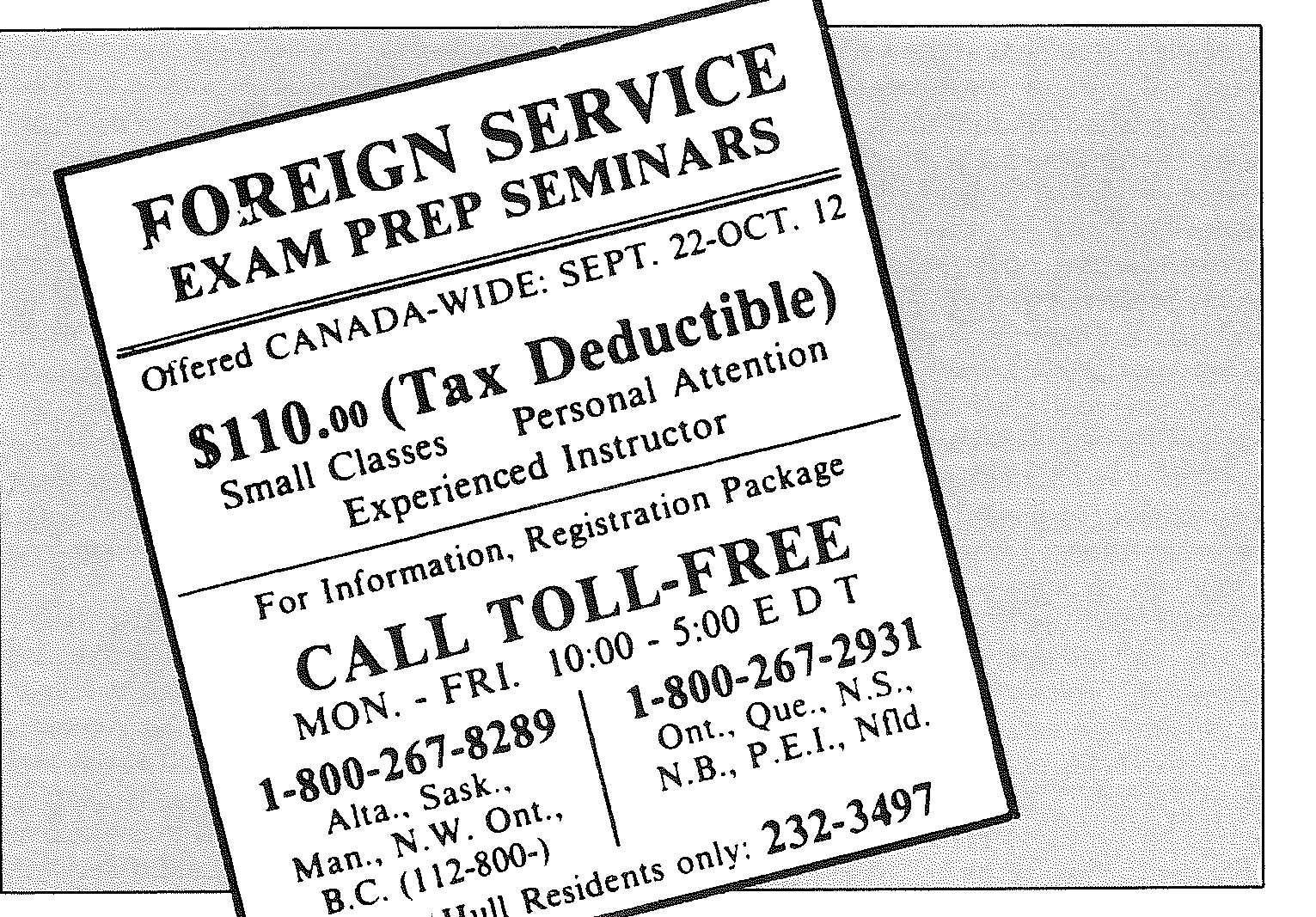
Last summer this ad ran in Canada’s national newspaper. bout de papier tracked down its author, Barry Yeates, a former foreign service officer who served in Washington, and asked about the experience. Mr. Yeates, currently manager, consultant and principal in Foreign Service Organization and Career Counselling Incorporated, wrote back:
“How do I get into External? Probably most Foreign Service officers remember when they sought the answer to that question. Perhaps you reflect occasionally on the entry competition that brought you into the Department – the exam, the interviews, the wait to find out whether you’d been accepted
I heard the question often after leaving the Department in 1980. Since I’d returned to work in the university world where students, aspiring to a career in the Foreign Service, regularly looked for advice about how to get “in”. After many such conversations, I realized that there was a need, and a potential market across Canada, for independent counselling of prospective candidates for the Foreign Service competition.
In 1983, I established Foreign Service Examination and Career Counselling Inc., and last fall tested the waters by conducting my first preparatory seminars in major cities across Canada. In a nutshell, it was an enjoyable and satisfying experience personally, although, as is often the case with a new business venture, the balance sheet was slightly tattered and tinged with red. If there is consolidation in symmetry, this paralleled my own condition after doing 14 presentations in 12 cities from Halifax to Vancouver in 19 days.
My basic premise was that, counter to the prevailing myth, one can indeed prepare, or at least prepare better, for the various stages of the Foreign Service competition.
To address these areas I organized a seven-part presentation. I tried to put registrants at ease at the outset by running through a list of commonly asked questions, discussing candidates’ backgrounds in relation to those of officers in the Department, and looking at the application and selection process. Discussion of the written exam ensued, and constituted the longest segment of the seminar. This involved general advice for taking multiple-choice exams, a review of many sample questions I had drafted (focusing not only on the right answers but also on the abilities being tested), and a run-through of how to do writing exercises. After going over a list of reading tips and techniques, I turned to the interview. Again leading off with general advice, I followed with an examination of personal qualities sought by the interviewers and the skills required to showcase them, I concluded with examples of analytical questions and role-playing scenarios a candidate might expect. The bulk of the session over, I discussed briefly the officer streams and the Department’s organization (and reorganization) in Canada and at posts. The short finale involved my own assessment of some pros and cons of the Department augmented by comments, gripes and reminiscences of former colleagues.
Clearly, some of the information I provide can — and should — be sought from other sources. Indeed, I encourage registrants to do this and provide suggestions on how to go about it. However, advice offered from an independent and critical distance, can play an important part in helping make good applicants better if only by bolstering their confidence and general awareness to foster optimum performance at each stage of the competition. Sows ears can’t be made into silk purses overnight, as some critics might fear, but merit may reveal itself a little more easily and quickly. And if this occurs, the benefit to the Department is obvious.
About 120 people enrolled in the seminars, which lasted about 4½ hours. Participants ranged in age and experience from second year university students to men and women of fiftyish seeking second careers. Overall they were a bright and interesting group, keenly committed to trying their best to join the Department and seemingly willing to persist in the attempt in future competitions if unsuccessful this time. Although I feel not all had “the right stuff” for External, I’m sure the Department would benefit by interviewing more candidates and personalizing the selection process, as was the case in the past.
You may be curious about the Department’s reaction. I informed both External Affairs and the Public Service Commission when I began planning the seminar in 1983.I also discussed the idea at length with former colleagues. I would characterize official responses as non-commital with traces of scepticism and trepidation. Not unexpected or unwarranted, I felt, given the government’s inability to control the program or anticipate its impact. Nonetheless, general information I requested was promptly supplied by Personnel Division in the Department and by the FS Recruitment Branch at the PSC. I hope for continued good relations, as we may be of mutual assistance and able to share information.
As to the reception of the concept by former colleagues, it has been overwhelmingly favourable. To some, the entrepreneurial side seemed the most intriguing, and several confided that they would have explored, and probably taken, such a course had one existed back when they were callow candidates.
The prospects: my sense is that the seminar service has a future. Not as lucrative as this neophyte businessman initially imagined; much more time-consuming and laborious to build than anticipated (what with stamp-licking and photocopying, for which, incidentally, my training as a junior FS was invaluable); but generally rewarding in that it has allowed me to develop an idea into a “product” which people seem to find helps them improve their chances for a Foreign Service career.
View the original scanned pages →
Originally published in bout de papier, Vol. 3, No. 1 (1985) — March 1985 // Mars 1985, p. 10. Read the rest of this issue →



