
bout de papier, Vol. 3, No. 1 (1985) — March 1985 // Mars 1985, pp. 7–9
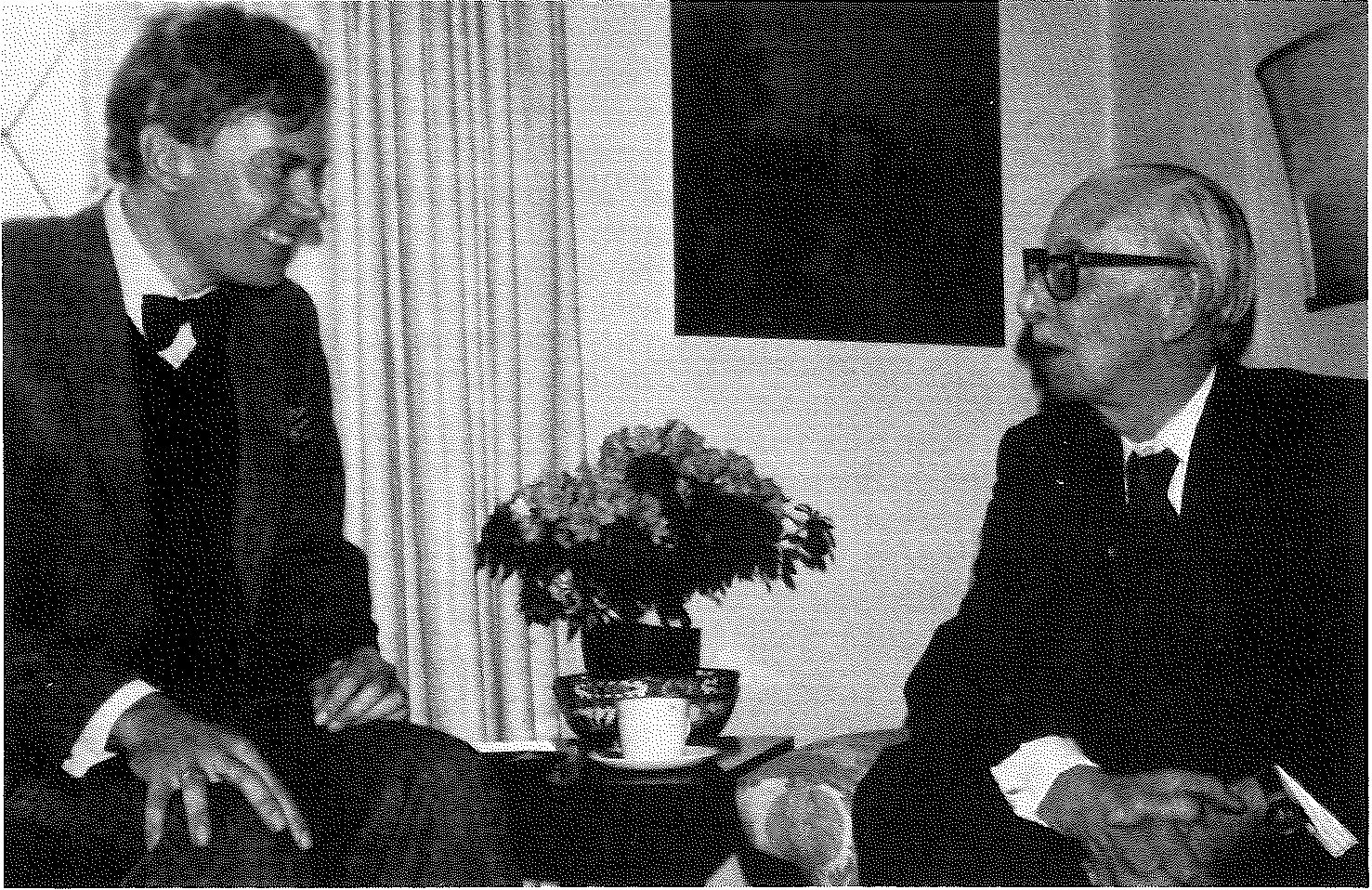
We begin with this issue, a series of interviews with some of the great men and women who have served in the Canadian foreign service. Since his retirement from the Foreign Service in 1971, Charles Ritchie has written a series of books which looks at the lighter side of life as a Canadian diplomat. Purposely eschewing the historical memoir or a study of the role of Canada in international affairs, Ritchie’s volumes are rather undiplomatic diaries of his life and times. The first, The Siren Years (1974), recorded his experiences as a young foreign service officer in London. It won the Governor-General’s Award for Non-Fiction. An Appetite for Life (1977) introduced the young Charles Ritchie. Diplomatic Passport (1981) followed his rise in the Service. Storm Signals (1983) takes the author from the United Nations in New York to the Canadian Embassy in Washington to Paris as Canadian Ambassador to NATO and finally to 12 Upper Brook Street, London as High Commissioner to Great Britain. bout de papier spoke to Mr. Ritchie in his flat in the Duncannon Arms about his life in the Service. Mr. Ritchie is currently working on another book — a series of sketches of individuals from various walks of life whom he encountered during his travels.
bout de papier: One of the things that struck me when I read your books was that life always was tremendously exciting and sounded like great fun but there must have been some frustrations or a down side to life in the foreign service?
C. RITCHIE: Of course there were and they were all internal personnel problems. The frustrations were not however, the kind that made you feel that I’d chosen the wrong profession. I think that the London post, in the end, was the least interesting politically. But it was the most delightful. There wasn’t very much of importance to work on after Washington. But, over a long period of nearly 40 years, there were so many different phases. When I first joined, which was the really early time in 1934, there wasn’t so much frustration but it was so different from anything which exists. There was no training of any kind. The pay was $1,800 a year and even in those days that was not very much. But then to have any kind of job was rather good. It was an education but not an education deliberately. One day you would be decoding, the next day you would be doing press clippings, then you would be answering letters from some crank about whether the Union Jack should fly or something of that kind. We kept a very low image, right on the level of the floor perhaps. I think I could say that there was no administration virtually. Dr. Skelton paid no attention to administration. He was really an academic: He was a close advisor to the Prime Minister not only on external affairs, on everything. So he was a power in the land and administration was something he left.
Norman Robertson, who succeeded him, was exactly the same. And everything to do with administration was left to Miss McCloskey. She had two female assistants. And if you were being posted abroad and wanted to know what your allowances would be or anything to do with administration you just went to see Miss McCloskey, if she had time to see you. And if she said you would go abroad away you went. Dr. Skelton might or might not sign the papers. It was really a very peculiar world in a way. I didn’t find it at all frustrating because I didn’t know anything else. I was not completely inclined towards administration myself and I never felt very sad about it.
bout de papier: How did the Department entertain foreign diplomats in the early years?
RITCHIE: Well there was no entertainment. There was no question of entertaining. There were no allowances, it came from your salary and you simply had friends around for a drink or something like that.
bout de papier: Posting procedure. Today we have this fairly elaborate system set out. What was it like in 1934?
RITCHIE: It was such a small service, almost everyone knew what everyone else was like. Vincent Massey would be asked if he liked X and he would discuss with Dr.
Skelton and say he would rather have Y. So it was all rather personal. All personnel arrangements above a certain level, that is to say the foreign service officer category, were built around a basis of knowing each other, what the traffic would bear, and how you got along. You would see how the wife would get on and all that sort of thing.
I don’t think I ever said that I would like to go anywhere particular. I wasn’t really concerned about that. And, of course, there were very few posts from which to choose. It is hard to describe the past practices of the Department because in the course of my life in the Department it has changed several times. It changed most dramatically when Arnold Heeney took over as undersecretary from Norman Robertson. Heeney had been dealing with the Prime Minister’s office and he had a sense of administration. He wanted to relate External Affairs to other departments and make it part of the whole civil service, which it had never thought itself as being. That was really the beginning of the sort of “grown up” administrative relationship with other departments. Before that during the long period when the Prime Minister was Secretary of State for External Affairs, we were almost part of the Prime Minister’s enclave and no other department or Civil Service Commissioner or anybody else put their nose too far into our affairs.
bout de papier: When you were going off to posts did you have any idea of what you were going to meet when you did arrive? Discussions on simple things, the allowances, the type of accommodation that you were going to receive?
RITCHIE: Well you went to see Miss McCloskey, and she told you about the allowances you were going to get. As for the work, it was very similar to academic matters. Apart from myself and one or two others, all had been teaching at university at one time or another. Pearson, Wrong, Skelton and the others were all academics and they had very much that approach. The atmosphere was more like a college. As well they were quite young men. They talked to you a great deal about all the current problems. Suppose you were going to Washington to help Norman Robertson negotiate tariff matters. You would go out to the cafeteria at the Chateau Laurier, accompanied by two or three officers, and talk. You had to educate yourself.. You heard all about it, not through any programs in actual instructions, but by talking with others.
bout de papier: You mention the Chateau. Was the Chateau the foreign service officers club or the lunch spot?
RITCHIE: The cafeteria was the cheapest place to eat. It was also close to the Department.
bout de papier: You were then in the East block or Langevin?
RITCHIE: East block. I never was anywhere else. The Chateau was the nearest place and it was also sort of a gathering place for other civil servants. And, of course, the senior civil servants received very small salaries. On top of that they had a point of view that any ostentatious expenditure was undesirable. Dr. Clark, who was the deputy minister of Finance, was a great civil servant. I’m sure he never took a taxi in his life. There was one place where we could get a free cup of coffee. We used to go there. It was all conducted on a rather reduced scale, sort of self-consciously so. That’s the way that we were supposed to behave.
bout de papier: What was a usual day back in those days?
RITCHIE: We started rather late. I was always rather late. Then, you just bowed your head and set about the task of the day. I’m talking of the very early days before the divisions were properly set up. Naturally later on there was a structure. I started with the Royal Commission on Price Spreads and Mass Buying in 1934. Mike Pearson was the secretary and I was just sent along to help. But this had nothing to do with foreign affairs at all and I was there for months.
Mike Pearson was such an odd person to work with because he appeared to be so casual. This was all a double take because he was a tremendously industrious and conscientious person. I got the notion that if he could be so casual I could be equally casual. So I would go on coffee breaks and carry on. Then, one day, I came back to find somebody else was sitting in my place. I spoke to Pearson, fearing a very unpleasant confrontation but not a word was said Then, fortunately for me, the other person proved more deficient and he disappeared. This interregnum lasted a few weeks. And then I was called back and I returned to my desk in the East Block.
bout de papier: What about your sources of information in the early days?
RITCHIE: We relied a lot on what we got from the British Foreign Office. That was the chief source. It was still the age of long dispatches, which went on and on. I don’t know if it’s entirely extinct now. The missions then did long dispatches. The third secretary spent weeks writing a dispatch, polishing and cleaning it up. The Counsellor then looked at it for questions of style and verbosity and expression. They were very educational from the point of view of the person who handled the job. You had to do a very thorough job. I wonder if anyone looks at these now. The USSEA looked at them but I know Mr. King only looked at short pieces of paper.
After the war things began to get organized with the proliferation of missions and the organization by Heeney. It is rather irritating that civil servants are often blamed for the proliferation of either jobs or missions but it was always the politicians who set up these missions. They would come up with ideas and the public servant would be asked to produce. The rather unfair thing was that the public got the idea it was self-generated.
bout de papier: One of the things that comes through in your book is the tremendous relevancy of what you did, either as Third Secretary or as Ambassador, you were very much part of the process.
RITCHIE: That is very true. This is what made life worthwhile. For example, after I’d been in the foreign service for some years there was a discussion about the post war plans. We had very much a sense of participating in the formulation of policy at a time when you were just formulating positions and reaching out to see what the Canadian stance would be on major issues. That was fascinating. The human contact was also most interesting.
bout de papier: Did this hold true throughout your career? Did you feel that there was a change towards the end. There is some talk now that diplomats are less relevant. You remember the most often quoted remark by Trudeau “I can read what I want in the New York Times”
RITCHIE: Yes. Well I think it perfectly true. I suppose those long dispatches that were written really weren’t justified. They were an education for the person but they couldn’t really serve much of a purpose. As to irrelevancy of Ambassadors, yes this is somewhat true. There is much more incessant travel by ministers. One of the other difficulties was, and still is, that, curiously, those people who have served abroad – when they came home they suddenly became different animals. You were a different animal when you were abroad. It was very easy to drift out of touch, not only with the ministers, but with the Department itself. Your only hope was that as people came on a delegation, you could get your pals around and find out what was happening. Sometimes you learned the brilliant dispatch you had sent was creating a most unpleasant smell. Nobody ever gave us an idea of what was happening. That was rather frustrating. I don’t know if it is like that now but you found it very easy to get out of touch. The great thing, as it was such a personal thing, was to have friends in the Department. The differences inside the Department were very often based, not so much upon how many employees you had, or rank, or any of that but on views that you held. For instance I would have one point of view about the objective of NATO. The undersecretary would perhaps have another. There would be controversy and sometimes quite sharp controversy on your estimate of what the traffic would bear and the Canadian position should be.
People wrote dispatches, letters, telegrams from the missions to the missions. Of course when we were at home we would have discussions. Somebody from the division, for instance, would send the usual papers up and then we would have to discuss it. The structure was simple then – you had a minister, an undersecretary, the deputy undersecretary. It was just linear down. It was not perpendicular and there were very few deputies. In our dealings with other departments, the evolution that I saw depended rather on the clout and knowledge of the undersecretary himself – especially his knowledge of administration and above all economic realities. If you had an undersecretary like Norman Robertson, who was no good at administration but who knew every tariff by heart and the exact prices for the last few years and could recite it by heart — if he went to a department, they paid attention to him because he had, as they say for a ship, an awful lot of displacement. He knew a lot about economics and politics in Canada. But I think that later on, somehow, perhaps we didn’t always have undersecretaries who had quite this wide knowledge or who impressed in the same way the people with whom they worked. Then, of course, there was the difference between those who spent most of their lives, or a lot of their lives, serving abroad. When they came back they didn’t really know the game plan.
bout de papier: In your books you suggest that, while serving abroad was fun, your career was made in Ottawa.
RITCHIE: Oh yes certainly. Of course your relations with your own government were far more important than your relations with any other government.
bout de papier: In your book you describe a number of people, the undersecretaries and the ministers. How would you paint a picture of the ideal undersecretary?
RITCHIE: I doubt I’ve ever met somebody who combined everything in that position. From the point of view of long-term policy Norman Robertson was by far the most remarkable undersecretary. Arnold Heeney knew how to run the show and was very competent but was not the same sort of thinker.
Relations with ministers were close – they were just down the corridor — you saw them every time you went for a walk. Our foreign service was small. Ottawa was small and all these people lived cheek by jowl with each other and all the ministers lived next door to each other in Rockcliffe, with their civil servants and their wives. They played tennis together and they went to parties together, and their wives knew each other well and knew all about their families and their affairs. It was a very closely knit little world. But, of course, basically, it was a closely knit Liberal world. I think, however, most foreign service officers felt they could devotedly serve either party. And I think they could. But still, I quite understood that people like Mr. Diefenbaker, or any incoming Conservative government who hadn’t been part of this little circle, wondered about these people. The whole thing had grown up under King.
bout de papier: A bit of a parallel with today?
RITCHIE: Yes very much … I came in under a Conservative administration with Bennett. Now there was a Prime Minister for you! He never slid down a bannister in his life or did a pirouette. A massive man with a winged collar. I remember when I came for my oral interview he said “Young man it is a great privilege to serve.” He said: “Many are called but few are chosen.” So we walked off with this great admonition in our Things have changed since then… The exams were different to what they are now. There were these long essays which included reviews. Of course, the other thing about the foreign service was that it had no effective French element inside the Department. There was Mr. Beaudry, who was an associate undersecretary. A charming and distinguished man. But it was always quite clear that he and the French element were not part of the process. The Paris Embassy was a different world. It had always been French from the days of M. Roy, before we had an Embassy. It was a French enclave. Many of the French-speaking foreign service officers as we expanded much preferred serving abroad, in Brazil, and Rome. One reason why they preferred it was that the whole method of working was so unadjusted to their way of working. That has all changed. Of course, then there was no question of French being made a qualification of joining the Department of External Affairs. I was fortunate because I happened to speak French. It was very peculiar because French was a requirement for almost all foreign services elsewhere. I remember taking it up in those days with one senior officer. I asked “why can’t we have classes where people can learn French?” ’, and he said “Oh no that would be quite wrong and unconstitutional because that would be like teaching French as a foreign language, and we wouldn’t do that – that would be very much resented.” That was part of the reason it didn’t play any part in the formulation of policy.
The breakthrough came when Mike Pearson appointed Jules Léger as undersecretary. Jules Léger was much younger and junior to other foreign service officers but he had such a great deal of integrity and modesty and he was such a good man that his appointment was not at all resented. But I am quite sure that for the first time one element that entered into it, apart from his own abilities, was that fact that he was French. And then of course the whole thing changed
bout de papier: What about other languages?
RITCHIE: There were no language requirements. But you could have training, if you were going to Japan or some place like that.
bout de papier: Why did you write the diaries?
RITCHIE: The diaries were an escape. I had no interest in writing down all my appointments during the day, who I dealt with, the staff problems. That wasn’t the object of the operation. There was nothing more boring than sitting down and writing everything that you had just done in the office. I had lots of notes scattered about, lists of personnel all sorts of things like that.
bout de papier: What was the greatest achievement of your career?
RITCHIE: Well, I don’t know that I achieved anything. I sort of took on the attitude towards the Department of a lawyer with a client. I thought my job was to work as plausibly and actively as I could and keep in close touch with the Prime Minister or foreign minister.
I was very interested in the early days at the United Nations. I loved that very much. It was very fascinating. From the point of view of a diplomatic job, it was most interesting work – negotiating with every country under the sun and with all their representatives. I handled a lot of disarmament work. When I look back on it nothing was achieved for all those endless disarmament resolutions at the United Nations. There is, of course, another side which may not be an achievement but, keeping your people out of trouble and keeping them from doing or saying something which would get the lads in a mess with Canadians or people abroad is no small thing. You had to keep on the watch, especially if you were in Washington.
bout de papier: Would you join today’s foreign service?
RITCHIE: I think that if I had never known the structure and the way of working that I was accustomed to, I would take a shot at it. Because after all, the relations between states are what it is all about and that is the basis of the whole career. I have never known a time in the Department of External Affairs when people didn’t say: “oh the frustration”, that was as true in 1934 as it is now. I have hardly ever known a time when they didn’t say “morale isn’t what it used to be”. I’ve heard that one for 40 years although I do think from what I hear of how the Department is set up now, my morale would be very bad. I don’t understand the rules of the game that is being played at present. The endless meetings and committee meetings which I never liked and thought were rather a waste of time and could be very trying. And the structure is confusing – this sort of lateral structure and authority. I think I would find it very difficult to disentangle myself. The rules of the game are different and of course the great emphasis on administration I find unattractive.
bout de papier: What about the attempts to fertilize the Department from without, to bring in people who didn’t come up through the ranks, and place them on single assignment.
RITCHIE: Well, just after the war when the expansion came quite a lot of people were brought in from universities. They were teachers in their forties. There was a need to expand and to expand in a hurry so they wanted men over forty with experience. It worked out not badly as far as we were concerned. They identified themselves quite readily, although they were never quite like the people who served as juniors.
bout de papier: What happens to old diplomats? Are they like old soldiers? Do they just fade away?
RITCHIE: We keep on. You must keep on in the habit of keeping up. We are certainly never used in an advisory capacity. After I retired I started writing and collecting. I keep in touch with some who have retired. Some I see really only accidentally. We often talk about foreign policy.
View the original scanned pages →
Originally published in bout de papier, Vol. 3, No. 1 (1985) — March 1985 // Mars 1985, pp. 7–9. Read the rest of this issue →



