
bout de papier, Vol. 29, No. 3 (2016), pp. 35–37
WHOSE MAN IN HAVANA:
ADVENTURES FROM THE
FAR SIDE OF DIPLOMACY,
By John W. Graham, University of Calgary
Press, 2015, pp 308, $34.95
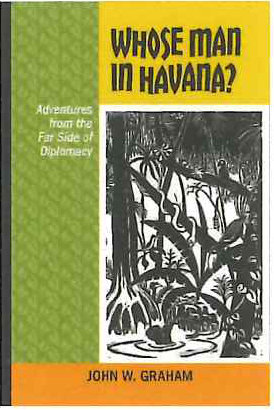
The epilogue to John Graham’s entertaining book Whose Man in Havana? states that the various anecdotes contained therein are by no means unique for a Foreign Service Officer of his generation. If this is indeed true, then perhaps this reviewer, still in the early years of his Global Affairs Canada career, may have missed the truly Golden Age of Canadian diplomacy.
Part travelogue, part foreign policy history and with text that can be simultaneously weighty one moment and lighthearted the next, many of the stories show the absurd aspects of diplomatic work and life abroad but also the fun that can be had in new and strange locales. A 35-year career diplomat who started with the department in 1957, John Graham was Head of Mission at Canada’s posts in Guyana, Suriname, Venezuela (as well as non-resident Ambassador in the Dominican Republic), among other senior posts. Following his departure from the department in 1992, he participated in over 30 election observer missions in the Balkans, Ukraine and South and Central America. The book is essentially a collection of thought-provoking anecdotes taken from this long and storied career, some funny, some bittersweet, often backdropped with historical events dating from the start of his first posting in 1960.
The book begins with the author’s assignment to the Dominican Republic, during the Trujillo dictatorship. One has the sense that while many things in the Canadian foreign service are unchanged (feeling perhaps forgotten in a low priority post being one of them, a modern mission security officer may be surprised to learn that the author’s primary security precaution was a Browning 9mm tucked into his belt (purchased on the advice of his predecessor). Initially dismayed to be assigned to this diplomatic backwater, he quickly discovers that some of the best experiences can be had in places that are somewhat off-the-beaten track where one covers a broad range of files and responsibilities.
His subsequent posting to Havana is the eponymous story to the book, something previously highlighted in an interview with the author in the Globe and Mail in 2012. As part of the rapprochement between the Canadian and U.S. governments following Pearson’s election as Prime Minister, Canada agreed to provide some on-the-ground intelligence from its embassy in Havana. The author was assigned (this being a time when officers did not have much, if any, say in their assignments) to discharge this function with minimal preparation. Many of his actual sketch drawings identifying Soviet equipment are included for reader interest.
Reading through these early pages, one has the sense that – before the arrival of email, MITNET and any number of ways by which HQ could instantly get updates on post activities – diplomacy required a far greater latitude for independent action, and relied heavily on the abilities of the officer in the field. While the modern era has better integrated HQ and post activities, one might feel a sense of nostalgia for a pre-information age era.
As the stories and anecdotes move to the present day, we learn of the author’s knack for getting the most out of a posting or assignment by soaking up as much of the local culture and scenery as possible. Language is very descriptive, at times bordering on Raymond Chandler. While acting as an election observer in Kyrgyzstan, the author goes to find a meal: “The restaurant was one of the grungiest I have ever been in. Roughly patched chairs, splintered linoleum tabletops, and vivid tropical island murals were lit by over-bright neon strip lighting. Our neighbours were young Kyrgyz who were throwing back the dollar-a-bottle vodka that we had been warned about.”
The text is littered with larger-than-life corrupt officials, saints, drunken bravado, off-the-clock silliness, sometimes ill-considered misadventures (such as flying above the jungle in a tiny, under-maintained airplane with several boxes of dynamite. The flavour changes from one chapter to another, with lighter fare alternating with denser discussions that provide background on Canadian foreign policy. For example, a story of participating in the Port-of-Spain Carnival is juxtaposed with a behind-the-scenes explanation of Canada’s response the United States invasion of Grenada. In those chapters which deal with the author’s involvement in more weighty matters, he takes pains to bring the reader up to speed with sufficient context.
Reading through these pages, you gain the sense that the author truly enjoyed his work, and that he had a genuine belief in the role of diplomacy and the international community in making the world a slightly better place. His plea, in the epilogue, (not necessarily a new one) stresses the importance of a credible, professional foreign service and its role to inform the formulation of foreign policy that truly has Canada’s best interests at heart.
Perhaps the one weakness of the book would be that sometimes passages within the anecdotes seem incomplete, or are clipped before their natural conclusion, leaving the reader wondering what happens next. In some sense this actually could very well be a compliment, in that the reader is engrossed and is eager to hear more. To be fair this is a minor issue in the scope of this thoroughly enjoyable work.
Interview with John Graham
Note de la rédaction : Dans son livre Whose Man in Havana? John Graham insiste sur l’importance d’un service extérieur professionel et crédible, et sur le rôle de celui-ci quant à la formulation d’une politique étrangère ayant les intérêts du Canada à cœur. Shauna Hemingway a rencontré l’auteur et ancien diplomate et lui a demandé quels seraient ses conseils pour une nouvelle génération d’agents du service extérieur.
SH: Chance shaped many of your opportunities and experiences as a Foreign Service Officer. What did you. bring to your postings that ensured a colourful and rewarding experience?
JG: Maybe a healthy sense of adventure and an enormous curiosity about the culture, the history of the country, its art forms, and, of course, its individuals. I found almost everywhere that a shared sense of humour allows you to cross many bridges, particularly in difficult times and difficult places. I speak of periods when I was mediating in the Dominican Republic or doing election stuff in the Balkans and Central America. In Bosnia, it sometimes meant being prepared to join local grandees in bad brandy at ten in the morning. It helps if you are open-minded and enjoy long conversations with people from all parts of society. In some circumstances it actually helped that I smoked cigars. Yes, that can also be counter-productive. And, as I said, a sense of humour – that really helps.
SH: If today’s Foreign Service could reflect one element of the Foreign Service of your day, what should it be?
JG: At the top of the list would be professional pride in doing what you are doing because you think it’s right and sound. Your sense of personal integrity springs from your values and, if the balance with your job works, life is good.
SH: Today’s Foreign Service Officers have a greater degree of control in charting their own course professionally. What would you say to a new officer?
JG: There’s a big difference today. I am so grateful that I was on a roulette wheel that I didn’t control. It led me to places that, at first, I was appalled to be sent to. Especially way off the beaten path, they turned out to be wonderful, amusing, entertaining and enriching. We filled in forms about where we wanted to go – London, Rome, etc. As long as I filled in those forms, I wasn’t sent to those places.
You had the advantage, at a small post, of covering the waterfront. You did consular, and you did cultural and administrative work, as well as political and economic or trade. If I had to send a telegram from Ciudad Trujillo (now Santo Domingo), I had to use book cypher, a term nobody knows anymore. You learned to write concisely. You also became very distressed with your colleagues from big missions when they copied their classified telegrams to a lot of other missions. It might take you half an hour just to decode the information line of a telegram that you didn’t need!
SH: You didn’t shy away from voicing your opinion to senior management both as a Foreign Service Officer and while working for NGOs. Why was that important to you?
JG: If you’re working on a problem that is troubling head office and you think head office has a twisted understanding of what’s going on and that you don’t, you try to straighten it out. That means talking turkey – polite turkey, of course. To be fair, that didn’t always happen, but often enough to keep the wheels running in the right direction.
SH: How do you view the Foreign Service at the time you served versus the Foreign Service of today?
JG: If we’re talking about my time versus this last decade, the differences are enormous. With very few exceptions, the kind of dialogue that was supposed to exist between the senior public service and ministers and ministers’ offices disappeared. Most of the time when I was in harness, there was two-way dialogue. Of course, from time to time we got into trouble. Sometimes egos got out of control. If you’re called Excellency long enough, or Excelentisimo, as you are in Latin America, it can go to your head with all sorts of unfortunate results.
SH: You have worked closely with both the Foreign Service and with development colleagues throughout your career. What, in your opinion, is the most important element to get right in today’s amalgamation within Global Affairs Canada?
JG: That’s an important question. What’s happened recently, not just in the last ten years but going back further, is that to save money and reduce personnel the easy route was to write a cheque to a multilateral organization. That saves an awful lot of person years, but it means that you no longer have Canadian boots on the ground helping with agricultural projects, or supporting the timber industry and so forth in somewhere like Guyana. We still spend a lot of money in the Caribbean. But almost all of it is through writing cheques to non-Canadian organizations. Our visibility and our leverage in those small islands, which used to automatically mean 14-15 UN votes, is gone. Maybe with the two institutions joined together, as they are in the British system, there will be better communication and better results.
SH: You emphasize in your book the importance of quality, non-partisan advice from the civil service to the government. You mention advising both the political level and DMs. How did your advice differ between the two? JG: It’s a human thing. If there’s a difference, it’s a difference that is the function of the character or personality of the Deputy Minister or Minister. The public service’s first allegiance is to the government, but – and I’m repeating myself – traditionally there was an intermediate process called consultation. I address this issue in the epilogue.
SH: You discuss in your book how free you were to speak to the media. What advantages and disadvantages did this bring to your work?
JG: It enormously widened the impact of your work. If there were difficult questions being put to Canada and you had answers, you were able to provide those answers. It made you and the mission and Canada more visible. Same with good news. If it was well done and well said, then it enhanced Canada’s image and perhaps its leverage. It’s branding, it’s publicity. For sure, public exposure can sometimes get you into trouble. But those risks are worth taking.
SH: In a posting abroad, one must balance the time spent reading and analyzing an issue with getting out and engaging local contacts. What advice would you have on achieving the right balance?
JG: That [latter] part is indispensable. You have to get out of the glass towers downtown. Find out what the slums are like, why there are slums, why there are so many drugs. You need to know what the prisons are like, how the police and the courts operate. You need to know what the public hospitals are like. Without a feel for these things, you can’t really understand the values of that society and the extent to which the values of that society are translated upward or not to government policy. You also need to know something about the history of where you are. Novels about that society help – in Colombia, Gabriel Garcia Marquez; in Peru, Mario Vargas Llosa. Does the local culture do ballet, plastic arts? Is the theatre full of local satire? You’re not going to report it all to Ottawa. You’re doing it so that you are better informed and can relate that much more effectively to the people of that country.
SH: “Going native” is a term used when FS identify too closely with their host country. How does it impact their effectiveness?
JG: There’s a line here that can get blurred. Keep focused on your professional image, but don’t hide behind that and don’t let status obscure your own personality. Of course, don’t be stuffy or pompous, but don’t let dignity go. If you’re going to the local Carnival, wear some clothes! SH: How did you stay connected to Canada?
JG: I never really felt disconnected as an FSO. At an Embassy, you are operating on a Canadian platform. You can be much more easily disconnected working in a multilateral mission. In an early chapter on Bosnia I say something about this. I was with the OSCE. Your national eccentricities are not so visible when you’re in the embassy, but boy (!) do they become visible when you are working as a member of a team made up of ten or more nationalities.
SH: Our Foreign Service Officers follow elections abroad and participate in monitoring missions. Is there a specific pitfall that you would urge monitors to avoid?
JG: Absolutely. One of the biggest is the nature of the election organization. You should not become associated, as I did, with an observation mission that is one flag only. One flag only, i.e. a Canadian observer mission or a Russian observer mission, means carrying all national baggage. One flag only tends to be interpreted by others, whether true or not, as meaning that your judgment on that election is subject to the advice and pressures of the government that has paid and selected you. I was on Canadian missions like that in Palestine and Ukraine, and it was bad. Another is the importance of long-term observation. If the election is expected to be dodgy, there should be a small group of long-term observers who will be there for three or four months. If you are a short-term observer, you need to use the short time you have constructively. It is important to move around, talk to representatives of all political parties, local police and the local bishop/mullah and so on. This way you can sometimes spot and occasionally defuse problems by reporting them to the responsible local authorities before they get out of hand. In the end you can do a better assessment of what has happened. And your public mantra is “neutrality, neutrality!”
View the original scanned pages →
Originally published in bout de papier, Vol. 29, No. 3 (2016), pp. 35–37. Read the rest of this issue →



