
bout de papier, Vol. 29, No. 3 (2016), pp. 16–19
Three weeks after Iraq’s invasion of Kuwait on August 2, 1990, the Canadian Embassy was forced to downsize. Despite Iraq’s threat to round up all foreign embassy staff that did not leave the country by August 24th, five colleagues remained inside the Embassy. The author and four other Embassy staff flew to Baghdad with the understanding that they would be allowed to return to Canada. Instead, they were detained in Baghdad as ‘guests’ of Saddam Hussein as punishment for the Embassy not closing in Kuwait. Weeks turned into months and on December 9, 1990, 130 days after Iraq’s invasion, all of the Canadian diplomats from Kuwait and other remaining Westerners under detention were released. The following account, pieced together from personal notes, recollections and conversation with former colleagues, gives shape to events that took place in the fall of 1990. Part I, published in the last volume of bout de papier, reflected on three uncertain weeks spent in Kuwait under Iraqi occupation.
Kuwait City, August 1990
Reluctantly following instructions to reduce staff at the Embassy in Kuwait, no one knew what actually awaited us in Baghdad. Those who would depart on August 24 included Michel Têtu and his spouse Ingrid, Mary Ann Kurjata, Mireille Farah, and myself. Like the Arab nomads from a previous era, I packed a small bag with some light clothing, a few mementos and other valuables in the form of two fine, silk prayer rugs, recently acquired, and a modest collection of old Omani silver jewelry.
Kuwait’s Airport (already renamed Saddam International Airport) was extremely tense. The security office was manned by Iraqi officers, and a portrait of Saddam hung nearby. The armed man in civilian clothing who searched my bag seemed truly apologetic, asking “where are you from?” “Canada,” He repeated the word with a sigh – “Canada” and gave a wistful glance. The x-ray machine picked up a miniature Sony radio and Dictaphone which he confiscated. “Sorry,” he said, with considerable conviction, picked up his gun, and walked back to join the others.
It felt odd sitting quietly in a darkened terminal, almost empty of travelers. The senior Iraqi officers looked smug. Their glances made no mistake of the fact that they were the victors enjoying their moment of glory. “Long live Saddam” was painted in Arabic on the wall and two Soviet Aleutian freighter aircraft sat on the tarmac – their massive holds being filled with plunder.
Baghdad, August 1990
After a panicked scrum getting off the flight in Baghdad, we were funneled into a crowded, airless terminal and greeted by Chargé d’affaires Dale Carl and a team from the Canadian Embassy. The Ambassador had departed earlier in the summer as part of the normal posting cycle and his replacement, Chris Poole, had not yet been appointed at the time of the invasion.
The Embassy in Baghdad was located on the Western side of the Tigris, off Mansour Street in a district by the same name. Embassy staff included Dale Carl, Jean Gauthier, Gaetan Letourneau, Janice Attree-Smith and David Smith. In addition to proximity to our staff quarters (SQ), the Mansour District hosted a number of other embassies and was within walking distance to the famed Al Mansour Racecourse.
Our small SQ, a house across from the Canadian Chancery and down the street from the British Official Residence, was shared with a couple of other Canadians caught up in the crisis.
Our first morning in Baghdad was a relatively late start – a chance to read, contemplate the ceiling fan and walk in the walled garden before others awoke. There had been spurts of gunfire during the night that were relatively close. Supposedly a day of rest, after an early call from Dale, it turned out to be a day filled with consular business, almost as usual. Many Iraqis and others wanted out, but the borders were sealed.
Leaving our SQ, I found our Iraqi ‘spotters’ parked directly in front in a battered sedan.
The neighbourhood was fairly lively, with the Saudi and Pakistani Embassies not far away. The latter had already become an encampment for 600 plus Pakistani refugees. Another 500 were expected later that day from Kuwait and, with the land border to Jordan now closed until further notice, they would remain living and sleeping in the street with little or no food.
We prepare to make a demarche at the Ministry of Foreign Affairs requesting permission to depart. En route I get out of the car to put up the flag – otherwise they will not let us in. A soldier with the maroon beret of the Republican Guard saluted, reluctantly.
Later in the day, we learn our arrival in Baghdad was reported in the Canadian press. The story that followed was more alarming. Canada, like other OECD countries, had rejected the deadline to close its embassy in Kuwait. It was likely our colleagues at the embassy had now been surrounded by troops, preventing anyone from coming or going. This was confirmed on August 26.
Not only was the Embassy in Kuwait now surrounded by troops, telephone and water lines had also been cut. Tanks were reportedly stationed outside of the British Embassy. The UN Security Council imposed a shipping blockade in response. Three days later, Iraq countered by officially declaring Kuwait to be its 19th province.
Baghdad, September 1990
Unlike our colleagues in Kuwait, we were able to make short, weekly telephone calls home on a new satellite phone – the latest in technology at the time. It came by diplomatic courier in far too many diplomatic bags, which created a fracas at the airport. The dish, once assembled, was the size of the hood of a car. While we now had no direct lines of communication with Kuwait, Michel Têtu and David Smith continued to make daily radio broadcasts to inform and entertain our colleagues.
After a month of extreme uncertainty there were still about 100 Canadians in Baghdad, including Kuwait Embassy staff who had been denied exit visas/permits. We were extremely lucky as U.S. and British hostages continued to be sent to various strategic military locations in Iraq and Kuwait to act as ‘human shields’. All of the captive Canadians had been released to the Canadian embassy.
A burden was lifted when on September 6, when we were able to evacuate 140 Canadian women and children from Kuwait to Baghdad and on to freedom in Turkey. This was the first flight out for foreign women and children from any country. With no Iraqi diplomatic ID, I was almost arrested by airport security for using the ID of a diplomatic colleague to help with the evacuation. Rescued by the Chief of Protocol for the Iraqi Army, I remember him saying “we wouldn’t like to see mistakes occur,” as he escorted me out of departure lounge. In the end, we were doing our job and the Iraqis were doing theirs.
After wheels up from Baghdad, corks popped while we tried to ensure everyone was accounted for before sending a ‘flash’ reporting telex.
Later, reflecting on the day, I realized the extent of the police state in which we found ourselves. Every 150-200 metres for at least ten kilometres on the way to the airport there had been ‘spotters’ – men who sat on benches covered by plywood shade umbrellas. All within sight of each other, wearing civilian clothes, appearing to be unarmed. Harmless, perhaps, but they, along with policeman under every bridge, were a constant reminder that we were always being observed and monitored.
Baghdad, October 1990
The first week of October the Iraqi Foreign Ministry sent a diplomatic note to western Embassies warning of a Revolutionary Command Council decree that “anyone harbouring a foreigner could be hanged as a spy”. The note ordered diplomats present for registration any foreigners on their compounds. The government later clarified it would take no action against embassies sheltering ‘civilians.’
About the same time Ottawa asked us to photograph our SQ and to clearly indicate where they were on various maps – an indicator that air strikes could be coming our way. As the political rhetoric ramped up, we all began to feel somewhat expendable. The need for a Plan B to escape and evade capture started to become a real possibility, should an air attack materialize or the political situation deteriorate.
After two months as “guests” in Iraq, many of the more than 8,000 westerners and Japanese who remained were growing restive as Saddam continued to try and manipulate western policies by letting some nationalities leave. On 11 October a group of about 350 westerners fleeing Iraq and Kuwait landed in London. It was the first such flight since the 22 September. Most of the passengers were Americans but seven Canadians were on board – mostly women and children and Western men of Arab descent.
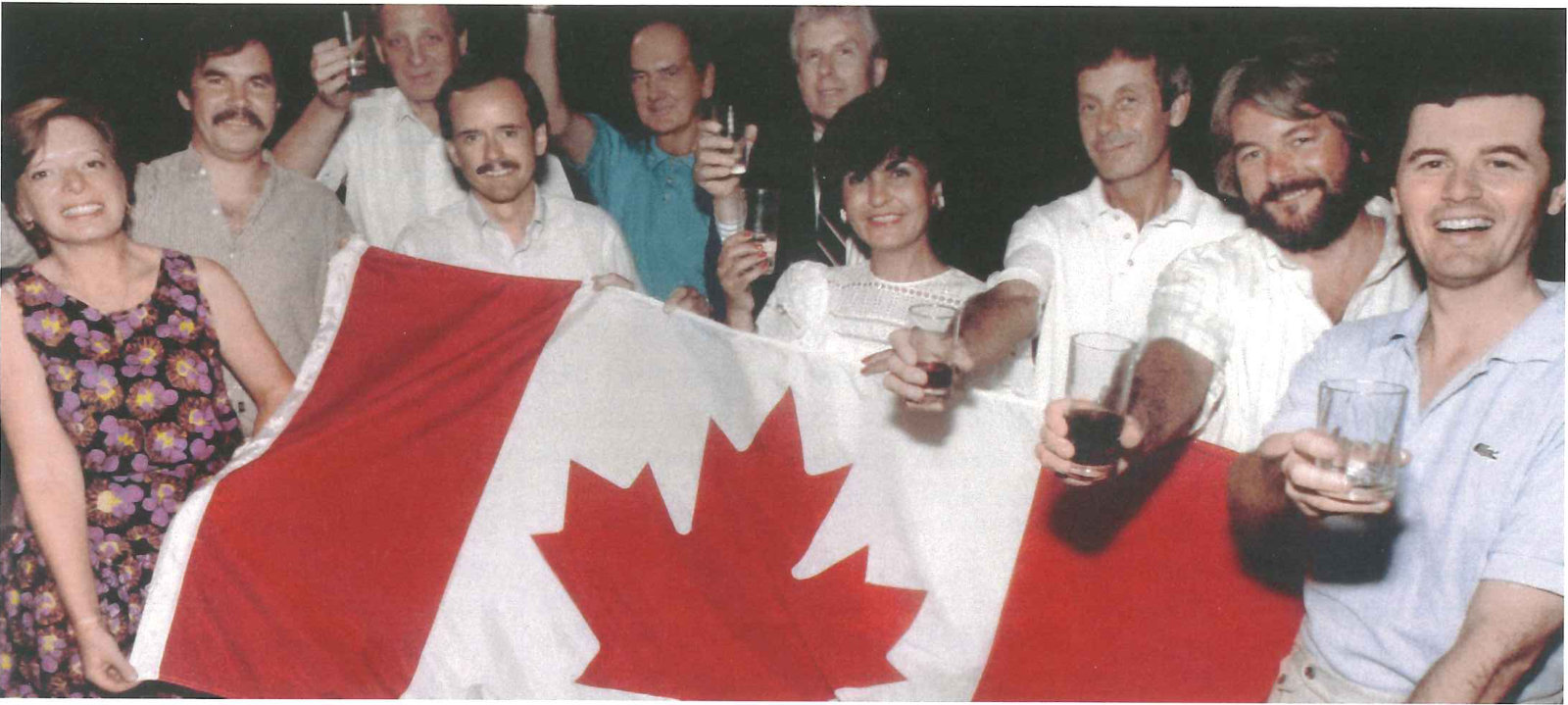
My brother in England sent me birthday wishes via a special BBC broadcast (no last name was used). Journalists came and went. Eric Margolis of the Toronto Sun and a photographer Greg Reekie came in mid-October. They met with Kuwait Embassy staff and other Canadian hostages and wrote a Thanksgiving cover story with photo entitled “Canadian ‘guests’ just wait.” With thoughts of home sparked by the visiting journalists we raised our glasses in a Thanksgiving toast for the camera.
Our five colleagues who emerged after eight weeks from the besieged Canadian Embassy in Kuwait arrived in Baghdad on October 19. Chargé Bill Bowden described the city he once knew as “dirty and largely empty.” The Iraqis had pillaged most moveable objects and garbage was piled everywhere. Sporadic gunfire could still be heard from the diminished resistance and from roving armed gangs. Joe Clark, then Minister of Foreign Affairs, said the five “exemplified the best tradition of the Canadian Foreign Service.”
Canada maintained that the Embassy remained technically open, in defiance of Iraq’s order to close. As a result, the Iraqi authorities continued to refuse to allow all Canadian diplomats previously based in Kuwait to leave Baghdad.
Two Canadian destroyers and a supply ship, a squadron of CF-18s and 1,700 military personnel from Canada were now in the Gulf at bases in Bahrain and Qatar. With a goal to enforce sanctions against Iraq, their gear also included special nuclear, biological and chemical warfare masks. By late October more than 200,000 troops from I countries were in the northern Saudi desert along with 100 ships from 14 nations and jets bombers, transport planes and helicopters.
Baghdad, November 1990
As October gave way to November, we continued to update our advice to Canadians. This included information on personal security and medical assistance; access to ‘friendly embassies’; emergency numbers and radio frequencies; what to do in the event of the outbreak of war, most likely in the form of an air attack on Baghdad, or restricted movements due to civil unrest. Evacuation procedures for land routes from Baghdad to the Turkish border (800 km north) or Amman (550 km west) were also highlighted.
We reported to Ottawa that Saddam’s military machine, oppressive security apparatus and shattered economy, resulting from almost a decade of war with Iran, gave Iraq a heightened sense of survival under adverse conditions. The effective use of psychological warfare to avoid or delay the outbreak of hostilities was clearly evident in his threats of inflicting heavy Western casualties if attacked.
Saddam had photo-ops with hostages and held interviews with news anchors such as Dan Rather from CBS and courted peace activists as TV networks tussled in their coverage of the crisis – some argued to mediate it. The sporadic release of detainees through high profile “special envoys” bought time for Iraq. Despite this, there was still no news for the Canadian guests at the Embassy in Baghdad about a possible departure date. Minister Clark refused to send an official delegation to Iraq saying it would only provide a propaganda opportunity to Saddam.
Rumours of an impending war were in the air and Iraqi Generals were reportedly on high alert. At the Melia Mansour Hotel in central Baghdad, the restaurant was filled with Japanese politicians, journalists and many women and children released from military targets preparing to go home. A waitress looked on through the slats of a room divider taking in the scene like the inmates we had both become.
Three Canadian MPs from the main parties visited Baghdad in late November for an I day mission – Lloyd Axworthy (LIB), Svend Robinson (NDP) and Bob Corbett (CON). They gained permission to depart with five Canadians, which would still leave behind 40 others.
On November 28 the Security Council in a Resolution indicated that it was concerned by Iraq’s attempts to “alter the demographic composition of…Kuwait and to destroy the civil records”. Importantly, a day later Resolution 678 announced that Iraq must voluntarily withdraw from Kuwait by January 15, 1991 and gave authority “ …to use all necessary means” to force Iraq from Kuwait if it does not comply.”
While Baghdad rejected the UN’s “ultimatums”, a new line had been drawn in sand. The MPs returned to Canada and, together, told reporters that the UN resolution allowing for military force “was a mistake, making it more difficult to free other Canadian hostages.”
Baghdad, December 1990
By December 1990, our impatience was growing, particularly as other nationals were leaving Iraq UN sanctions were beginning to take hold with shortages of fuel additives, newsprint, tires and some food. Then, out of the blue, on December 6 Saddam Hussein announced that all foreigners still held in Iraq and those hiding in Kuwait (approximately 2,600 people) were free to leave. That included us!
We continued to lack confidence about our security when dealing with an unpredictable dictator who had changed his mind several times before. In the end, we were indeed allowed to leave Baghdad on Sunday, December 9 on an American chartered Iraqi Airways 707. Thirty-two Canadians – twenty-one from Kuwait, including seven Embassy staff and their spouses and eleven Canadians from Baghdad – were released that day.
The flight of 300, mostly American and British citizens, arrived in Frankfurt around midnight. I don’t recall much of the actual airlift from Baghdad, other than the cumulative fatigue of four months under Iraqi occupation and detention and the cheers and relief that overcame us when we finally flew out of Iraqi airspace. Epilogue: During Christmas 1990 our thoughts were with the small staff of Canadian diplomats left behind at the Embassy in Baghdad and the Kuwaitis still living under occupation. More than 510,000 Iraqi troops were now in Kuwait and the south of Iraq facing off against a multinational force of about 490,000 in Saudi Arabia. Peace talks ended in failure and, with all diplomatic initiatives exhausted, the first Gulf War began January 16, 1991. It ended on February 26 with the Iraqi Army largely defeated and Kuwait in disarray, its population traumatized and its oil fields on fire. Part III of this series will discuss events related to the Gulf War, and Canada’s involvement in it, leading up to the author’s return to Bahrain and Kuwait in March-April of 1991.
View the original scanned pages →
Originally published in bout de papier, Vol. 29, No. 3 (2016), pp. 16–19. Read the rest of this issue →



