
bout de papier, Vol. 28, No. 3 (2014) — Winter 2014–15 // Hiver 2014-2015, pp. 33–35
The short, slight man in the white suit gave a small smile and pulled a flat gold bar, maybe eight inches long, from its velvet bag. Raoul had introduced him as Jo, a friend from the Philippines. The bar wasn’t his, he admitted. It was apparently Kublai Khan’s. “Just a copy,” he said slyly. “These were the first diplomatie passports, you know. Starting with Genghis, the Khans gave one to each of his travelling officials and got most upset if they were mistreated. It was the beginning of diplomatic immunity.”
“What does it say here?” Dash asked. Jo replied, “I’m told that a rough translation would go something like, “The bearer is under the protection of the Grand Khan. Mess with him and you will be very sorry. Although not for very long.’ Even some foreigners got them, like, ah, Marco Polo….” His smile widened.
This conversation was happening in San Francisco, where I was working a case involving some so-called Watusi derivatives for a client back home. What he hoped to derive, other than a slipped disc, was unclear, but it was his dollar. Since I was in town, I called some old friends. Dash lived here, while Ray, Ross and Raoul agreed to come up from LA. Jo had just arrived in San Francisco himself.
The streetlights and the moon reflected from the wet pavement, but a fog was gathering at the corners of the streets, mixing with the shadows in the alleyways. The gang never seems to meet by day, and the saloon where we gather, I can never find at other times. But the lights were low, the scotch was good and the laughter was friendly as we swapped stories, some of them even maybe true. Ray was going strong that night on crooks in the oil industry, I recall, and Dash always had something fun to recount from his days with the Pinks. But it was Jo who took the prize.
“Oh yes, the passport the Khan gave Marco still exists, usually locked behind bullet-proof glass in a museum. I’ve seen it,” he said. Dash asked, “How did you run across it?” Jo took a sip of his wine and said, “I was in — a country I will not name, but somewhere along the Silk Road. The Marco Polo passport was the centrepiece of an exhibit on the old trade route. Like you, Mr. Dikk, I was in town wrapping up an unrelated case, and stopped in out of idle curiosity. I had time to spend before my train left for Shanghai.”
He pulled out and lit a twisted black cigar. It smelled like someone had set the tar sands on fire. “When I got to the National Museum, people were running everywhere. I had just missed the opening, you see, and something had happened. They had taken the golden passport out of its display case as part of the official ceremony, and then it had been passed around the head table. Eventually, it was left just lying there. I would not have recommended such casual procedures, but then I was not consulted.”
“As the dinner broke up, the curator from the donating museum went to collect the passport, only to find that it had been swapped for a very good copy.” “How could he tell?” asked Ross, sipping the paint stripper he insists on. Jo replied, “Unlike any of the Khans’ other surviving passports, it has an inscription scratched on the back, which could only have been added in medieval Italy. This inscription has never been photographed, and it was missing from the copy.”
“The curator raised the alarm immediately, but it was too late. He had kept the eye of a hawk on the table and, although he missed the switch, he was sure no-one but the five people seated there had handled it. And he knew the real one had been there, because he brought it in himself. I trusted him on that, and it turned out I was right.”
“Like everyone else, the people at the head table had headed off, and whoever made the switch would have all the time they needed to hide the passport. And they were too important just to haul in and put though what I believe you call the wringer.”
“T turned to leave, but I was stopped by the Director of — I suppose it would be the equivalent of your FBI. He was a good friend, and the client whose private case I had just closed. He asked me to stay and help him. As an outsider, I could ask questions and go places his people could not, especially given the status of the suspects. I agreed.”
“While his officers focused on the hotel and asked a few polite questions of the VIPs, I tried to find out where the criminal could have obtained the copy — not impossible, but not exactly available on the street either. The question was soon answered for me. A police station in one of the richer parts of the city reported that a few days before, it had been called by a woman to say that her husband, a Pakistani immigrant, had been murdered in his antiques shop while she was in their apartment upstairs. He had gone down to open up late for a customer, who was coming to pick something up.”
He went on. “She heard them argue and crept down the stairs to see what was happening. She forgot her glasses, so she could not see the customer clearly, but she could tell that he was a tall man with black hair, and that he was speaking Urdu with her husband. Just as she got there, the fight turned violent. The man pulled a gun, shot the shopkeeper three times in the face, snatched something from the counter and dashed out. She ran to her husband but he was probably dead before he hit the floor.”
“We showed her a picture of the passport and she said it had arrived in the store from a dealer in Singapore just days earlier. We searched the place, but nothing like it was found.”
“Does the description of the killer match any of the VIP suspects?” Ray drawled. Jo took a picture from an inside pocket. “Here they are, together at the opening. All smiling, all scheming.” It was not a good picture, seriously out of focus, but you could make out the basics. There was a woman and at least three men; the figure in the second seat could have been either.
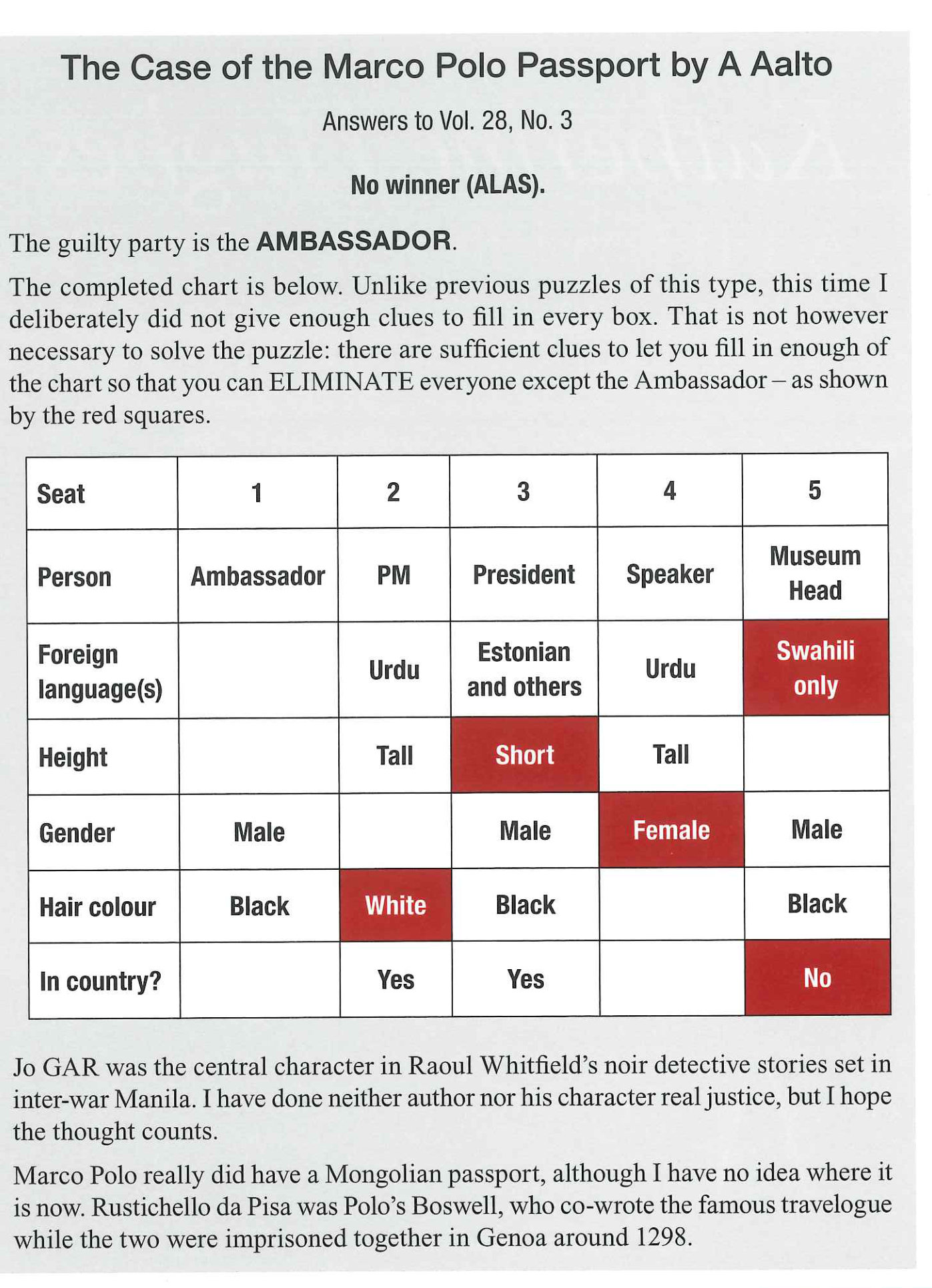
Jo said, “The black-haired man in the middle seat is the President. In addition to his native language, he speaks Estonian and maybe some other languages. The man at the end here speaks only Swahili as a second language and wasn’t in the country when the killing happened.”
Ross said, “What about this guy at the other end of the row, the one with long black hair and a short beard.” “That gentleman is the Ambassador of the country that loaned the passport. He’s also a collector of Asian antiques. Now, the Speaker here,” Jo went on, pointing to a figure three seats away from the Ambassador, “was certainly in the country, and she’s tall and she speaks Urdu.”
He pointed at another figure and said “This one with the white hair was around as well.” I jumped in to say, “But does anyone else speak Urdu? That would be the hardest thing to fake.” Jo replied, “Yes, the PM speaks Urdu, now that I think of it he’s the tall man sitting next to the short man who is next to the Speaker.” “And the man in the fifth chair?” asked Ray. “That’s the Head of the Museum, a crusader to get the country’s historical and archaeological antiquities back from abroad. Mm? Yes, the way the light hits his head makes it hard to tell, but his hair is black.”
“They all hate each other, so there’s no possibility of collaboration. In particular the President, the PM and the Speaker would all kill — my apologies — to get their hands on such a fabulous object. Maybe to sell it on the black art market (the PM is said to be dangerously low on funds to pay the militia that keeps him in power). Or to use it in some way to advance their political careers — perhaps by staging a miraculous “recovery” to polish up their credentials.” He fell silent.
Dash never could handle silence. “So what happened? Did you figure it out?” Jo took a sip of wine and nodded. “Yes I did. They could all have done it, we had no witnesses to the theft, and I did not underestimate their nerve. So I ran a bluff. The Director called a press conference, where the visiting curator announced that the passport handed around the head table had itself been a copy, a better copy than the one used by the killer. Afraid that something would happen to the original, he had made the substitution as he brought it into the room. At the Director’s request, he had not revealed this before, since the police had hoped the thief would be caught redhanded with the fake. He was now convinced, however, that the thief would never be found, and so he was invoking the security clause in the inter-museum contract and taking the real passport home with him the next day. Waving a golden tablet at the assembled journalists, he swore that it would not leave his possession until it was back in his museum. He was really very convincing, I have to say.”
Then we ringed the curator’s hotel room with hidden policemen and waited. I was sure that, having killed once on his way to getting the passport, the thief would not let it slip out of his hands. And about two o’clock in the morning the thief used a passkey to get into the room and put a gun to the curator’s temple as he lay in bed. Fortunately, I was under that bed. I grabbed the intruder’s ankles and pulled hard. He hit the floor harder and was in handcuffs before he even woke up. A search of his home turned up the real passport.”
The rest of us around the table gave him around of applause. I thought a minute and said to him, “That was good thinking, Jo. But we all have our own ways of working a case. I’ll bet I could figure out who it was just from your picture and what you told us about it.” Raoul’s whiskey stopped halfway to his mouth and he said, “You could, Shamus? Just how would you do that?”
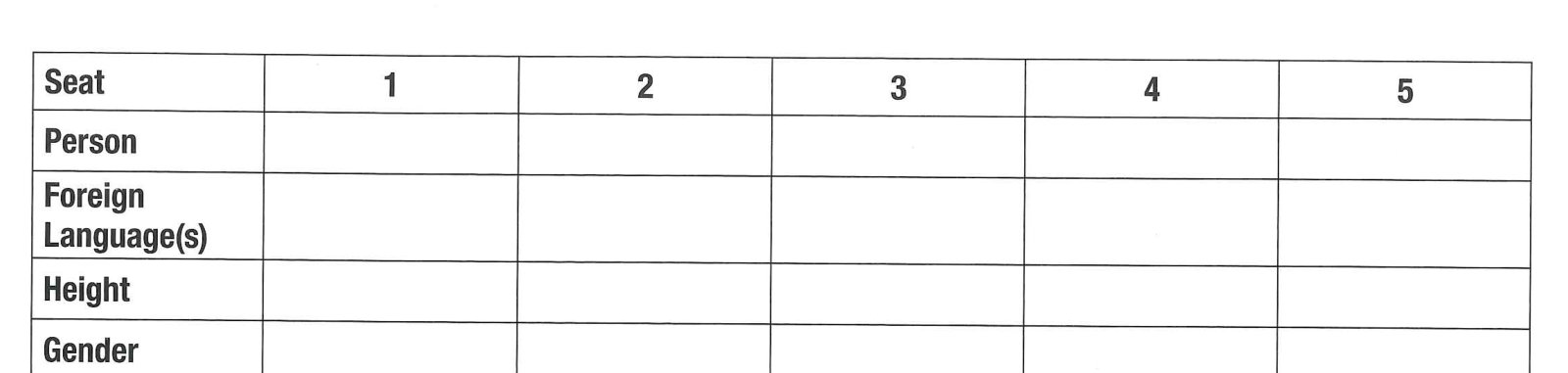
I asked the barkeep for some paper and a pencil. When they came, I drew a grid and explained. “We have a row of five people. We have five clues to the killer — height, hair colour and gender, plus knowledge of Urdu and the question of whether they were in town when the murder took place. We use the information you gave us to fill in as much of the grid as possible and see where that leaves us.”
It didn’t take long. I named the killer. Jo gave me a short round of applause in return, which I appreciated, and one of his cigars, which I pretended to.
Nothing was going to top that story, so we got ready to head off into the night. I turned to Jo for one last question. “What was that mysterious inscription on the back of the passport, anyway?” He coughed gently into his fist. “Actually, it reads, ‘Rustichello says — for a good time, see Lucretia B at the Doge and Duck Tavern’. In medieval Latin, of course.” “You’re kidding, right?” I insisted. “Not so, Mr. Dikk.”
He pulled out the velvet bag and extracted the passport. Reaching for the glass that held Ray’s stripper, he poured the last of it over the blank back. After a few second, he used his pocket handkerchief to rub off the golden paint and reveal a patch of faint but clear letters. He said, “The museum here in San Francisco thought it would be less likely to be stolen again if I brought it back anonymously, while the curator returned at the same time with much fanfare.”
Our jaws dropped. Dash gulped, “So this is really Marco Polo’s passport?” Jo laid his head on one side and said, “Perhaps. Or perhaps it is the curator’s second, better copy, the one he waved around at the press conference. Or maybe neither of us knows, so we will both work hard to protect the one we hold.” He picked up his panama from the table and placed it neatly on his slicked-back hair. “Remember, boys. Don’t mess with the Khan.”
Can you duplicate Shamus’ feat and identify the thief/murderer? bout de papier will decide the winner by drawing from a hat (panama if possible) containing all correct entries received by March 1. The winner will receive a book autographed by A Aalto. Not necessary to win, but can you guess Jo’s last name?
Free-lance prestidigitator A Aalto is having a wonderful time close to his ancestral home and had to be dragged off a yak to complete this puzzle. It is dedicated to Raoul Whitfield, for reasons which will be clear to anyone who has read certain of his short detective stories (which come highly recommended for period and regional colour). It is also dedicated to Genghis Khan, benefactor to our profession — he really did invent the diplomatic passport and exacted bloody retribution when his Ambassadors were offed. And thanks to Mrs. Aalto for encouragement and precision.
View the original scanned pages →
Originally published in bout de papier, Vol. 28, No. 3 (2014) — Winter 2014–15 // Hiver 2014-2015, pp. 33–35. Read the rest of this issue →



