
bout de papier, Vol. 28, No. 2 (2014) — Summer 2014 // Été 2014, pp. 9–10
Introduction
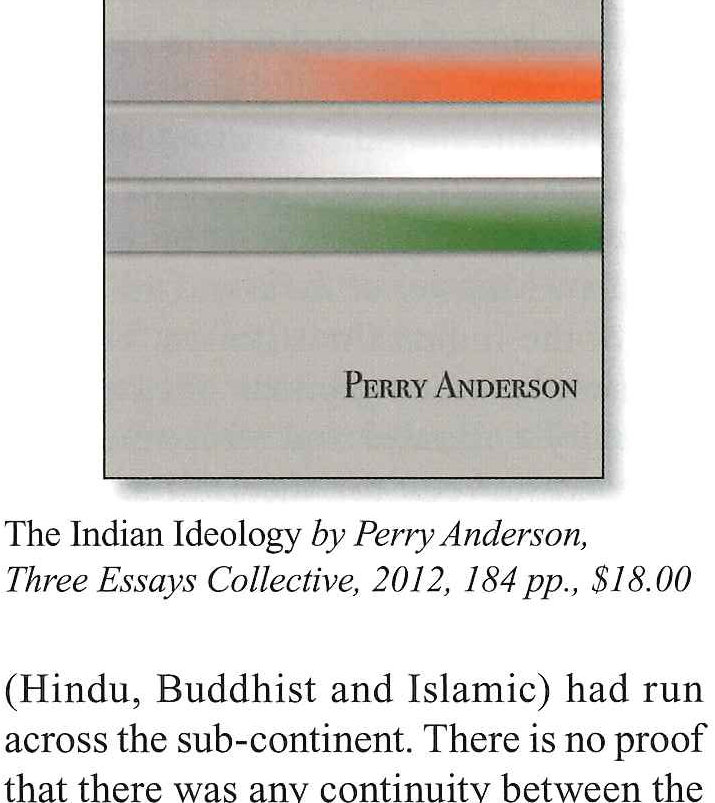
The Indian Ideology is a slim volume by Perry Anderson, the eminent British neo- Marxist historian. It caused a firestorm in academe when first published (as three essays in the London Review of Books). Collected and published in 2014 by Verso, it ranges from acerbic polemic to incisive critique, and effectively punctures the foundational myth that independent India was a “miracle” of “democratic stability, multi-cultural unity and impartial secularity”. That also makes it essential reading for diplomatic practitioners endeavouring to make sense of the rise to power of the controversial Narendra Modi and the Bharatiya Janata Party (BJP) with a majority government that trounced the “natural party of government”, the Congress.
The book has several targets, all “sacred cows” of Indian politics: the myth of Indian exceptionalism; the iconic status of the twin heroes of the Indian freedom struggle, Gandhi and Nehru; the role of the Indian National Congress in the partition of India; and, the caste-bound nature of India’s democracy. Anderson’s essays are thus a refreshing alternative to competing current narratives, notably the optimistic, even self-serving triumphalist narrative served up by Modi’s cheerleaders (which include both Americanized free-marketers and the “Hindu-firsters” of the Sangh Parivar or “Family of Organizations”), or the doom and gloom scenario preached by the shell-shocked Congress apologists, the anglicized old elites, and leftwing members of academe.
Indian exceptionalism
The “Indian ideology” that most offends Anderson is Indian exceptionalism. Its highly committed adherents include key prominent Indian thinkers such as welfare economist and Nobel laureate Amartya Sen and policy think tank guru (and former member of the IDRC Board of Governors), Pratap Bhanu Mehta. Anderson gives their considerable body of work short shrift and finds them all guilty of believing their own rhetoric. But he reserves special scorn for the granddaddy of Indian exceptionalism, India’s first Prime Minister, the old Harrovian and Cantabrigian, Jawaharlal Nehru.
India, Nehru maintained in his writings, was unique because it had a culture and civilization that had had a “continuity for five or six thousand years or more” but was also “changing and progressing” all that time. Reality suggests otherwise: even a cursory reading of Indian history will show this to be pure fantasy. To this day, Indian “unity” is enforced by firepower in the restive tribal areas, in Kashmir and the NE frontier. Taking a longer view, the writ of none of India’s three previous empires embedded in the sub-continent’s culture. In fact, it was not ancient empires but rather the British that created “India” by “skilful” use of alliances, annexations, “tutelage” and winning a few battles.
The British took full advantage of the fact that the sub-continent, in the dying days of the Mughal Empire, consisted of many, mainly Hindu independent “native states”. As part of the “unification strategy” of its newly acquired territory, the British introduced the telegraph, the railways and laws, established land borders such as the McMahon and Durand lines, and “proclaimed new ideals of civilization and progress” but made no serious attempt to end the caste system.
They even created local English educated elite whose children later became many of the leaders of the freedom struggle. Today’s Hindu-majority India owes far more to the sub-continent’s somewhat prosaic unification under British rule than to self-serving, grandiose mythic notions of an inspired melding of competing identities millennia ago.
Gandhi and Nehru
Much of the opprobrium heaped on Anderson is because he dared to portray the two icons of the freedom movement as human beings, warts and all. His Gandhi is a charismatic communicator, a “first-class organizer and fundraiser,” but also “temperamentally in many ways an autocrat”. His accusation that “religion mattered more than politics” to Gandhi is supported by facts. Gandhi saw Hinduism as indigenous to India, gave it primacy over all other faiths and injected a “massive dose of Hinduism” into the hitherto secular elitist Indian National Congress (INC) turning it into a tool of mass mobilization with Hindu symbology.
But Anderson’s real criticism is reserved for Nehru, the first prime minister of independent India. Anderson categorizes him as an upper caste fop, to which statement I would add, upper class, with “few political ideas of his own”. However, he does laud Nehru’s unflinching attachment to democracy that has withstood the test of time. Nehru, a secular person with an interest in natural sciences, exhibited an exaggerated filial devotion to Bapu (father) Gandhi. He withheld his own opinions and never challenged the latter’s authority or ideas. Gandhi soon realized that Nehru was more tractable than the fiery intellectual Subhas Bose, an erstwhile competitor on the political stage, with his socialist leanings… and so anointed Nehru as his successor. The Nehru dynastic succession was thus created.
The Partition of India and the role of the Congress Party
Anderson lays the blame for the Partition of India and the ensuing bloodbath, in which close to one million people died, squarely on the Congress acting in cahoots with the British. It is certainly not a popular view. Nehru, an unabashed Anglophile, had had a close relationship with the Viceroy, Lord Mountbatten, and the Vicerene that he exploited to his advantage. So convinced was Nehru of the strength of India’s unity, that he ignored the first formal signal of eventual partition: the 1940 Lahore Resolution passed by the All-India Muslim League calling for the creation of “independent states” for Muslims in north-western and eastern British India.
Anderson maintains that when partition became inevitable, Nehru, with the support of the Hindu-firster party, the Hindu Mahasabha, connived with Mountbatten to prematurely push through partition and the transfer of power. While the ex-colonial power looked the other way, India secured territory, backed up military force, in Hyderabad and Kashmir. The hopes for a united secular independent India were scotched forever.
Caste-bound democracy
The British Raj lacked resources necessary to control an entire subcontinent and was forced to collaborate with the local gatekeepers of culture. Thus, they accepted and codified the “Brahmin version” of subcontinental history with its twin pillars: the immutability of caste and the primacy of the Brahmins. Anderson describes the Congress Party as an alliance controlled by a coalition of “rich farmers, traders and urban professionals”, mainly from the upper castes.
One early exception was Dr. Bhimrao Ambedkar, a brilliant jurist and economist with advanced degrees from Columbia University and the London School of Economics, who was a Dalit (Untouchable). “Babasaheb” (father-lord, a term of respect), whom Anderson rightly admires, fought unceasingly for the rights of all the minorities, especially Untouchables.
The Indians, represented mainly by the Congress Party and the All-India Muslim League “failed to come to a resolution on how communal” representation should be configured electorally. Ramsay Macdonald, the British Prime Minister, then imposed the Communal Award of 1932 as part of the British policy of self-rule for India. According to the Award, all minority communities were given separate constituencies. It also categorized “Untouchables” as a minority. Ambedkar had always advocated for separate electorates for minorities. The Award infuriated upper-caste Hindus who held that Untouchables were part of the Hindu fold. Gandhi also subscribed to this view but considered untouchability per se abhorrent. He threatened a fast to death and Ambedkar was forced to back down. Nonetheless, Ambedkar went on to become the first Law Minister of India and the architect of the Indian Constitution. Finally, discrimination on grounds of caste was formally outlawed and constituencies were “reserved” for the Dalits. Since Independence, urbanization and industrialization slowly began to erode some of the rigidity of caste barriers. Yet, lower caste men and women are still victims of unspeakable violence and denial of justice especially in the Northern and Central Indian “cow belt” states.
In recent years, both North and South India have seen a proliferation of regional political parties that draw their support from Dalits and OBCs (Other Backward Castes). That has led to the formation of “vote banks” and rise of Tammany Hall-type politicians. Caste has become crucial in local politics. In the most recent election, both parties assiduously courted the Dalit and OBC vote across India. Modi, a member of the OBC, is India’s first low caste PM but his base is still the upper caste Hindus.
According to the Lokniti-CSDS analysis, the BJP was elected with 60 per cent of the upper caste vote and this vote is heavily concentrated in seven out of 29 states.
It might surprise Canadians to know the extent to which Cabinet-making in India requires balancing caste and faith interests as well as regional and linguistic interests. As the recent election demonstrated, identity politics (as expressed through caste and religion) is far more embedded in the Indian psyche than class and aspirations to a better life. India, extolled as a stable democracy, still remains “caste-bound” even after 70 years of independence.
When choosing his Cabinet, Modi all but ignored Eastern and Southern states and faith groups. Predictably, Modi’s 46-person cabinet has 20 upper caste Hindus, 13 OBCs, six adivasis (tribals) and only three Dalits. According to the Times of India, the caste mix changes drastically with the different levels of responsibility!
This confirms Anderson’s canny observation that “A rigid social hierarchy was the basis of original democratic stability, and its mutation into a compartmentalized identity politics has simultaneously deepened parliamentary democracy and debauched it.”
Conclusion
Many eminent Indian critics of Anderson’s work have raised the seemingly self-serving argument that non-Indians cannot “really understand the complexity of India”. An honest reading of Anderson’s book suggests otherwise. Anderson’s book has much to say to current practitioners about the historical antecedents of Modi’s “New Order” India. His analysis provides a powerful antidote to the optimistic rhetoric of BJP spinmeisters and certain sections of the Indian diaspora. A more realistic focus on India’s past helps make better sense of the new government and its behaviour.
Anu Bose is a friend of the Foreign Service. Born in Calcutta to a political Brahmo Samaj (Unitarian) family, in the waning days of the Raj, she holds a PhD from the University of Birmingham U.K. in Development Administration with a specialization in Economic Anthropology and Behavioural Economics. She is an independent consultant as well as a consumer and human rights activist.
View the original scanned pages →
Originally published in bout de papier, Vol. 28, No. 2 (2014) — Summer 2014 // Été 2014, pp. 9–10. Read the rest of this issue →



