
bout de papier, Vol. 28, No. 1 (2014) — Spring 2014 // Printemps 2014, pp. 29–31
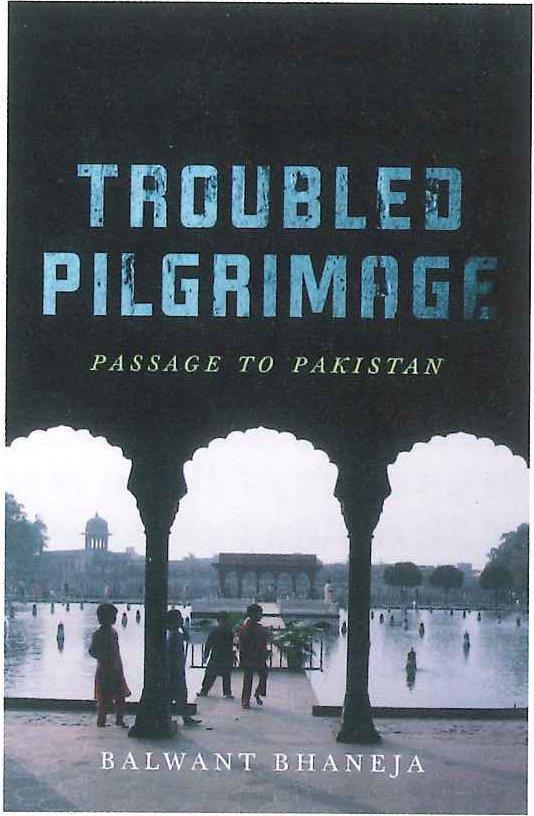
TROUBLED PILGRIMAGE:
PASSAGE TO PAKISTAN by Balwant
Bhaneja, A TSAR Book, 2013, 141 pp.
$24.95.
When Balwant Bhaneja retired from the Canadian Foreign Service he bravely undertook a solo voyage to Pakistan where his parents had lived to adulthood, about which he only had some vague childhood recollections and where he had no known relatives. This slim volume, Troubled Pilgrimage, Passage to Pakistan, is a very personal reflection on his short post 9/11 visit particularly to the small-towns of the Upper Sindh: Sukkur, Rohiri and Shikarpur, not your usual tourist destinations. In his own words, he went on “a real journey navigating the gulf between imagination and reality” travelling light on an old banger taxi, a small plane and a night train.
Bhaneja’s immediate family was already in Delhi in 1947 so he was spared the bloody aftermath of what the Indian writer Pankaj Mishra has termed “one of the greatest fiascoes of the twentieth century” the Partition of Greater India into two states, India and Pakistan, based on religion. However, he does remember the unexplained disappearance of his little Muslim playmates and the sudden arrival by train from Sindh of his elderly paternal grandmother, his uncle and 13 other relatives. The Sindhi Hindus were refugees in the truest sense of the word. Uprooted from Sindh, they came to India, where unlike the Punjabis and Bengalis, they had no “homeland” of their own. They scattered all over India and rebuilt their shattered lives through a combination of hard work and business acumen.
Bhaneja, like most Indians, grew up with stories of the bloodbath after Partition especially in the Punjab and Lower Sindh and negative stereotypes about the “enemy” Pakistan and its “murderous” Muslim majority. But in spite of himself, Bhaneja is rather taken by the efficient non-hijabed women immigration officials, the spanking new airport, the newspaper report of Hindus and Muslims celebrating Holi (the Hindu spring colour festival) together, the modern highway and bright lights of the capital, Islamabad. All this in sharp contrast to the untidy New Delhi airport and Indian capital’s crowded streets. Even the Islamic architecture in Islamabad seems somehow more authentic than the Edwardian “Anglo-Mughal” building style of Sir Edward Lutyens’ New Delhi. He is prepared to give Pakistan the benefit of the doubt and for good reason.
Bhaneja was also reared on nostalgic tales of Muslim and Hindu Sufi saints and their festivals in Sindh where all faiths were welcome. Bhaneja père never separated from his past. He kept the distinctive Sindhi culture and language alive, no mean feat in Hindi and Punjabi speaking Delhi. He had even organised a Sindhi-themed float in the iconic January Republic Day parade in 1960, always an odd mixture of “folk culture” and military might. The float represented Sindh’s Hindu patron saint, Jhuley Lal, references to whom appear several times throughout the book. More importantly, he bequeathed this deep love and understanding of the unique syncretic Sindhi Hindu culture to his son, regaling him with nostalgic tales of Sufi Muslim and Hindu saints and their festivals where both religions came together in a shared culture in pre-Partition days.
There are several lovely little vignettes in the book. I have chosen to concentrate on three, which spoke to me, like Bhaneja, another of Midnight’s Children. First, the account of his visit to hand deliver a parcel for the celebrated Sindhi Sufi singer, Abida Parveen. His meeting with her brother is, no doubt, an excellent example of the shared culture of Sindh’s two religions and of the legendary hospitality of the Indian sub-continent. I was struck by the unselfconscious way in which Bhaneja incorporated the Sindhi forms of address “Sai” (friend) and “Adi” (elder sister) into the narrative. As Ms Parveen was away, it was to Ali, a complete stranger, that he expressed some trepidation about travelling alone to Sindh. And, Ali reassures him that, as in their parents’ day, Hindus and Muslims lived peaceably in Sindh. As they parted, Ali presented Bhaneja with an “ajrak chadar”, a large woven cotton shawl blessed by a Sufi dervish or contemplative who was a devotee of “Lal Sai of Sindh”. Bhaneja is “moved” by this memento and reassured that post-Partition Sindh still retains the best of the past.
The second little gem is his description of his visit to Rohiri, the city of mystics, and his father’s birthplace. Here he discovered a small but thriving community of prosperous Hindu businessmen, teachers, and civil servants, some living in a neighbourhood with a mosque belonging to another minority group, the Shia. Bhaneja, a complete stranger, was embraced by a Mr. Bhatia, a retired civil servant-turned-electrical repairman and Hindu community leader. His kindness and hospitality is remarkable just as Ali had predicted. An afternoon spent at the Bhatia home more than compensates for the fact that he found no one who remembered his father’s folks and he is content when, with Bhatia, he does find the lane where his grandfather’s home had stood. Chapter 9 is a wonderful evocation of small town life in Upper Sindh and of an educated, well-established small, resilient and self-contained community which comprises less than 1% of the total population of Pakistan.
In Upper Sindh, Bhaneja is transformed. He confidently uses his rusty Sindhi and is much less wary about being from an “enemy” country. Bhaneja drops his guard somewhat and opens up to his chauffeur-guide, Nur Bux, asking him about his family and showing him a picture of Bhaneja père. His writer’s imagination has taken over conjuring up pictures of his young mother and himself as a child travelling by horse-drawn carriage between Shikarpur and Rohiri. En route to Shikarpur, his late mother’s birthplace, he is overcome by emotion and breaks into a song by Sarmast Sachal, an 18th century Sindhi poet, while Bux hummed along.
It is only when he arrives in the ancestral homeland that the full extent of Bhaneja’s knowledge of and passion for the syncretic culture of Hindu Sindh is revealed. He recalls a popular qawwali (A form of sacred Sufi Muslim vocal music popular in Sindh) “O Lal meri pat rakhiyo” (O red-robed one, may I always have your benign protection), sung in praise of two mystics associated with the river Indus: the red-robed Jhuley Lal, mentioned earlier, and his Muslim counterpart, Lal Shahbaz Qualandar. (The song has been widely recorded by both Muslim and Hindu singers, from the famous gawwali singer Nusrat Fateh Ali Khan of Dead Man Walking fame to the Bangladeshi pop artiste, Runa Laila.)
The third and final vignette is the disconcerting account of Bhaneja’s brush with the Islamists on the night train from Rohiri to Lahore. Waking up and peeping out from under his dervish-blessed shawl, he found himself in a “cabin” with five young Urdu speakers, all with Delhi accents, uniformly bearded and skull-capped. Bhaneja was clearly rattled by the openly flamboyant practice of their religiosity, including a homily. He had finally met “the enemy” and the old stereotypes, fears and latent mistrust returned. After a few minutes of strained conversation with the “madrassaniks” he removed himself to the corridor, rather rattled.
Canadian readers might feel that this former Canadian diplomat missed a great opportunity to grasp the nettle and open a dialogue with Pakistanis, if not Pakistan, right there on that train. In Bhaneja’s defense, I would say that is asking too much even of a self-confessed Gandhian like him. One of Midnight’s children and from a “displaced family” is not the ideal candidate for the job. How many really comprehend the deadly legacy of that hasty and unplanned withdrawal from Greater India by a war-weary British Raj? The visceral hatreds and suspicions run deep to this day. It has led to several wars, an ongoing proxy cross-border insurgency in Kashmir, border skirmishes, an arms race and two nuclear-armed states. The only other example which comes even close is Israel and Palestine.
India and Pakistan are like Siamese twins joined at the hip. The hatred of Pakistan, the “historic enemy” or “the other (evil) Siamese twin” is bred into those born in India and Pakistan. In India, these prejudices have been buttressed considerably by the ongoing conflict in Kashmir, the rise of Islamism on both sides of the border and the random bombings across India. The 2008 well-planned and savage attacks on several areas in the commercial capital of India, Bombay, or Mumbai, by the Lashkar-e- Taiba (an Islamist terrorist group) has only hardened existing attitudes. The Bharatiya Janata Party and its allied “Hindutva” advocates are quite happy to stoke these suspicions for political gain. What is more disturbing is that more Hindu Indians than before now harbour misgivings about Indian Muslims who form about 15% of the population, even going so far as to speak of them darkly as a “fifth column in our midst”. India has had several pogroms against Muslims and in 1992 Hindu mobs demolished the Barbari Masjid alleging that a Hindu temple used to stand at that site. Pakistan’s record is no better. In most areas of Pakistan minorities, even those belonging to Abrahamic faiths, live in fear of Islamist zealots.
It is a sad comment about the leadership of these two countries that in 60 years of existence there has never been a concerted government-led effort to bring about reconciliation between the peoples who share common languages and traditions. The festering wounds of fratricide and uprooting remain. Intense “cricket diplomacy”, cross-border trade, opening of borders and cultural exchanges are some of the ways that might bring the two peoples closer. But, it will not happen in the lifetime of “Midnight’s Children” like Bhaneja and I. Whether the next generation will be more willing to come together is a conversation for another day.
What did I not like about the book? Very little. I found Chapter 2, “Gandhi Darshan in Birla House”., a digression, which does not contribute to the narrative. But, then Bengal has always been ambivalent about Mahatma Gandhi. More importantly, the book also would have benefitted greatly if the photographs had had captions. But these are minor points which in no way detract from this charming little book about one man’s “returning the family honor”.
“Family honour” is an alien concept for Canadians. “Closure” is something Canadians understand. For Bhaneja, one of Midnight’s Children, this was a personal quest and he has had his “closure” in his own way. He comes to the sad realization that “you can’t go home again” because his birthplace, one of his four worlds, is gone forever. Fortunately for him, Canada, Ireland and India remain.
Ottawa-based Anu Bose is a friend of the Foreign Service. She was born in Calcutta to a highly political Brahmo Samaj (Unitarian) family, in the turbulent, waning days of the Raj. She holds a PhD from the University of Birmingham, UK, in Development Administration with a specialization in Economic Anthropology and Behavioural Economics. She is an independent consultant as well as a consumer and human rights activist and, as she is fond of saying, “somehow manages to muddle along in four worlds”.
View the original scanned pages →
Originally published in bout de papier, Vol. 28, No. 1 (2014) — Spring 2014 // Printemps 2014, pp. 29–31. Read the rest of this issue →



