
bout de papier, Vol. 28, No. 1 (2014) — Spring 2014 // Printemps 2014, pp. 36–39
“You? Identical twins?” smirked Sleazewagon. “To counterfeit a phrase, it must have been tough finding the same white suit in sizes 68 extra fat and 12 dwarf.” Don Gordo turned to the diminutive young woman beside him. “Ignore this lout, dearest sister. He should have been hung in effigy years ago!” “Effigy?” she replied. “That’s just outside Kapuskasing, right?” She and Don Gordo high/low-fived.
As they crossed the street, a manhole shot open and the Ottawa Tuba Festival Marching Band erupted like obese skyrockets, booming out the Oompah Brothers version of “Melancholy Baby”. Gordo and Maria’s answering zumba flattened three telephone poles, 17 skate-boarders and a pierogi wagon. Ace logician Ludwig Liebnitz shaded his eyes. It was going to be one of those days.
It had started off badly enough. Called to the office of the Centre’s chief, Hamish MacBannock, Liebnitz found MacBannock’s wife Hilda in the chair. The odour of Scotch and oatcakes drifting under the closet door suggested Hamish was on break. Hilda glared at Liebnitz, saying “We have to act fast, Commander Chaos has Heather.” Liebnitz shuddered. Chaos was a mad clown who revelled in his name. Heather was the MacBannock’s teen-aged tomboy daughter. “What does he want?” “With her, nothing. He wants Hamish to name Rialto Sleazewagon his successor and resign. Today. Or we’ll never see her again.”
A tall man with a pencil-thin moustache sneered from an armchair behind Liebnitz, “As if I’d be interested in running this dump. It was bad enough working here without having to worry about budgets and personnel and the annual polka contest.” Hilda coughed. “He called me, Liebnitz, to say he had been pitched by Chaos, but wanted no part of it. We’ve agreed to suspend hostilities while we sort this out.” Liebnitz nodded. Hilda was tough, had good judgement and knew a lot about the Centre. And there was no time to lose. “Who do we have to work this?” She replied, “Chaos said no police and only six people were allowed to know. So there’s Hamish and me, you and Rialto, and we can choose two more…”
A door burst open. “No need to furrow your brow in this matter of choosing, honoured señora. I, Don Gordo Beluga de Puerco y Frijoles, am here, along with my sister Maria. We are identical twins, so we understand about family. We had an appointment with Hamish and, Ay/, he never remembers to turn off the waiting room intercom, so we have heard everything!”
Liebnitz turned and considered the Centre’s corpulent fixer. Hilda paused and nodded, “Very well, I suppose you’ll do. So where do we go from here? Chaos usually leaves a hint. He likes making life a puzzle. So far, all he’s said is that she is in an office building in this city. He also promised things would work out.”
She was interrupted by someone knocking. “What is this, Grand Central Station?” Liebnitz asked. After some confusion, they decided the knock was from the closet door. Opened, it revealed a bleary-eyed Hamish, who said, “Hilda, the strangest thing. ..I was sipping a wee dram when the secret escape hatch slammed open and this courier — spandex bodysuit and whiteface — wheeled in his bicycle — things were getting a bit crowded — and handed me this envelope. Made me sign for it and demanded a tip — gave him an oatcake. It’s probably nothing, but the return address is a clown’s head…” Hilda kissed him gently and took the envelope. Hamish went back to the closet.
She opened the envelope and shook its contents onto the desktop. Five pieces of cardboard — and a sixth still glued into the envelope. Each had a different picture. “A message from Chaos,” said Liebnitz, “But what can it mean?” Sleazewagon replied, his sharp nose flaring. “They’re signs of the zodiac. I’ll bet they represent us. Virgo, trapped in the envelope, is Heather. Gemini, the twins, that’s easy. You, Liebnitz, must be Sagittarius the Archer, also called the soldier. But Scorpio?” Maria chuckled, “A treacherous insect? Not a difficult divination, señor.” Sleazewagon flushed, “I am often misunderstood, true.” Hilda chimed in, “Pisces the fish are probably Hamish and me. He drinks like one. Like Gemini, one card for two related people. But what about this lion? And why is it stapled to the archer?”
Liebnitz sighed. “The zodiacal lion is Leo. We need to call on my brother.” Hilda nodded. “T’ll keep an eye on Hamish and mind the store. You four, get going.”
And so they were racing down the street dodging counter-marching tubas. Soon they stood outside an austere brick building with no sign and only one item in the show window: a huge fish with eyes pointing both ways from its T-shaped skull. Liebnitz stopped them on the sidewalk. “What you have to know is that my brother is a total flake. I love him deeply, but he’s the most irresponsible guy I’ve ever met. The Sixties will never die as long as Leo lives. He doesn’t make a lot of sense, he does make embarrassing jokes. He pretends to forget my name and then starts singing Louie Louie. Let me handle him.”
They stepped into the store, which was immaculately decorated in a subdued style. From behind a long counter, a tall blond man in a frock coat and cravat smiled and said sonorously, “Ludwig, dear brother. A hearty welcome to you and your friends.” Liebnitz stared at him warily. “Uh, hello, Leo, long time no see.” Leo replied, “As you come with colleagues, I assume this call is not social. How may I help?”
Silence fell and Maria stepped in. “What kind of store is this?” Leo replied, “One catering to collectors of certain special items. “ He gestured. “We have a selection of naval toilets. A good sample of fine busts from all eras. A room for fans of Jerry Garcia. Biographies of everyone who has run a country since the Renaissance — and much, much more. Anything that interests you?” Ludwig smouldered. “What interests me is the game you’re playing. You’re dressed like an undertaker, you’re talking like Sydney Greenstreet on Prozac, you haven’t got my name wrong once. What gives?”
Leo smiled sadly and turned to the others. “I see Ludwig has been telling you the usual stories about me. I’m sorry his delusions have not yet been resolved. And even sorrier that I am not the wild and amusing fellow you were led to expect. It began in our childhood — but no, some things must remain private.” Ludwig restrained himself, barely, saying “OK, we’ll play it your way.” Leo smiled benignly. “What we need to know — badly —is whether anyone left a message for us.”
Leo looked thoughtful. “Now that you mention it, a rather odd woman did come in, wearing a trench coat and floppy clown shoes. She left these documents, saying someone might call for them. That would be you?” Ludwig reached out and snatched the papers. “I certainly hope so. OK, thanks for your help. Let’s have dinner some time and catch up.” “That would gladden my heart,” said Leo solemnly.
Ludwig growled and stomped out, the others following closely. As they reached the street, he turned back to see his brother come out from behind the counter. Below the frock coat, he wore flowered Bermuda shorts and snowshoes. He flipped a switch by the door and hidden speakers pulsed Louie Louie into the street. Pulling out a joint, he lit up, toked and starting laughing so hard he fell over.
“Jerk,” muttered Liebnitz. The others convulsed silently. Recovering, Maria asked, “What was that place anyway? All I saw was a bunch of unconnected junk he was treating like the crown jewels.” Sleazewagon smirked, “Gotta be a head shop — the hammerhead shark, the naval toilets, the Dead Head paraphernalia, the busts, the head of state bios — even a pot-head at the end.”
Don Gordo grunted. “Clever. But what do the papers say? Where do we go now?” Liebnitz replied, “Well, the first page reads: ‘Canada Supplies Emergency Vowels to Northern Serbia — Cities of Sjlbvdnzv, Grznc First Recipients’, “World Death Rate Holding Steady at 100%’, and ‘Drug War Over — Drugs Win’. “Madre de dios! Those are just headlines from Leo’s shop, his parting jest. What about the other pages?” Liebnitz said, “They appear to be a puzzle — about Canadian mysteries.”
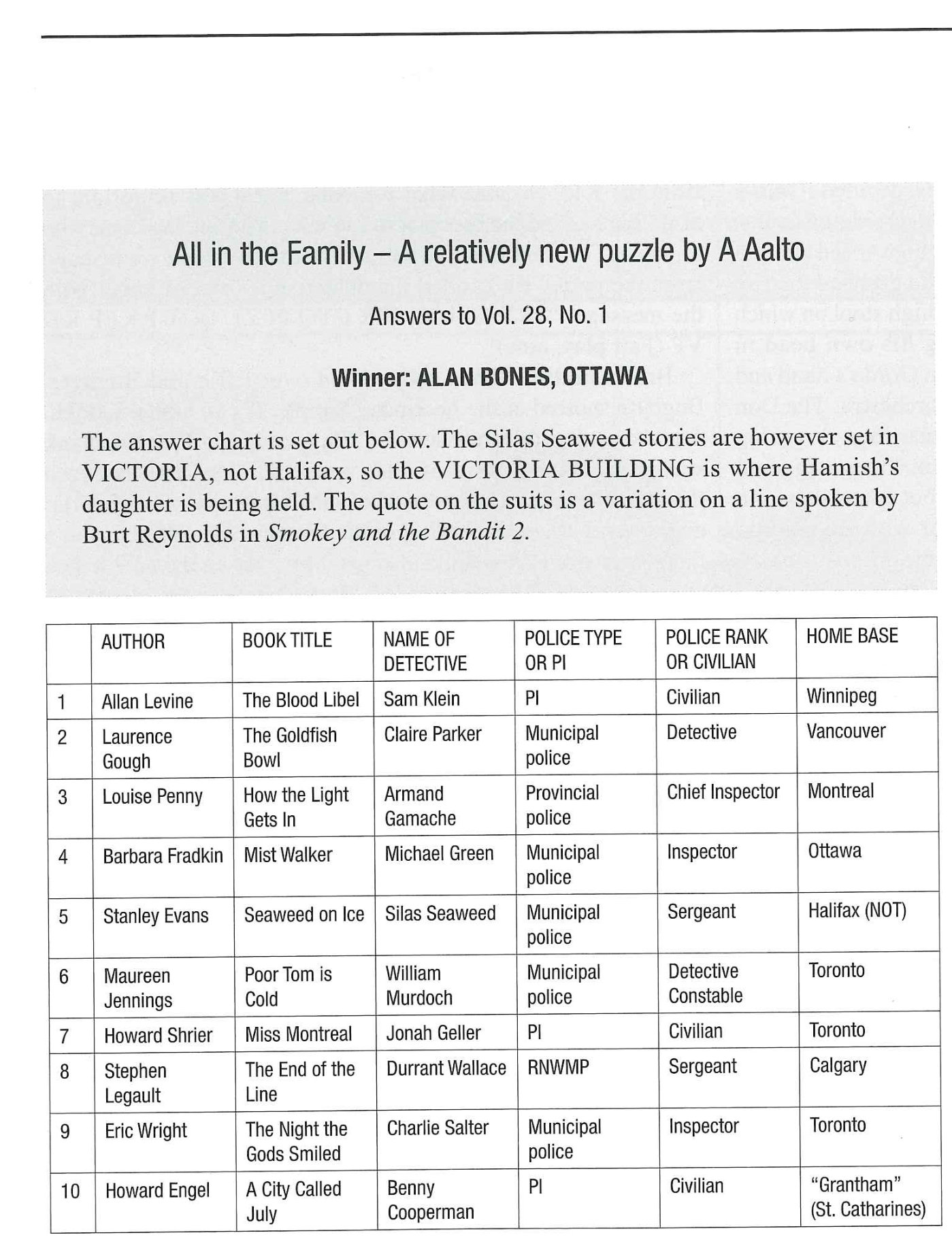
Sleazewagon and Liebnitz quickly filled in the chart. The ace logician rubbed his chin. “There’s something…yes! I’m sure we got the chart right, but the city in this box is not the real home base for the character in that row. If this is the wrong city, Pll bet the right one names the building.”
An Internet search confirmed the name of the right city. Within minutes they were at the building of the same name, zeroing in on a fitness centre called The Coming Order. “Trite,” said Sleazewagon. “I’ve worked with a lot of megalomaniacs. Hell, I’ve been a lot of megalomaniacs. They all worship Nietzsche, who said ‘Out of chaos comes order’.” “On the other hand,” said Don Gordo in grudging respect, “Chaos did tell Senora MacBannock that things would work out.”
Night had fallen and the building was locked, but Sleazewagon picked the lock on a side door. The team climbed the emergency stairs to the darkened gym. They were creeping through the rows of silent machines, when the arc lights suddenly crashed on. Revealed in the dazzle were Commander Chaos and his killer clowns, surrounding either a Nautilus machine or the rack, to which a young woman in black leather was strapped, looking determinedly bored.
Chaos clapped hands languidly and said “Well done. I’m impressed you found us, but I suppose the clues were obvious enough.” Maria turned to Don Gordo. “Oh the poor man, I think he had rickets as a child.” “Rickets, my dear sister? His legs seem straight enough” “Isn’t that the childhood disease where you grow up fat, bald and obnoxious?” “I believe you are thinking of ‘Rickles’. Ready now?” With that, they grabbed opposite ends of a nearby barbell and clotheslined two of the gangsters, Maria running along a balance beam to keep things even.
Liebnitz piled in and was soon mixing it up all over the mats. Sleazewagon fled to the mezzanine and proved his sneaky worth by dropping dumbbells on the distracted villains Leibnitz pushed to the wall below. Clown by clown, the Centre team carried the day, the gangsters being hampered by their size 17 shoes, enormous flashing noses that exploded when punched, and tendency to break into Pilates moves when hit by an exercise ball.
Last clown standing, Chaos braced himself against the floor-to-ceiling windows. As the twins strode up behind a weight bench, he pulled out a huge revolver. “So,” he snarled. “Maybe this is areal gun, a Magnum that can blow holes the size of grapefruit. Or maybe it’s a clown gun. Even I don’t know which. Are you feeling lucky — punks?”
Don Gordo paused and said, “Like you, Señor Chaos, my sister and I also worked under the big top. We were acrobats in the circus of Mr. Edwin Hyde and his brother Maldwin.” Chaos looked confused. Maria took up the story. “One of the brothers died and they dedicated the evening show to him. The troupe made the tent tremble with the cry, ‘For Maldie Hyde!’” “Formaldehyde?” Chaos asked in bewilderment. Don Gordo said, “Or, as the Irish priest taught us, ‘Formaldehyde, the Holy Ones’.” “Holy…” started Chaos punchily, as the twins chorused, “Saints preserve us”. Picking up the bench, they charged him with a banshee yell. He pulled the trigger, but all that emerged was a stick with a sign saying “bang”. He had time to wail, “Now I know what killed vaudeville!” before the bench caught him hard in the solar plexus and he felt the window behind him shatter as he soared out into the night.
Liebnitz and Sleazewagon were untying Heather, who pulled out a smartphone and began texting. “Got to let people know. Mom will get my tweet too, but not Dad. His smartphone hasn’t been the same since he used it to surf the 60s channels on his HDTV. Now all he gets are SMS from Gilligan and Maxwell Smart.” She turned to Sleazewagon, “Thanks for the rescue, Cousin Rio. I knew you’d save me.” Liebnitz’s eyebrow lifted. “Cousin Rio?” Sleazewagon snarled, “OK, so Hilda’s sister was my mother. How do think I got my first job at the Centre? It’s not like anyone makes a big public deal of it.”
Don Gordo and Maria come over, dusting broken glass from their once-white suits. The corpulent caballero twirled his moustache and proclaimed, “Once again the fearless twins foil the forces of injustice.” Sleazewagon exploded. “How can she be your identical twin? She’s female, two decades younger and three feet shorter than you!” “Caramba! Qué cabeza de hueso!” replied Don Gordo. “My sainted mother had two sets of children, many years apart — myself and my brother Don Guapo together, then Maria and her sister Dolores on the same day. I said Maria and I were identical twins, and we both are. But I never claimed we were each other’s.”
Can you duplicate Liebnitz’ and Sleazewagon’s feat by naming the building in which Hamish’s daughter was held? bout de papier will declare a winner by drawing from all correct answers received by July 15. The winner will receive a book signed by A Aalto. Not necessary to win, but can you also fill in the full chart? And identify the source of the suits quotation that Rialto “counterfeited”?
Free-lance prestidigitator A Aalto remains determined to out-last winter. All ten novels (and the series of which they form part) can be recommended to mystery lovers. Thanks meanwhile to The Onion (one of Aalto’s favourite sites) for the headlines. Thanks also to the ever-perceptive Mrs. Aalto, and to Magic and Jimmers for ideas that come on midnight dog-walks.
The chart
The chart has ten numbered rows listing ten Canadian detective novels. Each novel has a different name, author and hero. Each hero/ine is either a police officer (in one of a variety of police organizations, with one of a range of different ranks) or a private investigator (whose rank is always “civilian”), and has a Canadian city as home base. The organization types, ranks and home bases are not necessarily unique to one hero/ine.
The three PIs are Jonah Geller, the hero of The Blood Libel in row #1, and the soft-boiled shamus created by Howard Engel.
Inrow #6 is Margaret Jenning’s Poor Tom is Cold, one of three books with a Toronto home base.
Chief Inspector Armand Gamache works for the Sûreté du Québec. Silas Seaweed is the hero of Seaweed on Ice; on the list, he falls directly between the Ottawa municipal police Inspector and Detective Constable William Murdoch.
The detective based in Winnipeg, Miss Montreal, author Louise Penny, the municipal police Sergeant based in Halifax, and Eric Wright’s Inspector Charlie Salter are on five different odd-numbered rows.
Five of the seven police hero/ines work for municipal forces, one for the provincial police and one for the Royal Northwest Mounted Police, ancestor of the RCMP.
Sergeant Durrant Wallace in row #8 is based in Calgary; author Stanley Evans leads off row #5.
In the first or last row is found A City Called July, which is set in the fictional city of Grantham, Ontario, while Allan Levine’s Sam Klein is in the row just above or below the one with the book set in Vancouver. The Goldfish Bowl, the policeman based in Montreal, and Barbara Fradkin’s Michael Green appear in three consecutive rows, in that order
as you go down the list.
10. Hero Benny Cooperman is found in the second row below Stephen Legault’s The End of the Line.
11. The three row numbers for Laurence Gough’s municipal police Detective Claire Parker, How the Light Gets In and Mist Walker (in that order as you go down the list) add up to the row number of The Night the Gods Smiled.
12. The municipal police Inspector in row #9 is based in the same city as Howard Shrier’s civilian.

The Canadian Foreign Service Officer Awards were instituted in 1990 by the Professional Association of Foreign Service Officers (PAFSO) to provide recognition by their peers for exceptional achievements by individual officers.
L’Association professionnelle des agents du Service extérieur (APASE) a institué les Prix des agents du Service extérieur canadien en 1990 comme moyen de souligner les réalisations exceptionnelles-d’agents du Service extérieur par leurs pairs.
View the original scanned pages →
Originally published in bout de papier, Vol. 28, No. 1 (2014) — Spring 2014 // Printemps 2014, pp. 36–39. Read the rest of this issue →



