
bout de papier, Vol. 27, No. 4 (2013) — Winter 2013–14 // Hiver 2013-2014, pp. 28–29
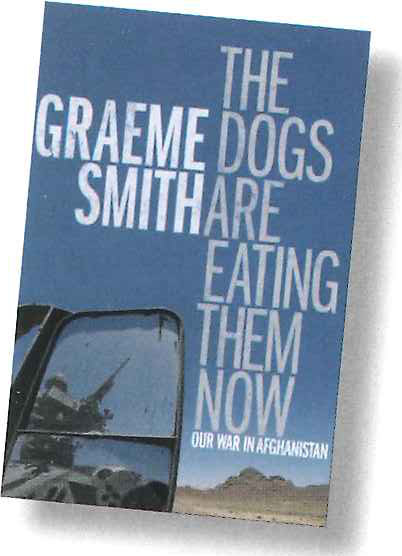
THE DOGS ARE EATING THEM
NOW, OUR WAR IN AFGHANISTAN
by Graeme Smith, Alfred A. Knopf
Canada, 2013, 299 pp., $32.00 CDN.
At a recent gathering at CIPS (the Centre for International Policy Studies of the University of Ottawa), Graeme Smith spoke candidly about his years from 2006 to 2009 as the correspondent for the Globe and Mail in Kandahar. Self-deprecating, he emphasized that he was still a very young journalist during his assignment in Afghanistan and hadn’t lingered over-long in university before it. He also spoke somewhat apologetically about the book, almost dismissing it as a “300 page rant”. The title, The Dogs Are Eating Them Now, Our War in Afghanistan, is a grim reference to the fate of bodies left in the field.
Smith’s modesty is disarming, but don’t be fooled. The book is not about an innocent coming of age, it is about a thoroughly professional reporter and guarded idealist become an often chagrined and exasperated realist. Neither foolhardy nor risk averse, he set about relentlessly collecting facts on the ground – increasingly dangerous work in Afghanistan and neighbouring Pakistan. The keen observation and pointed questions that are the journalist’s métier soon had him seeing things as they are, and not as western politicians and their spin doctors would have us see them. Some of them will not like this account, perhaps a few of our own diplomats included. However, he never quite abandons his idealism and concludes his narrative on a hopeful note that Afghanistan’s government may prove more resilient than we suppose.
From the diplomat’s perspective, there is much to like in Smith’s book. He has a gift for capturing the subtleties of situations many of us may have witnessed ourselves:
“The war attracted young professionals who saw themselves in a heroic role, saving locals from misery, or fighting the evil darkness of terrorism, or perhaps both at the same time. Somehow those glamorous pursuits also required lots of alcohol…
There was often a grimness to the drinking, a deliberate grinding down of consciousness, but occasionally women would show up in something shimmery, or sparkly, or wearing a tiara. This added a frisson to the dancing, and gave momentum to the evenings beyond the need to blur awareness. By the end of the night you could see the disappointment on the faces of the people who realized they could not drink themselves out of Afghanistan.”
Smith does not simply recap his many articles hoping that the sum would be greater than it parts. As an eyewitness and non-combatant participant, he documents the events and times that gave rise to his reporting and places the whole in a broad and thoughtful context. Underlying questions came sharply into focus as security conditions worsened, the pervasive climate of seeming duplicity intensified, body counts rose, and frustration mounted with getting anything meaningful done in such a foreign, tribal and feudal environment. Those questions went to the heart of matters: Why are we here? What are we trying to accomplish? What is this savage war really about? Do we actually know much about the people we are fighting? How do we salvage something real from the mess we may have made?
The narrative also ventures into narrower territory of our own. Regarding the neuralgic question of whether the Canadian military knowingly handed Afghan prisoners over to local authorities that tortured their captives, he acknowledges the confusion of the times but continues: “My great fear is that somewhere in the buzz of information, there was a terrible calculation, a decision to avoid fighting by the rules”. He writes of Richard Colvin and the issues he and others raised, concluding broadly that 66 …Westerners became intimately embroiled with a dirty war, and the filthy awfulness of it will remain a stain on their reputation.”
Smith writes of the real difficulty faced by Canadian troops in identifying who was the enemy among so many ordinary Afghans. He asks if such hugely extensive “collateral damage” can be justified if the enemy cannot be clearly identified? Did our troops unwittingly serve as enablers for Afghan government troops and officials that extorted their fellow citizens as ruthlessly as the Taliban themselves (and so greatly undermined our own efforts)? He uses Canada’s huge investment in the Kandahar prison (that nonetheless saw two massive prisoner breakouts) as a metaphor for the near futility of well-meaning investment in an environment and among people we scarcely understand. He also warns against the mindset that comes from over-exposure to such frustrations, as seen on a military bathroom wall: “Nuke Afghanistan”.
There are moments that speak to the dangers and moral dilemma of reporting as closely as Smith has done – a source very likely was killed for what he revealed to him, and Smith himself faced a de facto death warrant for naming a narcotics kingpin and pillar of the government who just happened to be the head of the Anti-narcotics police. The kingpin met his own violent end a couple of years later which allowed Smith to return to Afghanistan, this time with the International Crisis Group.
Smith will put his analytical skills to the test with the ICG and is determined to see how the final troop withdrawal in 2014 will affect the country. He wonders if the legacy of the West’s long involvement in Afghanistan will be a repeat of the end of communist rule, the civil wars of the warlords or, more optimistically, a period of relative peace with a negotiated truce between the Taliban (no longer fighting “infidel invaders”) and a government in Kabul capable of maintaining a modicum of security.
One wishes Smith could have focused more on Canada’s overall performance in Afghanistan. The book also would have benefitted from a more regional perspective – Pakistan’s continued descent into chaos could have huge destabilizing consequences for Afghanistan and is itself in part the result of the turmoil in Afghanistan in which the Pakistani military played a role.
The foregoing is not criticism; he was there to report on events in Kandahar and the immediate region. However, as it seems unlikely we will get a candid and transparent assessment of our performance from government sources, his book may be the next best thing. It should be recommended reading for future decision makers and public servants.
According to Ahmed Rashid (in this issue), Canadians may find themselves contemplating renewed involvement in a turbulent Central and South Asia sooner than we think. Smith suggests that the West dug itself into a hole in Afghanistan… and as the then US Ambassador to Pakistan, Ryan Crocker, once said to President-General Musharraf: “We have a saying in our country – If you dig yourself into a hole, stop digging”. Smith helps us learn from our role in Afghanistan while the experience is fresh and before we pick up that shovel.
Stuart Hughes is a retired Foreign Service officer and Editor of bout de papier.
View the original scanned pages →
Originally published in bout de papier, Vol. 27, No. 4 (2013) — Winter 2013–14 // Hiver 2013-2014, pp. 28–29. Read the rest of this issue →



