
bout de papier, Vol. 27, No. 3 (2013) — Autumn 2013 // Automne 2013, pp. 34–35
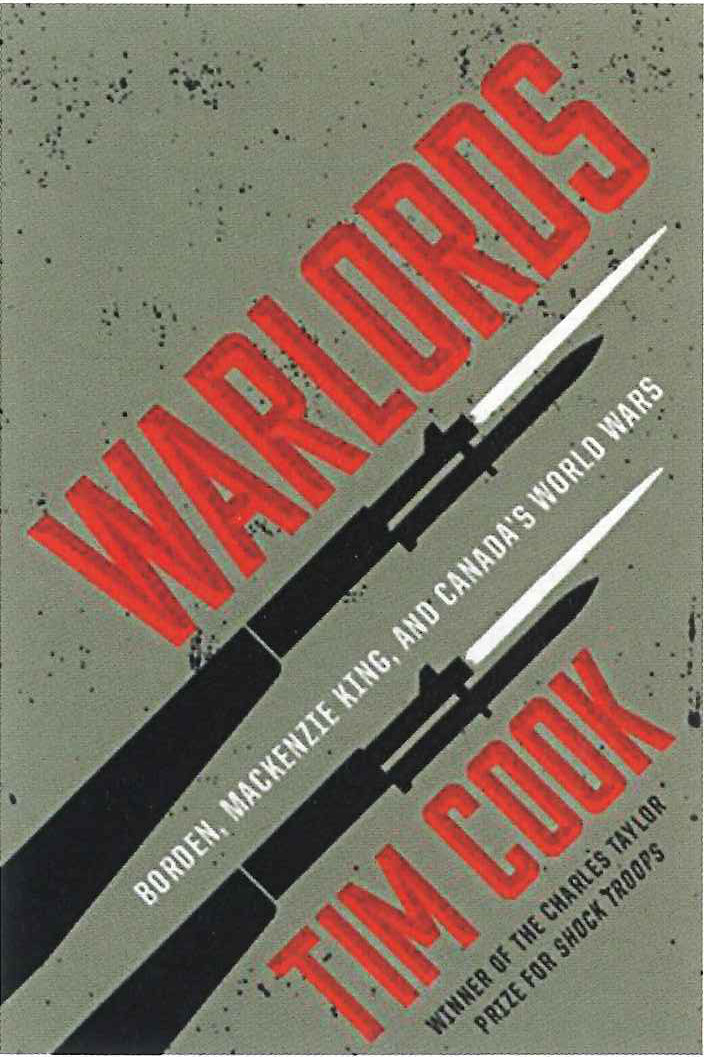
WARLORDS: BORDEN,
MACKENZIE KING, AND CANADA’S
WORLD WARS by Tim Cook, Allen
Lane Canada, The Penguin Group, 2012,
472 pp., $34.00.
In this carefully researched and clearly written volume, award-winning military historian Dr. Tim Cook of the Canadian War Museum steps well back from the front lines with a comparative study of how Canada’s unwarlike prime ministers dealt with the national strains and difficult decisions of the two world wars of the twentieth century. Neither Sir Robert Borden nor William Lyon Mackenzie King would conform to anyone’s preconception of a “warlord,” unlike other political leaders in both conflicts. Moreover, Canadians are understandably not accustomed to evaluating or understanding their prime ministers according to the criteria usually associated with that term. However, as Cook eloquently and ably argues, it is not unreasonable to assess their respective performance in ultimately directing the war effort of a significant participant on the victorious side in both conflicts. Unsurprisingly, neither politician was prepared for the demands that would be made on Canada and Canadians in these exceptional circumstances, though their differing responses to the challenges posed undoubtedly demonstrated differences in personal character as well as political approach.
In what became known as the Great War and later as the First World War when a sequel unfortunately afflicted the global community, the Canadian contribution soon escalated well beyond any prior expectations, as was the case for allies and enemies alike. Although the government appropriated unprecedented powers under the War Measures Act, its restraint in exercising that authority was at least as noteworthy as its greater intrusion into the daily lives of Canadians. As the war dragged on and its toll increased, the first example of modern mass warfare transformed Canada’s economy and society, and ultimately national politics as well. In a familiar story well told, Cook notes how Borden himself raised the recruiting objectives for the Canadian army to levels which strained voluntary enlistment beyond the breaking point. When Borden convinced himself that compulsory overseas military service (or conscription) was essential — in spite of its likely harm to national unity — to meet those targets, that attitude also prompted a series of decisions about the franchise and voting procedure for the overdue general election of 1917. As Cook notes, that electoral contest, more than any other in our history, was marked by “bitter arguments, wild accusations, shocking statements, and deliberate provocation.” Under the banner of patriotism and to assure the election of a “Union Government” to implement conscription, the Canadian government used its majority to manipulate the franchise and the distribution of the service as Cook demonstrates, the longer-term consequences of this short-term action ultimately damaged the governing party, including Borden’s successor Arthur Meighen, much more than the opposition Liberals led by Sir Wilfrid Laurier.
The political beneficiary of this damage to the Conservatives — and their erstwhile Liberal colleagues in the Union government — was a Laurier loyalist who had lost elections more often than he had won when he triumphed at the first leadership convention for a major party in Canadian political history, King. Whatever his limitations as a constituency candidate — through seven general elections as leader, he frequently had difficulty winning his own seat, even when he led his party to a national victory — King soon demonstrated a remarkable knack for leadership of party and government. As Cook observes, King may have earned a reputation for fostering conciliation and arbitration in relations between industry and labour, but his approach to politics demonstrated that he could be ruthless and uncompromising when his position was threatened. To his personal discomfort with military questions, King added lessons learned from Borden’s experience in the previous war, so that when he attempted to identify and uphold priorities for Canada in its war effort, he deliberately sought to avoid escalating commitments and the consequent resort to conscription that had so divided the country when Borden was prime minister. King was both tactically astute and lucky when he was able to hold and win decisively a wartime election before casualties mounted, then defer its sequel until the fighting in Europe was over. As Cook shows convincingly, King was no warlord in the military realm, though he never let the generals or his defence ministers forget who was ultimately in charge. Moreover, he was without rivals in national politics, whether in wartime or in the peace that preceded and followed the global struggle.
What then did these leaders have in common? With varying consequences, both demonstrated firm political leadership in
Perhaps inevitably, both identified their own aims and policies, as well as their own electoral success, with the good of the country — though King was unquestionably better positioned politically to withstand challenges after he won the greatest victory to that point in Canadian national politics in April 1940. Both leaders were often underestimated by colleagues and followers as well as by opponents, but they proved their mettle in the demanding context of the world wars. As Cook justifiably concludes, both were “adept at wielding power” and, though differing markedly in approach, “they guided their country to victory in the two most traumatic events in Canadian history.” Though neither resembled the traditional image of a “warlord,” each in his own way provided the guidance essential for the war effort, in all its varied aspects.
This is an excellent and highly readable analysis of how these different politicians reached the pinnacle of authority and how they exercised power once they reached the summit. Cook has made superb use of primary and secondary sources to tell an important story that tells us much about our country and our leaders. In a book of such breadth, there are inevitably some minor errors (notably in relation to some of the bit players in this drama), but these in no way detract from the validity of the judgments or from the lessons therein concerning the challenges of governing Canada — and of advancing its values and interests abroad. This is an excellent account, which deserves a wide readership, including amongst past and present diplomats.
Hector Mackenzie is Senior Departmental Historian and Academic Outreach Advisor, DFATD.
View the original scanned pages →
Originally published in bout de papier, Vol. 27, No. 3 (2013) — Autumn 2013 // Automne 2013, pp. 34–35. Read the rest of this issue →



