
bout de papier, Vol. 2, No. 2 (1984) — June 1984 // Juin 1984, pp. 11–12
Home buying fever is sweeping the Nation’s Capital! If, like thousands of Canadians, you’ve promised yourself to stop renting and buy that home you’ve always dreamed about, chances are you’ve caught the home buying bug. It’s a safe bet that you’ll be looking around in 1984 for a home. But remember, presenting yourself as a prospective home buyer to agents and seller sets yourself up to pleasing sales arguments that you may not be prepared to handle or even understand. Before even seriously thinking about buying a particular home that may interest you, we’d suggest you carefully calculate what it will cost you to own that home.
Buy or continue to rent?
An analysis of buying versus renting allows you to zero in on the sharp reality of what you can afford and what you are prepared to sacrifice. And your analysis will hammer home the fact that what you are prepared to sacrifice in terms of higher monthly mortgage payments will only be offset by what you think your home will be worth 5, 10, 15 years down the line.
Let’s look at a familiar example by comparing two couples, both with savings of $25,000.
Couple 1 opts to rent for the next ten years for $600 a month and has assumed that rent will increase at eight per cent each year. They have decided to each put away $1,000 a year for the next 10 years into a Registered Home Ownership Savings Plan.
Couple 2 plans to use the $25,000 as a down payment on a $100,000 home and take a 25-year mortgage, which they project will average out of 13 per cent over the next ten years. Property taxes are $1,875 a year and they estimate that the home cost of repairs, maintenance, and extra heating bills will incur an extra $1,000 a year. Both taxes and home cost are assumed by the couple to increase eight per cent each year.
The example shown in the box illustrated in Figure 1 compares the two cases.
Couple 1 will pay $104,303 in rent but will altogether put away $86,687 as a result of what they have saved in their RHOSP, taxes, and accumulated after-tax savings growth of their original $25,000.
Couple 2 will pay $87,803 in mortgage interest, $27,162 in taxes and $14,487 in home costs, for a total out-of-pocket cost of $129,452. But over the 10 year period couple 2 will put $8,917 in principal on the home and this, combined with their original down payment of $25,000, brings them to a $33,917 payment to date on their home.
What this analysis shows is that the cost of owning a home after ten years for couple 2 was $129,452 as compared to the cost of renting of $104,303 incurred by couple 1, a difference of $25,149. In addition couple 2 has a paid-in investment of $33,917 in their home while couple 1, by opting to rent, has put away $86,687 – $52,770 over couple
2. So, for couple 2 to be on an equal footing with couple 1, and account for the difference in savings and housing cost, they would have to sell their home for $177, 919. However, assuming a simple eight per cent average annual appreciation, the home would sell for $180,000.
How to shop for your home
Because it will probably be the largest single investment you’ll ever make, we suggest you take your time and shop around for the type of house you want to buy, the price you can afford, and the location you feel is best for you and your family. Here are some things you might wish to think about:
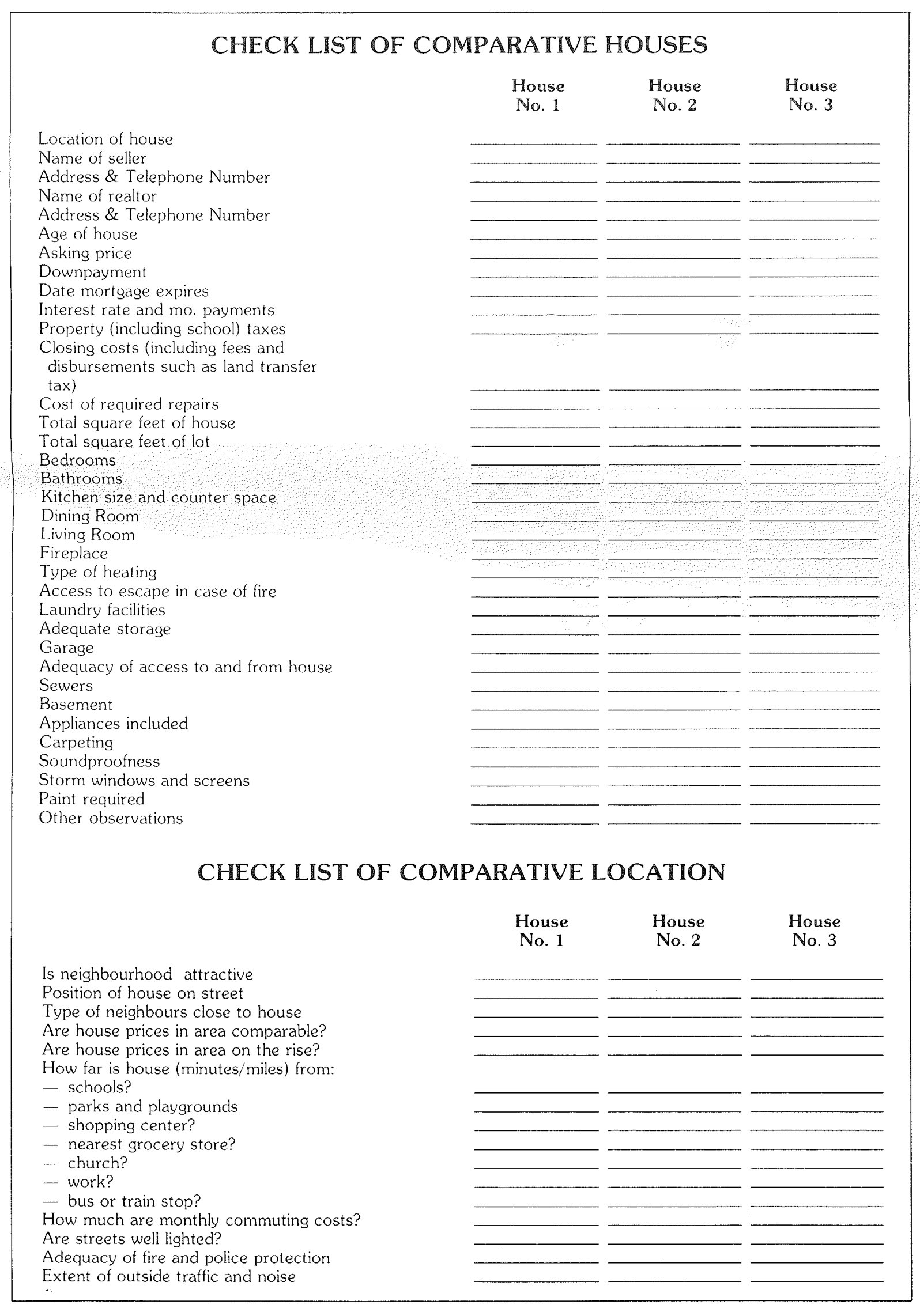
Offer to purchase
When you have tentatively decided to buy a house, you’ll be asked to sign a commitment known as an “offer to purchase”. There are some do’s and don’ts:
1. Be sure that you and, if you are married, your spouse, can afford the home at the price and at the level of mortgage payments the purchase would entail and that you will be happy living in the house and the area in which it is located.
2. Never make an offer to purchase a home half-heartedly or with a view that “I’ll probably never get it at that price anyway”. Once an offer to purchase is signed and accepted by the seller the contract is binding and you are committed to carry through on your offer to purchase.
3. Never rely on verbal explanations the seller or agent may offer as to what certain clauses of the contract mean.
4. Before entering into a written agreement always consult a lawyer for legal advice on points contained in the contract. Do not hesitate to insist on certain clauses or conditions which you may wish to add. It is always a good idea to make a “conditional” offer if possible – conditional on obtaining financing.
(bout de papier is grateful to the CS Co-op for preparing this article).
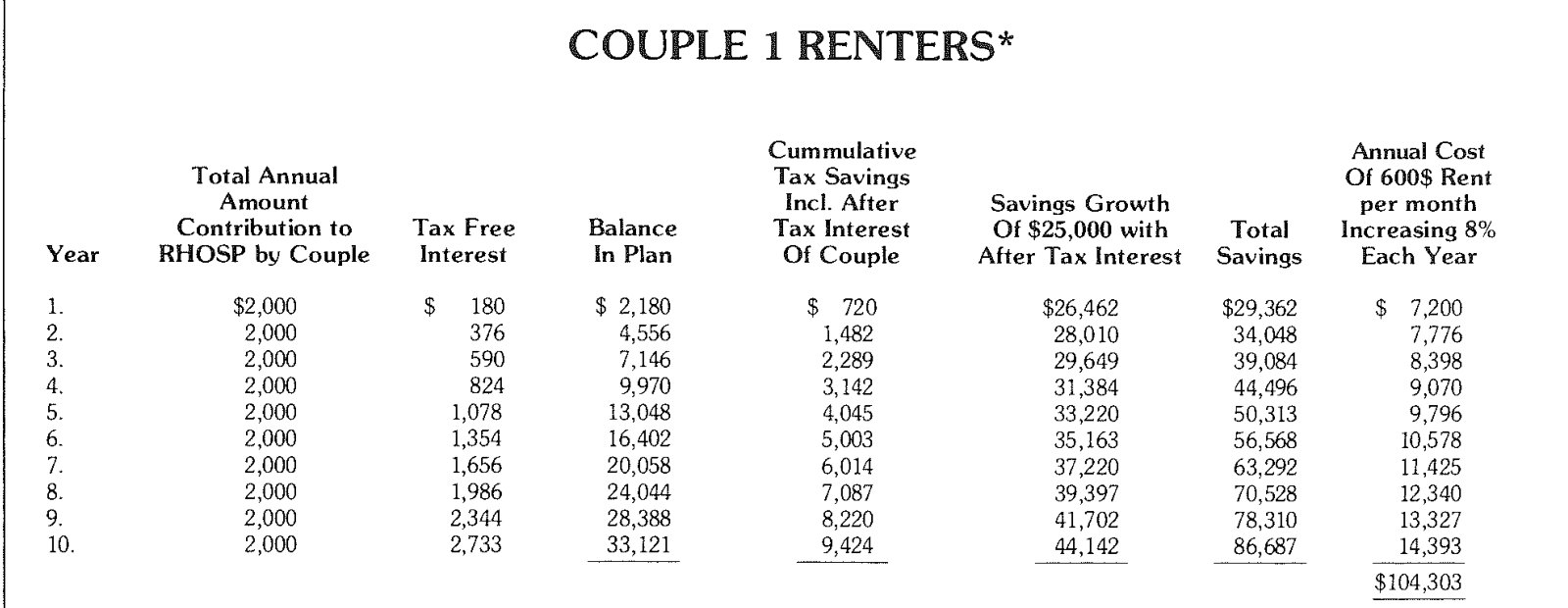
* The renting couple is assumed to each fall within a marginal income tax rate of 35% and as a result the same corresponding tax rate associated with each contributing $1,000 into their RHOSP. Interest on amount saved including tax savings is calculated at 9%. Rental cost of $600 was assumed to increase by 8% each year.
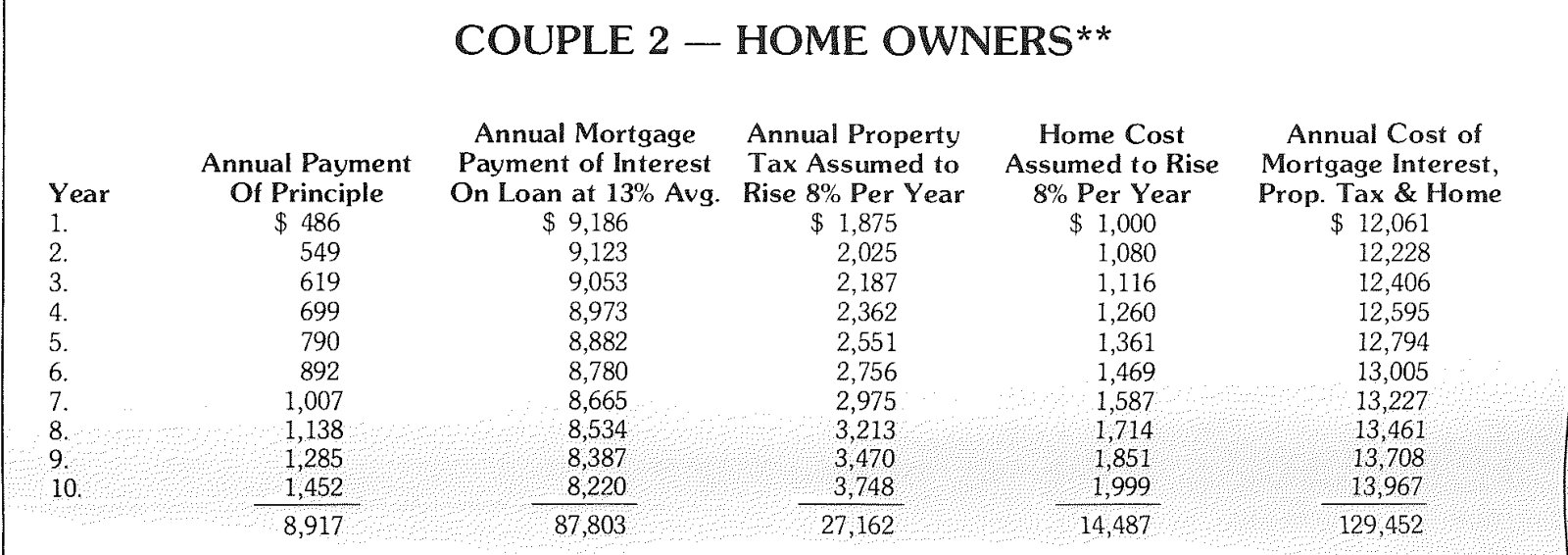
** Couple 2 is assumed to have purchased a $100,000 home with a $25,000 downpayment. A $75,000 mortgage over a 25 year amortization period at an assumed average interest rate of 13% for 10 years, equated to $806 per month or $9,672 a year. Property tax and home cost were assumed to rise 8% each year.
View the original scanned pages →
Originally published in bout de papier, Vol. 2, No. 2 (1984) — June 1984 // Juin 1984, pp. 11–12. Read the rest of this issue →



