
bout de papier, Vol. 24, No. 1 (2008) — Fall/Winter 2008 // Automne/Hiver 2008, pp. 30–35
A once-precocious teenager studying Under the Volcano in CanLit found himself only a few years later posted within the shadow of Malcolm Lowry’s Popocatepetl and Ixtazihuati, the great volcanoes of Mexico. Years later, and in the near vicinity of what one Australian wag once called “the twilight years,” a now-greybeard looks forward to new adventures in the reach of another great volcano, Anatolia’s often majestic Hasan Dağı. This is a modest story of a romantic notion, a long-nurtured ambition, a ton of work, a fascinating posting, and the rescue of a wonderful building in the middle of nowhere, aka: Güzelyurt, Turkey.
Romantic? Well, yes in fact, in retrospect and with a truly selective memory! It began some 15 years ago when a great friend of many of us in the Foreign Service, Michel de Salaberry, called to suggest that we go explore Turkey. Great idea, said I, but I happen to be working in San Francisco — almost exactly the opposite side of the world. “And your point would be??” Of course, I was on an endless flight shortly afterwards.
During the Zurich to Istanbul leg I sat beside a young Turkish engineer. That prompted a rude geopolitical question on my part. Bear in mind that I once spent time in Cyprus, where I learned an axiom of politics in the eastern Mediterranean: “Greeks good, Turks bad” (or was it the other way around?). My question, roughly put, was, “So, does Turkey have any friends in the region?” My neighbour thought a little too long for my taste in formulating an answer. Finally he said, “Yes — Greece.”
“Hello,” I thought to myself, have I missed something here? “Greece?!” “Hmmm, why Greece?” I continued (… the Soviet Empire was still in its death throes then). “Well,” he explained, “we have the largest standing army in NATO, after the US, to contain the Soviet threat to the east, the Iranians hate us because we are secular, Saddam Hussein in Iraq is a bit of a monster, the Syrians support the PKK, who kill our soldiers, and the Bulgarians are busy ethnic cleansing their Turks, so that makes the Greeks our best friends.”
Not sure I understood all that, but I hadn’t got off the plane and I knew already that Turkey was going to be a seriously interesting place. What I hadn’t anticipated was how much I came to like the people I met. The first real insight came aboard a little ferry going up the Golden Horn. We were headed for a small café honouring Pierre Loti (of course Michel absolutely had to toast a dead poet and Ottoman turcophile at a café perched high among the poplars and cypresses of old Stamboul). The trip had several stops. We were near the prow. Nearby was a wild-eyed chap, clearly disturbed, who slowly kept taking his clothes off.
In Canada everyone would have shifted to the stern and the ferry probably would have sunk with so many getting as far away as possible to avoid eye contact. I watched a couple of men chat with our friend with the faraway eyes, zip and button him up, and stuff a lit cigarette in his mouth. As memory serves, the same scene repeated itself at every stop — three of them. These people have a different social contract, I thought, and more power to them. Romantic? Maybe not, but I was more convinced than ever that this was a country I needed to know much better.
Fast forward a few years. Michel has become Ambassador in Iran by now and I am posted to Ankara looking for trouble (when I wasn’t causing it). Inchoate ideas of acquiring property in Turkey were gelling. Retirement gurus were warning that the entire baby boomer generation would be looking for choice places pretty much at once. If people of modest means wanted to secure something special, they needed to act quickly.
The challenge was what, where? Istanbul was attractive but still pricey and I had attended one too many sessions on earthquakes (18,000 people had recently died in the country in horrific temblors). The predictions for the metropolis were (and remain) pretty dire. The coasts were lovely but nowhere near Ankara; however, Cappadocia, the tranquil ancient Greek heartland of Anatolia, was only three-plus hours away.
Industrial tourism was growing fast and swallowing up whole swaths of the region. One fine day I stumbled upon the somewhat isolated town of Güzelyurt, which oddly enough is one of the nearest towns of real interest to Ankara. The town’s traffic jam occurs around 6 p.m. and consists primarily of cows and sheep. The people were very friendly and clearly hardworking. A very nice feel to it ….
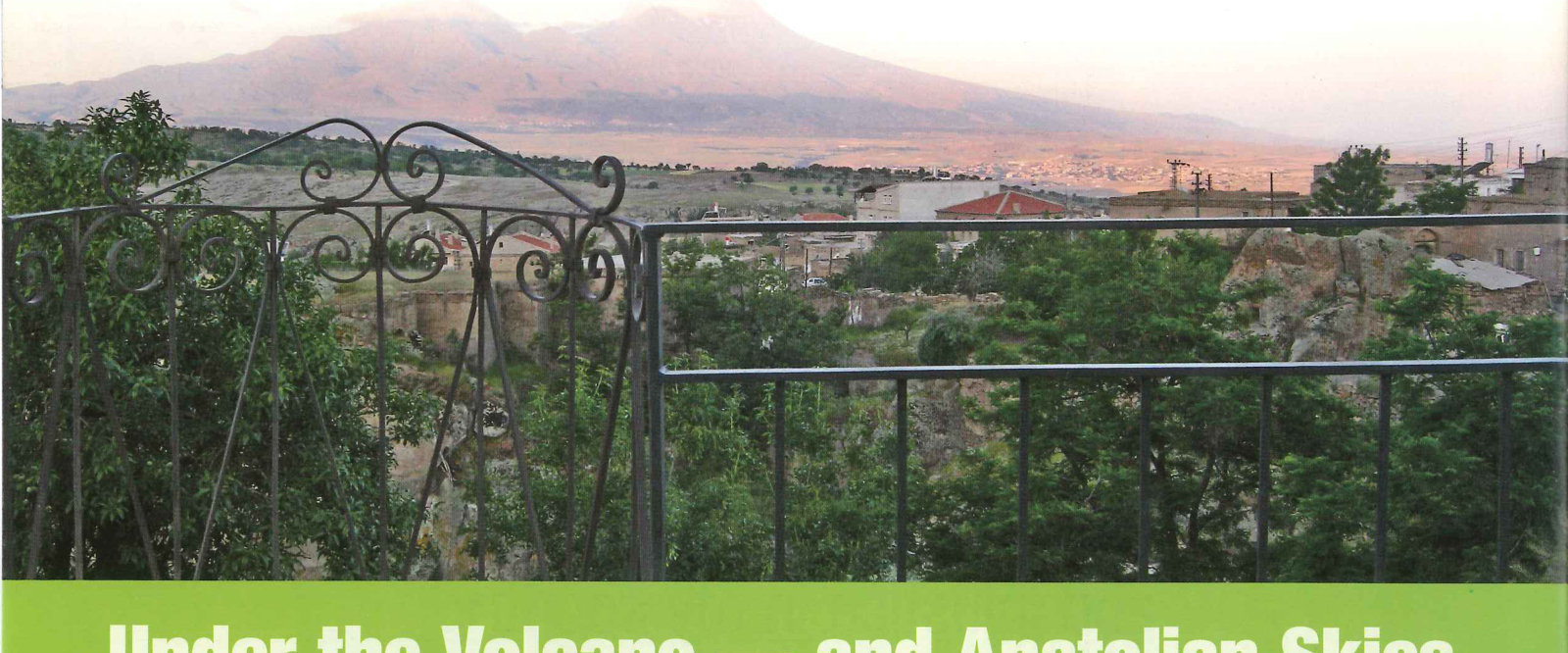
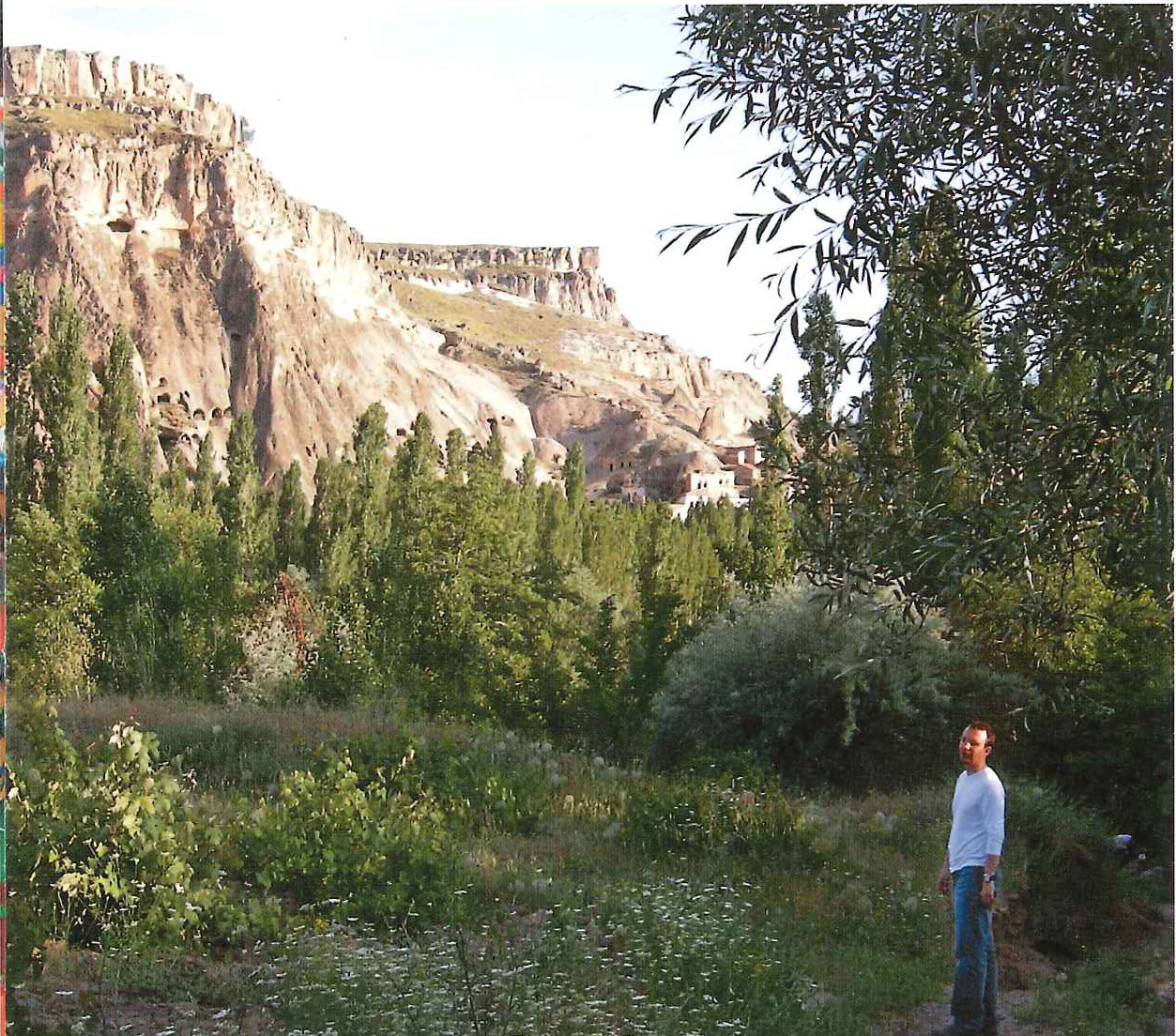
The town is what might be described in real estate parlance as “well-established.” It was the home of St. Gregory Nazianzus (a third-century Christian cleric of great repute), and was a centre of obsidian craftsmanship in Neolithic times. Above the town are great letters painted onto the rocks — “Giizelyurt,” or fine town, in Turkish on top, and the old Greek name of “Gelveri” below (a reference to Calvary, if memory serves). In the distance is a great cleft of rock in the landscape, the Ihlara valley, with its rushing river, towering cliffs and ancient cave churches at every turn. All this lies under the volcano, under Hasan Daë1, its summit mantled with snow for much of the year. The views are sweeping, dramatic and lovely.
Giizelyurt’s townsfolk descend from those who arrived from the Thessaloniki region of eastern Greece in the wrenching “exchange of peoples” in the mid-1920s. It saw the transfer of upwards of 800,000 ethnic Turks (read Muslims) out of Greece and the Aegean and Mediterranean islands and some 1.2 million Anatolian and Pontic (or Black Sea) Greeks to contemporary Greece. Again, by Greeks, most mean Greek Orthodox Greeks and some co-religionist Turks.
The melding of cultures might surprise purists today. Some of the Greek signs still visible in Giizelyurt, carved into doorways and over the town fountain, are puzzling to contemporary Greek visitors — and well they might be, as the letters are Greek but the words often Turkish. But it was one “artefact” I saw in Greece that really captured the ancient spirit of the place: a beautifully-made “Greek” kilim (or Turkish flatweave carpet) from Giizelyurt with a classic prayer niche motif — it could have been the pride of any Turkish family in the region but for one fact: the outline of the prayer niche was composed entirely of consecutive crosses.
Giizelyurt is known as the town of blue-eyed people; it is one of the few towns in Turkey that celebrates its Greek past. It welcomes every few years a festival of Anatolian Greek folk dancers. They hail from “Nea Kalvari” which is peopled by the descendants of the former inhabitants of Giizelyurt and is located not far from that cosmopolitan city the Ottomans called Salonika (where Ataturk was born). The flags of both countries flutter over the main square during the festival, while Ataturk’s bust looks on. Despite all the tough history of the region, I suspect Ataturk’s spirit has his ever-present glass of raki hoisted in salute.
The town is pleasant, with a classic little square with tea ever-ready and Turkish pizza plentiful; it also offers a couple of other modest restaurants, a fiercely noisy internet café where the kids play video games endlessly, and a fairly grand Greek monastery turned into an unpretentious hotel (with a refectory hall doubling as a quite enjoyable restaurant). There is an open-air museum, St. Gregory’s church (now a mosque), with other ancient churches around, and even an underground city. Look hard enough and you will also find old frescoes in secluded spots — St. George and the dragon being a favourite theme.
Among other things that make Giizelyurt special is its geographic position. Perched high against a row of hills at 1,500 metres, it looks down over that fabled valley of Ihlara (pronounced, as in the French Eu-gh-Lara) below Hasan Dag1. Reaching a respectable 3,300 metres, the volcano has been dormant for 15,000 years. Odds are good for uninterrupted sleep at night, though a modest tremor or two has been known to rumble through. Nimble hikers can reach the crater by July, but inevitably find that shepherds beat them to it.
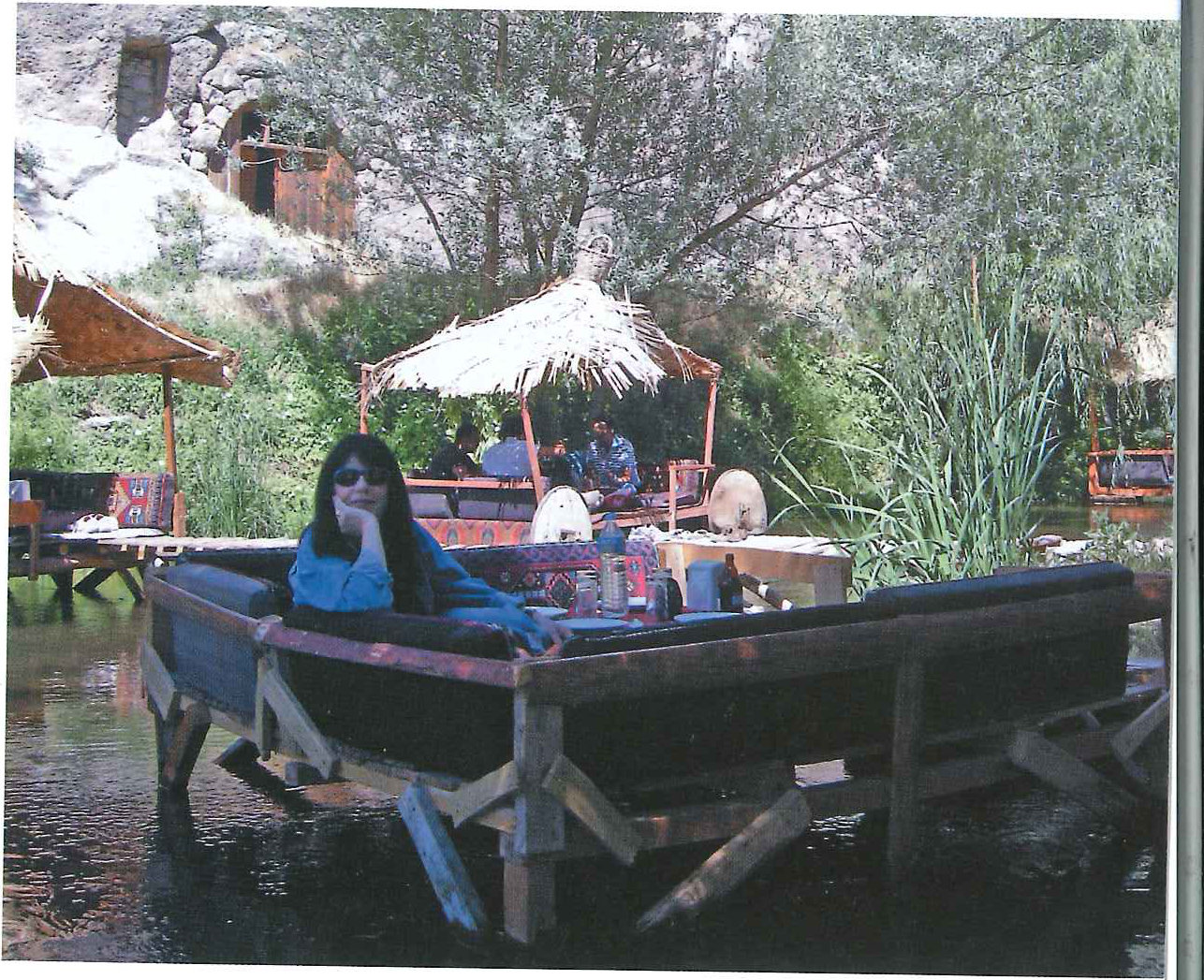
The Melendez River cuts through Ihlara and has created a mini-rift valley with sheer cliffs above its cool, wooded waters. Restaurants with cold beer and fresh trout greet you there, and a long hike brings you to the end of the valley at the foot of Selime Cathedral, a grand structure carved entirely into the rock. It even has tunnels for silk-route camel trains (to avoid the brigands of another day), and commanding views of the region. Fairy chimneys of eroded volcanic tufa are scattered liberally near the mesa that looms over Selime, and among the surrounding orchards. The chimneys, or Turkish hoodoos, look like wildly exaggerated sugar cones. Many have windows, carved into ancient dwellings; the silent witnesses with sightless sockets to millennia of human endeavour. The protected and isolated nature of the valley appealed to early Christians. The valley, now a national park, is peppered with other painted churches, some with their fourth- to twelfth-century frescoes still somewhat intact — a valley that arguably is the cradle of Christian monasticism.
The region is rich in picturesque sites. Below Giizelyurt is a 19th-century Orthodox monastery perched high on a rock, with a commanding view of the valley and sunsets. The nearby town of Giilagac — which means rosewood, roughly translated — harbours the tomb of the 13th-century Seljuk “Bachelor Sultan” (sounds vaguely suspect, doesn’t it?). High above Güzelyurt are the vestiges of the mountaintop Byzantine fortress that fell to the Turks around AD 800, a windy and cold place that must have been the bane of many a foot soldier. Amazingly, the hot springs once enjoyed by St. Gregory are still open to the public a little to the east (though totally modernized; modern Turks love their tiles and cement). A bit beyond that orbit lies Gôllü Dagi, or the Mountain of Lakes, with the remains of a fortress of the early second millennium BC destroyed by the vengeful Medes of Persia. It is an ambitious hike with a prepossessing view when the chilly clouds part (they knew what they were doing). It was also home to an obsidian workshop and its wares were traded in pre-historic times as far south as modern Israel, says Tim Harrison, a University of Toronto archaeologist active in eastern Turkey.
To the northeast lies Gésterli (ancient Gosteropolis) with another neolithic obsidian workshop, troglodyte town and, tucked away into the hills, a water-worn gorge that seems straight out of Yosemite Park — full of aeries, perfectly private, perfect for picnics. Nearby stands a small, rounded mountain with perfect cat’s ears — very odd until you realize that those ears are pre-Hellenistic tumuli, tombs of kings that were long forgotten even when Augustus became Emperor. To the north lies Isikli Hüyük, a tell of layered human settlements. It reportedly is the only site as yet discovered that has evidence of round or yurt-like house foundations as well as square foundations. Basically it is a steep hill by a riverside that clearly, geologically speaking, doesn’t belong there. Its evidence of the transition from nomadic to sedentary shelter dates back to at least 5,000 BC. Archaeologists from Istanbul are in charge and have halted work for now — their professional responsibility is a heavy one, knowing that they may only have one chance to excavate such a site.
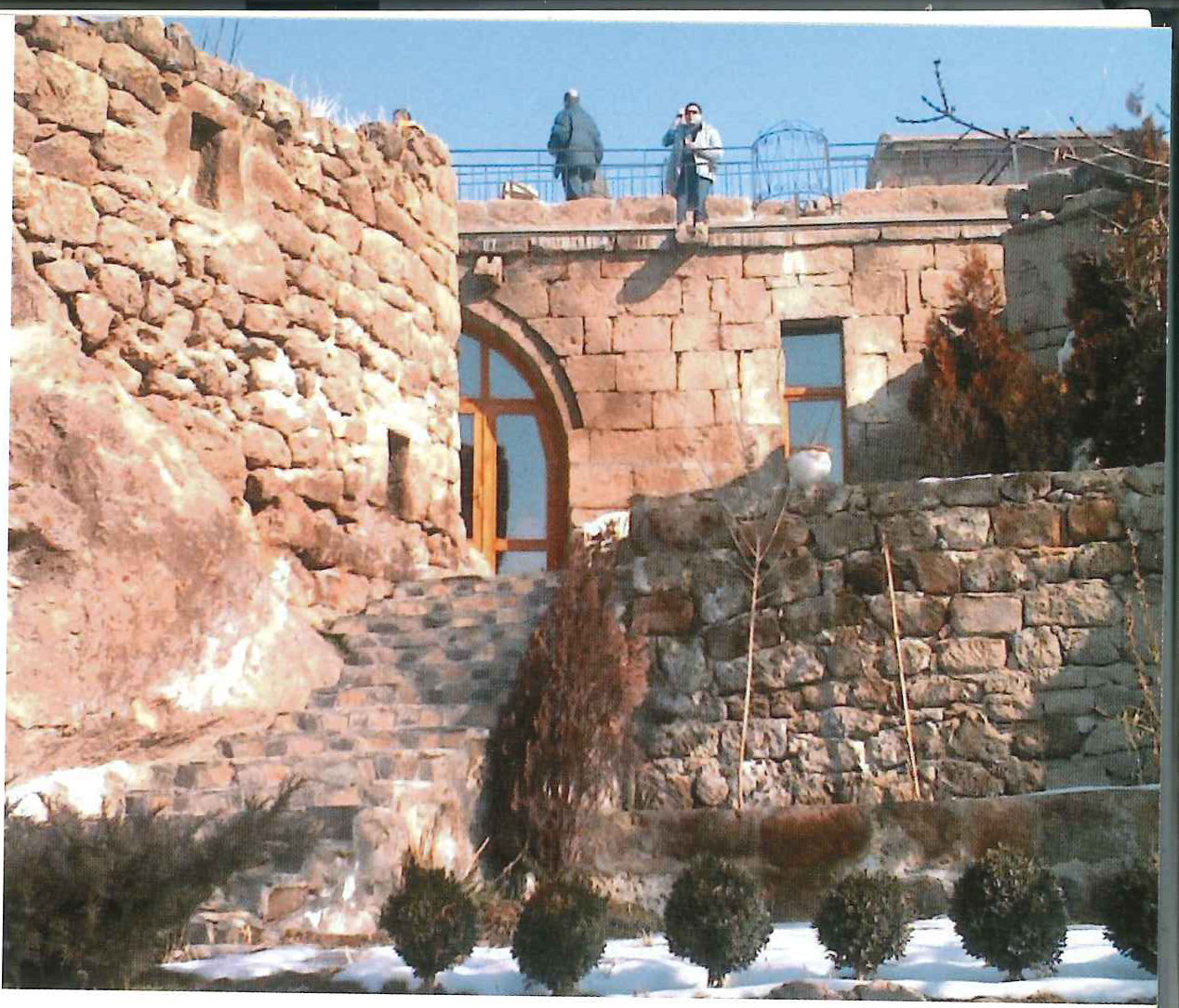
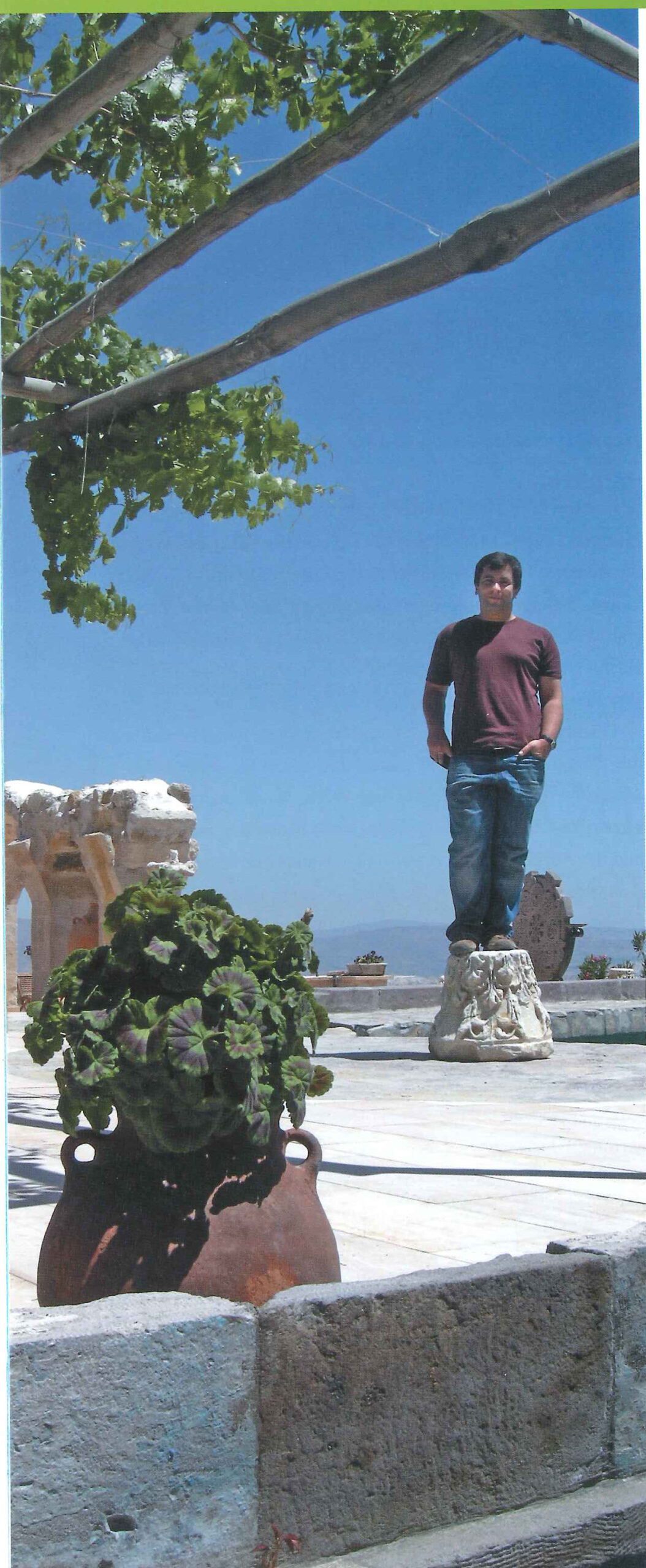
Happily for visitors, the house in Giizelyurt is certainly newer (though the owner is rumoured to be a troglodyte …). It was built in the 1870s or 1890s and is definitely not nomadic; it has made the transition fairly successfully from a large stone shell to a comfortable home. The floors were carved into the living rock with a great underground cavern for storage. Built with blocks of local tufa (volcanic stone), the rooms all have deep walls and high arches in Greek monastic style. The great flat roofs on the upper and lower section of the house are perfect for parties, grape arbours have been built, and a grill and stone benches installed. The lower roof terrace is private with views directly onto the lower parts of the town, of the Ihlara Valley, and the Fuji-like expanse of the volcano beyond. The sun, conveniently enough, sets in all its glory directly behind the mountain.
That said, when I bought “Giizelev” (or fine house) in 2001, it was being used to store firewood for local bakeries; a few the great, and not so great, historic homes of central Turkey. It had one wire for electricity, one little tap at the entrance, and no other plumbing whatever — never mind heating. The marvellously ecological roofing (compacted soil above rock, sand, logs and more soil), which sprouted grass in spring ideal for nursing goats and their kids, was a disaster in the making without the 24/7 maintenance that village life once afforded.
My neighbour, incidentally, is one of the only other foreigners in town. A German, Udo by name, he is in the development biz in “nearby” Georgia. He revels in the crisp, clean air of the region. His place is a mini-palazzo and has at least five storeys of chambers carved below the main floors.
“Good grief,’ I once said, “this is a project of a lifetime.” “Of course,” he responded, “that’s the idea! … it would make a nice winery don’t you think?” Every time I thought my sense of adventure had got the best of me with my house, I would think of Udo; suddenly the chaos I had created seemed quite manageable. The neighbour’s little palazzo is now a must-see, the wine pretty heady.
Rehabilitated for the 21st century, the “Canadian house,” as townsfolk call it, was a much greater endeavour than anticipated (now there’s a surprise). It now has relatively waterproof roofing (metric tonnes of soil were removed and rebar, rubber lining, cement and stone followed). Wiring was buried in the stone walls, doorways expanded and invented, stairs installed, and a wall or two taken down, garden terraces lowered (and raised), a courtyard waterproofed, a rebuilt roof rebuilt all over again, tonnes of rubble and detritus hauled away … and bright things installed: for one, there’s a master bath at the top (the old bakery) which now features lots of new and antique marble (it’s a modest hamam wannabe). But perhaps the greatest challenge was truly mundane: plumbing. The drain pipes were installed in the cavern below, then buried, level by level, down the terraced garden, hidden behind high stone walls to the valley bottom where eventually they reached the local sewer main … the whole thing is invisible — to others! As many a denizen of the region can tell you, flush toilets really are thrones if you know just how much work was involved ….
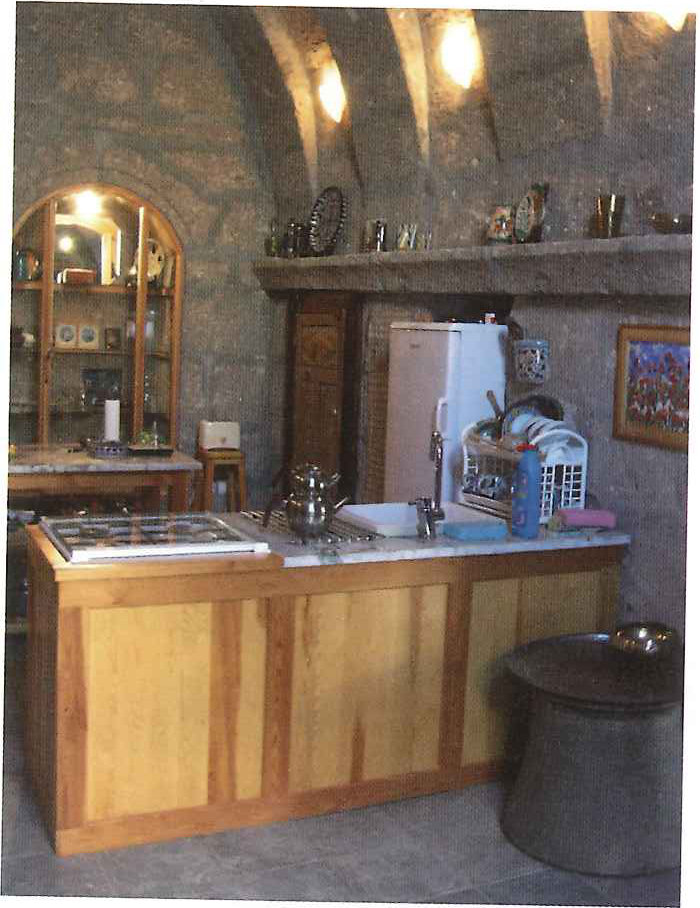
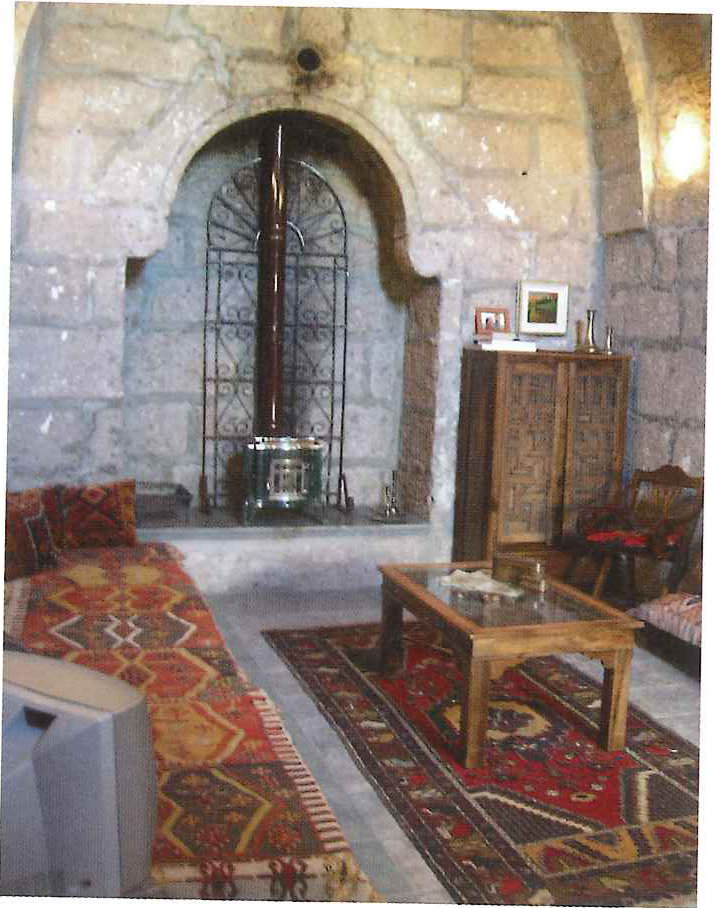
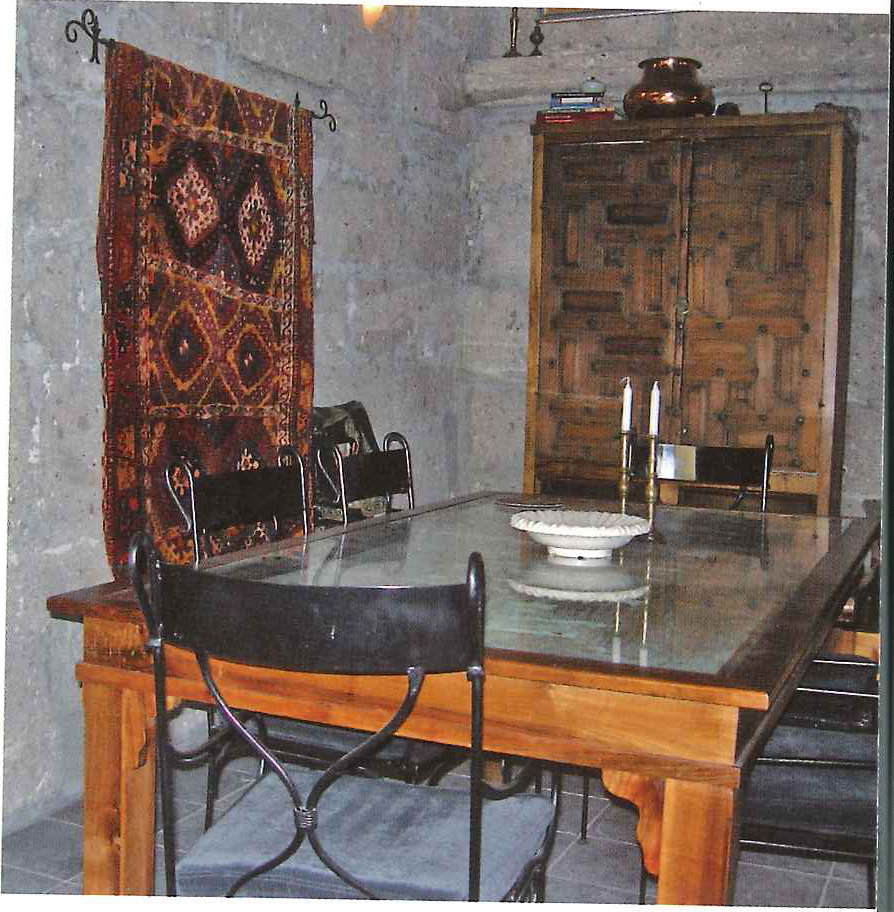
The well-equipped kitchen, dining room and living rooms are at the second level, and a suite is situated lower down that contains a sleeping loft, kitchen below, sitting area, bathroom, and yet another living room in the arched tunnel that parallels the suite connecting the open courtyard above with the terraced gardens below. The window facing your bed frames the volcano, a picture postcard to greet the day. The entire building had to be scoured by stone carvers to remove rotted stone and “sealed” with specialized German chemistry — a team of seven worked for two weeks non-stop. The stone is elegant and grey — and twice as hard as other local stone, something that the cleaners and scrapers discovered to their considerable chagrin.
The vaulted living and dining rooms have what are called sedirs in Turkish, or long stone sofas, now clad in pine (the word itself is Turkish) that serve for sitting and as extra beds at night. The furniture is almost all custom-made from (comfortable) wrought-iron, along with tables and armoires built by Turkish craftsmen assembling antique Ottoman doors of local walnut that I found in Ankara and beyond. The carpets come from local dealers, notably Mustafa Celik in Selime, a gentleman of the trade with good English and a tactile knowledge of the region. The building houses six easily. The house now has a full library of DVDs and music for quiet evenings. The spirit of the place is simple: to celebrate the best in the region’s past and to welcome even better tomorrow.
As the Cunard people used to say, getting there is half the fun. A close Turkish friend was invaluable in negotiating the bureaucratic steps, which were many and long (it needed clearance from the military no less), and helped in managing the project in innumerable ways. A local lawyer narrowed the field of original owners to one to ensure that the title would remain uncontested after sale (so far so good), and otherwise facilitated the purchase. An architect in Kayseri, passionate about salvaging the best of the region’s architectural past, helped with some of the trickier bits of rehabilitation, including the design of stairs and of the sleeping loft.
As for nuts and bolts, local craftsmen made the cabinets and doors (beautifully at that), marble experts installed antique and new marble pieces, and the local wrought-iron contractor built metres and metres of railings, terrace after terrace, some incorporating antique Turkish, Greek and Armenian workmanship. Furnace people installed a new system, cleverly taking advantage of the underground cavern. Tilers created new floors throughout. Plumbers made it all livable. Almost every workman in town sweated over some aspect of the place.
But the most important secret to success was the son of the former owner — Metin Anul — who took on the job of foreman for the project. Let’s simply say, thank God (Allah and Christos Pantokrator as well for that matter) that the purchase price was modest, because the transformation of the property into what it is today may have cost 10 times as much — even with ferocious cost control on the foreman’s part. Property now — just as the gurus predicted — is far more expensive, if you can find it. Happily, the ever-cheerful Metin continues as maitre d’ when I am not there, making the house available year round (oddly enough, Christmas can be magical, as Giizelyurt is just high enough to be blanketed by snow then, though it doesn’t always last long). Metin certainly likes “his” Güzelev, and has toured several dignitaries through it — a Turkish Minister of Tourism among them, trailing media and all.
William Butler Yeats once wrote that “the thing done is dead, the doing all.” The house is “done,” but certainly not dead. New projects always present themselves; solar panels are next. In some ways the real “doing” has just begun. As retirement approaches, the idea of a few months a year in “my” quiet corner of Cappadocia is more and more appealing. Yet, much of the joy of being there will be in welcoming old friends and new guests and sharing the marvels of the region with them. If you need to venture further afield, Derinkuyu (or deep well, in Turkish) is only 30 minutes away, with an underground city that goes down eight storeys. Beyond it lies classic Cappadocia with its open air museums, fabulous hikes in hoodoo valleys, and amazing balloon rides at the crack of dawn. Farther still lies Kayseri, or Caesarae, perched beneath the region’s other great volcano, Erciyes — a ski centre in winter.
Turkey is a remarkable country — the more you explore, the more you find. Civilizations are layered one atop another; it is the proverbial bridge between east and west, still the crossroads of Asia and Europe, and graced with great fresh food, really hospitable people, and now a vibrant economy (at last) … Oh yes, it also has a semi-Mongolian and sometimes truly impossible language. It is a country where world issues play themselves out: while much more at peace with its neighbours than it has been, it remains rife with internal issues as secular forces struggle, peacefully, with resurgent and presumably “moderate” fundamentalism. Understand Anatolia and you’ll know much of the tapestry of human history; understand today’s Turkey and I wager you will have understood much of the contemporary world.
This article is very much an open letter. I mean to encourage old friends and new, boomers and gurus, and the many thoughtful readers of bout, to come by some time. So much of the cut and thrust of civilization — in the New World as in the old — has taken place “under the volcano.” Come to Cappadocia, to Giizelyurt, and someone may hand you a glass of local wine to ease the contemplation of those wide-lens Anatolian skies and of the fiercely grand slice of life it has sheltered. Carpe diem? Carpadocia, efendim!
View the original scanned pages →
Originally published in bout de papier, Vol. 24, No. 1 (2008) — Fall/Winter 2008 // Automne/Hiver 2008, pp. 30–35. Read the rest of this issue →



