
bout de papier, Vol. 23, No. 3 (2008), pp. 26–31
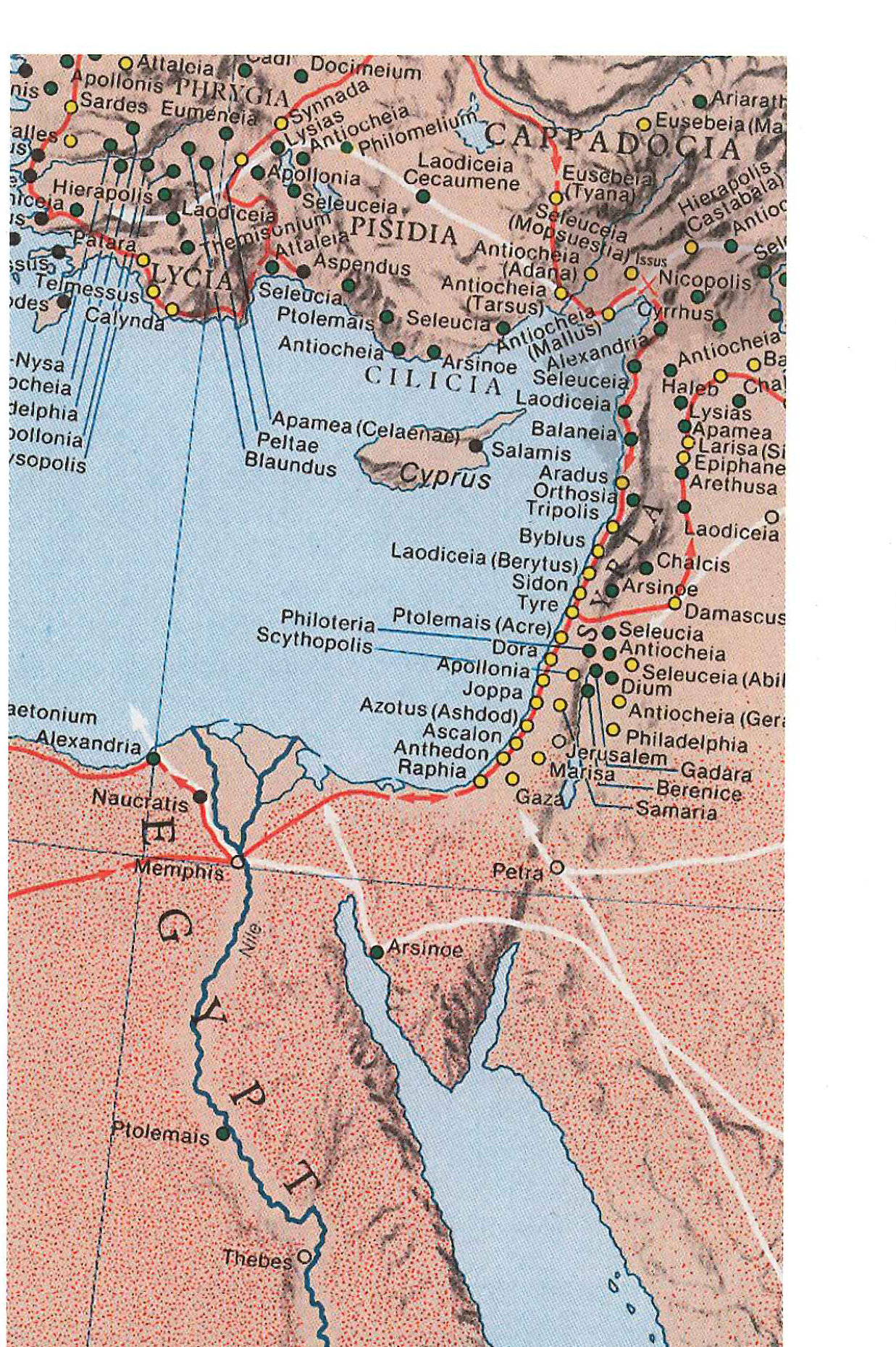
About a century ago a papyrus was found in upper Egypt which preserved a trip report prepared around 1090 BC by an Egyptian priest named Wenamun. Wenamun was a senior cleric, the Elder of the Portal of the Great Temple of Amun-Re in Thebes. At the behest of the High Priest, Herihor, he journeyed to Byblos (Jubail) on the coast of Lebanon, to obtain a supply of cedar. The timber was required to build a new ceremonial barque for his god. While his account is unfortunately incomplete, enough survives to chronicle how a series of misunderstandings on Wenamun’s part compromised what should have been a routine commercial arrangement. It is an example of what can happen when an amateur, however well intentioned or proficient in his or her own field, is sent to do a job best left to a foreign service professional.
The mission should have been a straightforward one. Byblos and Egypt had been closely linked politically and commercially for over 1,500 years — literally back to the dawn of recorded history. Byblos was a major port of export for Egyptian goods going to the northern and western Mediterranean and, in turn, was Egypt’s main source of Lebanese cedar. Traditionally when the Temple of Amun-Re required lumber for a new barque, the Pharaoh sent an embassy to Byblos to purchase it. Unfortunately for the success of his mission, Wenamun set out unprepared and unaware of how past missions of this type had been conducted.
In Wenamun’s time Egyptian fortunes were at a very low ebb. The Pharaoh of the time, Ramasses XI, was the last, and least effectual, of the slowly decaying XX Dynasty. Effective control of the country lay in the hands of three warlords. Herihor (Wenamun’s boss) controlled upper Egypt from Thebes. Despite his priestly title, he was actually a professional soldier and even after becoming High Priest, retained his title of Commander of Upper and Lower Egypt. In Tanis — a burgeoning port at the mouth of the Nile – Nesubanedjed (usually called Smendes — the Greek rendering of his name) had assumed the title Organizer of the Country and controlled lower Egypt (the delta north of what is now Cairo). Egyptian territories in what is now Sudan were controlled by Paynehsi, Viceroy of Nubia. Herihor got along well enough with Smendes (they may have been in-laws), but was a bitter rival of Paynehsi, and as a result of their struggle Nubia broke completely away from Egypt. None of these warlords bothered to assume the royal title. For Herihor this was hardly necessary, as his temple owned virtually all the land in Upper Egypt. It was not until 20 years later — when Ramasses XI had finally faded away – that Smendes proclaimed himself Pharaoh of a new XXI Dynasty.
In its days of glory, Egypt had controlled much of the coast of the Levant. This was swept away in the great upheavals of the 12th century BC, which had also seen the overthrow of the Hittite Empire, the collapse of the Mycenean civilization in Greece, and the destruction of many Canaanite city states. Few states had been spared. Some Lebanese ports, like Byblos, had weathered the storm, while Ramasses Ill of Egypt had waged epic – but victorious – battles to expel invaders from Libya and the so-called Sea Peoples. Archaeologists and philologists have spilt much ink in trying to determine who these Sea Peoples were. Their material remains show affinities with the Aegean and the Balkans. They likely included both the instigators of and refugees from the turmoil which had overwhelmed the Hittites and the Myceneans — a catastrophe so complete that, in Greece, all knowledge of writing was lost for 500 years, the economy reverted to a bare subsistence level and political organization to that of the tribe or village. Many of the Sea Peoples settled on the coast of Palestine, founding their own settlements amidst the ruins of the Canaanite towns they had destroyed. The biblical Philistines derive their name from one of these peoples, the Peleset. In sum, where 100 years earlier the eastern Mediterranean had been a bi-polar world dominated by Egypt and the Hittites, it was now, if anything, a-polar. Of the significance of such convulsions and developments, Wenamun seems to have set out blithely unaware, equipped with little more than his credentials, signed by Herhor, a portable shrine to Amun, and — in light of his mission — a rather paltry travel advance.
Wenamun’s first stop was Tanis. In his report he writes: On the day of my arrival at Tanis, the place where Smendes and Tentamun [Smendes’ consort] are, / gave them the dispatches of Amun-Re, King of Gods. They had read them out before them and they said “Yes!” to the saying of Amun-Re, King of the Gods … Smendes and Tentamun sent me off with the ship’s captain Mengebet, and I went down upon the great sea of Syria.
Here is where Wenamun’s mission starts to go off the rails. He surrendered his credentials to Smendes and so had nothing to show the King of Byblos when he got there. He also seems to have assumed that Mengebet’s ship was an Egyptian vessel. In fact, it was just one of many chartered Syrian ships that Smendes used to trade with the Levant. Now his misfortunes began to mount.
The ship stopped at Dor, a town near modern Haifa, ruled by Tjeker, one of the Sea Peoples. There one of the ship’s crew stole Wenamun’s travel advance. Wenamun lost … one vessel of gold worth 5 deben, four jars of silver worth 20 deben, and a bag with I deben of silver. As a deben was equivalent to about 14 grams, Wenamun’s losses amounted to two and half ounces of gold and a pound of silver. No financial catastrophe for one of his standing, but an embarrassment. Wenamun was not going to take this lying down. He sought compensation from Beder, the Tjeker prince who earlier had welcomed him with 50 loaves of bread, a flask of wine and a haunch of beef.
Wenamun reported that: The next morning, / went to where the prince was and said to him: “I have been robbed in your harbour. Now you are ruler of this land, the chief and chief magistrate, you are the one who controls it. Retrieve my money! Indeed, the money belongs to Amun-Re, … it belongs to Smendes, it belongs to Herihor, my lord and to other great ones of Egypt. It is yours… It is for Zekerbaal, the ruler of Byblos!
Beder was somewhat bemused by this. He replied, “I do not know what you said to me! If a thief, who belongs to my country, boarded your ship and stole your money — then / would replace it for you from my storeroom until some-one found your thief. Alas, the thief who robbed you is yours, he belongs to your ship! Spend some days here and visit me! I will search for him!”
Wenamun waited nine days in vain, but his ship was anxious to sail. In the end he set out for Byblos empty-handed. Beder suggested to Wenamun that, when he got to Byblos, he should compensate himself for his losses with his shipmates’ possessions – that would force them to look for the thief. Availing himself of this dubious advice, Wenamun seized 30 deben of silver as he left the ship at Byblos, saying he would return it if they found the thief.
Wenamun found lodgings at a tavern near the harbour and set up his travelling shrine to Amun-of-the-road. Zekerbaal, the king of Byblos, must have heard what Wenamun had done and ordered him to leave his harbour. Wenamun pointed out that he could not leave until he found a ship bound for Egypt. The stand-off continued for the next 29 days, with Zekerbaal… sending to me daily to say: “Leave my harbour!” Then, by chance (or was it by some judicious bribery on Wenamun’s part — although one might doubt he had either the initiative or the cash to achieve it) one of Zekerbaal’s courtiers went into a religious trance, claiming that only exposure to Wenamun’s travelling idol would restore him. Zekerbaal therefore summoned Wenamun.
Wenamun reports, however, that he was about to leave town: Now it was while the entranced one was entranced that night, / had found a ship which was bound for Egypt. I readied all my belongings and was waiting for complete darkness, so / could transport the god so no other eye could see him. Then the harbour master came to me, saying: “Wait until morning, says the ruler!” I said to him: “Was it not you who daily took time to come to me, saying: ’Leave my harbour”? Do you now say: ’Wait this night”’, in order to let the ship that I found depart, and then you will come to say: “Go away’?” He went and told it to the ruler. Then the ruler sent to the captain of the ship, saying: “Wait until morning, says the ruler.”
So the next morning Wenamun went to the palace to see Zekerbaal. He describes the scene in his report: / found him sitting in his loft. As he turned his back to the window, the waves of the great Sea of Syria were breaking behind the back of his head. I said to him: “Amun will be merciful!”
Zekerbaal asked Wenamun how long it had been since he had left Thebes. Wenamun replied that he had left five months earlier. He then asked for Wenamun’s credentials. Wenamun said he had given them to Smendes. Zekerbaal was not impressed. Wenamun reports: Then he became very angry and said to me: “Now then, dispatches, letters you have none. Where is the ship of pinewood that Smendes gave you? Where is its Syrian crew? Did he assign you to that captain and the barbarians in order that he have you killed and thrown into the sea?”
Wenamun was surprised by this, living 1,000 km from the sea and thinking he had been on an Egyptian ship. Zekerbaal gave Wenamun a short lecture on the Levantine shipping industry. There were, he pointed out, no less than 20 ships in his harbour chartered by Smendes, and 50 more in Sidon. Wenamun then explained his mission to Zekerbaal and in response got a lesson about international trade.
And then he to me: “On what commission did you come?” And I said to him: “ have come after the lumber contract for the great and august barque of Amun-Re, King of Gods. As your father did and as your father’s father did, you too should do!” And he said to me: “They did it in trade! When you pay me for doing it, I shall do it! Yea, my forefathers performed this commission, when the Pharaoh had sent six ships loaded with Egyptian goods which they emptied them into our storehouses. But you, what is it that you have brought for me?”
To prove his point, Zekerbaal called up the records of these past transactions from his registry, and had them read out loud. Wenamun reports: And 1,000 deben [12 kg] of silver were tallied up for all in his records. He said to me: “If the ruler of Egypt were lord of what is mine and / were his servant, he would not have sent this silver and gold …. These were not coronation gifts he gave my father! I am also not your servant, nor am I the servant of him who sent you!”
Zekerbaal then asked Wenamun how — if he got the lumber he sought — he planned to get it home. Would he make a big raft from of it? Likely he would drown and then what would the gods do?
Wenamun tried to appeal to Zekerbaal’s piety. Zekerbaal should give him the lumber because everything belonged to Amun, the trees, the ships, the sea itself. Amun had, through Herihor, directly tasked Wenamun with this mission, and Zekerbaal had insulted the god by leaving Wenamun languishing on the harbour-front for 29 days. Instead of silver and gold, Zekerbaal’s ancestors should have asked for life and health from Amun. Wenamun urged Zekerbaal that he “Say ’Yes!’ to Amun and carry out his commission. While you live you shall be well and prosperous and successful for your entire country and your people. Do not desire for yourself anything else from Amun-Re, King of Gods!”
Zekerbaal, however, was not swayed by this appeal. Finally realizing that, in Byblos, Trade trumped Faith, Wenamun agreed to write to Smendes asking him to send goods to exchange for the timber and ships to carry it back. Zekerbaal agreed to send a ship to Tanis with a messenger. He even threw in a downpayment: wood for the barque’s keel, bow and stern pieces and four other pieces of hewn timber. The messenger returned in the first month of winter with a shipment of gold and silver vessels, clothing, textiles, ropes, ox-hides and food stuffs. According to Wenamun, The prince rejoiced. He assigned three hundred men and three hundred oxen, and he set supervisors over them to have them fell the timbers. They were felled and they lay there during the winter. In the third month of summer they dragged them to the shore of the sea.
Zekerbaal then told Wenamun he had met all his obligations, despite Wenamun’s shortcomings as an ambassador. Wenamun might, he suggested, have shared the fate suffered by a group of Egyptian diplomats 150 years earlier who, for some offence, had languished in Byblos for 17 years and had eventually died there. He offered to show Wenamun their tomb. Wenamun declined, pointing out the diplomats had been in the service of an Egyptian prince, not of the god Amun. Wenamun suggested instead that Zekerbaal erect a commemorative stele stating that: Amun-Re, King of Gods, sent me Amun-of-the-Road, his envoy, together with Wenamun, his human envoy, in quest of lumber for the great noble barque of Amun-Re, King of Gods. I felled it; I loaded it; / supplied my ships and my crews. I let them reach Egypt so as to beg for me from Amun fifty years of life over and above my allotted fate. Wenamun assured him that this would greatly impress future Egyptian delegations. Wenamun also promised Zekerbaal that: If I reach the place where the High Priest of Amun is and he sees your accomplishment, it will draw profit to you.
Now, just when it seemed that Wenamun had, in spite of everything, achieved his objectives, the roof fell in. He reported: / went off to the shore of the sea, to where the logs were lying. And I saw eleven ships that had come in from the sea and belonged to the Tjeker. The Tjeker (one of the Sea Peoples — we last met them in Dor, where Wenamun lost his travel advance) demanded that Wenamun be arrested and his cargo detained. Wenamun despaired: / was ready to sit down and cry. And the ruler’s scribe came out to me and said: “What is the matter with you?” And I said to him: “Have you not seen those migratory birds which are going down to Egypt for the second time? Look at them, they are able to move to the northern delta! What must arrive before I, who have been abandoned, get there? Have you not seen those who come to arrest me?” The scribe reported back to Zekerbaal, who seemed to share Wenamun’s pain: And he went and he told it to the ruler. And the ruler was ready to cry because of the words quoted to him. To console Wenamun, Zekerbaal sent the scribe back to Wenamun, along with two flagons of wine, a sheep and: Tanetne, a songstress from Egypt who was with him, saying: “Sing for him! Don’t let him be desperate!” And he sent to me, saying: “Eat and drink! Do not despair! You shall hear what is to be said during the morning!’”
The next morning, Zekerbaal and his council met with the Tjeker. The Tjeker wanted Zekerbaal to detain Wenamun, as they deemed him their enemy. The reason for this is unclear. Had hostilities broken out between Smendes and the Tjeker? Or had the 30 deben of silver that Wenamun had purloined somehow come back to haunt him? Zekerbaal refused. He could not detain an emissary of Amun-Re, but was willing to expel Wenamun, and if the Tjeker could catch him, so be it.
Wenamun was lucky — for a time. Placed aboard a Byblian ship, he eluded the Tjeker and got away to Cyprus. However, his reception there was not welcoming. People at the dock wanted to kill him, but Wenamun managed to elude the mob and reached the palace where he found Hatiba, the princess of the town. I saluted her and said to the people who stood around her: “Is there not one among you who understands Egyptian?” And one among them said: “I understand it.” I said to him: “Tell my lady that I have heard it said as far away as Thebes, the place where Amun is: ’If wrong is done in every place, in Cyprus right is done! Now is wrong is being done here too?” She replied: “Truly, what are you talking about?” And I said to her: “The sea raged and the winds blew me to your land — are you going to allow them to accept my mooring line in order to kill me? I am an envoy of Amun, people should welcome me at any time! As for the crew of the ruler of Byblos, whom they also wish to kill – won’t their lord find ten crews of yours and kill them? She had the people summoned and they were reprimanded. And she said to me: “Be at rest!…”
Here the manuscript abruptly ends. We can conclude that Wenamun somehow got home to write his account — a sadder but, we hope, wiser man. We do not know if Wenamun’s cedar ever got to Egypt. Maybe it did. Zekerbaal clearly took his commercial responsibilities seriously. He would have wanted to ensure that Smendes — a trusted trading partner — eventually got what he paid for. cannot help but admire Zekerbaal for his tactful handling of Wenamun, who arrived under dubious circumstances so badly briefed and unprepared for his assignment. Zekerbaal, while not sharing the intensity of Wenamun’s faith in the power of Amun-Re, was too shrewd a ruler to annoy the gods unnecessarily, or to turn down the prospect of a lucrative lumber sale – once Wenamun was educated in how a rules-based trading regime operated.
Wenamun had not understood the system of reciprocal royal gift exchanges — a mainstay not only of bronze-age diplomacy, but also a crucial part of the commercial system of his time. In the past when wood was required for Amun’s barque, it was the Pharaoh, not the High Priest, who sent a delegation to Byblos bearing suitable gifts to pay for it. His Holiness General Herihor, by sending Wenamun, had usurped yet another royal prerogative. Unfortunately the Temple of Amun lacked the institutional memory of how things were really done. Zekerbaal, by contrast, knew the system perfectly well and had the records to prove it. In sum, Wenamun’s misadventures serve as an object lesson in the perils of not leaving diplomacy to the professionals.
View the original scanned pages →
Originally published in bout de papier, Vol. 23, No. 3 (2008), pp. 26–31. Read the rest of this issue →



