
bout de papier, Vol. 12, No. 4 (1995-1996) — Winter 1995–96 // Hiver 1995-1996, pp. 8–11
More than fifty years have gone by since Lester Pearson, Hume Wrong, Escott Reid, Charles Ritchie and their colleagues in the Department of External Affairs laboured with their opposite numbers, mainly British and American, in drafting the document presented to governments in San Francisco, in June of 1945, as the Charter of the United Nations. Since that time the UN has been a continuous and major preoccupation of the Canadian government, and in particular, of members of the Foreign Service.
As the United Nations celebrates its fiftieth anniversary Canadians remain as firmly attached to the purposes and principles of the Charter as they were in 1945, and we see the Organization as offering the best hope for progress in achieving those goals. Moreover, in a world beset by the pulls of it offers a vitally-important mechanism special interests and new global alliances for offsetting pressures for great-power dominance. The UN therefore remains a key element in the execution of Canadian foreign policy.
At one time or another most members of the Foreign Service have had the experience of working in a UN milieu, whether it be in New York, Geneva, Vienna or any of the missions concerned with UN agencies in different cities of the world. For members of the Foreign Service, working at the UN or one of its agencies has always presented a challenge, and will continue to do so.
But operating in the UN environment is not for everyone. Nothing happens without long and tedious negotiation. Most UN bodies have large memberships straddling all regions of the globe and a wide range of views on what is desirable. Even if only half the membership elects to speak to a single item it means a three-day debate. Coping with this style of diplomacy requires a high patience-factor, a sense of humour, a nose for wheeling and dealing, the ability to tolerate disappointments, and to take satisfaction from small successes.
Article I of the United Nations Charter sums up the purposes of the Organization — to make the world a better place to live in – in three short paragraphs, and concludes with a fourth — ’To be a centre for harmonizing the actions of nations in the attainment of these common ends.”
Put that way it sounds simple, but as anyone who has tried to make things happen at the UN well knows, the reality is vastly different. The eminent UN scholar, Inis Claude, once compared the organization to a carpenter’s plane with each member-government having a hand on it, pushing to attain its goals. To the extent that enough hands push in the same direction there is progress, but all too often the result is stalemate, or even regressive movement.
In a sense, the working life in any UN institution is like a poker game. It is important to play by the rules, but a good player has to use guile and bluff as well as maintaining a reputation for fairness and keeping one’s word.
The celebration of the fiftieth anniversary of the founding of the United Nations faces the members of the Canadian Foreign Service responsible for UN affairs with highly-important challenges and opportunities. The anniversary is significant not only for the accomplishments of the last half-century. By circumstance it coincides with a sea-change in the world political scene and presents an unprecedented challenge to all member-nations and the peoples they represent to build upon the lessons of the past and to make the occasion an opportunity for renewal and reform.
In fact this process of renewal and reform has been under way for several years. The first step was the commissioning by the Security Council of the Secretary-General’s Report, “An Agenda for Peace”,, published in 1992. It was followed by reports on Development and Human Rights. The appropriate UN Committees have been considering these reports, and such questions as the composition of the Security Council, the role of the economic institutions of the UN, and other major institutional problems. In addition there have been important studies commissioned by individual governments. Canada, for example has launched a study on the rapid deployment of peacekeeping forces. The Ford Foundation, and NGOs, including the Research Committee of the Canadian Committee for the 50th Anniversary of the United Nations, have also carried out a number of important studies.
These matters came to a head at the 50th Session of the General Assembly in the autumn of 1995.
Underlying our aspirations for strengthening and improving the UN’s capacity for effective action in these subject areas is recognition of the need to ensure the health and vigour of the UN as a corporate institution. This is the straw that is essential if we are to produce the bricks that build the walls of accomplishment of the goals of the Charter.
The UN is being called upon to respond to unprecedented challenges and responsibilities at a time when governments find it exceedingly difficult to provide the necessary resources.
The sad fact is that in spite of demands for reform and a series of studies extending over several years, in the words of Mohamed Sahnoun, “little progress has been made to improve the efficiency of the organization and prepare it for the challenges it is already facing.” A recent article in Time, “Running on Empty”, repeated the argument that the UN’s financial problems are due in no small measure to inefficiency, corruption and mismanagement.
The UN’s capacity to fulfil its Charter purposes is dependent on the resources made available to it by member-governments, and their willingness to provide the necessary level of support is bound to be affected by the effectiveness and efficiency of UN operations. This applies with particular force to the UN’s largest contributor, the United States. The temper of the current Congress is not receptive to the UN and we can be sure that legislators anxious to discredit it will be on the alert to make the most of every evidence of mismanagement.
It is imperative, therefore, that in addressing the need for reform in substantive areas of UN activity, we do not neglect the more mundane but equally critical need to restore and maintain the health of the UN’s body politic. Are the separate organs that make up the totality of the Organization working as effectively as possible? What are their relationships with each other? After fifty years what changes need to be made to the management policies and practices now in effect meet our expectations of future needs?
We must recognize that many governments will view initiatives for more effective management with suspicion. Over the years the developing nations have had three main political objectives: the end of colonialism, the end of apartheid in South Africa, and the liberation of Palestine. Equally important, but often ignored by the developed nations, is their view that the UN has not fulfilled its responsibilities in the economic and social fields.
Thwarted in their efforts to get the UN to force solutions to their taste, the developing nations have used their voting power to set up committees, conferences, secretariats and public relations programs designed to focus world attention on these issues.
These differences, past and continuing, are at the root of the differing views of governments when they talk about efficiency and accountability, and here is perhaps the single most important area for reform through constructive confidence-building. Resistance by the principal contributors to the budgetary consequences of third-world initiatives has encouraged the conviction by the developing nations that calls for efficiency and effectiveness are really motivated by the desire not to pay for activities that the principal contributors don’t like.
To compound the problem is the fact that although the principle of “Capacity to Pay” in determining the “membership fees” of governments sounds equitable, the amount assessed against the vast majority of members is so small that it is derisory and doesn’t encourage financial responsibility.
But many of the reasons for old suspicions have gone, and there is evidence of a more widespread recognition that the capacity of the UN to do its job will be improved by management reform.
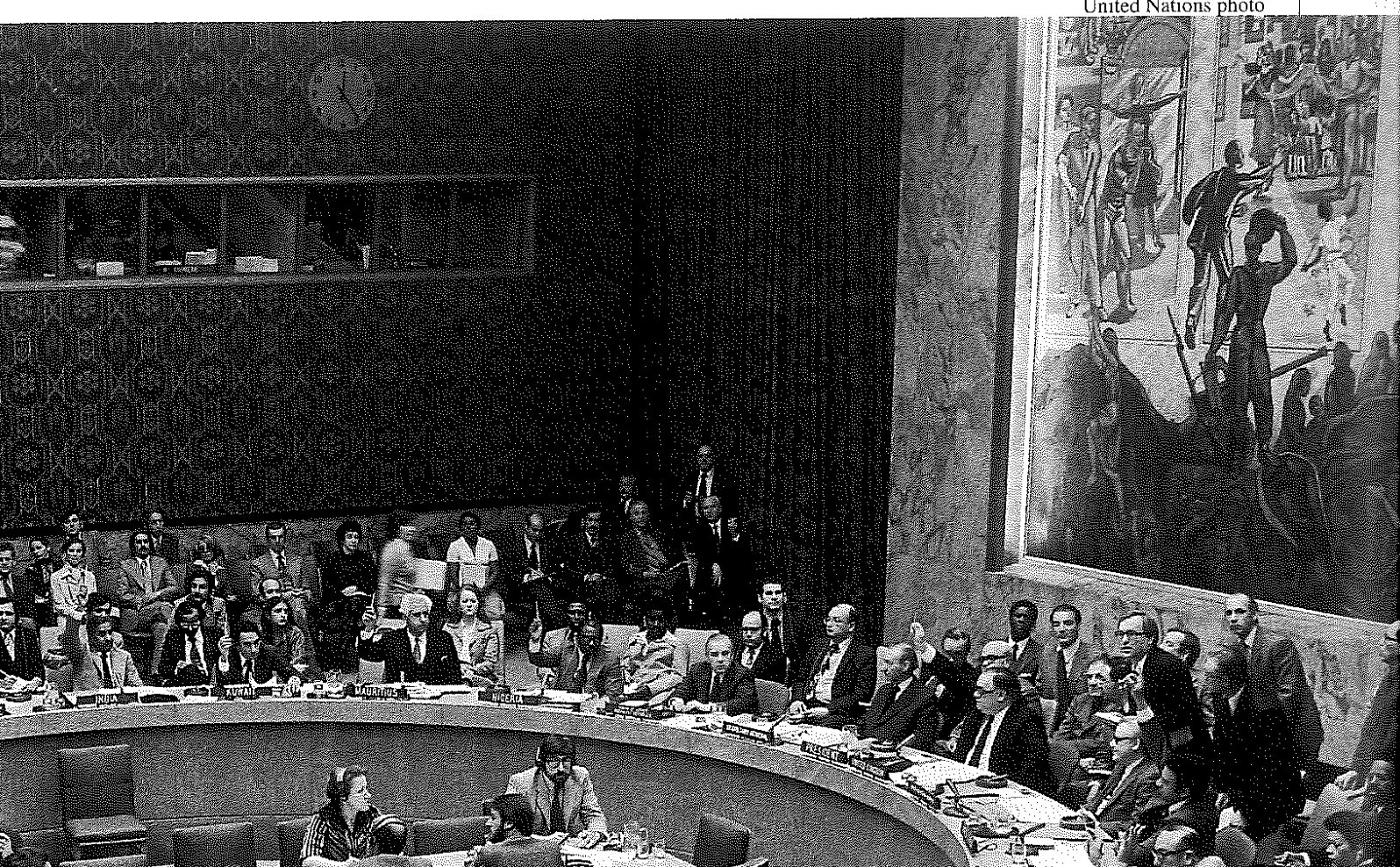
Responsibility for the UN’s financial health and its management and budget process rests with the General Assembly. At the technical level its Advisory Committee on Administrative and Budgetary Questions works reasonably well, but when issues of substance arise their treatment by the General Assembly leaves much to be desired.
Both the Security Council and the General Assembly approve activities without ensuring that the necessary resources will be available. The General Assembly has made no serious effort to control the bureaucracy of the Secretariat. Governments are delinquent in paying assessed contributions. The focus of governments has been on attaining their disparate goals rather than cooperating to achieve organizational efficiency and effectiveness and a sound fiscal position.
Some Elements of Management Reform
Accountability
Fundamental to management reform is the entrenchment of the principle of accountability. Each of the organs as set out in the Charter should be required, on a regular basis, to demonstrate to the member governments, through reports to the General Assembly, that it is fulfilling its purposes and role as defined in the Charter, by responding to the challenges confronting it with economy, efficiency and effectiveness.
The General Assembly has a particular responsibility in this process because it is the approving authority for the Organization’s budget. Not only is this the lever to ensure that resources are available for the initiatives and programs proposed for adoption, but also that the Secretariat, in particular, institutes effective internal mechanisms to fulfil its obligation of accountability. As a result of a recent American initiative a new office, that of Inspector-General has been created, but its effectiveness remains to be demonstrated, and in any case it is an intra-secretarial operation responsible to the Secretary- General. The proper monitoring device for of the staff the working languages of the organization are “second languages”, and working cultures vary widely.
But that is not to say that there can be no room for reform. The Secretariat suffers from elephantiasis. Vested interests, both external and internal, operate with impunity, frustrating the efforts of those dedicated international public servants who are doing their best to fulfil their important responsibilities. Both in organization and numbers the Secretariat Augean stable needs a thorough cleaning.
After fifty years during which the personnel policies and practices of the UN have become increasingly complex, with a history of legislative, judicial and administrative decisions, surely the time has arrived for a review of the system. Do the basic assumptions on which it is based reflect the current views of the member governments? Why not commission a study on these matters by management consultants and have it reviewed by a special committee of the General Assembly set up for this purpose?
Inter-Agency Relations
By design, the Specialized Agencies operate as independent entities, but the “shareholders” (member governments) are the same as for the United Nations itself, and there should be effective cooperation to achieve common goals. In fact, the Heads of Agencies have all too often run them like satrapies, pursuing their own aims, and the mechanism for cooperation, the Administrative Committee on Coordination is notorious for its ineffectiveness.
The Secretary-General has commissioned a special study about what should be done to improve the situation, but reform will require firm pressure from governments. For that matter, governments should also examine their own internal coordinating mechanisms. Perhaps it should be a subject for consideration at the annual meeting of Major Contributor Governments. For many years we in Canada have relied on the Interdepartmental Committee on the Specialized Agencies, but could it be made more effective?
Summation
The reform process which got under way at the 50th session of the General Assembly will be of critical importance to the future of the UN Resolution of the issues to be dealt with will not come quickly or easily, but it should be a principal objective of the Fiftieth Anniversary program to tackle them vigorously. The mere fact that they are being addressed coherently may make it easier to identify and take steps to implement supporting reforms.
Problem areas of the past have been or are about to be overtaken by events, so that resources allocated to those activities can be reduced or eliminated, certainly refocused; Southern African issues are on the way to being settled; some progress has been made in the troubled Middle East; controversial construction projects to provide conference facilities in the developing world are nearing completion, providing alternatives to New York, Geneva, Vienna and Rome. The opportunity has never been greater to convince the membership as a whole that effective resource management is in the common interest of all. Thus, it should be possible even now, for member governments to come to some sort of consensus on the urgent importance of accompanying reform in program areas with a management reform program, and what is to be encompassed within it.
To this end, a concerted effort should be made to enlist influential delegations in all regional groups to support a planned series of initiatives aimed at making each component of the Organization more efficient and productive, and accountable for its operations.
Canada should set management reform as a principal goal of its contribution to the Anniversary reform package. It is essentially an exercise in bridge-building between the have and have-not nations. We have credibility with other delegations, particularly the developing nations, and are in a good position to provide leadership. For the Foreign Service the 50th anniversary of the UN presents a challenge which is exceeded only by that facing the Canadian founding fathers of the UN. But challenges synonymous with opportunities, and the Foreign Service as always, can be counted on to seize them.
View the original scanned pages →
Originally published in bout de papier, Vol. 12, No. 4 (1995-1996) — Winter 1995–96 // Hiver 1995-1996, pp. 8–11. Read the rest of this issue →



