
bout de papier, Vol. 19, No. 2 (2002) — Summer/Fall 2002 // Été/Automne 2002, pp. 19–23
UN Secretary General Kofi Annan once ’remarked “Diplomacy can get you long way, diplomacy backed by firmness and force will get you a lot further.” The Roman (Byzantine) Emperor Michael VIII Paeleologus (1259-82) could well have added “ … money helps as well.”
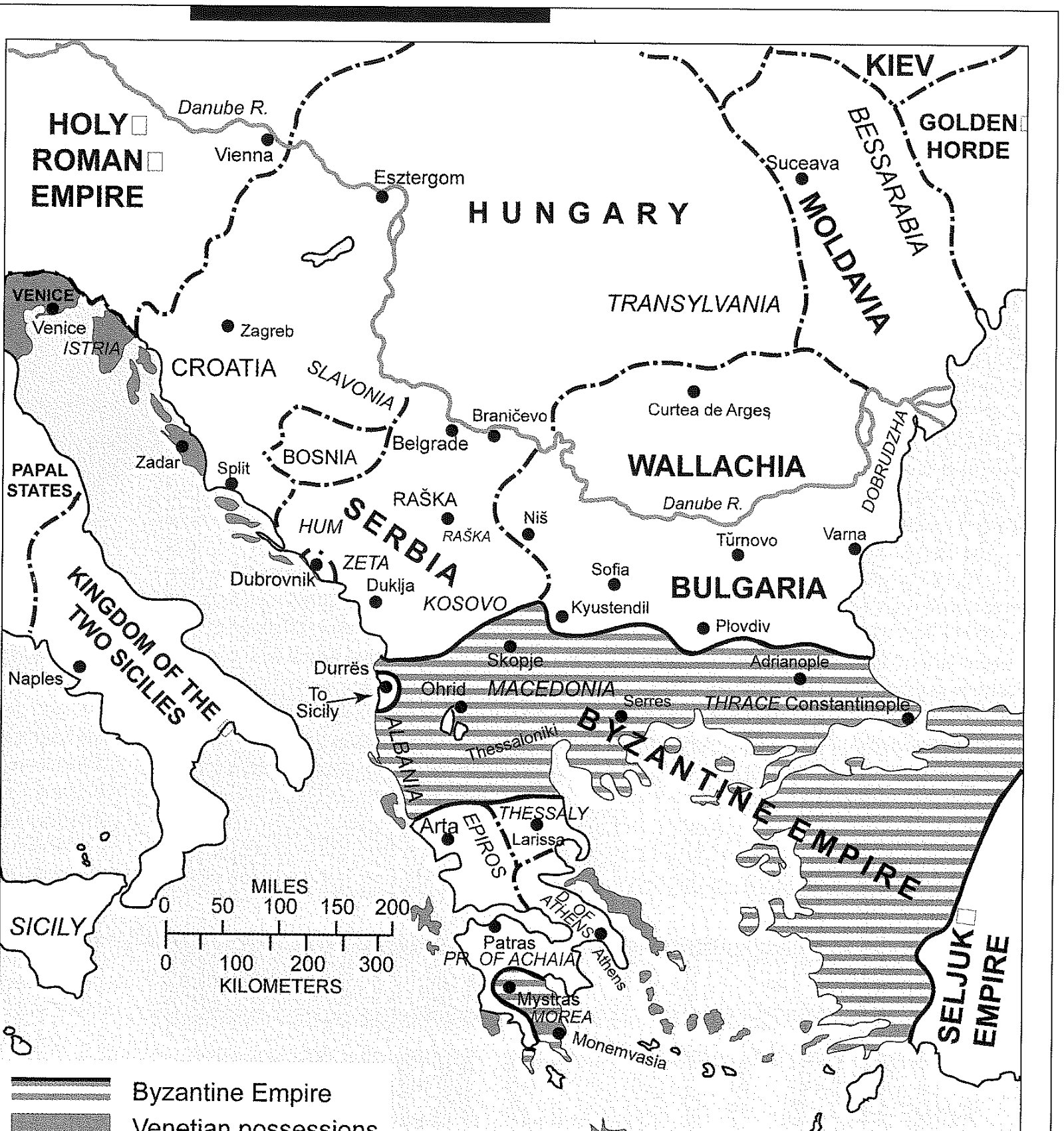
In the glory days of the Roman Empire, foreign policy was relatively simple, as there was, then as now, only one superpower in the “known world” and Rome’s neighbours acted accordingly, or else. Diplomatic finesse was not really needed. But, as the centuries passed and the Empire’s boundaries waxed and (more usually) waned, the world got more complicated. The need for guile and conciliation (and generous subventions) tended to supplant brute force as the preferred policy option. The reality crunch came in 1204, when the Venetians hijacked the Fourth Crusade and captured Constantinople. They helped themselves to the City’s portable wealth and art treasures, expropriated “one quarter and half of one quarter of the Roman Empire” (mostly strategic ports and islands) leaving Constantinople and a shell “Empire of Romania” in the hands of Baldwin of Flanders, who had to distribute most of what was left to the knights and barons who had taken part in the enterprise In fact, Baldwin and the crusaders were able to secure little more than southern Greece, the north shore of the Aegean and the area around the Sea of Marmora. The rest remained in the hands of local Byzantine warlords, each of whom was soon claiming to be the legitimate Roman Emperor, a claim that could only be made good by reconquering Constantinople.
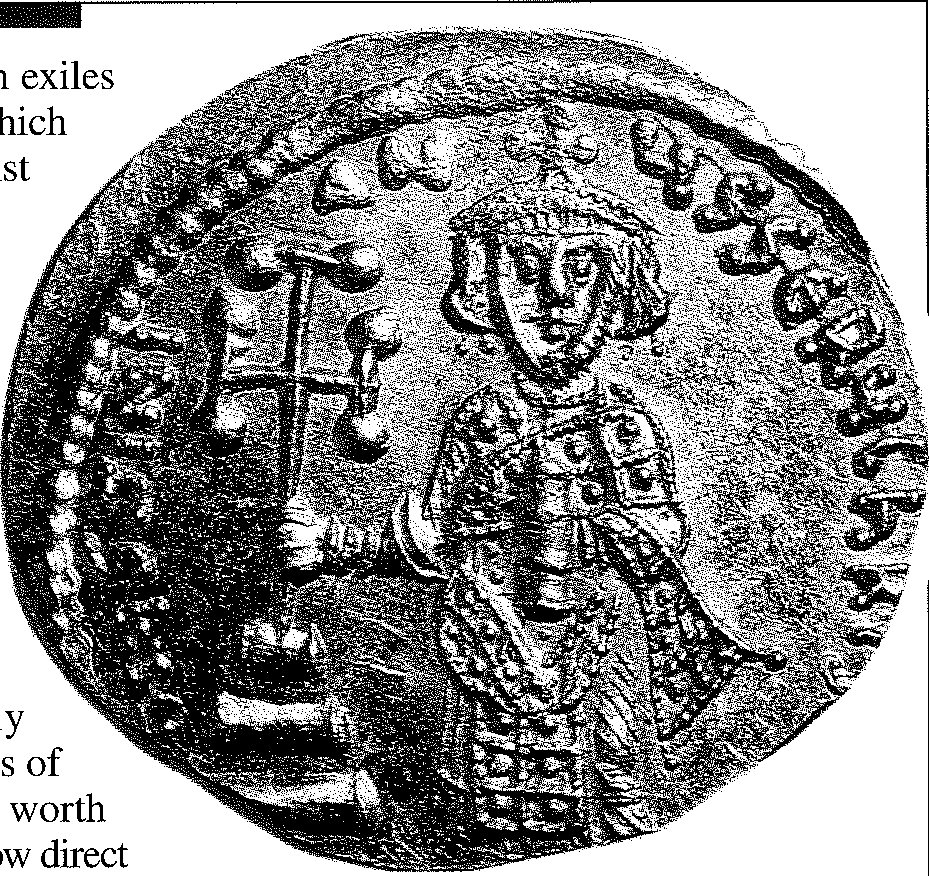
By 1261, this Latin “Empire”, now reduced to Constantinople and its environs, was in such dire financial straits that Baldwin I’s son, Baldwin II, had to pawn his children to the Venetians and sell off the lead and roof beams of Constantinople’s public buildings. Venice retained its hold on Crete, and the islands. Most of present day Albania and central Greece comprised the so-called Despotate of Epirus, while southern Greece supported a flourishing network of French and Italian duchies and baronies. The largest of the Byzantine successor states was the so-called Empire of Nicaea. Building on a base in western Asia Minor, the Lascarid dynasty also managed to recover a fair swath of Balkan territory. The Lascarid line terminated with the minority rule of John IV, and Michael Paeleologus, Nicaea’s leading general became regent. Michael disliked the temporary nature of his assignment, and had himself crowned co-emperor. Young John was relegated to a monastery, and, to ensure he could entertain no future imperial ambitions, blinded — this act earned Michael considerable opprobrium, particularly from the Church.
In 1261, a Nicaean general noticed that the Latin army and its Venetian naval support had left Constantinople on a raid. He exploited this lapse in security by forcing his way past the skeleton garrison and raised Nicaea’s double-headed eagle on the 5th century walls of the “Queen of Cities”. It was a depopulated wreck, but Michael’s triumphant entry soon after signalled the rebirth of the Roman Empire, to survive for almost two more centuries.
In charge of Constantinople, Michael proclaimed himself “the new Constantine” recalling the 4th Century Emperor who had founded the city and made Christianity the Empire’s religion. Their ruthless energy apart, the two had little in common. Constantine had ruled an Empire of some 50 million, extending from the Tyne to the Tigris. Its annual revenues, worth an estimated 110,000 kilos of gold, supported a standing army of over one half million men. No single power could remotely threaten his empire’s existence. Michael VIII ruled north-west Anatolia, a strip of territory stretching across the Balkans from Constantinople to the Adriatic, some Aegean islands and some strongholds in southern Greece. His empire’s population was about four million. Annual revenues of about 12,000 kilos of gold, supported a standing army of some 5,000. When augmented with mercenaries and levies, he could field forces of up to 20,000.
The only thing Michael had in abundance was enemies, and several posed a potentially mortal threat to the Empire’s existence. Michael used diplomacy and force to prevent this from happening. To protect his northern and eastern flanks Michael cultivated the Mongol powers that now dominated Central Asia, Iran and Russia. The Ilkhan of Persia, to whom he married a daughter, could hold the Seljuk Turks of central Anatolia in check. The Khan of the Golden Horde helped keep the Bulgars, Serbs and Hungarians honest. Michael also cultivated the Mamlukes, the rising power in Egypt and Syria. They were a potential counter to the Ilkhans, as well as to the great Italian maritime states of Venice and Genoa. In the Balkans he continued the aggressive stance of the Nicaean state, making inroads into Bulgaria, Thessaly and Macedonia. Italian naval condottieri helped extend his control over the Aegean. But the greatest threat to the Empire’s existence would be a coalition of western powers, backed by one of the Italian maritime states, doing repeat performance of the Fourth Crusade. The main focus of Michael’s diplomacy was to prevent this coalition from forming.
Baldwin II, the deposed Latin Emperor, was quick to seek western help to restore his throne. The logical source of such help was Manfred, King of Sicily (and of most of Italy south of Rome), with whom he had marriage links, and who held strategic bridgeheads in Albania. But Manfred had inherited his father Frederick I’s family feud with the Papacy, and the Pope was more interested in waging a holy war to depose Manfred than one to recover Constantinople.
The situation became much more dangerous for Michael by the end of the decade. The Pope rallied the French King’s brother, Charles of Anjou, to his cause. In 1266, Charles overthrew Manfred, who died in battle, and two years later executed Manfred’s nephew, Conradin, after his vain attempt to retake the Kingdom. As King of Sicily, Charles and the Papacy were united in their desire to restore the Latin Empire. Charles inherited and began to extend Manfred’s trans-Adriatic bridgehead. By a marriage alliance, Charles also secured Hungarian support for his eastern enterprise and his envoys were working Serbia and Bulgaria. In terms of the naval balance, Charles could, in addition to Sicily’s not inconsiderable resources, call on Venice, still smarting from its ouster from Constantinople. Michael had not fully revived the Byzantine fleet.
Michael tried to weaken Papal support for Charles by offering to heal the schism which had increasingly distanced the Greek and Roman churches since 1054. Pope Clement IV was in no mood to compromise. The Greek church would have to submit unconditionally to Rome’s demands before talks could even begin. Michael, whose relations with his prelates was already gravely strained by their disapproval of his deposing and blinding the child emperor John IV, knew this was a non-starter. He had more success with Charles’ brother, King Louis IX of France. Louis too wanted a crusade, but much as he hated “schismatics”, he preferred to direct his energies against real infidels. Michael’s envoys were able to plant the seed of an expedition against Tunis. Louis looked to his brother for support, and Charles saw that his own interests could be served by a bridgehead in Africa. While Louis’ (soon to be St. Louis) premature death thwarted Michael’s hopes that western efforts would become mired in Tunisia, nonetheless Charles lost many troops in Tunis to pestilence and part of his fleet to a storm. Diplomacy, advocacy and good luck had won Michael at least some years’ grace.
Additional time was won by Pope Clement’s death. The new pope, Gregory X, had previously been papal legate to the Holy Land, and his main ambition was a united Christian crusade to save the crumbling fortunes of the Kingdom of Jerusalem. Gregory was, therefore, willing to accept something less than unconditional acceptance of Papal supremacy by the Byzantines. To this end, an Oecumenical Council, the medieval equivalent of a major UN Conference, was convened in Lyons in 1274. Gregory invited the leading clergy and crowned heads of Europe with the aim of uniting the Churches and launching his grand Crusade. The Crusading project was not a rousing success. Only one monarch, the King of Aragon, actually attended, and pledges from the rest of Europe’s rulers were conditional in the extreme.
Michael himself did not attend, but tried to muster an outwardly impressive delegation. Alas, the galley carrying the official gifts was sunk in a storm, and fielding credible senior clergy willing to sign on to an Act of Union between the Eastern and Western Churches was a challenge. Even so, the Council accepted the sincerity of Michael’s pledge to unite the churches. Gregory forbad Charles from mounting any expedition against Michael. He also turned a blind eye to Michael’s efforts to chip away at Charles’ Albanian bridgehead and at the Latin principalities in Greece.
Pope Gregory died in 1277. His successor, John XXI, was sceptical about the sincerity with which the Church union had been accepted in Byzantium. His suspicions were correct. Lyons was bitterly resented and the Byzantine clergy resisted it at every turn. The horrors of the sack of Constantinople had not been forgotten (indeed, as the present Pope recently discovered, the wound still festers). Michael found that, despite mass arrests and clerical and court shuffles, enforcing the Pope’s demands threatened rebellion, within the Byzantine Church, within the army, and even within his own family. In 1279 Papal nuncios were dispatched to ensure absolute and literal compliance with the terms of the Council of Lyons – and more. Michael, however, was able to convince the nuncios of the sincerity of his own conversion and of his efforts (as a tour of his dungeons amply illustrated) to enforce it. At the same time he convinced his own clergy that a show of outward compliance, or at least constructive theological obfuscation, was in the national interest. By now there was a new pope, Nicholas III, scion of Rome’s Orsini family and no friend to the Angevin cause. The nuncios’ report back hardly satisfied him, but he agreed that Michael was trying. Charles was told that his planned invasion should be postponed.
Unfortunately the reprieve was short-lived. In August 1280, Pope Nicholas died and, after a lengthy conclave, was replaced in February 1281 by a French Pope, Martin IV. Michael sent a delegation to congratulate him and persuade him of the Empire’s continued support for Council of Lyons. The delegation arrived in Viterbo to find, to their dismay, Pope Martin meeting Michael’s chief enemies: Charles of Anjou; Baldwin II, the deposed Latin Emperor; and representatives of Venice and Pisa. They had just concluded a “Treaty for the Restoration of the Roman Empire usurped by Paeleologus”.. Michael was declared a heretic and excommunicate and the Byzantine envoys told him that if he did not surrender his empire to the Pope by May 1, 1282, he would be overthrown by force. Charles and the Venetians each pledged 120 warships to the venture, transport for 8-10,000 cavalry, backed by even larger infantry forces.
Michael’s prospects did not look encouraging. Charles’ invasion fleet was mustering in the ports of southern Italy and Sicily, while his advance guard in Albania was already advancing into the interior. Serbia and Bulgaria had new and hostile rulers, Turkoman raiders were making serious inroads in south-west Anatolia, diverting much of Michael’s army. There were some bright spots, Charles’ forces in Albania soon suffered a major defeat and were thrown back to the coast, Sicilian efforts to create a united front in Latin Greece had failed, and Michael likewise retained control of the Aegean, but all this could be quickly swept away by Charles’ armada.
The classic Byzantine diplomatic response to a threat of an attack was to make common cause with the attacker’s enemies. Here Michael had long been at work. Charles of Anjou had no lack enemies. Angevin ambitions in northern Italy clashed with those of Rudolph von Hapsburg the German Emperor. Genoa, found his presence in the Provence too close for comfort, and besides, any friend of Venice was no friend of theirs. Pedro III, King of Aragon, had claims on Charles’ Provençal holdings, and his wife was a daughter of Manfred, deposed by Charles. Many Sicilian exiles had found shelter in Barcelona, which became a hotbed of intrigue against Angevin rule.
The most active member of this Sicilian exile community was Pedro’s own foreign minister (and formerly a minister in Manfred’s government) Giovanni di Procida. Like Michael, he saw a commonality of interest, and was able to persuade the Emperor that he could engineer an uprising in Sicily. The cost was not cheap — reportedly Michael contributed 30,000 ounces of gold, approximately one month’s worth of the Empire’s total tax revenue. How direct and personal di Procida’s involvement was, is uncertain. Sicilian legend has him clandestinely travelling the length and breadth of the Mediterranean, from Constantinople to Rome (where Pope Nicholas’ support was allegedly purchased — only for him to die at a crucial moment) to Sicily and back to Barcelona, dispensing his ton of gold. If this exercise in shuttle diplomacy is true, it was no mean feat for a septuagenarian who was also holding down a high profile day job. However, it is clear that Michael’s funds were put to good use, partly to finance an Aragonese expeditionary force, and partly to arm and organize Sicilian resistance cells, which would rise up and prevent Charles’ fleet, now assembling in the ports of Sicily, from sailing to Byzantium.
The circumstances are obscure, but the revolt may have been launched prematurely when, on March 30, 1282, a riot broke out in Palermo. Large numbers of Sicilians had gathered for Easter Monday Vespers (evening prayers). The mood was already tense, as the governor had been conducting heavy-handed searches for weapons caches. A French sergeant tried to abduct a Sicilian woman, her husband stabbed him to death. His comrades who tried to avenge his death were set on by the mob and killed. A general uprising throughout Sicily ensued, those French soldiers and officials who could took shelter in the citadel, the rest were slaughtered. Already primed by Michael’s Byzants, the revolt spread rapidly through the island Some strongholds held out long enough to allow their occupants to evacuate to the mainland, but in all some 8000 Angevin supporters were massacred, and Charles’ invasion fleet was destroyed. The cities and towns of Sicily formed themselves into communes and called on Pedro to help repel the counter-attack that Charles was now preparing. Pedro was ready and willing, and a twenty year long war for control of Sicily ensued. Needless to say the Angevin invasion of the Roman Empire was never launched.
Neither Michael, who died that same year, nor Charles, who died in 1284, long survived their confrontation. Their dynasties lived on — the Angevins till 1343 and the Paleologoi to 1453, but their successors presided over the long decline of their respective realms. Michael VIII was a ruthless and resourceful monarch, more successful in pursuit of his foreign policies than he was domestically. His religious policies created considerable internal division. While he averted a mortal danger to the Empire, Michael’s efforts to restore it to its pre-1204 glorv sapped its strength anc resources. That said, no ruler of Nicaea could have passed up the chance to retake Constantinople, the very legitimacy of his rule lay in striving for “The City”.
The treasury exhausted, Michael’s son and successor Andronicus II drastically curtailed the defence budget. He could no longer defend the Empire’s Anatolian heartland. Within sixty years of Michael VIII’s death, Anatolia was all but lost to a hitherto unknown Turkish clan, the Ottomans. Not long after they crossed into Europe, and about a century later they destroyed
View the original scanned pages →
Originally published in bout de papier, Vol. 19, No. 2 (2002) — Summer/Fall 2002 // Été/Automne 2002, pp. 19–23. Read the rest of this issue →



