
bout de papier, Vol. 17, No. 2 (2000) — Summer 2000 // Été 2000, pp. 30–33
bout de papier: What was it like coming to California as a former Prime Minister and taking on the job of Consul General?
The Right Honourable Kim Campbell: From my previous life as a political science professor and from perches in elected office at all three levels of government, I knew it would be interesting to see government from the other side of the divide. However, after you’ve been Prime Minister, a lot of people do ask,, ’What’s a nice girl like you doing in a place like this?” My answer is always that democracy is a blunt instrument. Being Consul General has, for the most part, been a pleasurable experience. Foreign service officers are dedicated people who do good work. My only regret is that so few Canadians really know what they do. bout de papier: Is this the job you expected?
Ms. Campbell: Each Consul General brings his or her own assets to this job and no two people do the job the same way. When I first came I made it clear that I was ready to do anything people could use me for. The officers I have worked with carry a big load and have come up with interesting projects to involve me. I have tried to use the entertaining facilities at the house and my speaking opportunities to support all of our programs. Certainly Public Affairs was one of the most important programs here, but given the extraordinary developments in Silicon Valley with information technology and investment prospects, it has been particularly exciting to find synergies with Canadian innovators.
I think I have done the gamut in this territory: meeting with governors, senators and congressmen, addressing major universities and many organizations. I have greeted trade missions led by Minister Marchi, and those brought in by provincial trade ministers. Minister Axworthy was here, so was Minister Copps, and Ambassador Chrétien from Washington on several occasions. Their visits were productive and the post certainly clears the decks to arrange a program for them.
We had a great group of 75 Canadian businesswomen come down to look at exporting, and there have been various other Canadian groups, specializing in architecture or biotech or animation, whom I met when they came through. At one point I even found myself on a stage in San Francisco talking to a little animated “New Media Kim” on screen at a presentation of Canadian software technology.
I think I have flown so many times between San Francisco, San Jose, San Diego and Los Angeles that I have worn a little ridge in the airwaves. I have met with lots of US business contacts, with incentive travel organizers for the tourism industry, with venture capitalists and environmental groups and political activists. And I don’t think they were just being polite — I think they were genuinely interested in hearing about Canada and hearing our side of an issue.
We have had some very successful cultural events: Canadian films selected for festivals in California and Arizona, lots of theatre and dance performances, and many concerts, including a series for a Landmine Free World featuring legendary singer songwriters, including Bruce Cockburn. For the visual arts, there was a festival in Scottsdale, Arizona, called “Spirits in the Sun” to open the market for Canadian aboriginal arts and crafts. We also helped with more formal gallery shows such as the exhibit of work by Jeff Wall at the Museum of Contemporary Art.
It was rather nice that in this my last year here the Consulate was presented with a special proclamation — gold letters and all — thanking us for our on-going support of the arts, which I received during one of the events which took place at the Southwest Museum around a spectacular exhibition of masks from Canada’s northwest, a show called “Down from the Shimmering Sky.” bout de papier: Are we making an impact in the United States?
Ms. Campbell: Given the huge trading relationship, there is an enormous amount of business taking place without government assistance. In California, we concentrate on expanding opportunities where they are not being seized, and promoting investment in Canada from the huge pools of capital in this region.
The perception of Canada for many people in the United States is out of date, so we have an important message to deliver: that Canada is a high-tech, highly educated, highly competent place to do business.
If my presence in LA has made a difference, that’s hard to measure. Certainly, the cachet of being a former Prime Minister does open doors not usually open to Consuls General. I have spoken to a great many audiences, to people who clearly did not know the nature of the US- Canadian relationship, or the developments in Canadian society and economy, or our role in international affairs. I have also done a lot of radio and televison. Reaching an audience of 300,000 people at one time is energy effective. Leaving a positive, informed and nuanced vision of our country is a good thing, but it is hard to measure how that impression may translate into action or attitudes.
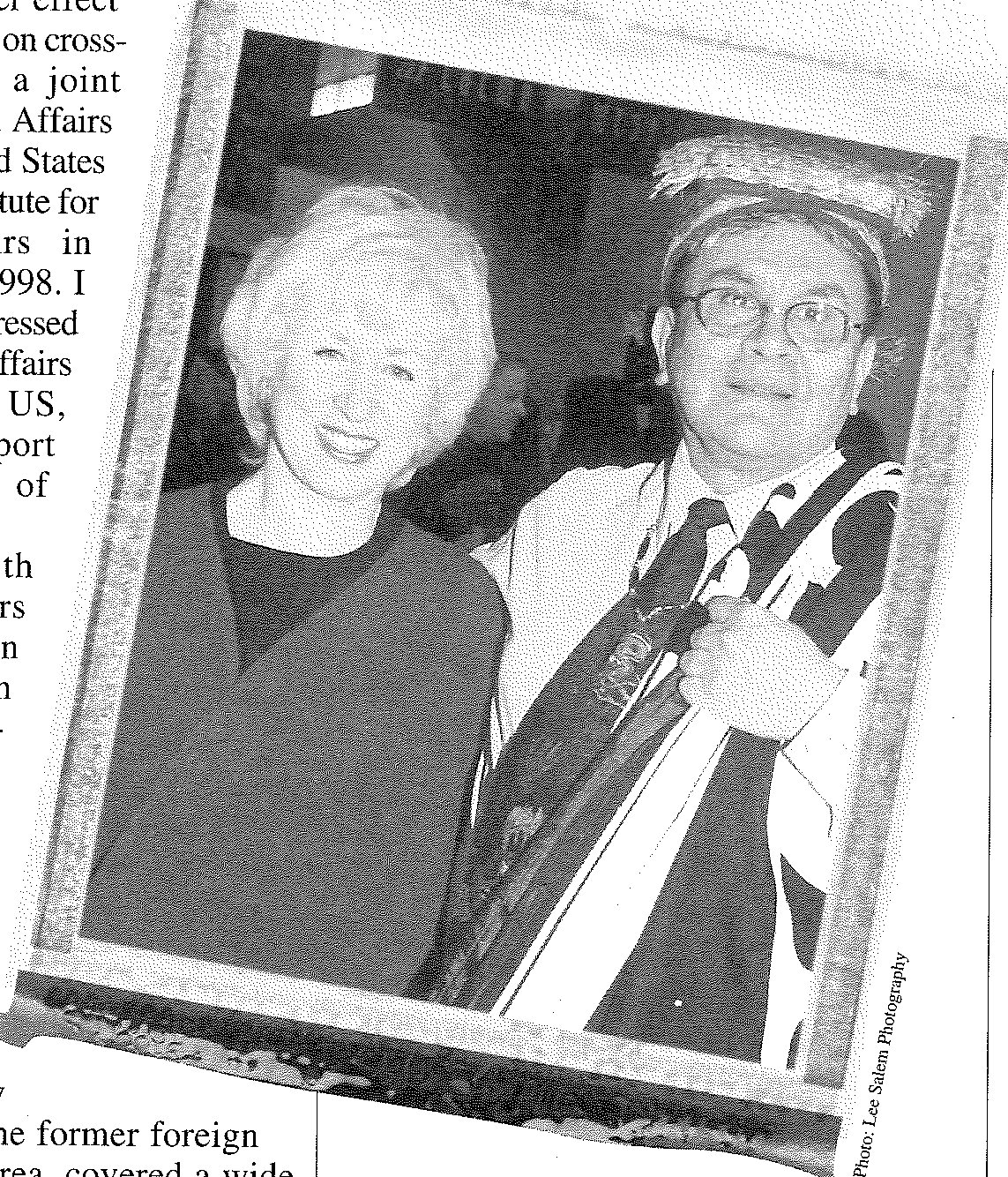
bout de papier: You have been wearing several hats while in Los Angeles. How have they been helpful to foreign policy objectives?
Ms. Campbell: Yes, I have taken on other roles, notably with the Council of Women World Leaders, a group formed in 1996, with a membership of women who have been president or prime minister of their country, and which I have chaired since April 1998. In addition to our own summits, the Council has convened meetings of high-level women in economics and finance in association with the World Bank and with regional development banks, as well as a meeting of women justice ministers held in collaboration with the United Nations.
Our objective is to create a network among these women and show the value — and the normalcy — of having women at this level of decision making. I have shared contacts made at these meetings with other posts in the event my introduction provides a useful entry for them.
I was also elected to the International Women’s Forum which has led to speaking engagements and access to senior journalists and opinion leaders. Obviously I am an example of one glass ceiling squarely knocked upon. My association with women’s issues has raised awareness of Canada’s achievements in gender equality.
One spin-off was collaboration with Women Against Gun Violence. Their fundraisers, held at the official residence completely at their expense, were attended by leading state, county and city politicians, good people to know, and I had a chance to describe Canadian gun control law and the resulting lower crime rates.
Other links have come from my work with the National Democratic Institute (NDI) in Washington. I co-chaired an NDI conference on emerging democracies in Yemen last year. CIDA was one of five supporting countries, so having a Canadian in the Chair elevated our profile. But, while this was an addition to my work as Consul General, as things unfold it has local value. During the Democratic convention in LA in August, the NDI presents a non-partisan education program for 500 legislators from around the world brought as observers. As a result of my previous involvement with them, I am included in an NDI panel discussion on political process and am hosting a reception – all of which offers a chance to give a Canadian perspective.
Another “multiplier effect” came with my address on cross-border relations to a joint meeting of the World Affairs Councils of the United States and the Canadian Institute for International Affairs in Ottawa, in October 1998. I have subsequently addressed a number of World Affairs Councils across the US, always with the support of my fellow heads of mission.
My rapport with the LA World Affairs Council also resulted in a televised discussion with former Secretaries of State and world leaders, filmed before a live audience at the University of Southern California this spring. Our panel of Warren Christopher, Shimon Peres, Andrei Kozyrev and Han Sung-Joo, the former foreign minister of South Korea, covered a wide range of world issues for a one-hour program which will be shown on PBS stations and distributed through universities and colleges in the United States.
Other things too. I am on the Visiting Committee of the Weatherhead Center for International Affairs at Harvard. A fellow committee member from Hawaii made sure that I got the best speaking engagements and the most effective meetings when I visited his State in 1997. He provided the same courtesies for Ambassador Chrétien a few months later.
I am also a Trustee of the Thunderbird American Graduate School of International Management in Phoenix, and I’m on the Corporation of Northeastern University in Boston, and the Advisory Board of the School of Public Policy at UCLA — and these things bring me into contact with people who often turn out to be helpful allies for Canadian interests.
Americans like Canada in a benign way, but Canada is virtually invisible here. Wearing my other hats while serving as Consul General has helped remind Americans that Canada is a player. I take heart in a comment from Los Angeles Times columnist Bob Scheer, who said at one of our dinner parties, “You know I never used to think about Canada, but now I find myself defending it.”
The Rt. Hon. Kim Campbell with Chief Robert Joseph, Curator of Down From the Shining Skies Southwest Museum, Los Angeles, January 15, 2000 bout de papier: Are targeted advocacy efforts successful? Should we develop a larger public awareness of Canada?
Ms. Campbell: It depends on the issue you are tackling. The imposition of Section 110 of the US Immigration Act required direct contact with members of Congress. We did this, armed with an understanding of the political pressures on them so that we could give the answers they needed to dispute the regulation. We’ve also been in touch with governors, like Governor Jane Hull of Arizona, and with groups like Chambers of Commerce who were not aware of the implications of the legislation and who subsequently became very vocal in lobbying efforts. In these specialized areas you do have to be strategic.
Looking ahead to the presidential election, I had a very interesting meeting with Governor Bush’s foreign policy advisor, Condeeza Rice, which, I think, gave her a better understanding of Canada’s outlook on the bilateral relationship and on foreign affairs.
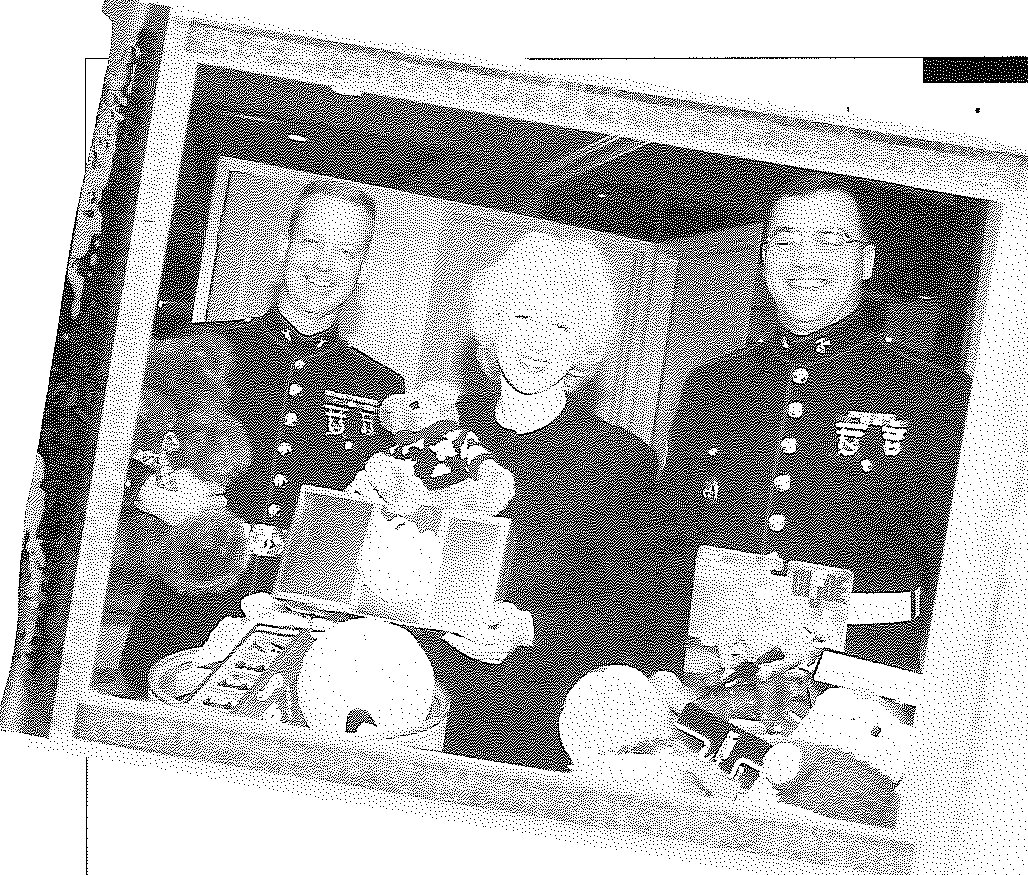
However, if you take the case of the film and television communities’ anger about “Runaway Productions” or the purchase of Canadian animation by the Public Broadcasting System, these issues give rise to Toys for Tots — Military Breakfast, San Diego, December 1998 demonstrations and public campaigns. Here, it’s important to make sure that counter arguments are heard by a broader public. We have done a lot of media interviews on the subject which helped diffuse the “Blame Canada” reaction, but even those tend to be targeted to outlets with an audience already interested in public affairs. It is a challenge to cover the waterfront. We work with other organizations, like the Directors’ Guild of Canada and other professional associations and unions in Canada which can speak more directly to this issue.
bout de papier: Is the foreign service well equipped to conduct contemporary international politics effectively?
Ms. Campbell: I don’t think there is an ideal model for foreign service. Even the most effective embassy of Canada around the world is still representing Canada, and the weight it has is related to the weight that we have in the world. We are not the United States. No matter how we may wish otherwise, when the Canadian ambassador walks into a reception, he or she is not going to get the same response as the American ambassador because the American carries the mantle of the power of the United States.
We have a foreign minister who is passionate about the job and who has worked very hard to put Canada’s stamp on international affairs. But I was personally disappointed when the US Anti-Landmines campaign won the Nobel Peace Prize, and there was no mention of Canada’s role. Those who won the prize are hugely complimentary about Lloyd Axworthy and the role he played to get the treaty signed. However, even with an activist foreign policy and a Minister who knows very clearly what he wants to do, the reality is that Canada does not always get credit. in Calitornia. I try to leave Americans with a more informed view, but I know it’s a tiny contribution to dispel a lack of attention of gargantuan proportions. bout de papier: You have a reputation for hosting memorable and high-profile functions. How have they helped raise Canada’s profile in California?
Ms. Campbell : Diplomatic entertaining creates relationships of comfort and familiarity which make it possible to pick up the phone and talk to people later. We have brought a great many eminently “re-contactable” people to this house.
Our Oscar party in honour of Norman Jewison, for example, and other events related to the film industry — the luncheon for the winners of the Scientific and Technical Academy Awards, the Banff Televison Festival, the Sheridan College Animation Award and receptions following special screenings of Canadian films — all attract entertainment industry executives and celebrities.
We have also held many receptions for specific business interests, for provincial and city delegations, Canadian universities seeking alumni, Immigration contacts, the RCMP, and we held a series of Canadian Salons featuring artists like Raffi and Gino Quillico, plus lectures on the Canadian elections or Quebec politics. I have two big Visitors Books full of guests’ signatures. I think I have used this lovely house creatively and hosted parties with a unique format.
I like to mix people from my own work, senior journalists, academics, directors of “think tanks”., with people from the entertainment industry — Betty White, Carl Reiner, David Foster, Carol King, Allan Thicke, Artie Shaw, Dan Ackroyd — many of whom come through the contacts of my partner, Hershey Felder.
Los Angeles is a city where people “ghettoise”; the entertainment world, lawyers, business people or politicians are inclined to see only each other. An invitation to the Canadian Residence means you will meet interesting, accomplished people whom you might not otherwise encounter.
We have set a standard for entertaining which has earned us a reputation for good food and lots of it because we cook ourselves, rather than get in caterers, which is a huge saving. And, as Hershey is also an accomplished musician, there is always music after dinner: Hershey at the piano and performances by singers, cellists, violinists in various combinations. Our parties have actually been written up in the Los Angeles Times as “the hottest ticket in tinsel town.” bout de papier: Any suggestions for improving the role of a Consul General?
Ms. Campbell: When I speak to Canadian audiences they seem to be pleased to hear about our work in the southwest and many have followed up with questions about how to scope out the opportunities in this market for their product. But I do feel that understanding of foreign affairs work is low. Perhaps one of the benefits of moving on to my next chapter is that, given media interest shown in me, I can use this as an opportunity to describe the challenges and the successes of the Department’s work in the US.
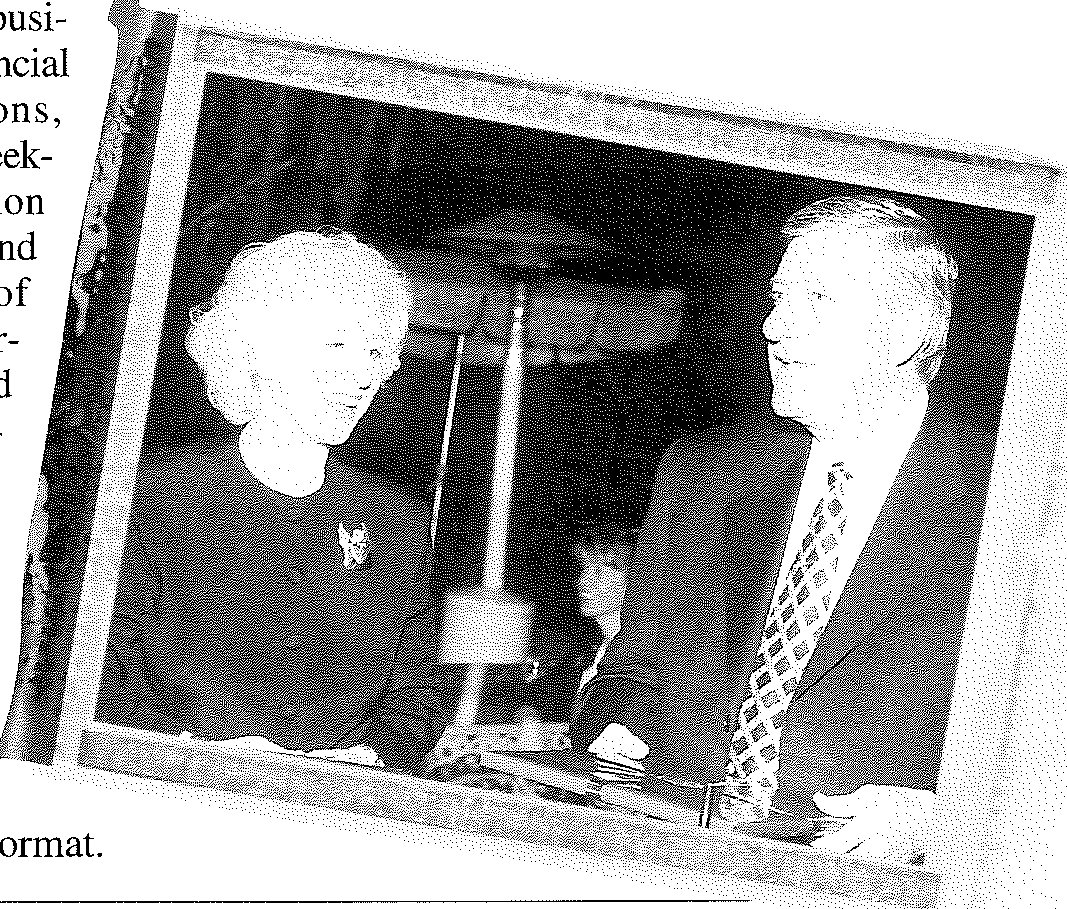
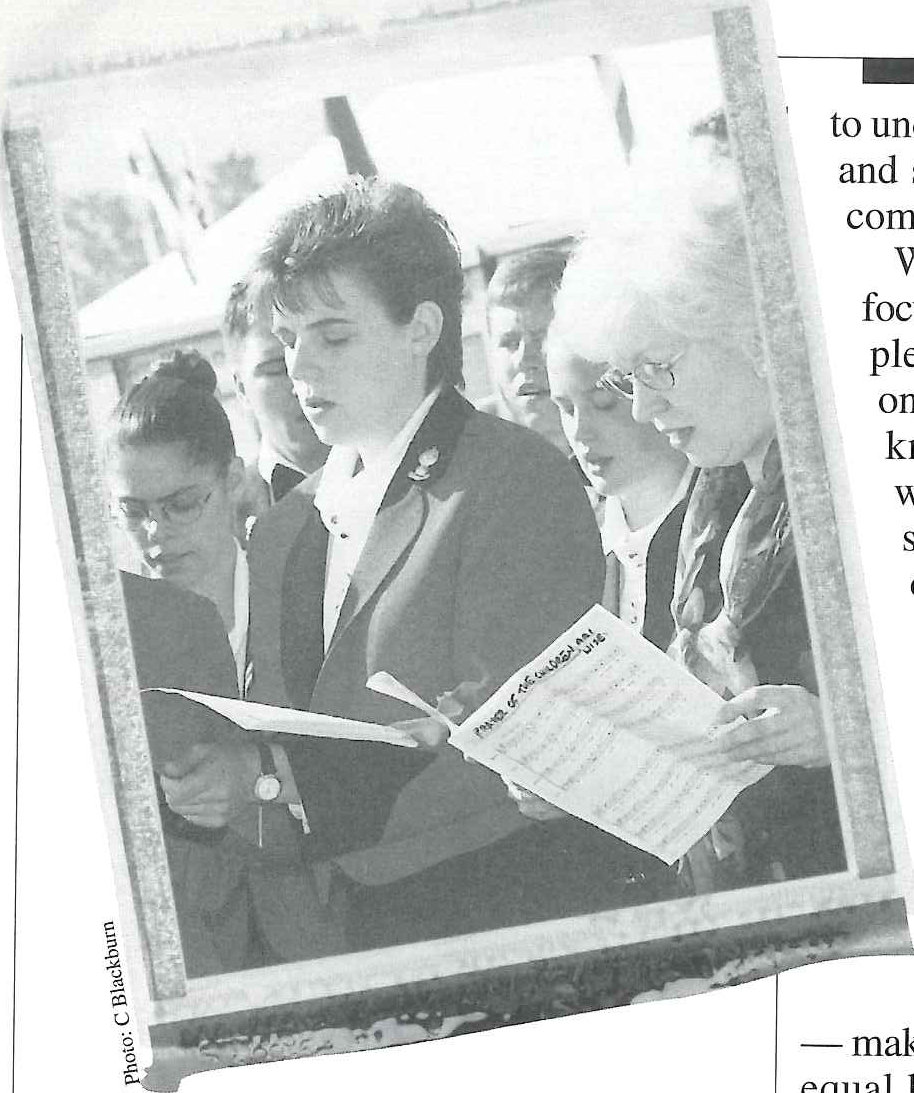
Photo: C Blackburn
Ms Campbell singing with the choir of the 15th Field Regiment Band, Royal Canadian Artillery, at the Nortel International Film Festival, Palm Springs, January 1998
Among my disappointments is that heads of mission in the United States are not plugged into the broader foreign policy work of the Department. It is important for people to keep connected to the big picture to understand what is going on elsewhere, and sometimes to answer questions that come out of the blue.
We must not become exclusively focussed on the United States. For example, Canada is now in its second year on the UN Security Council, but I only know what we’re doing there from what I read in the paper. With a better sense of the important issues, heads of mission might at least echo messages. In terms of professional development within the foreign service, I think this link is a crucial one. bout de papier: Has this chapter of your career been a challenge?
Ms. Campbell: When people ask what I miss about politics, I say — making real decisions. Nothing else can equal being at the heart of the action. It would be dishonest to say that I found this job as stimulating as, say, being Minister of Justice — I don’t. On the other hand, the government has been very supportive of my doing other international things, which has added to the interest of my term here.
I have learned a lot and it has been a fun, but I don’t want to spend the rest of my life as a “former Prime Minister”. Although the cachet of that job has been put to good service, I am too young to rest on that particular laurel. I am happy to have been here; I have enjoyed the people I worked with and the people I have met. This is an exciting part of the world, in a very exciting country and an important outpost for Canada. bout de papier: And advice for the young foreign service officer?
Ms. Campbell: I have been impressed by the skill and expertise of the people at our offices here. Equally, those I have met elsewhere in the US and in far flung places have been extremely well informed and helpful.
I have already expressed my views about whether foreign service officers are appropriately remunerated but, yes, I believe it is an important career. The foreign service is a way of seeing the world, serving your country, and it is probably easier on you than the navy. bout de papier: Ms. Campbell, thank you.
Editor’s Note: bout de papier acknowledges the assistance of Anne Garneau of the Canadian Consulate in Los Angeles for bringing this interview to our readers.
View the original scanned pages →
Originally published in bout de papier, Vol. 17, No. 2 (2000) — Summer 2000 // Été 2000, pp. 30–33. Read the rest of this issue →



