
bout de papier, Vol. 32, No. 2 (2022), pp. 8–11
THE TWO SENIOR KGB OFFICERS masquerading as Soviet hockey officials flinched as shattered glass and ice hit the walls and floor of the cramped, colourless ante-room of Moscow’s otherwise stately Palace of Sports. It was late morning of Thursday, September 28, 1972. The decisive Game Eight of the Canada-USSR Summit Series was due to be played later that evening. Team Canada’s assistant coach, John Ferguson, had sent the side table and its pitcher of water flying as he leapt to his feet from his hard wooden chair, launching a verbal broadside against the two Russians: “You sons of bitches — you suckered us.”
Fergie was not a person you wanted to anger. He had been a very productive NHL scorer during his eight seasons with the Montreal Canadiens before retiring the previous year, in 1971. He was better known however as Jean Beliveau’s left wing protector and someone who let his fists do the talking.
The small room fell silent. The tension thickened.
There was no need for me to translate what Ferguson had said. There was no mistaking the force and intent behind his words, and anyway the two Russians spoke perfect English. I knew them both.
Alexander Gresko had appeared unexpectedly on the Moscow scene as deputy head of the International Department of the Soviet Ministry of Physical Culture and Sports in April of 1972, when I first encountered him. A basic background check had shown that he had been kicked out of the United Kingdom in October of 1971 as part of an extensive expulsion of one hundred and five Soviet diplomats and other officials for “activities incompatible with their diplomatic status.” In plain talk: “spying.” Gresko was said to have been engaged in attempting to recruit well-placed British citizens to betray their country by working for the Soviet Union. The dark-haired and youngish-looking Gresko had a surface affability that covered a combative nature, and his clothing displayed a The second KGB officer, older and greyer, with a long face, aristocratic nose and a perpetually sly grin, had a semi-sophisticated air, aided by a more fashionable suit. Kiril Romesky, who always seemed to have a different title as part of his duties at the Physical Culture and Sports Ministry, was senior to Gresko but normally let his junior countryman do the talking. When he did pipe up, almost always in Russian, you paid attention.
Romesky had been a late addition to the small Soviet delegation travelling with the USSR team to Canada for the first four games in early September 1972 for what had initially been billed as an eight-game home-and-home “Friendship Series.” As second secretary at the Canadian embassy, I had been involved from the beginning in negotiations for the series, and due to my Russian-language capability and position as a defenceman on the “Moscow Maple Leafs” beer-league hockey team, I had been tasked to be the Canadian government’s “Liaison Officer and Interpreter.” Thus, I had flown from the Soviet capital to Montreal, Toronto, Winnipeg and Vancouver with Romesky, other officials and the Soviet team. His principal job was to ensure the Soviet players remained disciplined off the ice and to deter any potential embarrassing situations for the USSR, such as a possible defection.
Another person shoehorned into the ante-room was Team Canada’s head coach and general manager, Harry Sinden. He and Ferguson had just finished running the morning on-ice practice with Team Canada at the Sports Palace, and this was a convenient location for the continuation of the extremely heated argument over who would be the two referees for the final game. The series was now deadlocked at three victories apiece, with one tie, after consecutive and stunning one-goal victories by Canada in Games Six and Seven, both winning goals scored by Paul Henderson. Everything was now on the line.
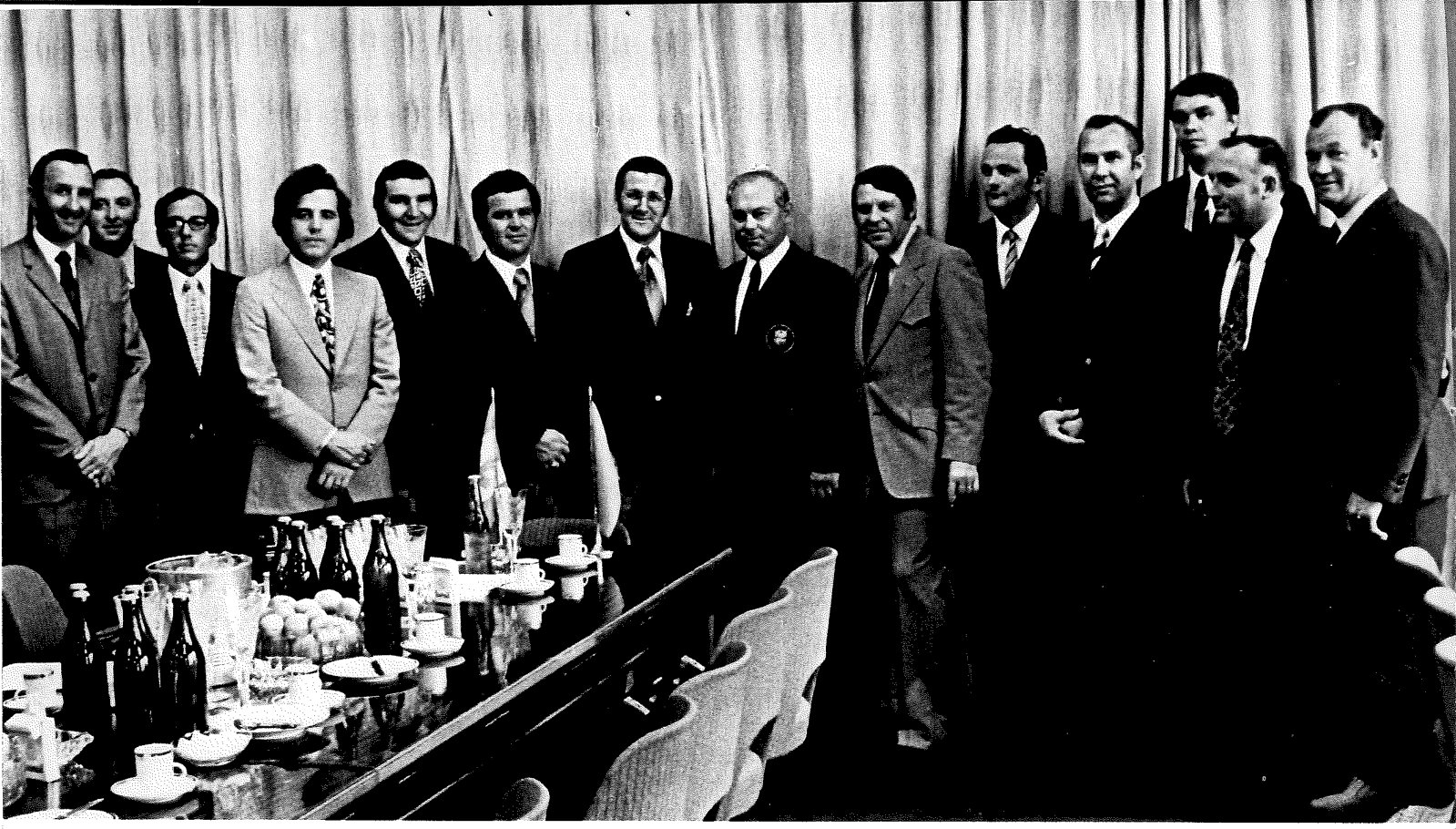
Sinden often appeared harried, preferring to keep the top button of his shirt undone and his tie askew, even when wearing his official blue Team Canada blazer and chequered grey pants. He was a contrast to the more dapper Ferguson and to Team Canada leader Robert Alan Eagleson. The “Eagle,” or “Big Bird” as he was nicknamed in some quarters, was also present in the ante-room. Eagleson was a dynamic force of his own — the founding executive director of the National Hockey League Players Association was a hard-driving Toronto lawyer and consummate networker with political ambitions.
Like Eagleson, Sinden ran hot, as if he had jet fuel in his veins. In describing his own actions, he was fond of using the converse expression “losing my cool” — which he did often. But then Harry had the weight of the entire nation of Canada on his shoulders. Team Canada, with its roster of all-star NHL professionals, was expected to sweep the ice clean against the so-called “amateurs” of the Soviet Union. Sinden had won a Stanley Cup with the Boston Bruins in 1970 and, perhaps of more significance in his current context, had played and beaten the USSR team at the 1958 World Championships in Oslo, Norway, as part of the Allen Cup champion Whitby Dunlops. Harry Sinden was fully expected to deliver victory for Canada and Canadians in this monumental series as well.
When Team Canada stumbled badly out of the gate in the first game in Montreal on September 2 and went on to lose the Canadian portion of the series with two losses, one win and a tie, the blame game began in earnest, and the wrath of the country and the media fell on the players — but particularly on Sinden. His reputation took an awful beating. Now he had much to prove in the communist capital, with wall-to-wall media coverage, including over one hundred Canadian journalists desperately seeking photos and juicy copy, and under the close attention of nearly three thousand frenetic Canadian fans who had come to Russia to watch the games. No pressure, eh?
From the moment Sinden had been named head coach, in mid-June of 1972, he had expressed his dissatisfaction with the arrangements for referees and the use of the international rules that had been negotiated and signed in April in Prague as part of the overall series agreement between the Canadian Amateur Hockey Association (CAHA) and the Soviet Ice Hockey Federation. Sinden believed the deal favoured the Soviets, as they were familiar with this system, and that two referees with no linesmen would miss a lot of infractions, or they would compete with each other to see who could call the most penalties. During follow-up negotiations in Moscow in July he attempted to change these arrangements, but the Soviet side would not budge from the agreed position that these were international, and not NHL, matches.
For the first four games, in Canada, the April agreement called for a pool of four American referees with international experience: Gord Lee, Len Gagnon, Frank Larsen and Steve Dowling. They would split the first two games. Both sides would then agree on which two refs to choose for Games Three and Four based on their initial performance. If there was no agreement, then Canada would pick the referees for Game Three and the USSR for Game Four. Lee and Gagnon started out fairly well, largely staying out of the spotlight.
Team Canada’s opening game 7-3 loss was not laid at their doorstep. On the other hand, Larsen and Dowling were said to have been subjected to a strong scolding in their dressing room by the general secretary of the Soviet Ice Hockey Federation, Andrei Starovoitov, following the USSR’s 4-1 defeat in Game Two in Toronto. A wastebasket and chair or two had apparently been kicked over and the word “barbarians” used to describe Team Canada’s “excessive and illegal physical play.” Starovoitov would call Sinden late that night arguing that Lee and Gagnon be used exclusively for the final two games in Canada. Sinden obliged him, but later would say he noticed the refs had tightened up in Games Three and Four, to the detriment of Team Canada. It convinced him more than ever that, from the beginning, NHL rules should have been in place — enforced by NHL referees. However, he did readily admit that Team Canada had displayed poor play and a lack of stamina in these two games, which was beyond the scope of the referees.
The fat hit the fire in Stockholm during the two exhibition games there, on September 16 and 17, against Team Sweden, which were intended as a warm-up for Team Canada on the wider Olympic-sized ice, as would be used in Moscow. These games turned into a nasty bloodbath, with spearing, cross-checking and slashing galore. Team Canada’s Wayne Cashman, for one, endured fifty stitches to sew up his tongue, which was split severely by a Swedish butt-end. Sinden blamed the referees for letting the games get out of hand, in particular the two West Germans, Franz Baader and Josef Kompalla (whom he later would call “Badder” and “Wurst”). Both were part of the four-person European pool to be employed in Moscow (Sweden’s Ove Dahlberg and Czechoslovakia’s Rudolf (Rudy) Bata being the other two). Sinden said the two West Germans were “absolutely terrible; they couldn’t even skate,” adding that “they were miles behind the play all night and don’t know the damn rules.” He blamed their “incompetence” for making the game very bitter by not calling penalties on the Swedes for “backstabbing” and other dirty stickwork.
According to Sinden, at the end of the second period of the second game, a donnybrook broke out in the joint corridor that led from the ice when he continued to berate the German officials while players from both sides shouted insults at each other. A shoving match ensued, which drew a crowd of Swedish photojournalists and eventually Swedish police, apparently with dogs. Sinden later described the scene as “ugly.” Canada’s ambassador to Sweden, Margaret Meagher, controversially called Team Canada’s actions a “disgrace” and issued an apology. It is a matter of debate if she did the right thing in calling out her fellow countrymen publicly, but it was certainly not Canada’s finest hour in this Scandinavian country. Sinden had left Sweden with three conclusions: one, refereeing would be the biggest problem in Moscow; two, if the team did not start playing better it would lose; three, no matter how bad the Swedish experience had been it might help bring the players closer together as a team.
Game Six (on September 24, the second of the four games in Moscow) reinforced Harry’s first concern. Baader and Kompalla were back on the ice. Team Canada won a 3-2 squeaker to get back into the series, but Sinden was apoplectic about the refereeing, saying the two Germans were the most incompetent officials he had ever seen. They had called eight penalties on Team Canada for a total of thirty-one minutes, including a questionable infraction in the last two minutes, against only four minutes (two minors) for the USSR team. Mind you, twelve of those minutes involved Canada’s Bobby Clarke, for his ankle slash of the leading Soviet scorer, Valeri Kharlamov, but still the distribution of penalties was disproportionate. Sinden said the Germans had done everything they could to help the Russians and was insistent that this was the last game for the two officials.
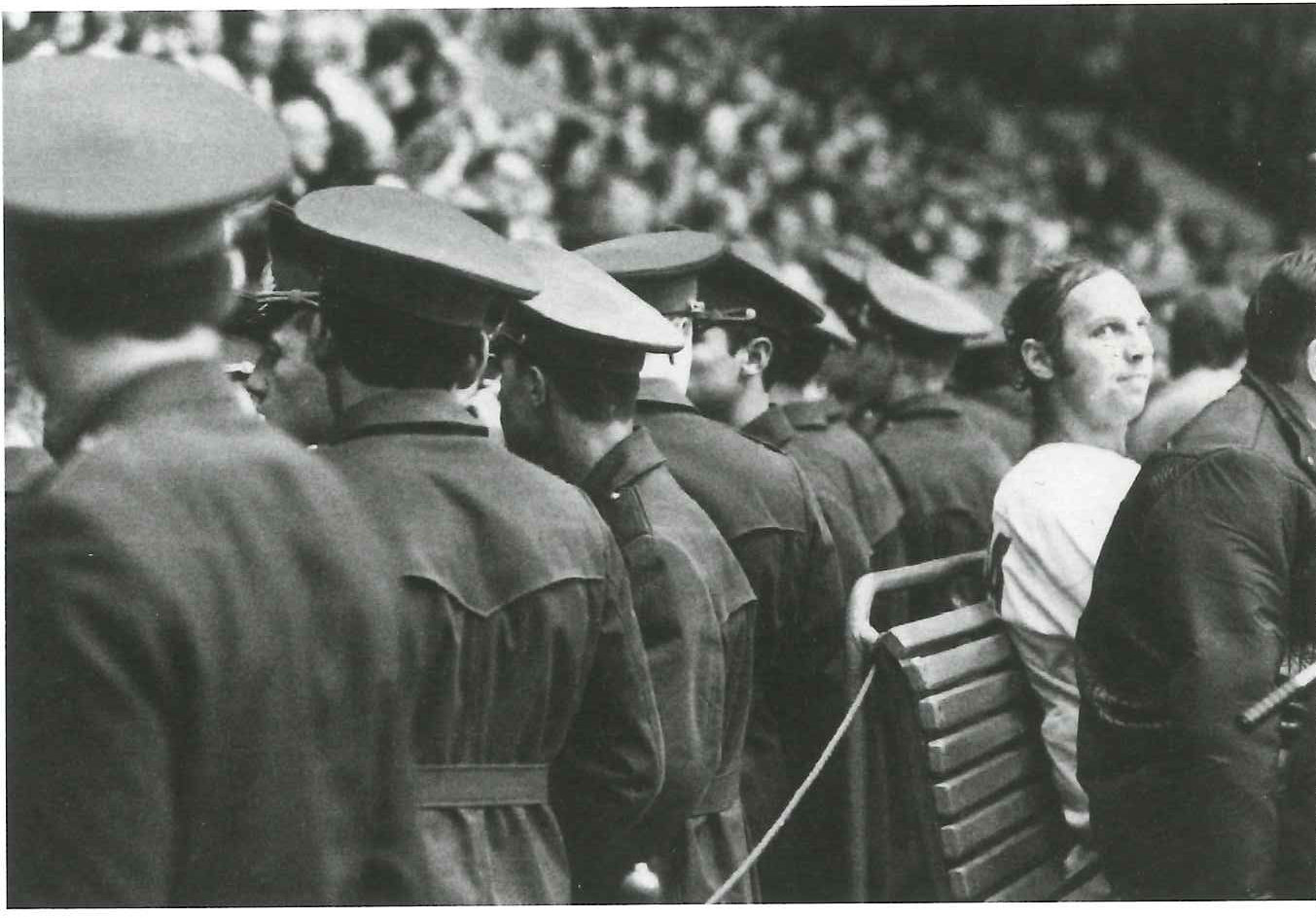
Sinden however had gone far beyond just yelling and shouting at the referees from behind the boards. He and Ferguson threw towels and a fold-up chair onto the ice in an effort to create a scene for the crowd and television audience and draw attention to their disdain for the officiating. They hoped the Germans would be shamed into altering their behaviour. Ferguson was given a bench penalty for his actions. At the end of the second period, as had happened in Stockholm, Sinden, at close quarters, chased the two referees up a common corridor while screaming at them. He was accompanied by Bobby Orr, who was in the vicinity and in street clothes, still recovering from off-season knee surgery that had prevented him from playing. This time it was Soviet officials and the Soviet police who intervened. By the time the game came to an end, the militia were lined up shoulder to shoulder in the runway to the dressing rooms.
The pressure continued to build.
Originally published in bout de papier, Vol. 32, No. 2 (2022), pp. 8–11. Read the rest of this issue →


