
bout de papier, Vol. 11, No. 1 (1994) — Spring 1994 // Printemps 1994, pp. 35–37
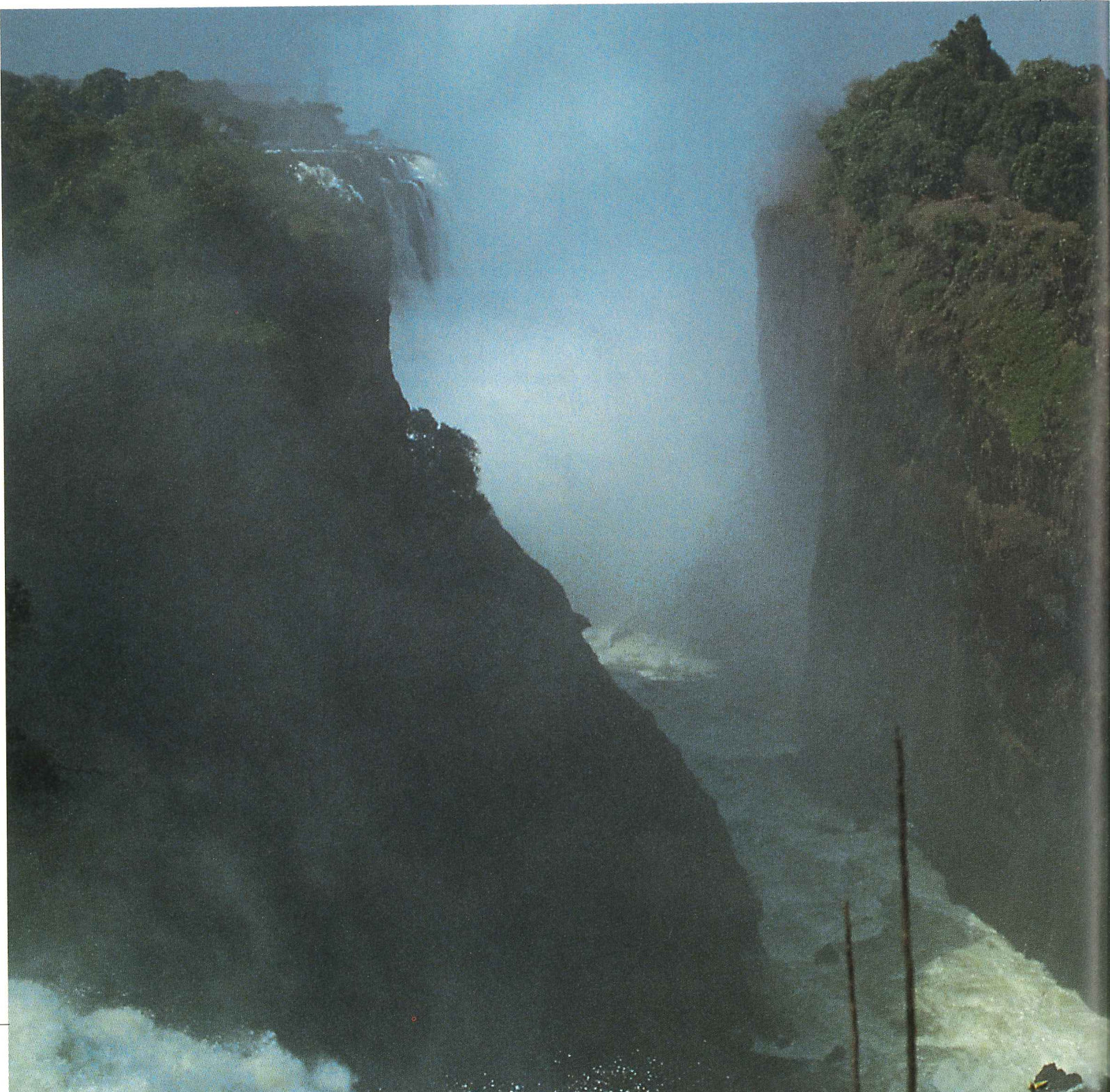
A deep and malevolent rumbling, heard long before the source is seen, accompanied the earth’s steady trembling. Several columns of vapour, occasionally rising 500 metres into the air, hovered over the area and were visible from a distance of many kilometres. Approaching by air, one saw only a long, low-hanging cloud obscuring much of the promethean view which was visible from the ground.
The ancient inhabitants of the area had called it Chongwe, the Place of the Rainbow. The Makololo, who came later, used the name, Mosi oa Tunya, the Smoke that Thunders. To honour a foreign queen, it was renamed Victoria Falls in 1855 by Dr. David Livingstone, the first white man to reach this point on the Zambezi River, some 1200 kilometres from its source. Livingstone’s statue stands today by the edge of the Zambezi near the cataracts just above the falls. Magnificent by any name, Victoria Falls is one of nature’s matchless marvels.
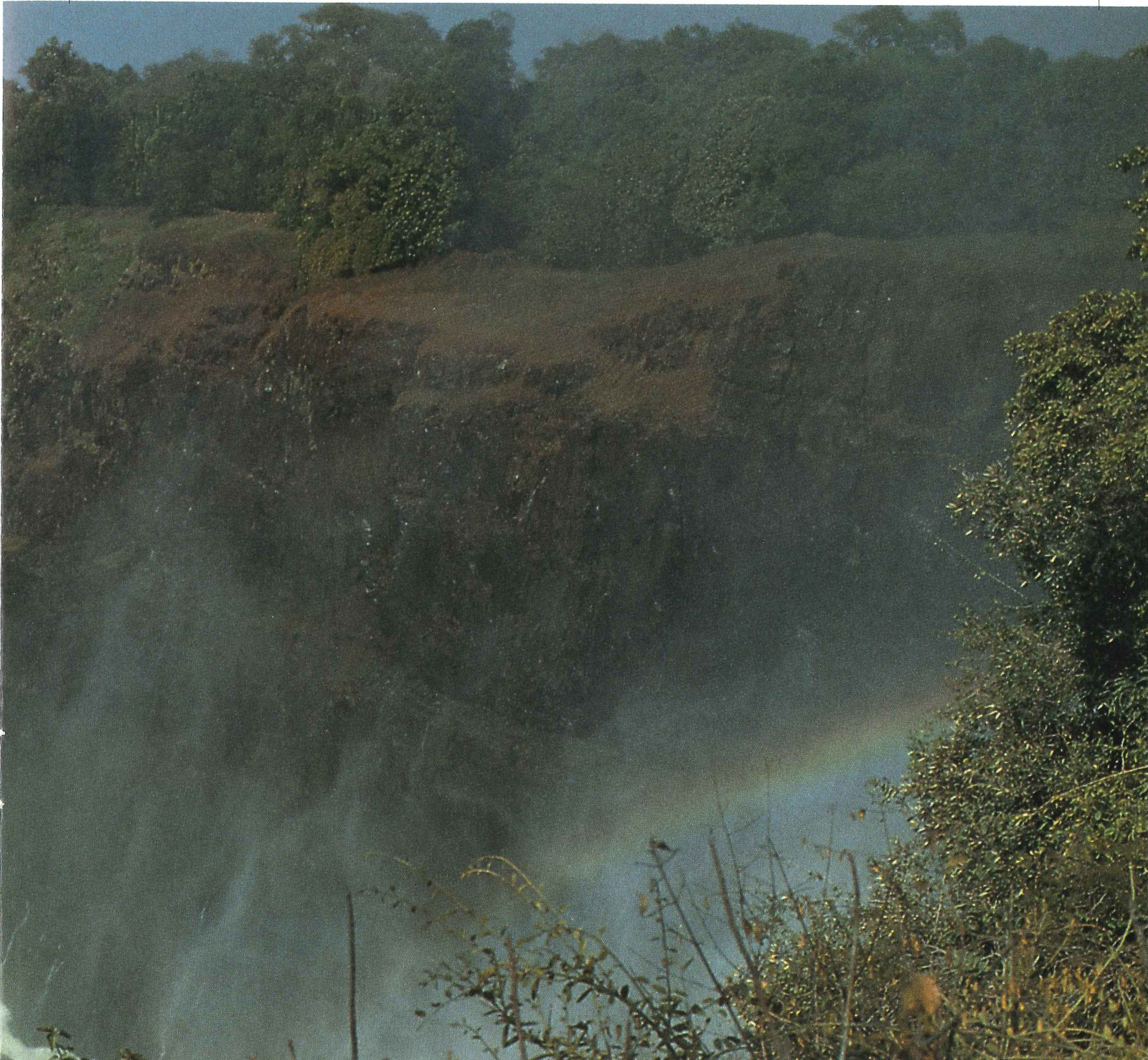
The Zambezi River straddles the frontier between Zambia and Zimbabwe as it thunders towards Victoria Falls. The river drops as much as ninety meters in places, spilling up to 545 million litres of water per minute at the height of the flood season. Shifting winds deposit mist from the Falls to keep the lush tropical foliage perpetually green. Approaching the falls, one enters a magical place unrivaled elsewhere on earth. Double rainbows, created by billowing vapour thrown up by the thundering water, competes with the sheer grandeur of the five separate falls which make up the 1700 metre-wide chasm. Twice as high as Niagara and nearly double the width, Victoria Falls tumbles over the lip of a natural fault which has retreated in a zig-zag fashion through geologic time. Above the gorge, the Zambezi races through turbulent cataracts before tumbling over the long fissure in the earth to begin winding circuitously along a path carved by the Falls millions of years before. Up close, the noise is deafening. The basalt rock beneath my feet trembled from the sheer power of the falls.
Coming from the Victoria Falls Hotel, very close to where the Zambezi tumbles over the abyss, I had approached the Falls overland on the Zimbabwean side. The more direct bush route had been recommended over an easier stroll along a tarmacked road running through the small town of Victoria Falls so that I could avoid two lions which had taken up residence for the past week a short distance from town in the tall, burnt yellow grass along the verges of the well-travelled highway.
Well-maintained paths around Victoria Falls provide several excellent viewing points. But the best sights are reserved for more intrepid visitors. Leaving the path, I crossed the slippery wet grass towards the gorge. As I approached the fissure, the fine mist from the Falls became constant and the wet grassy knoll on which I stood began to slope downward. I had wanted to take a photograph of the Falls through the spectacular multiple rainbows. Having been well briefed by a guest at my hotel, I knew what to expect. Shortly before being engulfed by the mist and with camera in hand, I had pulled a large plastic laundry bag over my head, pushed the camera lens through a small pre-cut opening which I had prepared, and began to photograph the Falls. One wonders which was the more amazing sight that day: the magnificent Falls or the absurd tourist, plastic bag covering the upper part of his body and seemingly on the verge of toppling over the rim of the cliff.
Water-logged, but with camera equipment dry and safe – and with the photographs I had wanted – I sopped back to the Victoria Falls Hotel. The hotel, splendid and majestic, conveyed the gracious elegance of another age. Built in 1915 to replace an earlier and simpler structure, the refined white tropical building had been developed to service excursion trains from Cape Province in South Africa. The rail line, with a bridge of engineering accomplishment spanning the Victoria Falls gorge, was part of an ambitious Cape-to-Cairo railway begun at the close of the imperial era but never completed.
The grounds of the hotel abound with beautiful jacaranda trees and flowering bushes, and bore witness to a daily stream of wildlife including colourful birds, mongoose and ever-present guenons monkeys. Great tree climbers, these are Africa’s most common monkey family. They weigh about five kilograms each and are distinguished by the way they walk with their tails held out behind them – often with a youngster clinging on. The noisy and rambunctious monkeys were a delight until suppertime when they viewed the feast laid out for guests in the open-air dining area as an opportunity for sampling the fare. Darting between the tables, the monkeys would snatch items in passing. An attempt at decorum was maintained by a waiter patrolling the dining area with a slingshot firing beans at the uninvited guests. His aim was sure and worthy of Olympian recognition. His skill was acknowledged by the monkeys which moved in a noisy wave before him — while diners ducked, hands clutching their heads in protection against ricocheting beans.
The hotel lies a short distance from the town of Victoria Falls and only minutes from the border with Zambia. Flying to Livingstone on the Zambian side of the Falls, I had taken a taxi to the border. With luggage in tow, I had marched up to the customs office where a queuing mass of local people, waiting to cross the frontier, had parted before me — perhaps in surprise at seeing a European crossing the border on foot. The cheerful crowd, patting my back and laughing, had passed me to the front of the line where passport formalities had been completed. One border guard had agreeably set off on his bike to find a taxi on the Zimbabwean side to carry me the short distance to the hotel from the frontier.
The small town of Victoria Falls is a short distance from the Zambezi River. Although possessed of all modern conveniences, it retains a small-town frontier feeling. A few minutes walk from the town centre is Falls Craft Village, an open-air museum introducing the visitor to the way of life of the indigenous groups which have inhabited the region. The collection runs from the simple stick and grass huts of the Bushman to the elaborately decorated huts of the Venda and Ndebele people. Shops close to the village display beautiful (and inexpensive) locally-made carvings in stone, as well as more mundane tourist fare.
Not far from Victoria Falls is Hwange National Park, one of Zimbabwe’s best locations for watching lions and elephants in their natural element. Closer to the town are other lowveld areas for the day-tripper wanting to sample Zimbabwean wildlife.
A half-dozen of us went by truck to one nearby area shortly after daybreak in search of game in the upriver Zambezi bushland towards the Caprivi Strip in Namibia.
Although the sun shone golden orange on the horizon, the air was colder than any of us had expected and we huddled low against the cab of the truck. Only several hours later did the sun warm the air to the point where we were comfortable in our shorts and light shirts.
The passing landscape changed constantly. Our truck rushed by lush green shrubs and bush along the Zambezi before we reached the tall grasses of the savannas. Driving the high-axeled truck through the metre-high grass was not so much difficult as clumsy. Progress was slow. After moving through grasslands for only a short time, we catch a movement in the grass twenty metres in front of us. Quickly halting, we glimpsed a pride of lions perfectly camouflaged in the burnt yellow grass except for several pointed dark ears raised in caution above the thick undergrowth. In an instant they bolted, their passage identified by a wave moving through the grass and the occasional flash of a black-tipped tail.
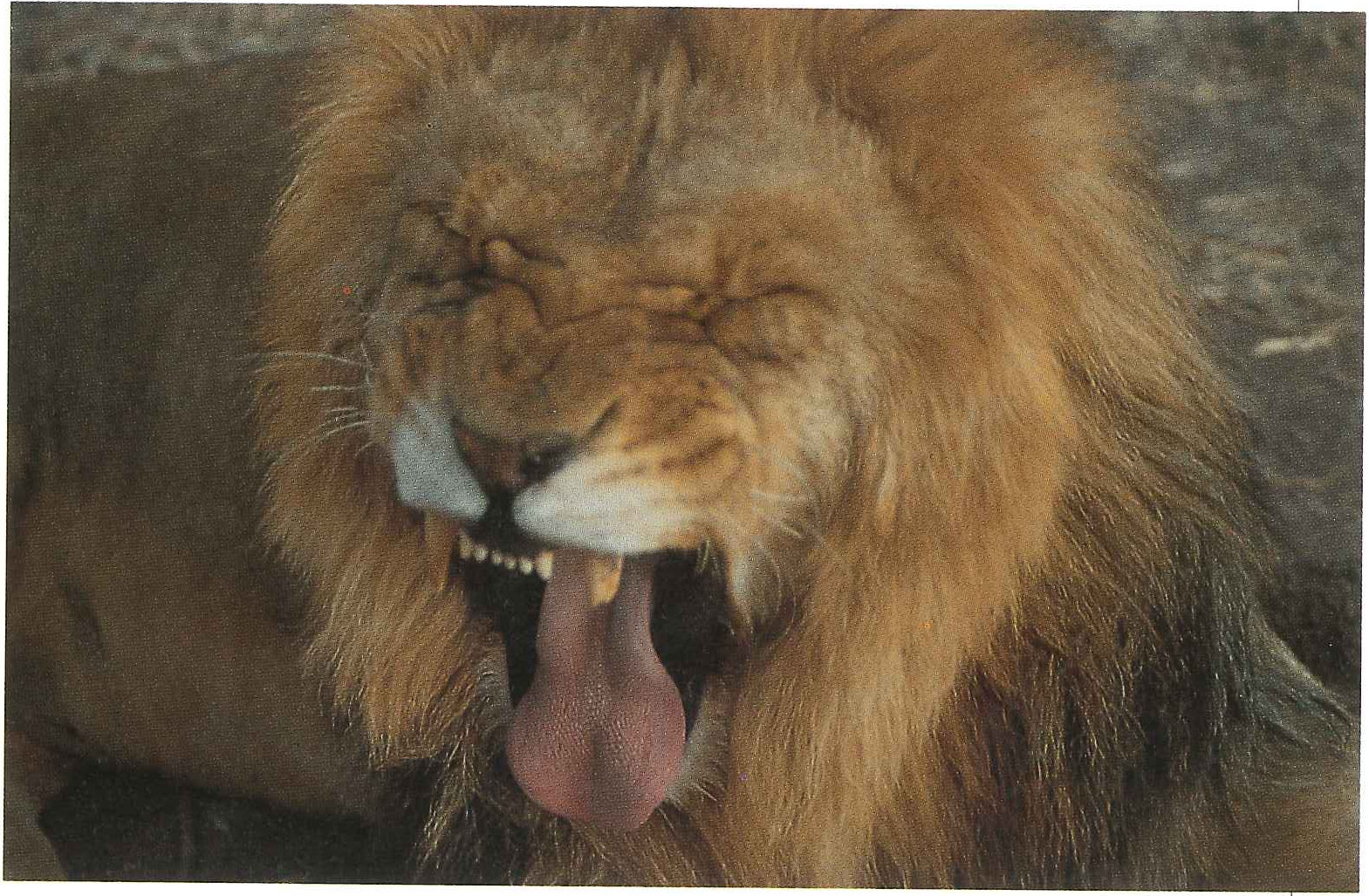
Our luck was better later in the day when we came across several lions resting in the afternoon sun. Bored and impervious to our presence, the lions allowed us to maneuver the truck very close, yawning at times to show their disdain for less exalted creatures.
Game was abundant everywhere. Moving through the bushland or the tall grasses, a moment rarely passed without sightings of zebra, gnus, gazelles, elands, ostrich or large kudus. Buffaloes, closer to the wetlands, were plentiful. One herd raced before us along a rough track for a while before bearing off to the left and turning into a defensive circle with the calves in the center. Although harmless-looking, and with the seeming docility of dairy cows, buffaloes are ferocious and unpredictable. We paused to photograph the buffaloes even though their lowering horns told us our presence was not wanted, but as they started menacingly towards us, pride fell before valour and our clumsy truck beat a retreat.
Huge baobab trees filled the horizon on our return to the hotel. Silhouetted against a bright blue sky, the stocky-trunked baobabs looked like uprooted trees replanted with their spreading roots reaching skyward. With every kilometre closer to the hotel, the landscape changed from dry burnt-yellow grasses and dusty-looking trees and bushes to the dark and rich greens credited to the mist thrown up by Victoria Falls. And with our return to the hotel came the low thunderous roar of the Falls attesting to the power and ferocity of one of nature’s unique sights.
View the original scanned pages →
Originally published in bout de papier, Vol. 11, No. 1 (1994) — Spring 1994 // Printemps 1994, pp. 35–37. Read the rest of this issue →



