
bout de papier, Vol. 11, No. 1 (1994) — Spring 1994 // Printemps 1994, pp. 11–13
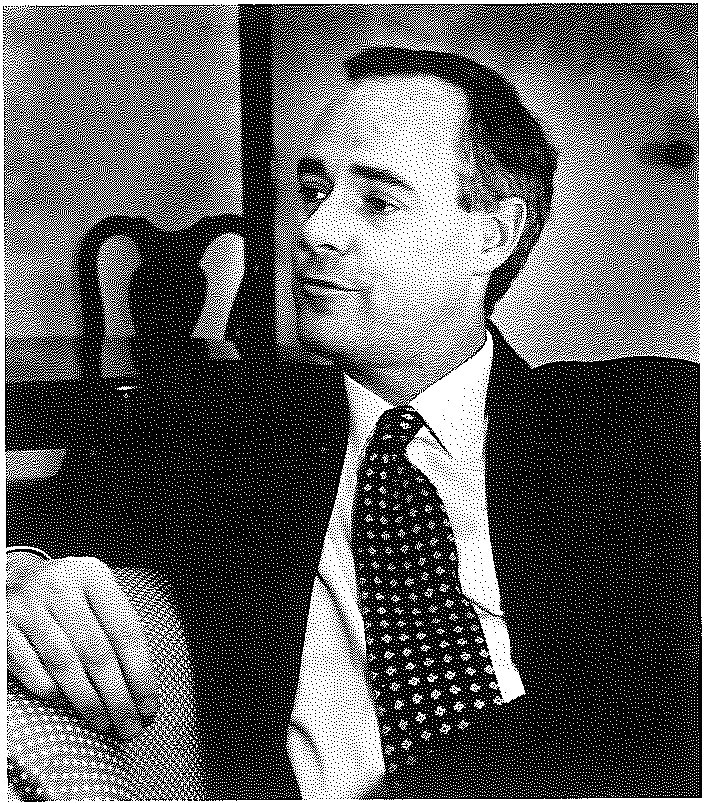
On his last day as Secretary of State for External Affairs, Perrin Beatty discussed with the editor of bout de papier his impressions, memories and experiences of his stay in the Pearson Building
bout: What was your most memorable event during your time as Foreign Minister?
Beatty: I think it would have to be the signing of the agreement of peace between Israel and the PLO. It was a tremendous privilege to be there, representing Canada as one of just a handful of Foreign Ministers from around the world, watching the course of world history change.
It was, in and of itself, a tremendous historical event, but secondly it was a recognition for Canada.
It’s something I’ll never forget, no matter how long I live.
bout: As a Foreign Minister, you meet many people. Are there any persons who stand out, either in your foreign meetings or on the domestic side?
Beatty: Four stand out for very different reasons.
Warren Christopher of course because he represents the most powerful country in the world and he is a thoughtful person. He’s very respectful of the views of others.
Douglas Hurd, because he is enormously insightful. You find that any time he speaks he’s just able to capture the essence of an issue and describe it exceptionally well. Listening to him, for example, describe his views on what went wrong in Bosnia and what the challenges were ahead for us was a privilege to be there.
Foreign Minister Kozyrev from Russia. It was fascinating for me to have that insight into an area which has long fascinated me and which is going through a very difficult transition. They (the Russians) have a very capable Foreign Minister, whose instincts are basically very democratic and very pro-western.
And then there is Don MacKinnon from New Zealand who, after Monday night (October 25), took time off from the middle of his election campaign to pick up the phone and call me from New Zealand just to offer good wishes for the future. That was a personal act of generosity on his part.
bout: I guess the personal relations between leaders is one thing people probably underestimate.
Beatty: Absolutely. I know the question that you mean to ask me next so I’ll answer it now. What was the most surprising thing for you (as Foreign Minister)?
Well, it was the element to which foreign policy, which diplomacy, is done personally — the amount of business that gets done on the telephone, the amount of business that gets transacted at a meeting such as the ASEAN Foreign Ministers meeting, or at a meeting of Foreign Ministers of the G-7. The personal relationships are exceptionally important for resolving issues. They are important in enabling the Western world to move by consensus. In terms of the resolution of issues, they’re important because the relationship of trust and confidence you build with your counterparts enables you to pick up the telephone and resolve issues on a one-to-one basis.
I wasn’t aware of the extent to which personal diplomacy was important before coming here. In every other portfolio that I had, you had a relationship with your international counterparts. But it was not on a continuing, personal basis.
bout: That’s interesting. I wasn’t going to ask you that question, but I’m glad you answered it.
Beatty: That’s why I volunteered it.
bout: But the question I was going to ask is “you’ve had a very distinguished political career; you’ve been a Minister of a number of portfolios including Communications, Health and Welfare, Defence. So how does External Affairs compare as a portfolio, in terms of the complexity of the issues, the time pressures, even the responsiveness of the bureaucracy? Any comments?
Beatty: It’s unique within government. It is, in my opinion, one of the most fascinating portfolios in terms of the challenges we face, the issues we deal with. The quality of people who are serving is exceptionally high. There was an intense sense of pride in their work and they were exceptionally knowledgeable and driven to serve the country.
I was struck very early about the pace of events. The day after the swearing-in, I was at my mother-in-law’s for a party that she was holding. It was just a party she holds every summer. The telephone rang and it was my chief of staff calling to say that the Americans had bombed the Iraqi intelligence headquarters in Baghdad. It happened very quickly, before I had even gone through the briefing books. The world doesn’t stop to let you catch up, nor does it stop during an election campaign.
During the election campaign, I was in Washington for the signing of the Israeli- PLO peace agreement; I was in New York for the UN General Assembly; we had to deal with issues related to the insurrection in Russia, the lifting of sanctions in South Africa and Haiti as well as the ongoing problems in the former Yugoslavia.
The pace of events is exceptionally rapid. The nature of the job doesn’t allow a great deal of time for reflection. It means then that you really need to have exceptional people in the foreign service to back you up.
Another element that’s evident is that there’s a culture within the foreign service (and within External Affairs more broadly) that’s different from any other department. I haven’t had a chance to fully get a handle on this yet because it’s been such a short time that I’ve spent here. When I went into Defence, there was a military culture which was different from civilian culture, and it’s evident to everyone because the people are wearing uniforms. It’s apparent as you go into the place that you’re dealing with an institution that’s different, and that there’s a very extensive protocol that’s followed within the military.
Within External Affairs, the people working there dress the same way people do in other departments, but there’s an ethic and an esprit de corps and a feeling of belonging to an institution that makes External unique.
bout: What was the perception in other departments of External Affairs?
Beatty: I guess there’s always a competitiveness between other line departments and External Affairs. External has the umbrella responsibility for our relations with other countries, while individual departments feel that they have the expertise on a particular issue. One of the first issues I was dealing with here was related to what I was doing previously in Communications — the question of protecting Canadian magazines. I came at it from the perspective of the Department of Communications — the importance of our acting to protect our industry and stop it from being swamped.
The perspective of External is much broader than that and you look at the broader question of our relationship with the United States. The approach taken by the government was, I think, the right one. But it was very useful for me at a very early stage to see one issue from two perspectives.
bout: Do you have the feeling that other departments think that sometimes we at External are dilettantes on some issues?
Beatty: Certainly, you hear that criticism, you’ve seen it in print from time to time, and I’m sure you hear it when you’re bumping into people socially and professionally, as well.
I don’t know whether its dilettantism or a sense of elitism that people might feel exists here, a feeling that this is a department unlike any other. Well, this is a department unlike any other — its responsibilities are different and the nature of career development of foreign service officers is very different from that of people in any other department of government.
And it’s not surprising that perspectives would be different as well. I’m very proud of the foreign service. I was very proud of them before I came into the department, because I had a chance to deal with Canadian Embassies abroad in my other capacities and was really struck by how professional the people serving Canada abroad were. That was only confirmed during the time that I spent here. It is professional and The Hon. Perrin Beatty there’s a great pride that people have in their professionalism, and I think that Canadians are better served by the Foreign Service than they may realize.
bout: What did you least like about being Foreign Minister?
Beatty: It certainly makes demands on your family life. I have a wife and two small children, and for me the most important thing in my life is my family. To do the job properly, you have to be constantly in motion, and constantly travelling, and I didn’t do a great deal of travel compared to my predecessors for example, in large part because I knew we were coming into an election and my focus had to be domestic to an extent.
But I always used to marvel at how Barbara McDougall was able to get off the plane and then had to get her suitcase, reload, and get back on another plane. There’s no doubt it takes a toll on your physical well-being and on your capacity to maintain family and other relationships.
bout: Do you think that Canadian foreign policy tries to do too much? Should we try to focus a bit more? Are we all over the map?
Beatty: I think it’s certainly time for a foreign policy review, and by foreign policy – I define it very broadly, to include foreign policy itself, aid, and defence. It’s not because I believe it’s fundamentally flawed I believe the policy we’ve followed since World War Two, the broad lines of it, are very sensible. The fact is the world has changed. The Berlin Wall no longer exists; the Soviet Union no longer exists; but also the constraints on Canada have changed — the financial constraints on us have changed dramatically.
So I think we have to ask ourselves, “How do we focus to have the maximum impact in those areas where there’s an identifiable Canadian interest?” And by that I don’t mean simply how do we promote trade. If there’s an interest in human rights, how do we maximize the impact we have? If we want to be a player within our hemisphere, how do we do that? If we want to stress the fact that we’re a Pacific nation, how do we give a greater emphasis to our role in the Asia Pacific?
I think what we need is a very open and broad foreign policy review which invites Canadians to be part of the process. And, at the end of the day, that we begin to say, “Okay, how have the global realities changed, and what should our priorities be? How do we focus on those areas where we can have the greatest impact, and where are Canada’s interests most at stake?”
bout: If you were Minister for the next four years, or advising your successor, what issues now, without having gone through this foreign policy review, would you instinctively put your time on in the next four years, or recommend to your successor?
Beatty: I think there are a number that stand out. I’d like to see us put a greater emphasis on Asia and the Pacific. We are a Pacific country, and yet our mind-set in Canada is still very much focused on the Atlantic. For ten years we’ve done more trade in the Pacific than we have across the Atlantic. There are tremendous opportunities there for us. I was struck by the fact, when I attended the ASEAN Foreign Ministers meeting, that we were legitimately there as a Pacific country. Our colleagues from Europe were there, but they are not a Pacific country. We have a special tie with the Pacific and a special relationship that I think we can emphasize more than we have in the past.
It also helps to counterbalance the ties that we have with the United States. There are important economic, cultural, political ties that we have with our closest neighbour. It’s the most powerful country in the world.
But, as somebody who has studied history in school, I’m very much aware that one of the key issues in Canadian history has always been the maintenance of a distinct
Canadian nation on the upper half of the North American continent.
One of the ways which we can achieve a distinct Canadian identity is to encourage ties that prevent us from having a strictly uni-dimensional relationship with the United States. It also prevents us from something that we’ve tended to fall into in the past, and that’s defining ourselves in terms of who we weren’t, defining ourselves in terms of not being American. We have a broader role to play, and we should define ourselves vis-à-vis the whole of the world.
I think we have a vital role to play in issues related to nuclear non-proliferation. We are a country that’s had a history with the civil use of nuclear technology. We once had a military role with nuclear technology which we’ve renounced. We go into discussions with other countries with clean hands. There’s a role that we can play in encouraging non-proliferation. When I look at the big differences between the time when we wrote the White Paper on National Defence in 1987 and now, the world is much safer when it comes to the prospect of a global nuclear conflagration.
But the threshold for the use of nuclear weapons has been lowered. The possibility of them being used in regional conflicts has increased dramatically. We have to find some way of getting the genie back into the bottle. That should be a priority for Canada.
One which Prime Minister Campbell stressed here and at the UN General Assembly is the need for multilateralism. The world has finally come to the point where what Canada has been saying all these years can come true. We can look to international fora to solve problems, instead of solving them bilaterally. And we shouldn’t allow that moment to slip away from us.
bout: The role of government is generally questioned all across the board. If you were an independent consultant, what advice would you give External Affairs in terms of adapting to the reality of government in the future, one which we all know will be one of downsizing and budgetary restraint if External is to maintain its traditional functions, or even fundamentally change its role?
Beatty: I think one of the things that External has to do is to demonstrate its relevance domestically. It has to demonstrate, for example, that this is an economic portfolio as well as one which deals with philosophical issues. The emphasis on using our posts abroad to promote trade has to be stressed. We have enormously professional people around the world in strategic places and their work results in jobs for Canadians. Particularly at a time when there are enormous constraints on all areas of government activity and government spending, it’s important to demonstrate that External benefits Canadians domestically.
I believe in the importance of External for the intrinsic merit of managing our relations with other countries, but I think it’s important to demonstrate in a more tangible way that there is a direct return to taxpayers. We should quantify it in terms of jobs for Canadians and prosperity for Canadians. There is much more that we could be doing to manage that.
bout: Do you think Canadians care about foreign policy?
Beatty: I think they do care, but right now their primary concern is how to keep a roof over their heads and how to keep food in their kids’ mouths.
But I well remember the reaction of Canadians when they saw innocent children in Bosnia who were suffering in hospital. You know, we are a generous people; we’re proud of our history in international affairs; we’re proud that we are seen as a country that comes to the table with clean hands — we have no colonialist history; we’re a country which has never used our armed forces to try to take one square centimetre of someone else’s soil; and we’ve always behaved in international affairs with integrity and with generosity.
And I think that’s a source of pride to Canadians. At a time when economic pressures are so acute on Canadian families, their attention, naturally, first turns inward But I do not believe that they would like to see us abandon an internationalist role for Canada.
bout: Minister, one last question, a personal question. We all know you served admirably for twenty years as an MP for your riding. How did you personally feel on the night of the election?
Beatty: I can honestly say that my first feeling was one of gratitude for 21 years. I’m 43, my father died when he was 44, and I look at the life-time of any politician. I’ve stretched my life experience. If I look at what I’ve been able to experience during that time, the privilege of being able to serve both my own constituents and to serve Canada, I’m the luckiest person I know!
And I have nothing but gratitude for it and a tremendous sense of privilege. I certainly would have liked to have been able to continue to do the work. Of all the portfolios that I’ve held, the most interesting and challenging is the one that I currently have. I would have liked to have at least been able to spend a few years here and to become involved with the issues and to leave more of a personal stamp on our relationship with the rest of the world.
But nonetheless, I feel very grateful for having been here even for the very short time, and I feel that to have had the privilege to serve as a Member of Parliament and a Member of Cabinet in seven different departments is a tremendous honour that I will never forget.
The initial thrill I had, in being elected back in 1972 — it’s never worn off. When I go home at night and look back over my shoulder at the Parliament Buildings I still feel a shiver running down my spine about how, what an unbelievable privilege it is to be here.
But it also reminds me, as I look at the age of the buildings, that people much more famous than I have come and gone and the buildings are still there. What we hold is a lease on the office; we don’t hold title to it.
bout: Given what you’re just saying, which is very idealistic, what is your reaction to public cynicism about politicians?
Beatty: Much of the sense is warranted — when people turn on the television and watch the behaviour in the House of Commons, I can’t think of any other group of professional men and women who go to such pains to alienate their clientele. If we want greater respect from people, we have to earn it. It doesn’t come as a matter of right, it’s something which has to be earned.
Having said that, my experience with Members of Parliament from all Parties, over 21 years, is that they are genuinely motivated by a sense of public service. They enjoy thoroughly what they’re doing, they want more than anything else to feel as if they’ve made a contribution to their country, and that is the motivation. In my view, that’s the right motivation for somebody going into public life.
bout: Any future plans at the moment?
Beatty: Not at this point. I hope to take a breather and to spend some time with the family; I’m taking the kids out for Halloween, it’s the one plan that I’ve got, then hopefully we’ll go from there!
View the original scanned pages →
Originally published in bout de papier, Vol. 11, No. 1 (1994) — Spring 1994 // Printemps 1994, pp. 11–13. Read the rest of this issue →



