
bout de papier, Vol. 18, No. 3 (2001) — Fall 2001 // Automne 2001, pp. 33–35
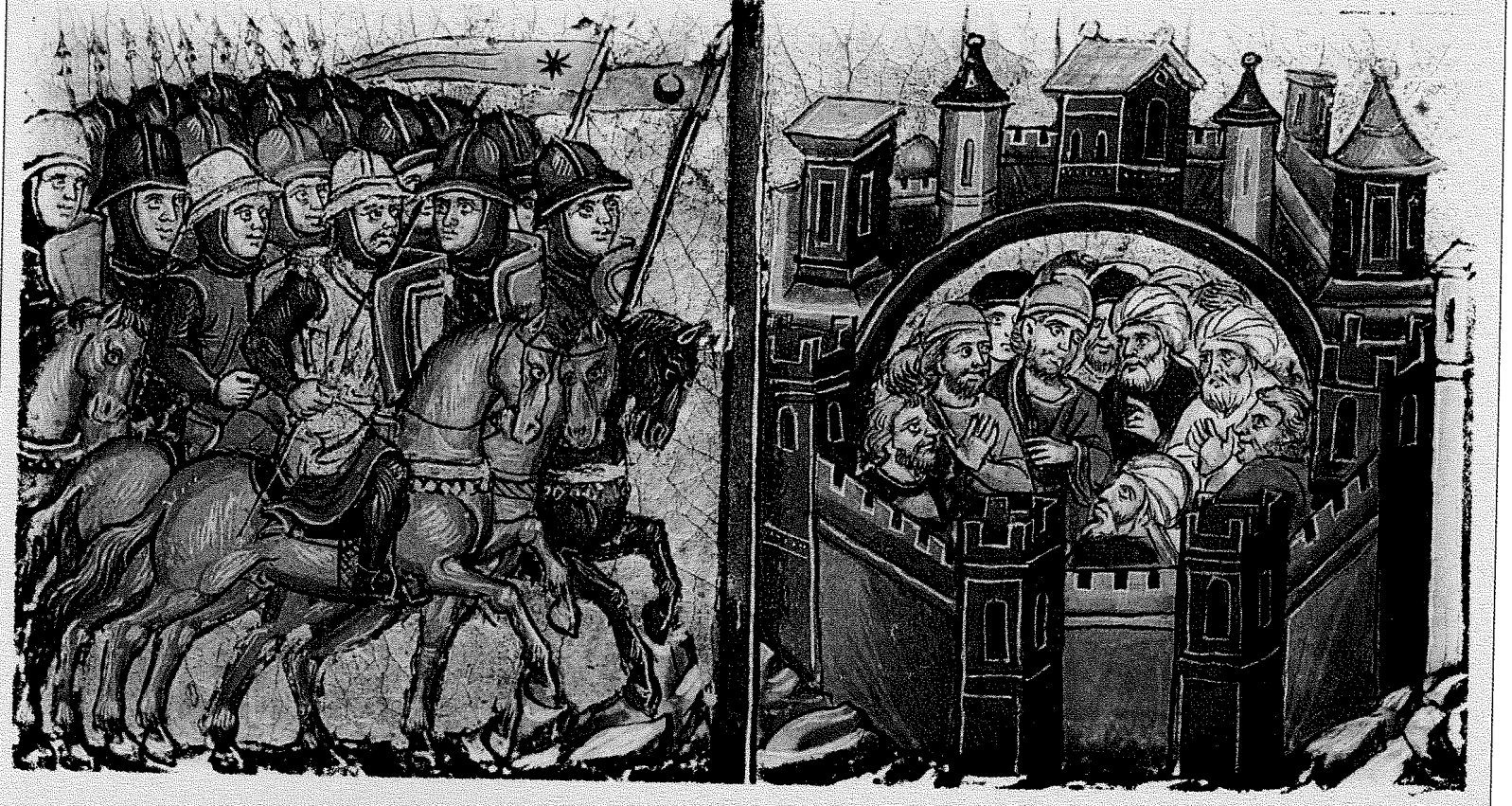
As recent events have shown, one of the most intractable obstacles to any lasting peace in the Middle East is the question of Jerusalem. For the past three thousand years this city, holy to three faiths, has changed hands many times, often very violently. The Roman siege of 71 AD, the Persian conquest in 614 AD, and the First Crusade in 1099 all ended in scenes of massacre and destruction on a scale hardly conceivable in a pre-industrial age. While other changes of sovereignty have been less bloody, they have almost invariably been won at the point of the sword, or spear, or tank. To achieve the transfer of Jerusalem by negotiation, and not by force, is surely the ultimate diplomatic triumph. It was achieved once, in February 1229, by Frederick Il von Hohenstaufen, Holy Roman Emperor, and King of the Two Sicilies. He got little thanks for it.
Frederick II, known as stupor mundi, the Wonder of the World, was a renaissance monarch two centuries before the Renaissance. He was a scholar, interested in science and philosophy, a sportsman (he wrote a zoological treatise on falcons), a linguist (he spoke, in addition to his native German and Italian, Latin, Greek and Arabic), and above all he was a very unconventional Christian monarch, who kept a harem and a Saracen bodyguard and was more often excommunicate than not. From his mother, Constance, Frederick had inherited the “Two Sicilies” (Sicily proper and all of southern Italy). Through his father Heinrich von Hohenstaufen, Frederick claimed, and was eventually elected to rule, the Holy Roman Empire, embracing modern Austria, the Benelux, Bohemia, Germany, Switzerland and Northern Italy. Finally, by marriage to the heiress Yolanda of Brienne, he could style himself king of Jerusalem, a title he hoped to make reality, by restoring the holy city to the toehold the crusaders still held in “Outremer” (outre mer, i.e., the Middle East).
Between the two main halves of his European realm lay the Papal States. While earlier popes had helped establish Frederick in both Sicily and the German Empire, the most recent incumbent, Gregory IX, found Frederick a little too close for comfort. Moreover, Gregory was keen to assert Papal claims to the primacy over the Empire. Frederick had vowed to go on a Crusade in return for papal support for his election as emperor. Fulfilling this vow was easier said than done, as Frederick had more than his share of fractious vassals. While the date for his departure was constantly postponed, the Fifth Crusade languished and died in the marshes of the Nile delta, awaiting his arrival. Pope Gregory’s patience ran out and Frederick was ordered to depart tout suite, or else. Frederick finally set sail in 1227, but his expedition was ravaged by an epidemic, and turned back. Frederick was among the stricken and repaired to a spa to recover. To Gregory this was the last straw:
Frederick was excommunicated, and when, early in 1228, he finally left for the Outremer without having sought Papal forgiveness, Gregory excommunicated him again. Never before had a leader of a crusade set forth singly, let alone doubly, excommunicate.
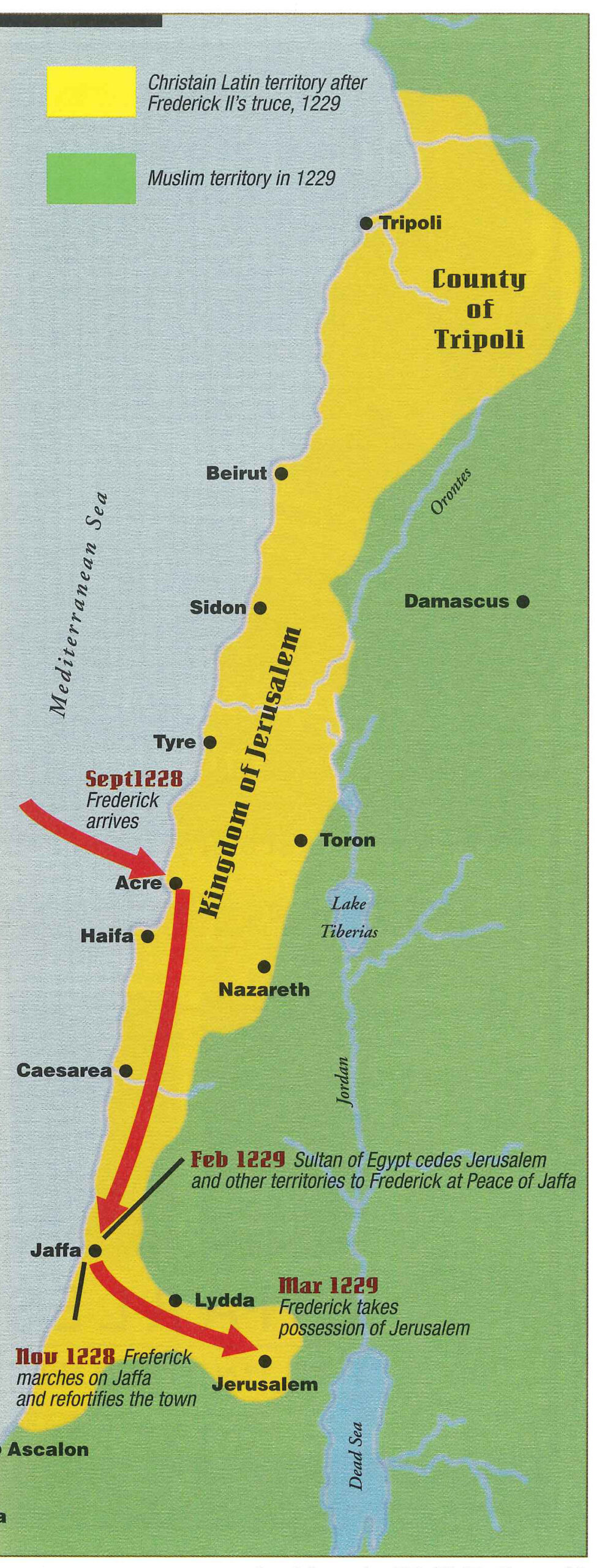
Even for Frederick, whose religious conviction were, at best, questionable, excommunication had its down side. It released his vassals from their allegiance, something many were eager to take advantage of. Worse still (although many were scandalized by the act) Gregory sent his own armies into the Kingdom of Sicily to support the rebels. To defend his kingdom, Frederick had to leave the bulk of his troops at home. He arrived in Outremer (having spent time in Cyprus trying to order that island’s affairs — plus ça change in the fall of 1228, with very limited resources. If anything was to be achieved, it would have to be by negotiation, not brute force, and it would have to be achieved quickly.
Frederick had already been in correspondence with the Sultan of Egypt, al-Kemal Kemal and his brothers (al-Mu’ azzam in Damascus and Ashraf in northern Iraq) were heirs to their uncle, the great Saladin, who had taken Jerusalem from the crusaders in 1187. Kemal and his brothers were also bitter rivals and each sought the aid of outside powers in his efforts to relieve the others of their holdings. Mu’azzam enlisted the support of the Khwarismian Turks who ruled what is now Iran and the adjoining “Stans”. Kemal turned to Frederick, sending his envoy Fakhr-ed-din to Palermo in 1226 to open negotiations. Kemal knew of Frederick’s planned crusade and was willing to offer the return of Jerusalem and other cities holy to the Christians (at the time under Mu’azzam’s and not Kemal’s control) in exchange for his aid. By the time Frederick arrived, however, the situation had changed; Mu’azzam was dead and Kemal had succeeded in gaining Jerusalem and was now busily engaged trying to oust Mu’azzam’s son, an-Nasir, from Damascus. Nasir’s position was weak, as his Khwarismian allies were increasingly pre-occupied by the threat posed by Genghis Khan.
Nevertheless, Frederick persisted. His opening demand was for the return of all territory west of the Jordan held by the crusaders before 1187. This was a non-starter. Frederick’s bargaining position was further compromised by the obvious restiveness of the local cru- SELL 1 139512 died in child-birth and by right the legitimate heir was their son Conrad. The local nobility had no desire to see the loosely ordered arrangements of the Kingdom of Jerusalem subjected to the degree of centralized control that Frederick was accustomed to exercising over Sicily. Moreover, the warrior monks of the Knights Templar and the Knights of St. John, the shock troops of any crusade, preferred to distance themselves from an excommunicate. Only the Teutonic Knights, whose Grand Master, Hermann von Salza, was appointed by Frederick, were willing to obey him.
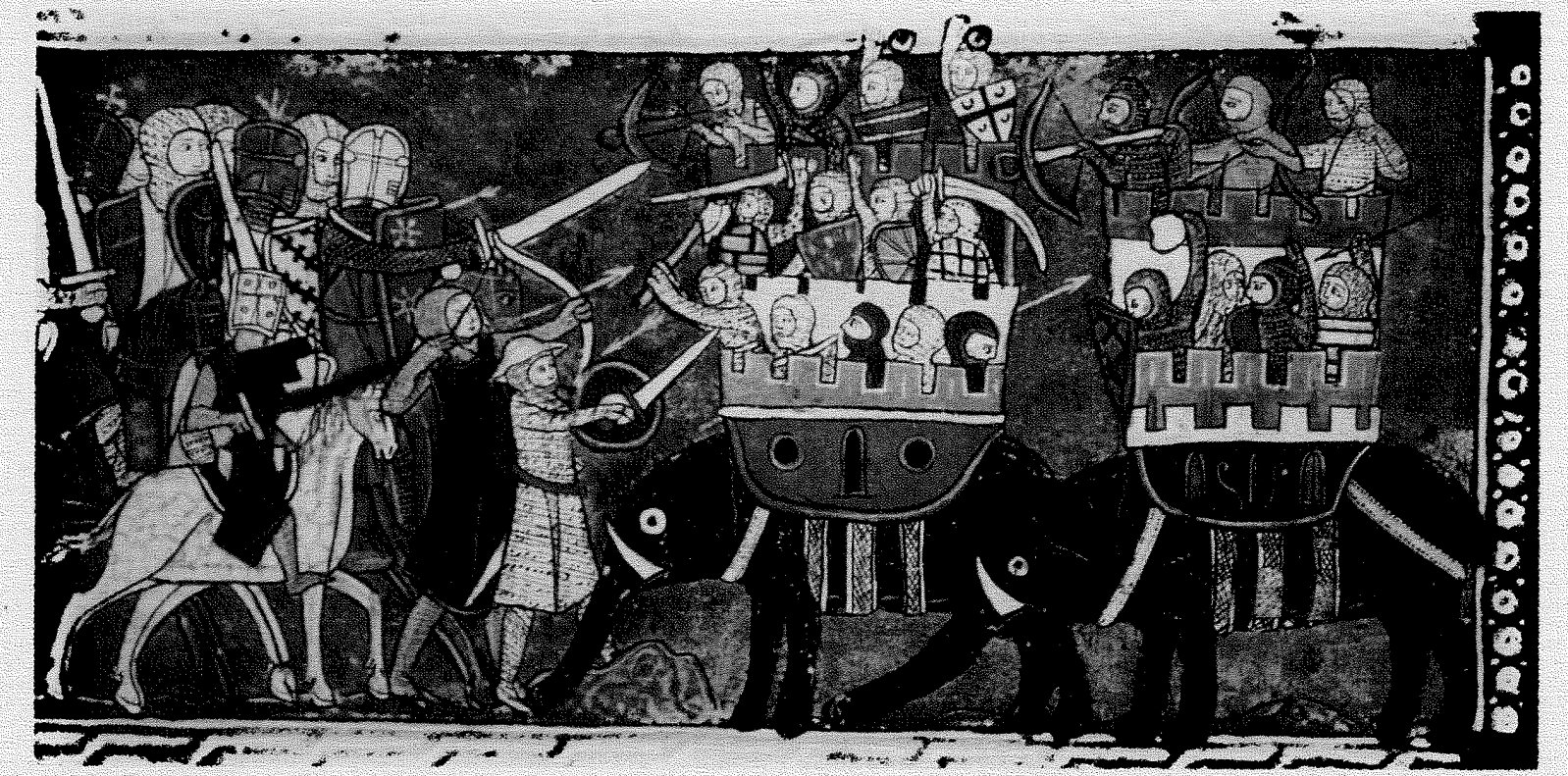
Nonetheless, once direct negotiations began, the chemistry between Kemal and Frederick proved to be excellent. Kemal felt an affinity to Frederick, who, unlike most westerners, spoke Arabic and understood Islamic customs. Although he found Frederick’s professed disdain for religion disconcerting, Frederick the sort of man he could do business with. Frederick made it very clear to Kemal that he needed a success, to justify his going on crusade despite the papal ban. He argued that as Kemal had sought his aid, he could not let Frederick go home empty-handed. Besides, Frederick argued, Jerusalem was even more sacred to Christians than it was to Moslems. Surely, for Kemal, Damascus was the more important prize. To back up his arguments Frederick mounted a judicious show of force, coordinating it with a counter-attack that Nasir launched from Damascus.
Kemal had few resources to spare to fend off even a limited crusader offensive, particularly as the threat of Genghis Khan had momentarily receded and the Khwarismians were looking west again. He concluded that it was in own his best interest to ensure that Frederick went home as soon as possible, with something to show for his efforts, if not everything he wanted. In the end Kemal agreed to yield Jerusalem (less the Moslem holy places) in return for Frederick’s aid (or at least non-interference) in his siege of Damascus, Bethlehem, Nazareth and parts of Galilee, along with narrow corridors linking them to the crusader enclaves on the coast. The treaty was signed in Jaffa in simply not good enough; the glass was, as they perceived it, very much a half-empty one. The Moslems retained a dangerous foothold in the heart of the city, whose defences were in any case in a ruinous state, while the link between Jerusalem and the coast was tenuous indeed. The fact that Kemal tried to make his concessions more palatable to the Moslem world by asserting that Jerusalem was his for the re-taking once the truce expired did nothing to sooth the crusaders’ concerns.
In March, Frederick formally entered Jerusalem and wore his crown in the Church of the Holy Sepulchre. Most of the nobility and clergy of Outremer boycotted the ceremony, while the Latin Patriarch placed Jerusalem under an interdict, effectively closing down all its churches. This did not go over well with the pilgrims who had followed Frederick to Jerusalem. Frederick was outraged by these slights. He halted all work on re-fortifying city, other than the Tower of David, which he gave, along with other strategic fortresses, to the Teutonic Knights. Soon after, he departed Outremer, never to return.
Frederick was not the first and certainly not the last statesman to see his Middle-Eastern diplomatic triumphs crumble. Nonetheless, despite his detractors, his accomplishment was impressive. Jerusalem stayed in crusader hands for almost 20 years and over time his lieutenants in Outremer were even able, by exploiting continued Moslem dissension, to strengthen the corridors joining Jerusalem and the Galilee to the coast. Frederick’s understanding of the politics and culture of his Moslem counterparts, his persistence, despite his less than ideal bargaining position, his measured combination of a show of force and negotiation and, not least, the good personal rapport he established with Kemal all helped him achieve his goals. On the other hand, his failure to understand the local crusader community, and his tactless and high-handed way of dealing with them, did much to undermine his accomplishments.
One final footnote to all this. There may have been a Canadian connection that helped smooth the path to Frederick’s diplomatic tour de force. Frederick, as noted above, was a keen falconer, a hobby still passionately pursued in the Middle East. The prize among falcons is the gyrfalcon, with its impressive speed and size, its white plumage, and above all its extreme rarity. To open negotiations Frederick presented a pair of them to Kemal, along with a polar bear. Historians have suggested that only place where Frederick could have obtained these creatures was from the Canadian High Arctic. Hunters and traders from the Norse settlements in Greenland regularly visited this region. Indeed, fragments of chain-mail, a merchant’s scales and other Viking artifacts have been found there. Part of the Greenlanders’ tribute to their Norwegian overlord was paid in falcons, and it is likely from Norway that Frederick in turn obtained the gifts he gave to Kemal. Precisely how the gyrfalcons and the polar bear made it alive and well from Resolute Bay to Outremer is, alas, a tale lost to history, but Kemal was clearly delighted with his gifts, and so perhaps began a tradition of Canadian involvement in the Middle East Peace Process. As footnote, this incident was cited as one of the reasons why Canada should be forthcoming when in the late 1970s we received a request from Saudis for a breeding pair of gyrfalcons for the royal mews. Any link between the birds being delivered to Riyadh by a Canadian Wildlife Service falconer and the successful conclusion of the first round at Camp David is no doubt pure coincidence.
Roger Lucy joined External Affairs in 1971. He has served in Chicago, Tehran, Oslo and Port of Spain.
View the original scanned pages →
Originally published in bout de papier, Vol. 18, No. 3 (2001) — Fall 2001 // Automne 2001, pp. 33–35. Read the rest of this issue →



