
bout de papier, Vol. 15, No. 2 (1998) — Summer 1998 // Été 1998, pp. 3–7
In September 1972, I took over the newly-created branch of the Department of External Affairs called the Bureau of Communications and General Services — identified for short as ACP — reporting to Larry O’Toole, the assistant undersecretary for administration. By far the most pressing task of ACP was to ensure the smooth move of the Department into its new headquarters, the building which was to be given the name of Lester B. Pearson. This responsibility came my way because it was a function of the Central Services Division — one of the four divisions that made up the bureau — to look after accommodation and furnishings at headquarters. My part in the project was small, concerned with logistics and cosmetics rather than with construction, and limited to the last nine months before the Department’s move when the building was already firmly set on its massive podium on Sussex Drive, its complex form and character delineated in brown granite aggregate.
Over the sixty years since External Affairs had been created in 1909, the staff of the Department had grown from a few clerks into a professional organisation, two thousand of whom were stationed at the headquarters in Ottawa. From the early duties of looking after passports and a few representatives abroad, and channelling correspondence between the Canadian Government and the Colonial Office in London, the Department had evolved into a service respected abroad and admired even at home.
In the 1920s and 1930s, the Department was located in the East Block of the Parliament Buildings which it shared with the Prime Minister and the Privy Council. When the bureaucracies of the two central agencies of government burgeoned, External Affairs was forced to expand elsewhere. In the 1940s, the Department moved divisions into the New Post Office at the corner of Sparks and Elgin Streets and the Daly Building — once a department store and now razed, east of the Chateau Laurier — while the Passport Office took up quarters on Sparks Street. Other accommodation farther from the Hill was added in later years. By the 1960s, when the Langevin Block — across Wellington Street from the East Block — had become the site of the major divisions of the Department, the demands of Parliament and the Privy Council for office space bordering the Hill led to the location of External Affairs in its own building. It seemed a good idea to the departmental establishment, despite the fact that the Department would be situated farther from the antechambers of power.
Construction began in 1970 on the site across Sussex Drive from the National Research Council. Rather than a single building, the design provided for a cluster of four blocks of varying height and mass joined by a central reception hall, grand in scale and two-storeys high. The planning of the headquarters building had been meticulous. Parameters were set forward in the first place by the Department of Public Works (DPW) which, as the “landlord’s agent”, would remain responsible for the building even when External occupied it — and beyond, if the Department were to move elsewhere. External Affairs was consulted in detail about its special requirements by DPW and then by the architects – Webb, Zerata-Menkes of Toronto — and the building contractors, The Foundation Company of Canada. As the construction advanced, it was necessary to focus on the realities that had been created in steel and mortar to satisfy these requirements. To the credit of all those who had been involved in the planning — especially the project manager, Bill Rankin of DPW, and Malcolm Grant, then director of Central Services Division of External Affairs — there were few the use of new
Inevitably there were to be problems caused by failings such as overstated space demands and lack of imagination in the use of new office technology, and unforeseen “warts” that grew on the linear external fabric to accommodate an extra tube or exhaust. Other concerns arose from the interior “landscaping” of the building which had been imposed by contemporary DPW doctrine. To meet the objections of staff to the lack of privacy in the unaccustomed open spaces of general offices, we provided movable partitions; when these were installed, the spaces were converted into ugly mazes, moving people to complain that their view of the outdoors was impaired. Others argued against open landscaping on security grounds and forced the construction of separate offices; as most of these were located on the interior side of corridors without windows — and with poor ventilation because the air conditioning system was designed with the open landscape in mind — the solution proved as objectionable as the problem.
From the outset of planning the move to the new headquarters, it was evident that we should conduct a programme of information on the building to familiarise the staff with its features and achieve acceptance of it. Tours were undertaken weeks in advance of the move of each major division with the staff being polled after these visits to identify problems. The location of the headquarters on a street that did not enjoy direct bus service from most parts of the capital region of Ottawa and Hull was a major concern to be addressed.
Department’s staff at headquarters, more than half were “non-rotational” they did not go abroad and were permanently based at headquarters. For them, the changes of daily routine, indeed of life-style, that were to be imposed by the move were much more dramatic than for the rotational personnel.
Begun in mid-June, the move of divisions to the new building continued at the pace of two or three every weekend until mid- August. The official opening had been set earlier for the 1st of August, when Queen Elizabeth would be in Ottawa for the first Commonwealth Heads of Government meeting ever to be held in Canada. Planning for the ceremony was well underway in April. As the Queen wished to make a speech of tribute to L.B. Pearson during her visit, it followed that she should open the building.
Plans were soon made and approved and we turned our minds to the preparation of the Queen’s speech which would be one of only two that she would make during her visit to Canada. The first draft of the speech was largely the work of Geoffrey Murray who had been close to Mr. Pearson — especially on United Nations matters — and had been the principal spinner of words for the foreign policy review of 1970. By mid-June, the text had been approved by the Minister, Mitchell Sharp, passed for clearance by the Prime Minister and transmitted to the Palace.
The details of the programme now dominated my time. Fortunately, I was able to obtain the services of an assistant, Kay Peterson, who, as the day neared, became the departmental voice to the press and broadcasting media about the event, for which coverage promised to be intensive.
After the announcement was made of the programme for the August royal visit, including the Pearson Building ceremony, requests for places at the opening flowed in. The first was from the Honourable Paul Martin, External’s Minister a few years earlier, who wanted a “ticket” for a former executive assistant. We put together a folder of information for the press and a thinner version which was to be given to the guests at the ceremony. Some arrangements went well: the lawn areas around the building were sodded in time and the platforms required for the seating were quickly built on top of the large planters at the front entrance. A military band was organised and banners readied. As the event neared, a huge CBC camera and sound team was deployed and the red carpet was readied for unrolling. In her small office, Kay Peterson briefed journalists — including the star anchor of the CBC News, Lloyd Robertson — most of them sitting on the floor, taking notes.
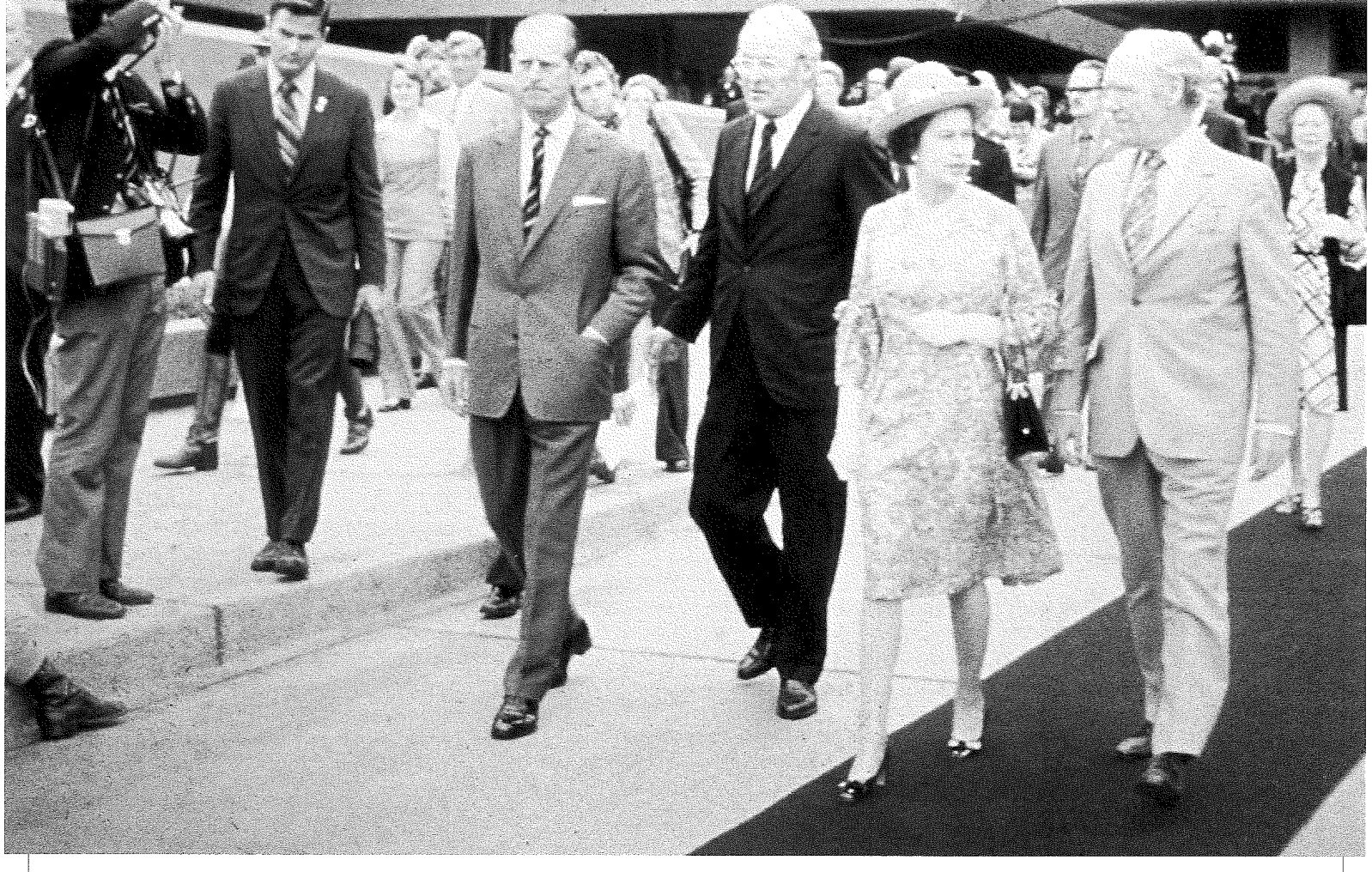
It rained on the morning of the ceremony: the seating outside the front entrance had to be adjusted to avoid drips. I watched the arrival of the royal party from the ninth floor balcony and looked down on the half-hour ceremony in which Queen Elizabeth delivered her speech. A trumpet fanfare sounded the formal opening of the building. Moments later, I was at the ninth floor bank of elevators to greet the Queen who was accompanied by Mitchell Sharp. We walked along the balcony, pausing to look at the Gatineau Hills while Prince Philip and others arrived. Inside the reception area waited over a hundred members of the Department specially selected by their peers for the honour of seeing the Queen. Mr. Sharp led Her Majesty along the line of those standing on the right while the Under-Secretary, Ed Ritchie, introduced Prince Philip to those on the left. All was soon over and the Queen descended to the front of the building to conclude the ceremony and depart.
In the run-up to the opening of Mr. Pearson’s building, it was suggested that somewhere in it, a plaque bearing a replica of his flowing signature be displayed. It occurred to me that on the coming 10th of September, it would be 25 years since Mr. Pearson became Secretary of State for External Affairs in the Cabinet of Prime Minister Mackenzie King. Financed by those who had served in the days when LBP was Minister, the plaque was the building’s first commemorative tablet.
By the time that the Queen had opened the Pearson Building, its architecture and setting had been widely accepted by people in the capital region. Of all its attributes, however, none drew more public attention and fire than some of the pieces of “fixed” art which were provided as part of the construction programme and approved by DPW’s advisory committee on art.
Of the nine works, the four pairs of sculptured bronze doors by Robert Hedrick, which were set in the glass walls of the lobby entrance, gained the widest approval. About others controversy arose. Even Arthur Handy’s planes of sheet metal, painted deep red, that formed a sculpture outdoors between two wings of the cafeteria, were provocative though not in plain view. It helped that Handy had a modest sense of the importance of his work, engagingly described by him as representing nothing but “three-and-one-half tons of f***ing steel”
Few were aware of the Inuksuk, a cairn on a near-human scale that was created by Oseotuk of Cape Dorset of loosely piled stones from the Arctic, where similar figures stood on the featureless shores as temporary landmarks for travellers or markers to direct the migration of caribou. Our Inuksuk was located outside in the garden of the conference area, overlooking the bridge to Quebec. Because the cairn’s stones were held together only by gravity, it was vulnerable. On a Saturday, driving towards the bridge, Pamela McDougall of the Department saw a naked man embracing the Inuksuk. Across the bridge, Pamela reversed direction to alert the security guards. Nonplussed, they warned the man off after persuading him to put his pants on. Although only a few pieces of stone had been dislodged in the attack, the attempted rape was enough to persuade DPW to bring the Inuksuk indoors, and to bolt its pieces solidly together.
The most prominent — and most excoriated – fixed work of art was Robert Murray’s sculpture which was located in the courtyard of the main entrance of the building. Crafted from a single strip of steel plate, twice the bulk of a contemporary Cadillac limousine and painted in blue epoxy, the curved and angled product was inexplicably entitled “Haida”. Unfortunately for its fabricator, the sculpture was set up in front of the Pearson Building just as the City Fathers of Ottawa decided to adopt a by-law requiring dog-owners to pick up after their pets. As the shape of the sculpture resembled that of the tool that dog lovers would employ, “Haida” was quickly renamed “The Poop Scoop”
The Poop Scoop became an object of such cutting derision that the official art establishment, DPW and the Government itself felt the wrath of the unwashed. On the eve of the Queen’s opening of the Pearson Building, a Liberal Member of Parliament suggested that Mitchell Sharp “get rid of that blue piece of metal” before the Queen saw it. Mr. Sharp agreed that “there is an understandable difference of opinion about that particular thing”. ’ When Prince Philip spotted it during the opening ceremony, he quipped to Ed Ritchie: “Is that something that the builders left behind?” The Ottawa Journal editorialised that it was time “to stop gouging the taxpayers for this sort of trash”.
The last significant “fixed” work of art was a memorial to Lester B. Pearson.
DPW’s Fine Arts committee invited artists to compete for a memorial that would be located in the entrance foyer. It was made clear that the memorial was to symbolise Mr. Pearson’s role in the Department, his accomplishments in international affairs that gave Canada its high place in the search for peace and security; in a word, it was to commemorate Pearson from 1928 to 1957. Ten artists were invited to submit “maquettes” which were considered by the DPW art committee. Charles Gagnon’s proposal was deemed the one most faithfully reflecting the aims of the competition. An oil mural entitled “Timescreen/ Thoughtspace”,, it consisted of quotations from Pearson’s speeches and highlights of his career set in three panels against a grey/white/black background. Gagnon spent over a year painting the mural which was unveiled on June 11, 1975 by Mrs. Maryon Pearson.
The mural was closely examined in the days that followed. Like many others who had known Mr. Pearson, our former minister, Howard Green, came by for a look and indicated his approval. The Department’s librarian spotted a misspelling of “turbulence” in the text and the Bilingual Adviser and his staff conducted a search of the French words, ferreting out other mistakes.
I recalled that, moments after unveiling the mural, Mrs. Pearson had found that the name of her hometown, Winnipeg, was misspelt. But these were small blemishes in a huge canvas that gained in favour as the days and months passed.
The highlights of my responsibility for the Pearson Building over the three years as director-general of ACP were the move of the Department to its new headquarters, the official opening by the Queen and the placing of the memorial mural in the building. I was involved in much more detail than I had reckoned for. My involvement was also deeper because Ed Ritchie was unfailing in his attention to the image of the Department as reflected by the building and constantly in touch with me on matters that seemed to tarnish it — or might burnish it. His pride in the building and concern for the welfare of the staff were at once goads and props to me in my job. By giving me his backing and the authority of his position in many dealings with outside departments and agencies, he made my work at once easier and more rewarding.
View the original scanned pages →
Originally published in bout de papier, Vol. 15, No. 2 (1998) — Summer 1998 // Été 1998, pp. 3–7. Read the rest of this issue →



