
Mine finto entry bomale ploma Slavius Prisos presented ’ account of a mission he undertook in 449 A.D. to the court of Attila the Hun. Colleagues have asked to know more about Priscus’ career in the Roman foreign service, and whether he went on other missions. Unfortunately his memoirs have largely disappeared, except for some fragments excerpted in a collection of diplomatic despatches collected by Emperor Constantine VII in the tenth century (see Foreign Policy for Byzantines, bout 4/16, Winter 1999/2000). From this and some entries in the Suda (a sort of Encyclopedia Byzantina) we can glean some idea of his career, and, with some extrapolation, fill in some of the gaps. What is clear is that the world was just as complicated a place 1500 years ago as it is today, and Priscus received a number of quite challenging assignments.
Priscus was born in the second decade of the fifth century in Panium, a town on the European shore of the Sea of Marmora. He clearly came from a prosperous background: his family could afford to give him a first class education in philosophy, rhetoric and probably the law, while his writings betray a sense of resentment about the government’s increasing tax burden on the land-owning gentry. Being close to the East Roman capital Constantinople, he probably received his higher education there. Of the other possibilities: Athens had the most prestigious philosophy school, but its faculty was staunchly pagan, and a reputation for “Hellenism” was at the time not normally compatible with a successful career in the public service — the high moral tone in the capital being set by a series of staunchly Orthodox empresses. A first class education could also be obtained in some of the great eastern cities such as Antioch and Alexandria, but these too were riven by conflict between a pagan faculty and an increasingly stridently Christian student body. About the time that Priscus was born, Hypatia, the head of the Philosophy faculty in Alexandria, had been lynched by a Christian mob and the library, housed in the temple of Serapis, torched. Beirut also had an excellent law school and with it training in Latin — essential for a public service career — but most of its graduates were streamed into the provincial bureaucracy and law courts. All this training was available in Constantinople; moreover, the faculty there were appointed by the Senate and often personally chosen by the Emperor or his representatives. While this was not necessarily a guarantee of the intellectual quality of the professors, they were assured of having good connections, and in the Roman world, when it came to appointments and promotions, connections were everything. A fine example is the Gallic writer and teacher Ausonius, who landed the job of tutor for the future western Emperor Gratianus. On Gratianus’ accession in 375, Ausonius was placed in charge of the civil service, which allowed him to find lucrative jobs for most of his family and favoured former students.
The late Roman civil service was, by modern standards, quite modest, but its size and scope was vaster than anything which had preceded it. In the early years of the Empire, most administrative tasks were undertaken by the emperors’ own household — trusted slaves and freedmen – and at the provincial level by the governors’ household plus some clerical, administrative and enforcement personnel seconded from the Army. Most administration was delegated to the cities, which were responsible for public works, law and order and tax collection (town councillors were held personally responsible for any deficits). By the late third century this system collapsed under the demands of an Empire under attack on all fronts. The emperor Diocletian drastically overhauled the administration, multiplying the number of provinces and layers of administration, setting up a centralized fiscal system and rationalizing tax collection. A soldier himself, he drew much of his new bureaucracy from the army. Late Roman civil servants received military ranks and uniforms, and were even nominally enrolled in the I Legion (actually stationed near present-day Budapest). Service conferred privileges, including generous tax exemptions, the right to be tried in special courts and immunity from some of the more unpleasant forms of execution.
Normally one joined the civil service by becoming an unpaid supernumerary at a government office. In due course, when a vacancy appeared, a diligent, fortunate or well connected supernumerary would be allowed to buy a permanent position. This may sound like graft, but was in fact more like an annuity, the interest on the capital used to buy the office being its salary and other perquisites. Promotion was mostly by seniority (some parents enrolled their infant children to give them a head-start up the ladder), with some scope for an accelerated career for the more able or better connected.
It is believed that on graduation Priscus landed a job working for the Imperial commission drawing up what became the Theodosian Code, which compiled all Imperial legislation made in the previous century. He was probably working for the Master of Offices, a sort of Minister of everything: PCO, Solicitor General, Minister of Communications and Minister of Public Works all rolled into one. The Master of Offices also had some responsibility for Foreign Affairs, being in charge of the Office of Interpreters of all Nations.
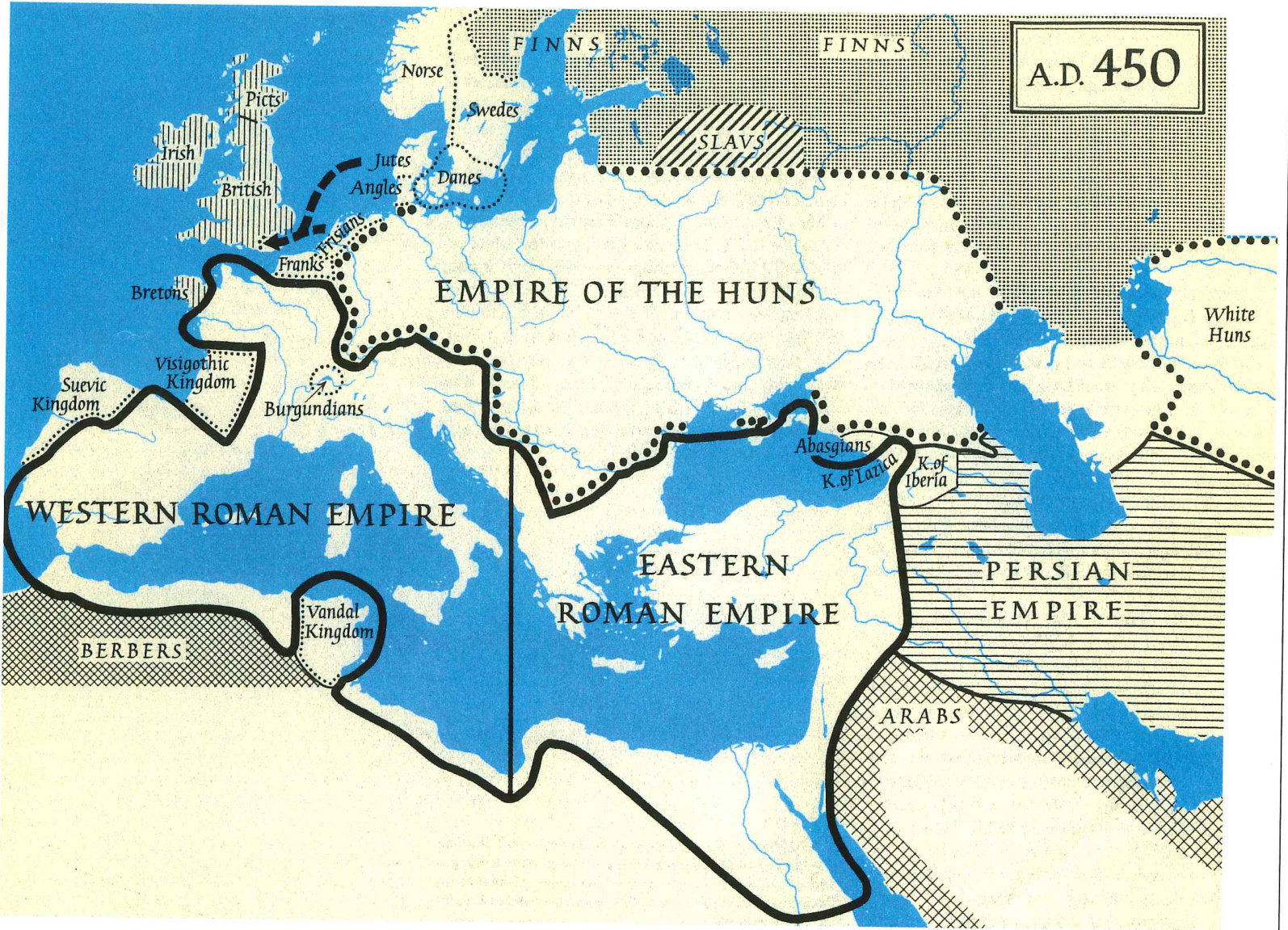
Through much of their history, the Romans had not payed an awful lot of attention to the arts of diplomacy. Force or the threat thereof usually sufficed to attain their objectives. Only the Persians offered anything like a serious threat to Roman supremacy, and even that threat was usually more perceived than real. A series of disasters in the second half of the fourth century radically changed the world. In 362 the Emperor Julian led a massive invasion of Persia, getting as far as the capital Ctesiphon (just south of Baghdad). He was unable to take it and, short of supplies, began to retreat. In the course of a skirmish he was killed and his successor, to extricate his army, was forced to surrender several provinces along the upper Tigris. After Julian’s death the Empire was effectively divided into two, although normally members of the same dynasty ruled in each half. It’s no coincidence that the boundary between the Latin-speaking west and the Greek-speaking east follows the present Bosnian-Serbian border.
In 375 the Huns swept over the Volga and crushed the Goths, who sought refuge within the Empire. This was granted, but mistreatment and exploitation by local Roman officials drove the Goths to revolt. Trying to suppress it, the eastern Emperor Valens and most of his field army were surrounded and killed near Adrianople in 378. His successor, Theodosius, patched up a peace with the Goths, but at the cost of allowing them to remain within the Empire. He also had to contend with two serious revolts in the western Empire which further drained Roman resources. In 407 the barbarians breached the Rhine frontier, overran Gaul, and penetrated into Spain. They were never completely evicted, and one tribe, the Vandals, even crossed into North Africa and took control of the richest provinces in the western Empire. To top off these disasters, in 410, Alaric, king of the Visigoths, sacked Rome. In such an environment, the Romans lacked the military resources to ensure a successful military solution to a crisis if attacked on more than one front at a time.
The eastern Empire in general fared better, until the 440s, when Attila united the Huns and began to attack across the Danube, destroying many of the frontier cities. It will be recalled that in 449, Maximinus, a respected general, was selected to go on a mission to Attila, who was making demands for increased tribute and the return of Hun refugees. Maximinus asked Priscus to accompany him as an assistant. Unbeknownst to Maximinus and Priscus, Chrysaphius, the Empress’ Chamberlain, had tasked Vigilas (assigned to the embassy by the Office of Interpreters) with arranging Attila’s murder; worse, the plot was revealed to Attila, who was not amused. Priscus, nonetheless, was able to mitigate some of the more extreme demands of the capricious barbarian king and buy valuable time.
In July 450, the Emperor Theodosius II died, leaving no male heir. The last representative of the Imperial House was his pious and virgin sister Pulcheria. Theodosius had had little interest in ruling; his main pursuits were hunting and theology. Pulcheria and Flavius Aspar, Master of Soldiers in the Imperial Presence, were the real powers behind the throne.
Aspar was of barbarian origin, part Gothic, part (judging from his name, which means “horse”) Alan. The Alans were a tribe of Iranian horse nomads, then resident in the Ukraine. Their descendants, the Ossetians, can be found on the borders of Russia, Georgia and Chechnya. Along with the Anglo-Saxons and the Swabians, they are virtually the only barbarian peoples who today survive from this, the Migration Age. Aspar came from a military family. His father was also a Roman general and, while working under him, Aspar helped overthrow an unwanted pretender to the West Roman throne. Having distinguished himself defending the eastern Balkans, he was promoted in 441 to become, in effect, head of the east Roman equivalent of Homeland Security. Priscus claims that Aspar, translated from the Danube frontier to the fleshpots of Constantinople, slipped into an idle and dissolute lifestyle. Despite this and a series of serious defeats, he kept this job for over 30 years.
Aspar solved the succession crisis by persuading Pulcheria to marry his chief of staff, Marcian, who then became emperor. The marriage respected Pulcheria’s vow of chastity and Marcian also agreed to promote her religious agenda. One of his first acts, however, was to end the appeasement of the Huns. Chrysaphius, one of the chief promoters of this appeasement policy (when he wasn’t trying to have Attila assassinated) was executed and protection payments were terminated. This was not as rash as it sounds; Attila was turning his sights on the West Roman Empire. His casus belli was the western Emperor Valentinian’s sister Honoria. She had been caught in flagrante with one of her servants and was quickly married off to a boringly respectable senator with no imperial ambitions. In despair she sent her ring to Attila with an appeal that he rescue her. Attila chose to interpret this as a marriage proposal and demanded Valentinian hand over halt the western Empire to him as her dowry. At the same time the king of the Franks, on the lower Rhine, had died. His two sons were disputing the succession: one sought support from Attila, the other from Rome.
In the fall of 450, Marcian sent Maximinus and Priscus on a mission to Rome. Priscus’ surviving works give few details, beyond the fact they met the pro-Roman claimant to the Frankish throne. However Valentinian had been taking his time recognizing Marcian, and Marcian probably also wanted to stiffen Valentinian’s spine and assure him the East Roman army would counter-attack if Italy were threatened (which in fact did occur). They also met with Aetius, Aspar’s counterpart in the western Empire. The mission would seem to have been successful. The western Romans resisted Attila’s demands, and at the battle of Chalons, Aetius led a coalition of Roman, Frankish and Visigothic forces to defeat him. Maximinus and Priscus also met Pope Leo. At Pulcheria’s behest, Marcian was trying to organize an ecumenical council, to be held at Chalcedon on the Asian side of the Bosphoros. The Pope’s support for what Pulcheria wanted to be the Orthodox position was required. Leo gave his endorsement and entrusted Maximinus with letters to take back to Constantinople.
Their next assignment was in the Middle East. All we have to go on is a fragment from Priscus’ memoirs to the effect that Aspar’s son Ardabur (Master of Soldiers for the Orient) was fighting the Saracens (bedouin) near Damascus, but that by the time Maximinus and Priscus arrived he was already engaged in dictating the peace terms to their envoys. That Ardabur was engaged at all indicates the situation must have seemed quite serious. Over the several centuries of their great power rivalry the Romans and Persians increasingly concentrated the bulk of their regular armies along the upper Tigris and Euphrates where modern Turkey, Syria and Iraq now converge — a zone studded with heavily fortified cities. To compensate, both superpowers delegated defence of their southern borders to local Arab chieftains, Phylarchs, who were tasked with maintaining order along the desert frontier, fending off Arab raiders from deeper in the interior (in particular those sponsored by the other side), and providing auxiliary troops when open warfare broke out between Rome and Persia. This the favoured Arab chiefs did, in exchange for honours and titles for themselves, subsidies and rations for their tribesmen, and a share in whatever tribute they could collect from tribes deeper in the interior. The proxy wars that Rome and Persia waged in Arabia extended down into Yemen, stimulating the political, military and religious development of the peninsula. Two centuries later the two empires, having fought themselves to exhaustion in a war that lasted almost 30 years, reaped the awful consequences of this meddling in the peninsula, while out-sourcing the defence of their southern frontiers.
As noted, normally the Master of Soldiers did not need to bother with events in Syria or Palestine, and Ardabur’s presence there, as well as the dispatch of Maximinus and Priscus, indicates that something was seriously amiss. It could be that Persian-sponsored Arabs had mounted a major attack (although that would have violated the treaties between Rome and Persia which forbade direct attacks on each other’s territory by their clients); that a major tribe had a grievance against Rome and was trying to renegotiate their terms and conditions (in the 370s one allied queen, Mawia, had mounted a series of raids on Lebanon, Palestine and even into Egypt in order to get a favoured hermit appointed bishop over her people); or that two tribal chieftains were contesting who should be the Phylarch, with all the perks and patronage such a title could command. It is known that sometime in century the Salihids, who been Rome’s chief clients in this region, were displaced by another tribe, the Ghassanids. In any event Ardabur seems to have found a military solution to the problem and there was no need to resort to diplomacy.
Maximinus and Priscus therefore proceeded to the next trouble spot, the southern frontiers of Egypt. In the late third century, under pressure from raids from the Blemmyes, a barbarian people who lived in what is now northern Sudan, the Romans had pulled back to the First Cataract of the Nile and entrusted the demilitarized zone to the Nubians, who still maintained many of the traditions of ancient Egypt. Normally the Blemmyes were hostile to the Nubians, who ir thus acted as a buffer for the Roman frontier. Unfortunately, on this occasion both peoples had decided to attack Roman Egypt, possibly because they feared their traditional religion was under threat from Roman missionaries, who were actively proselytizing in Ethiopia and Yemen. The defences held, and the Blemmyes specifically asked for Maximinus (who must have been known to and trusted by them) to negotiate a peace settlement. Initially they were only willing to keep its terms as long as Maximinus remained in Egypt; however, he was able to get them to agree to keep its terms for his lifetime. The Blemmyes and Nubians agreed to surrender their prisoners and plunder (and even pay for any stolen cattle which they had eaten), as well as handing over some nobly born hostages. Probably as a gesture to demonstrate that the Romans were not trying to convert them, the treaty was concluded at a pagan temple that had been kept open for their use on the Roman side of the frontier (pagan temples had been officially closed throughout the Empire in 392). Unfortunately before the ink on the treaty had dried, Maximinus fell ill and died, and considering the treaty void, and having forcibly recovered their hostages, the Blemmyes revolted again.
Florus, the Governor and Military Commander of Egypt, was able to suppress this new revolt and Priscus accompanied him back to Alexandria. Before he could return to Constantinople serious rioting broke out in Alexandria between rival supporters of the recently exiled Coptic Patriarch and his government-appointed successor. Troops sent to quell the uprising were routed by the mob, driven into an abandoned temple and burnt to death. Florus cut the grain ration, closed the baths, theatres and race track and called for help. Two thousand newly enrolled guardsmen were sent as reinforcements from Constantinople but showed themselves more interested in molesting the populace than in restoring order. On Priscus’ advice, Florus was persuaded to listen to the grievances of the Alexandrians He agreed to restore the grain ration and re-open the public amenities. The rioting ended and Priscus returned to the capital.
Clearly Priscus was thought to have performed well. This is reflected in his next assignment as Assessor (chief legal advisor) to Euphemius, Marcian’s new Master of Offices. This was considered a very important position, drawing an annual salary of 10lb. of gold In this function Priscus was involved in mediating an end to a civil war in Lazica, the Black Sea coastal province of Georgia. The Lazican king, Gobazes I, faced an uprising by his son. The Romans intervened on behalf of the son, but their expeditionary force did not accomplish much. Gobazes appealed to the Persians, but heavily engaged with barbarian attacks on their eastern border, they did not want to get involved in a region which, while culturally aligned to e vosa, was uclutu to fall within the Roman sphere of influence. The Romans sought Persian permission to stage an attack on Lazica through the part of Armenia which lay under Persian control. Using this threat, Euphemius and Priscus were able to persuade Gobazes that it was in his best interest to seek terms. With a trusted Roman intermediary serving as a guarantee of his safety, Gobazes handed-over Lazica to his son and retired to Constantinople.
This is the last mention of any involvement by Priscus in diplomatic affairs. It is quite possible he left the civil service in 457, when Marcian died. He may have fallen afoul of Aspar, as his history becomes progressively more critical of him, in particular Aspar’s involvement in a disastrous expedition in 468 to oust the Vandals from North Africa. The expedition cost 130,000 Ib. of gold and Vandal fireships the bottom. Because of Aspar’s origins (a strong Alan contingent had accompanied the Vandals to Africa) the chattering classes had long suspected him of other loyalties. Some even accused him of bribing the Basiliscus, leader of the ill-fated expedition. However, Basiliscus (a son in law of Marcian’s successor Leo I — another Aspar protégé) was incompetent enough to lose the battle without any outside encouragement.
Priscus lived into the 480s, probably staying in Constantinople. His history continues to the end of the reign of Leo. He was therefore able to record, with some satisfaction, how in 471 Aspar overreached himself by trying to set his son Patricius up as heir to the throne and was deposed and executed. Priscus’ historical work, heavily mined by historians who followed him, seems to have survived haps because it was so heavily excerpted, not enough people saw fit to copy out the original in its entirety to ensure the survival of copies down to modern times. This is a great tragedy, but we must be grateful for what does survive, as Priscus lived in interesting times and was a keen observer of the turbulent events of his day, to which he was so often required to contribute his diplomatic skills.
View the original scanned pages →
Originally published in bout de papier, Vol. 19, No. 3 (2002-2003) — Fall/Winter 2002/2003 // Automne/Hiver 2002/2003, pp. 25–31. Read the rest of this issue →



