bout de papier, Vol. 26, No. 1 (2011) — Summer/Fall 2011 // Été/Automne 2011, pp. 43–44
THE DEFENCE OF THE REALM:
THE AUTHORIZED HISTORY OF
MIS, by Christopher Andrew. Toronto:
Viking, 2009, 1032 pp, $45.00; THE
SECRET HISTORY OF MI6: 1909—
1949, by Keith Jeffery. New York: Penguin
Press, 2010, 810 pp, $50.00; GCHQ: THE
UNCENSORED STORY OF BRITAIN’S
MOST SECRET INTELLIGENCE
AGENCY, by Richard J. Aldrich. London:
Harper Press, 2010, 666 pp, $22.95 (paper).
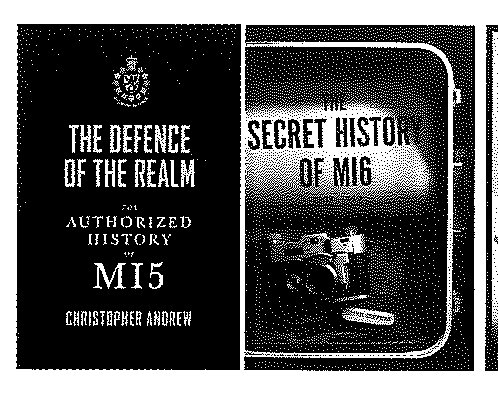
Three exceptional books were published in the past year on British intelligence. Logging in at 600 to 1,000 pages each, these are not for the faint of heart. However, they are a must-read for those who want to understand the world of British intelligence. Each covers a separate agency: the British Security Service (MIS), the Secret Intelligence Service (SIS or MI6), and the GCHQ or the SIGINT (Signals Intelligence) service. Each was written by acknowledged academic experts in intelligence.
Two books, on MIS and MI6 respectively, enjoyed full access to agency files, something entirely unheard of. That provides them with an aura of authority which does not always apply to literature on intelligence (often “tell all” stories reflecting selected leaks from individuals with agendas to authors with agendas). Aldrich’s on the British Signals Intelligence Agency (GCHQ) is unique, reflecting the wealth of material which has been declassified over the years or managed to enter the public domain. He demonstrates the success of diligent “data mining”, uncovering nuggets to tell a compelling story when collated and interpreted correctly. He acknowledges that a significant contribution resulted from a recent British effort to enhance intelligence accountability by releasing and declassifying records and making them available to researchers. These books cover the prime British intelligence organizations but not the Service units, Defence Intelligence Staff, or the Joint Intelligence Committee (the JIC was partly covered in a recent excellent book on the machinery of intelligence in Britain).
Aldrich’s book on the GCHQ tells the story of the most secret of secret services, the signals intelligence sector, from which there are, in fact, few secrets. Less glamorous than the James Bonds of MI6 and MI5 services, GCHQ is the realm of geeks. Rather than dapper tuxedos one is apt to find blue jeans and flannel shirts in the halls of the “Doughnut”, GCHQ’s new circular headquarters at Cheltenham which opened in 2003 and proved too small even before it was completed. He tells the story of SIGINT from its early days and its dramatic contribution to victory in World War IJ, information that only became available decades later. He describes the bureaucratic machinations to ensure success while a penurious government sought to curb escalating costs.
GCHQ’s story is told mostly through case histories. The successes in World War II have been recounted elsewhere although Aldrich is a superb historian who places these early years of GCHQ in greater government and historical context. More fascinating is the postwar period on which less has been published. He highlights successes and failures including the Berlin tunnel, an operation whose success is still being debated (from the British perspective), as well as various collection efforts from diplomatic sites, and the successes on the Soviet invasion of Afghanistan.
Aldrich concludes that the overall record for Britain’s SIGINT in anticipating and predicting the surprises of the Cold War was “at best mediocre.” The Russian invasion of Czechoslovakia, the Arab-Israeli War of 1973, the Chinese attack on Vietnam in 1979, and the Soviet intervention in Poland in 1980 all came unexpectedly. This also was true of the July 2005 London terrorist bombing. There are reasons for these failures. Money is one of the biggest. Intelligence work is expensive and funding has to be sufficient even in times of relative peace and tranquility. Technological advances are equally important. The very best of the IT geniuses regrettably find their rewards in industry, not in government service.
Christopher Andrew’s book on the British Security Service (MIS, established in 1909) is the result of MIS’s decision to mark its centenary with a study of its history based on full access to its files. Andrew, one of Britain’s foremost historians on intelligence, was given “virtually unrestricted access….” While there was obviously information about sources and methods which could not be revealed, he received assurances that no attempt would be made to change any of his judgments.
A difficult challenge facing MIS was to foresee changing priorities to national security. There also were many successes and failures. The “double cross” system in World War II, when MIS effectively controlled German espionage in Britain, had a direct and discernible impact on the outcome of the war. The significant and critical infiltration by Soviet intelligence of British intelligence probably affected the evolution of the Cold War, although general Soviet distrust of its own agents, particularly during the Stalin era, likely mitigated the harm to the West. Andrew argues that the lack of long-term perspectives hampered the effectiveness of MIS in understanding the relationship between intelligence and policy in the Soviet Union and in the Service’s response to the Northern Ireland Troubles.
Keith Jeffery’s history of the Secret Intelligence Service (SIS or MI6) only covers the period 1909-49. While fully understandable, this is unfortunate. With its official existence only relatively recently acknowledged, MI6 periodically purged its operational files when they were no longer needed. As a collection agency it saw little need to retain old operational material. The lack of complete archival material had a negative impact on the breadth of Jeffery’s study (although some material, recognized as historically significant, was retained).
Much of this history is based on headquarters administrative records, material found in the files of other departments, and various memoirs prepared by retired members of the service. Jeffery faced more stringent security requirements than did Andrew and admits the need to “omit some significant and important SIS stories.” The paucity of operational files, and the focus solely on collection, also prevented him from tracking intelligence and determining how it was used.
A clear measure of SIS success, Jeffery suggests, was its survival. There were few friends in Whitehall in the early years and a host of adversaries in the intelligence agencies of the armed services who all thought they could do better. The book reflects how small the organization was for most of its existence. As well, it is striking how many of its staff in the early years were “second-raters”, generally underpaid and often not very effective. The overall performance of MI6 is very mixed. There were some notable successes, but a great many failures as well. During World War II, MI6 performed less well than would have been expected. Most of its intelligence assets were wound up by the Germans in 1939. A perception of wartime success by MI6 owes a great deal to its control of SIGINT which earned access and support from Winston Churchill.
Intelligence is a strange business made stranger by its own myth making. Its bureaucracy, as the three books clearly show, consumes vast resources. Fights for resources are continuous and hampered by lack of understanding elsewhere in government of the contribution of intelligence, a craft which does not respond well to being turned on like a tap in times of crisis. Within the intelligence world one sees in these books the lack of a historical perspective by the operators of what has gone before but might still be of importance; the absence of historical continuity is damning. Most troubling was the ongoing request for resources the lack of which often contributed to mediocrity. These books underscore that downsizing comes at a high price when intelligence of national importance is required.
View the original scanned pages →
Originally published in bout de papier, Vol. 26, No. 1 (2011) — Summer/Fall 2011 // Été/Automne 2011, pp. 43–44. Read the rest of this issue →