
bout de papier, Vol. 10, No. 4 (1993) — Fall/Winter 1993 // Automne/Hiver 1993, pp. 26–27
Story and photo by Nick Coghlan
All week, headlines had blared “Canada Dangerous!”, “Don’t underestimate the Canadians!” and, a little less respectfully, “Here come the Ugly Ducklings”. I had to bluff my way to the ramp of the incoming Japan Airlines flight from Vancouver – the Mexican media had snapped up every available security pass.
Surely even the Prime Minister hadn’t been able to muster a reception like this, I thought, as I fought my way through the Arrival lounge. “Ahí, vienen!” — “Here they come!” — went the jubilant cry as the first red and white tracksuit was glimpsed among a sea of bewildered Japanese faces. Five TV crews, fifteen photographers and thirty or more reporters stampeded forward, flashbulbs popping, microphones and miniature tape recorders thrust forward aggressively. The Canadian Soccer team had arrived!
Professional soccer is little known in Canada but the game is, of course, the world’s most popular and attracts nothing less than religious fervour in Mexico and the rest of Latin America. Mexico’s fortunes at the international level have been mixed. The 1970 World Cup was held here but since that time her teams have been lacklustre and she was disqualified from the 1990 World Cup for fielding over-age players in an earlier youth tournament. The fans have remained faithful, though, and tickets for the Canada- Mexico game, one of a series of World Cup qualifiers that Mexico, Canada, Honduras and El Salvador were playing on a round-robin basis, had been sold out for days.
Sirens blaring, lights flashing, six members of Mexico City’s elite police motorcycle squad escorted “my” delegation to the hotel in the Zona Rosa, clearing the busy highways and charging through a score of red lights. The escort would stay with the team throughout, constantly amazing those who sat at the front of the bus with their daredevil swerves and their ability — one hand on the throttle, the other signalling or thumping cars on the trunk – to open channels through the apparently impenetrable Mexico City traffic jams. Travelling to practice in Vancouver or Toronto would never be the same again.
The royal treatment was deceptive, as we found out when we reported to the Azteca stadium for our first practice. In spite of personal assurances from the President of the Mexican Football Federation that we would be allowed unlimited time at the “Colossus” as the world’s second largest stadium is known, the field was mysteriously “not suitable for use” when we arrived at the gates. This was no surprise, it is part of the gamesmanship with which virtually every country in this region approaches soccer. We had already taken the precaution of arranging back-up ground at the nearby German Club.
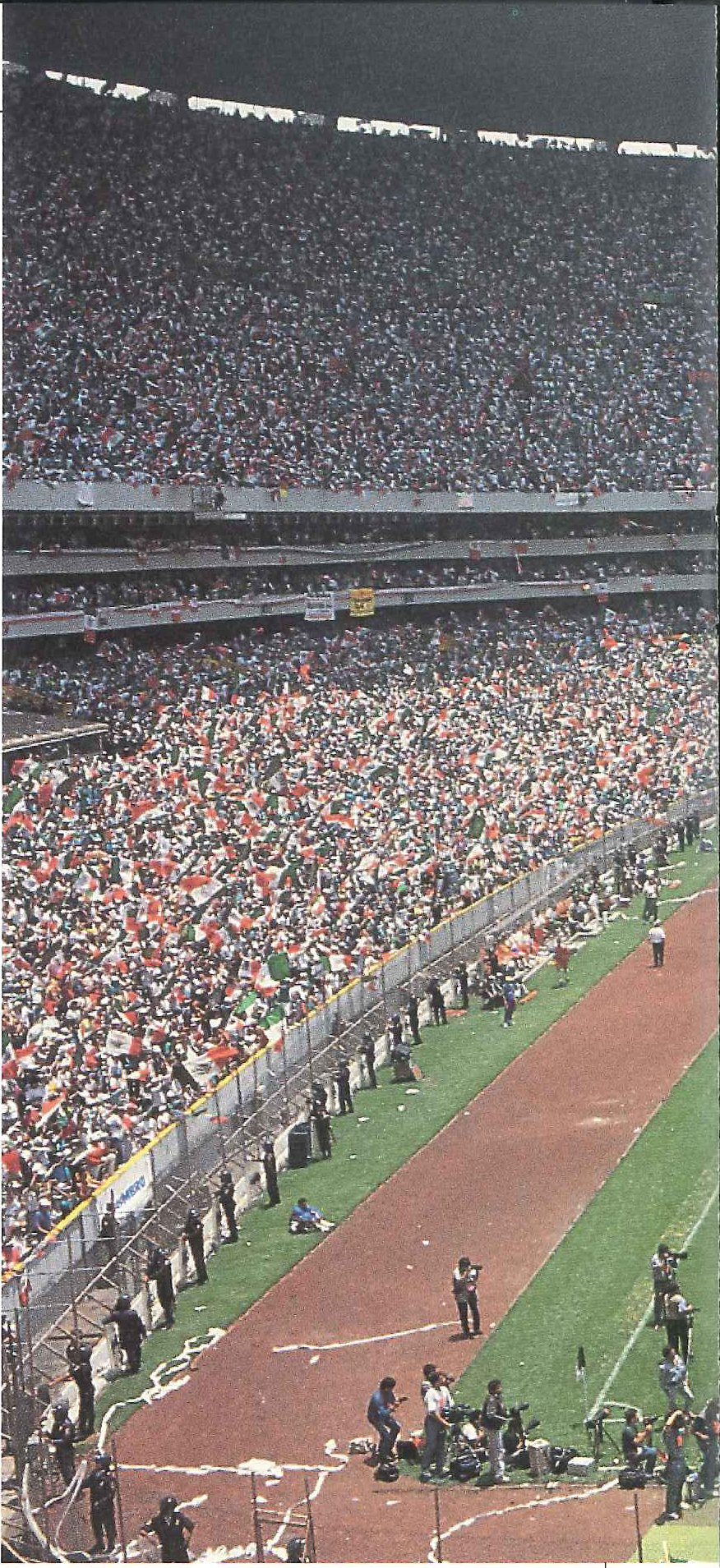
Match day. Today the escort was doubled, the streets around the hotel closed off. At 80 kph we rumbled south to the stadium, the escort riding up to three km ahead to clear the road. This was no small feat. Ten km from the Azteca, the traffic was virtually solid with huge Mexican flags billowing from every car and bus and horns honking. It seemed as though half of Mexico was on its way to the ground. The effect on the players was salutary. Not a word was spoken as we moved through the stadium gates and down the steep, dark tunnel that leads straight to the dressing rooms. Getting off the bus, we were immediately aware of a great dull booming sound: the heavy concrete walls of the tunnel were vibrating. Squatting in the shadows, flak-jacketed riot police held their muzzled dogs on a short leash and eyed us impassively. One hundred feet above in the sunlight, with ninety minutes still to go before kick-off, 120,000 singing and cheering fans already packed the arena.
As the players dressed, I walked out of the tunnel and into a dazzling, unforgettable scene. Around the rectangle of bright green turf, the entire stadium pulsated with 50,000 red, white and green flags waving rhythmically to an emotional mariachi song that echoed out from the giant loudspeakers that are suspended two hundred feet over the centre spot. Tentatively, unnoticed in the tumult of press photographers behind the goal and the phalanxes of riot police moving to their positions around the perimeter, I trod the sacred turf of the Azteca stadium in front of 120,000 fanatical football supporters — and a tiny part of a long-forgotten childhood dream came true.
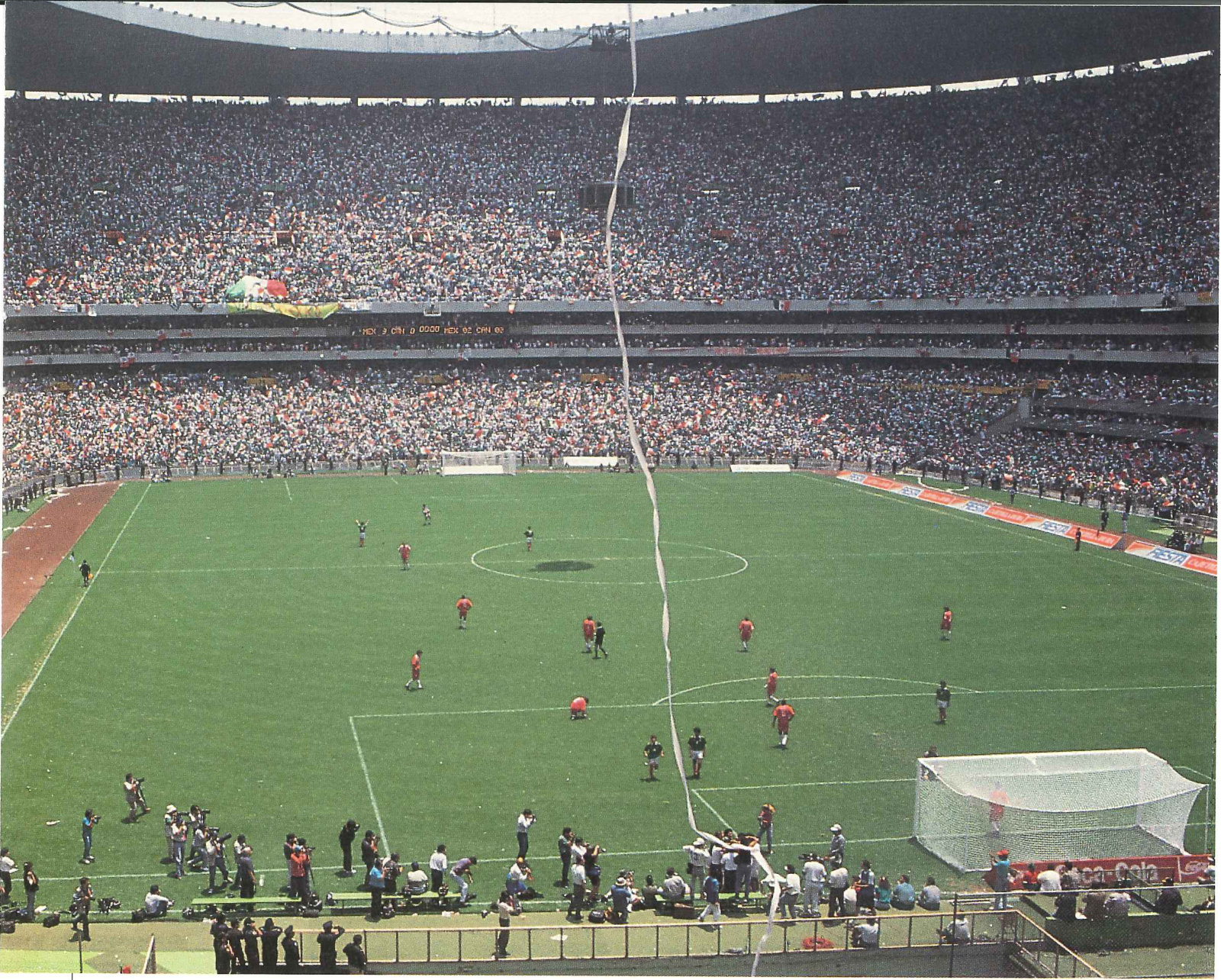
Moments later, the din reached a sudden, frightening crescendo. Out of the tunnel the Canadians were coming, tracksuits a brilliant white and red, blinking and pale-faced, each one no doubt fulfilling his dream too. Two helicopters swooped into the oval patch of sky above, their rotors unheard against the deep, throbbing wave of booing. For a few moments, the eyes of half of Mexico were on Canada and Canada alone. Forget NAFTA, forget the parallel accords, the ministerial visits, the Montreal symphony, the press conferences in the Embassy. At this moment, for the crowd in the Azteca and for the TV audience of 40 million, “Canada” was its eleven lonely soccer players and their even lonelier coach. Field a hockey team,
And the game? Well, the least said the better. Whatever the reason — the crowd, the stadium, the altitude, the pollution, the heat — it was an off day for the maple leafs, and we finished on the wrong end of a 4-0 scoreline. Fortunately, when they are on their way to a win, the Mexicans are the most generous of hosts. O Canada was listened to in a respectful silence that was almost as deafening as the roar of the crowd preceding it. The team’s gesture of carrying a Mexican flag onto the field was enthusiastically applauded. The thirty or so Embassy personnel who bravely sported the white and red on the terraces were treated to beer, slaps on the back and wry condolences. What a pity that Mexico does not field a hockey team, though.
(P.S. A week after the game in Mexico, Canada went on to beat El Salvador. On May 9th in Toronto, Canada and Mexico were due to meet again. The winner would get a direct ticket to the finals in the USA, but in the event of a draw or a loss by Canada, the latter would enter a repechage
View the original scanned pages →
Originally published in bout de papier, Vol. 10, No. 4 (1993) — Fall/Winter 1993 // Automne/Hiver 1993, pp. 26–27. Read the rest of this issue →



