
bout de papier, Vol. 22, No. 4 (2007) — Winter/Spring 2007 // Hiver/Printemps 2007, pp. 18–19
THE BERLIN ASSIGNMENT by Adrian
de Hoog, Breakwater Books Ltd., 512 pp.
2006, $24.95
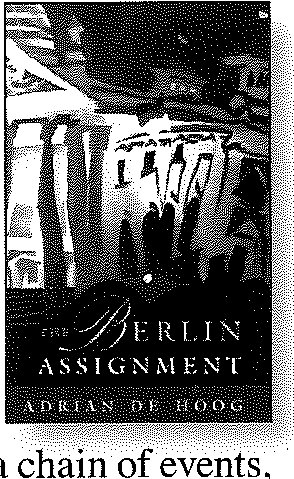
Adrian de Hoog’s first novel, The Berlin Assignment is a very good read, well crafted and smartly written as it follows an FS officer who returns to Berlin 25 years after his postgraduate studies there. His coming back sets off clouded in the ambiguously sinister atmosphere of post-Cold War Berlin. For those who love fog and intrigue in Berlin, this is your book.
As stellar as his foreign service career was, Adrian may be on the way to finding his true calling — as a novelist, with a fine pen for narrative, atmosphere and turn of phrase. This should not be surprising for those of us who remember him in the department. After all, who else could write equally well taut talking points at G8 Summits, training manuals on the 13 management competencies that sang, and intellectually gripping presentations to Cabinet on climate change? Oh, my God, is this review sounding like an appraisal report?
Leaving aside the above, I too may have found my true calling – reviewing novels whose heroes are Canadian diplomats. This has not kept me terribly busy
– the last time I did it was ten years ago when I reviewed famed Canadian journalist-gone-south Robin MacNeil’s second novel, The Voyage.
But de Hoog’s and MacNeil’s novels share traits which may suggest that we are at the beginnings of a new sub-genre of the thriller – the Canadian consul general of intrigue.
Both books have a Canadian consul as the principal character; both heroes have pretty lively sex lives (our boys pay more attention to SEX than PMAs); both novels revel in the minutiae of the Canadian foreign service; and both novels’ plots track the somewhat meandering going-ons of the protagonists whose lives then come somewhat undone, ending with some (but not really catastrophic – after all we are Canadian) impact on their lives.
Despite de Hoog’s wonderfully descriptive prose (no Da Vinci Code one sentence chapters here), his wonderful capturing of the eerie atmosphere of Berlin, his successful weaving of the currents of Berlin past (the post-war catastrophe, the Cold War split, the insanity of East Germany and the Stasi empire, the resurgence of neo-Nazism and the Ossies vs the Wessies) and our hero’s past with this city both sinister and beautiful, something is missing
Maybe it’s this — this kind of Canadian consul general genre is, if I may suggest, lacking pulsating action and suspense. James Bond, Jack Ryan and John Smiley can rest easy – their day and night jobs are safe; our Canadian heroes are really not engaged with earth-shaking events of global consequence.
No mad rush to stop the assassination of a President (or even a PM); no frantic foiling of a terrorist plot to nuke Baltimore, let alone Barrie, Ontario; no uncovering of a conspiracy to wipe out a secret cult dedicated to preserving the secret that Jesus married Mary Magdalen and their offspring are now alive and well and living in Scotland. The Sum of All Fears for Canadian diplomats just may be a Team Canada mission.
In The Berlin Assignment, Richard Hanbury is a 25-year plodder, who accepts an assignment to open up the official residence in Berlin, builds up his network, becomes pals with the Chief of Protocol (see what I mean?), goes to and offers up hospitality events, finds furniture for the new place and wires the office for SIGNET. He also deals with his local staff — a roly poly Brit administrator who has a tremendously kinky sex life with his fat wife, Frieda, and a strict German secretary who has a negative view of our hero’s propensity to take long walks and leave the driver at home.
Hanbury’s chief interest is to renew acquaintance with his old girlfriend, whom he dumped unceremoniously 25 years ago, check up on some old friends he knew in East Berlin, when East Berlin was East Berlin, and date and mate an up-and-coming East Berlin journalist.
Now although our man has not hijacked a Russian nuclear submarine, his personal adventures bring him into the orbit of some sinister characters, one embedded in the old Cold War intelligence wars, another dabbling in neo-Nazi politics, and most evil of all, one running the Foreign Affairs personnel branch. And alas, his Berlin wanderings lead to his downfall.
But as Elaine once said about The English Patient in “Seinfeld” – “Go ahead and just die – who cares!”
As well, de Hoog’s book often straddles uneasily between satire and thriller, and the reader is often left wondering which one is which. For example, throughout the book, de Hoog associates the Foreign Service metaphorically with the Church and suggests that we in the ES do so too. “The Personnel Department turned into Investitures, policies in Asia were formed in — where else – the Asian Temple; the Zealots looked after Europe, the spooks inhabited the Crypt and Irving Hayword when Tony worked for him was Priest in charge of the Disarmament Priory.” Really? I thought our acronyms were bad enough. I hope readers really do not think we talk like that.
Then there is the character of the Deputy Minister, Bo Bilinski, who is often referred to as the High Priest. Bo, a Rocky Mountains boy, hates public policy.
“’The crap of government’, he whispered to his wife ’it’s like sitting in a vat of goddamn filth.’ Bo had always managed to outrun the putrid slime of policy. Hadn’t he shot Tax Policy to pieces without being corrupted? And blown Competition Policy apart with his swagger undiminished? Even a thorough evisceration of Industrial Policy hadn’t threatened his survival as a human being. But running Foreign Policy forced him to the conclusion it was time to quit. Foreign Policy was inconstant, a moving target, weaving and dodging. Even if he happened to land a blow, it seemed he had only punched a bog, because foul vapours were suddenly released.”
Great stuff, great satire. And don’t we all feel the same; though I’m glad I did not quite put it that way during my last EX competition. But if this is meant to be a thriller, isn’t it too a bit corny?
Yet in the end, The Berlin Assignment reveals a solid talent and stylist. And I have no doubt when Adrian irons out a first timer’s kinks and gets his groove, he will produce a great thriller, perhaps the first Canadian consul thriller. Or even, the great Canadian satire – the Canadian DM trilogy — the Lords of the Eighth? We should all look forward to them.
View the original scanned pages →
Originally published in bout de papier, Vol. 22, No. 4 (2007) — Winter/Spring 2007 // Hiver/Printemps 2007, pp. 18–19. Read the rest of this issue →



