
bout de papier, Vol. 26, No. 1 (2011) — Summer/Fall 2011 // Été/Automne 2011, p. 41
THE AMBASSADOR’S CAMEL:
UNDIPLOMATIC TALES OF
EMBASSY LIFE, by David Holdsworth,
iUniverse Inc., 2010, $11.95.
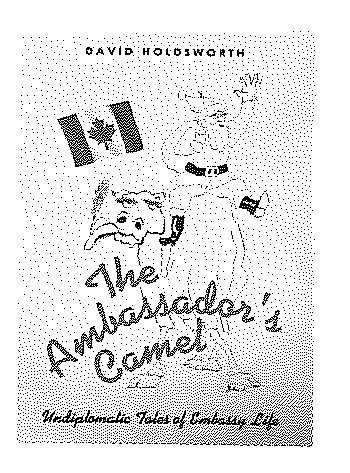
satie entree The Ambassador’s si Camel: Undiplomatic Tales of Embassy Life, a new book by David Holdsworth, tells a lot about life in the Foreign Service through the deft use of humour. In time, it may well enter the canon of formative resource material for training budding FSOs. In the course of 120 pages the reader is run through a gauntlet of adventure never anticipated by instructors at the Canadian Foreign Service Institute as staff at Canada’s embassy in (fictional) Bharalya take a new Chargé by the hand for some on-the-job-training. Without giving away too much yet whetting the appetite, imagine a rotational assignment that includes:
* Training a parrot called Shakespeare to skewer corps colleagues by revealing their illicit adulterous pursuits;
* Working with confreres from likeminded nations to mount Potemkin villages in order to fulfil a visiting minister’s earnest expectations that the donor country’s aid program is doing wonders for adoring Aboriginals;
* Allowing Piggy enough rope to impersonate an elected official with the consequence of hanging his country by accidentally committing it to an unwanted state visit and unattainable economic expansion;
* Dealing with naked consular cases;
* Allowing a visiting politician an opportunity to receive front page coverage back home of a hapless episode in a Bharali bawdy-house; Blackmailing one’s superiors into the posting of your dreams; Shaking down an auditor into submitting an undeserved “satisfactory” assessment: And, memorably, providing embassy Christmas party guests with a spectacular version of Bharali reindeer-love when a surrogate camel gets carried away with one of its own, in the embassy compound next door.
In The Ambassador’s Camel Holdsworth creates for our delectation a whole mini-universe of Canadian diplomatic field representation. Characters fill the pages with stream-specific accuracy; there’s the HOM’s formidable EA known as the “Dragon” who takes particular delight to inform the ever hopeful Chargé, Godfrey, that Ottawa has indeed passed him over by appointing a new ambassador, Percy Williamson. Everything is relative of course because Percy, we learn in “Camel’s” opening pages, has been dumped into an ASEAN outpost by the political class simply to get him out of their hair.
Other stock characters in this Pirandello pastiche include the Trade Commissioner, the CIDA Chief, the head of Admin and Piggy Wigglesworth whose rank remains clouded but probably somewhere between Attaché and Third Secretary — so inept that Ottawa had informally decreed he should remain en poste “until he retires or dies whichever comes first, preferably the former”.
David Holdsworth’s light-hearted take on Canadian Foreign Service can be incisive. For example, his take on inspectors — “an auditor is someone who doesn’t know how to cook but drives their spouse crazy by organizing the kitchen” — has resonance with most of us.
The Ambassador’s Camel is a delightful romp in an esoteric community best appreciated by practitioners — much in the way former Royal Conservatory of Music students get a kick out of the play “Two Pianos, Four Hands”.
The author, David Holdsworth, retired in 2002 after a long public service career during which he experienced first-hand the funny as well as the serious sides of international life. He served as a Counsellor (Development) at the Canadian High Commission in India, as CIDA Vice-President for Asia and as Assistant Secretary to the Cabinet in the Privy Council Office. He lives in Ottawa and now divides his time between a busy management consulting practice and writing.
The book is ably buttressed by cheeky and perceptive illustrations by David’s redoubtable CIDA partner, Jean-H. Guilmette, recalling the collaboration between Lawrence Durrell and V. H. Drummond in Esprit de Corps: Sketches from Diplomatic Life. It was published in 2010 by iUniverse Inc., and is available at www booksonbeechwood ca.
Bonne lecture.
View the original scanned pages →
Originally published in bout de papier, Vol. 26, No. 1 (2011) — Summer/Fall 2011 // Été/Automne 2011, p. 41. Read the rest of this issue →



