
bout de papier, Vol. 26, No. 4 (2012) — Summer 2012 // Été 2012, pp. 23–24
How do you organize a Foreign Service reunion? A year beforehand, talk up the notion when you run into former colleagues. Hope that someone takes your idea and runs with it. When that doesn’t happen (surprise), start putting together a list of names and emails. Call a brainstorming meeting. Provide wine and cheese as an incentive. Get a planning team together. Have volunteers scout potential venues and track down former colleagues. Fix dates. Decide on venues and menus. Nominate a sommelier and a treasurer. Collect funds and get a liquor licence and wine. Have fun locating and reconnecting with former colleagues.
And so the 40th reunion of the Foreign Service class of ”72 took shape and was held over the weekend of June 1—2, 2012. The dates were chosen to take advantage of Ottawa’s (normally fine) late spring weather as well as special activities such as the annual Doors Open and the new blockbuster exhibits at the major museums. In the end, we located almost every officer concerned.
Getting in touch again with colleagues proved one of the more rewarding parts of the exercise. In 1972, we had all entered different Foreign Service Departments: External, ITC and Immigration. The decision to include all streams of the Foreign Service proved the right one. Besides, everyone knows that the trade people are better at parties.
On Friday, June 1 Gabriel Lessard and Corrine Paollilo-Lessard graciously hosted a reception at their residence just south of Ottawa on the banks of the Rideau River. The damp weather proved irrelevant as old friends enthusiastically socialized and caught up on news. ID stickers helped connect names with once younger faces. We were fortunate to be joined by Marc Perron and Lawrence Lederman who had been, respectively, the External and ITC assignments officers for the new 1972 recruits.
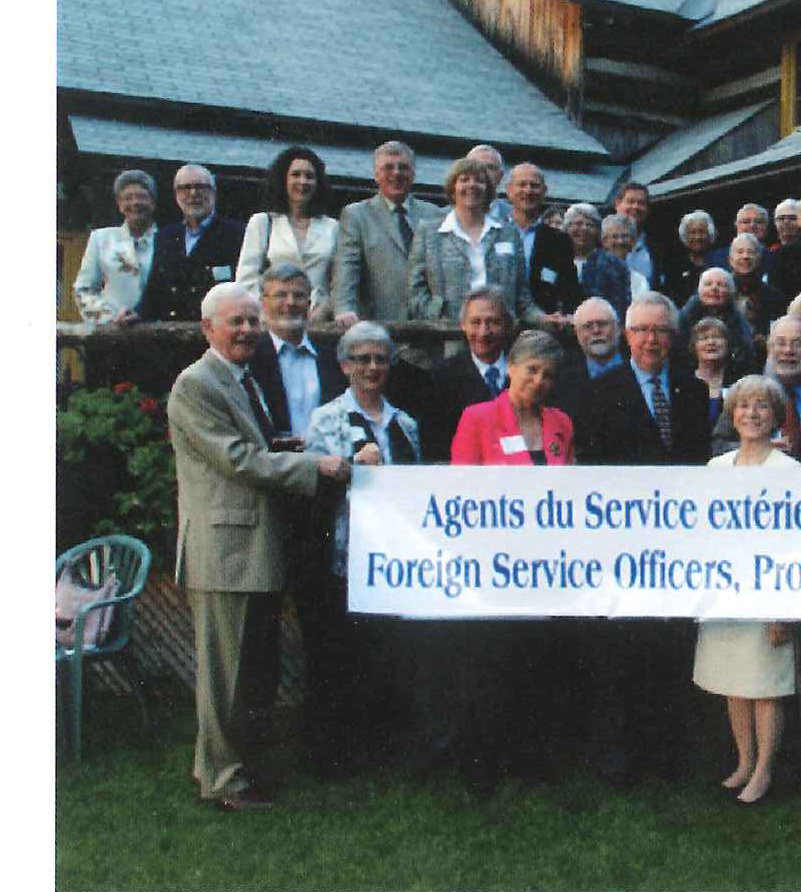
On Saturday evening, June 2, the group held a dinner at La Grange de la Gatineau, a spectacular venue on the Gatineau River near Cantley, Quebec. The three-course dinner was served in a 180-year-old converted log barn overlooking the River. A total of 59 persons attended, with participants travelling from Washington, Florida, British Columbia, Nova Scotia, Toronto, Winnipeg and Montreal. Richard Kohler, a former Chief of Protocol, acted as MC. The evening began with the clouds lifting in time for an outdoor “family” photograph. Later in the evening, there was a candle lighting and moment of silence for six former colleagues who have passed away. The MC then conveyed greetings from those unable to attend due to health or professional obligations.
The featured speaker was the Right Honourable Joe Clark. Who could be a better choice for this group than Canada’s longest-serving Minister of Foreign Affairs since the 1950s? As well as serving at Foreign Affairs from 1984-91, nearly seven years, Mr. Clark began his 24-year Parliamentary career in the same a spectacular venue on the Gatineau River near Cantley, Quebec. The three-course dinner was served in a 180-year-old converted log barn overlooking the River. A total of 59 persons attended, with participants travelling from Washington, Florida, British Columbia, Nova Scotia, Toronto, Winnipeg and Montreal. Richard Kohler, a former Chief of Protocol, acted as MC. The evening began with the clouds lifting in time for an outdoor “family” photograph. Later in the evening, there was a candle lighting and moment of silence for six former colleagues who have passed away. The MC then conveyed greetings from those unable to attend due to health or professional obligations.
The featured speaker was the Right Honourable Joe Clark. Who could be a better choice for this group than Canada’s longest-serving Minister of Foreign Affairs since the 1950s? As well as serving at Foreign Affairs from 1984-91, nearly seven years, Mr. Clark began his 24-year Parliamentary career in the same year as our group was recruited. In his remarks, Mr. Clark made a strong case for Canadian foreign policy leadership based on engagement with the world as a whole —no “gated community” approach overly focussed on NATO and trade which risked estranging us from others. He favoured a foreign policy which drew upon Canada’s unique and globally recognized capacities. These included our experience in managing diversity and issues of identity. A partnership of innovation (civil society, youth, new media) and mandate (governments) was required. At the national level, Mr. Clark saw the need for revitalizing the role of political parties and House of Commons committees, as well as using new media and other tools to engage more young people in the political system. In addition, Canadians and their leaders have lost the “habit of national conversation.”
The rewards for organizing the reunion were in seeing people enjoy themselves, experiencing life after DFAIT. Yes, it was a lot of work but a great team was involved. Particular thanks are extended to Michael Brock, André Charbonneau, Ann Charles, Kurt Jensen, Richard Kohler, Hark Kroll, Brian LeConte, Gilliane Lapointe, Gabriel Lessard, Nicole Senécal and Richard Tétu. Would we do it again? Absolutely. Well, maybe. We’ll have to get back to you on that, say in 9 years, closer to our 50th.
Now retired from the Foreign Service, Tan Ferguson served as Director General, Africa Bureau (2005—07). His last postings were as Deputy Permanent Representative to the UN in Geneva (2001-05) and High Commissioner to Nigeria (1999-2001).
View the original scanned pages →
Originally published in bout de papier, Vol. 26, No. 4 (2012) — Summer 2012 // Été 2012, pp. 23–24. Read the rest of this issue →



